
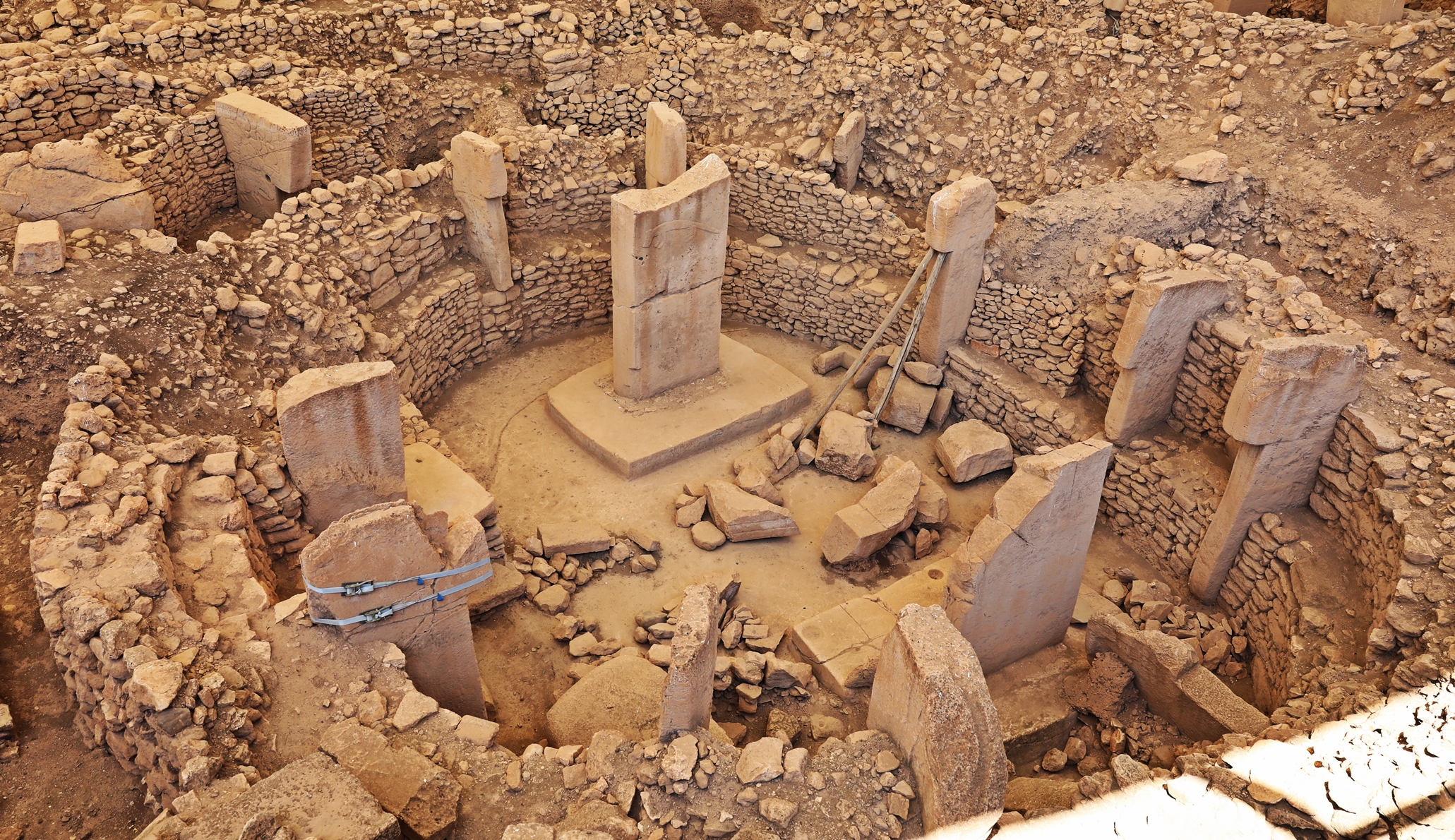
With a name that means Potbelly Hill in English, we weren’t sure what to expect of the site Göbekli Tepe. What we found though, was an ancient wonder built by Neolithic man that gave historians a new understanding of how ancient societies developed.
Discovered in the 1960s by a local farmer, Göbekli Tepe was at first dismissed by researchers as unimportant. In the mid 1990s a German archeologist thought there was more to this site and began excavating. It turns out he was right because this ancient archeological site in southeastern Turkey is revealing a lot of new information about early humans. Dating from 9600 to 8200 BCE, Göbekli Tepe has completely changed historians’ understanding of how humans settled into organized communities and what role religion played in societal development.
Located on a small hill on the edge of Upper Mesopotamia, researchers exposed groups of concentric stone circles, believed to be the remains of small shelters. The outer walls were made from small stones and they encircle large, T-shaped monoliths.


It seems simple enough at first glance, but it has offered researchers so much more. Prior to their discoveries at this site, archeologists and historians believed that as soon as humans began cultivating cereal crops, they started to live in more permanent villages. It is called the Agricultural Revolution. They also believed that it was after Neolithic humans began living together in villages that religions developed and societal bonds became important.
Göbekli Tepe however, turned that thinking on its head. What these circular stones revealed is that 12,000 years ago hunter-gatherer nomads, not villagers, had large, social gatherings involving several tribes. Based on their findings, archeologists believe Göbekli Tepe was an important place of worship making it the first known temple to date. It is also believed that not only did they have religious ceremonies, but the nomads used this time to share knowledge and skills with each other and to strengthen social bonds. These findings indicate that previous beliefs about how societies developed are likely inaccurate. Archeologists did find evidence of grain processing and large-scale gazelle hunting at the site, but there was no indication of a permanent settlement. In fact, this site pre-dates the Agricultural Revolution by 500 years.


From their findings at Göbekli Tepe, archeologists now believe that religion and social interaction brought people together to form community long before they became farmers and settled in villages. These researchers believe therefore that religion and social bonding were not the result of people coming together but the cause of it, and may have led to the beginning of more complex societies.
In addition to this new information, the stones display a level of craftmanship not believed to exist in this Pre-Pottery Neolithic Age. Many of the pillars and stones are decorated with reliefs of animals such as foxes, birds, cranes, and gazelles. Some carvings even appear in 3D. The images are most likely linked to mythological legends and religious rites. Apparently there are depictions of humans too, but these are on display in the museum.


As we toured the site we stared in awe at the artwork. It is incredible to think that these stones were so elegantly decorated using very crude tools and were made even before they invented pottery.


Archaeologists are still uncovering fascinating details at Göbekli Tepe. At least 43 megalith pillars have been found to date and the site is still being excavated. It is believed that more than 200 pillars and 20 circles exist at this site. Thirty-five km away from Göbekli Tepe is another site that may be even older. Karahan Tepe is open to the public but is currently more archaeological dig site than museum. In a few years it will undoubtedly be another great archeological site in Turkey.

Entry fee – 450 TRY ($20 USD); Opening Hours – 8:30 am – 5:00 pm
Note the entrance fee continues to go up. It was only 90 TRY a year ago and increased steadily until it was 450 TRY by the end of August, 2023.
Getting to Göbekli Tepe
If you have a car it is a short 18 km drive from the city of Şanlıurfa. If you don’t have a car the easiest way is to take a city bus. Bus 26 leaves from outside the Şanlıurfa Museum at 9:45 am and 12:45 pm returning at 12:00 pm and 3:45 pm. You can pay by credit card. It also makes a stop outside of the main bus station.
Şanlıurfa
Not only is the busy city of Şanlıurfa the nearest city to explore Göbekli Tepe, it also has remarkable stories from its history. Believed to be the ancient city of Ur, Şanlıurfa, more commonly called Urfa, has a few sites that are worth exploring.
Mevlid-i Halil Cave
Deep in the stone cliffs on the edge of this modern city is a story important to Jews, Christians and Muslims. Mevlid-i Halil Cave is believed to be the site where the prophet Abraham was born. The legend says that King Nimrod of Babylon prophesied that a baby was going to be born that would convert everyone to a new religion. He feared they would no longer believe in his religion of idol worship. The king therefore decreed that all babies born that year were to be killed. Abraham’s mother was pregnant and hearing this, she hid in a cave until she gave birth to Abraham. It is said that Abraham didn’t leave the cave until he was a teenager.

Mevlid translates in English to ‘Birth of the Prophet’. Today the cave is an important pilgrimage site for all 3 religions; although the only religious structures there are mosques. There are separate entrances for women and men. The men’s side is much smaller but has a large, man-made prayer room outside. A glass wall allows a small view of the cave’s interior.
The women’s area occupies of a larger portion of the cave and a long wall with a glass window allows you to look deep into the cave. It is in the deepest part of the cave that Abraham was believed to be born. The space in front of this window is the women’s prayer room. It felt a little strange to walk around with a camera when people were praying, but most of the women ignored me.


Entry is free, and appropriate dress is required. Women must cover arms, legs and hair. Men must cover shoulders and legs.
In front of the cave is Mevlid-i Halil Mosque. It has multiple small domes at the entrance and around the perimeter of the large marble courtyard.


Balıklıgöl
Near the cave is another site related to Abraham. Balıklıgöl translates in English to ‘The Pool of the Sacred Fish’ and is also called the Pool of Abraham. According to legend, King Nimrod threw Abraham into a fire at this location. Instead of burning him, the fire turned into water and the firewood became carp. The site is considered sacred and when we visited there were a lot of pilgrims wading in the water. Today there are still a lot of carp swimming in the pool. The fish are protected and visitors are encouraged to feed them.


Both the cave and the pool are located in the lovely Gölbaşı Park. It’s a popular place to come, not just to see these historic sites, but also to go for walks in the shade of the large trees and dine at one of the many restaurants.

Urfa Old Town
In addition to these two main sites, there are a few other places in Urfa’s historical centre to explore. It was once on the ancient trade routes so there are a few caravansaries, as well as old mosques.


Kızılkoyun Necropolis
Not far away from Mevlid-i Halil Cave is a 3rd century cemetery. Kızılkoyun Necropolis has over 130 rock caves that were carved into a cliff by the Byzantines. The site is closed to visitors, but it is only protected by a low fence so we could see quite a few of the tombs from the sidewalk. Other reminders of the Byzantines are the aqueducts in the city’s downtown,


Urfa Castle
On top of the rocky cliff above Mevlid-i Halil Cave lie the remains of Urfa Castle. There is not much left to the castle today, but we could see two, tall 3rd century columns and its 9th century wall. The castle is closed, but there are walking trails up to its base. From just below the castle we could see the necropolis and the modern city of Urfa in the distance.


How to get to Urfa
There is a domestic airport in Urfa. Internal flights in Turkey are generally quite inexpensive, but often connect through Istanbul making what should be a short flight much longer. Urfa is also easily reached from many cities by car or bus. The highways in Turkey are excellent as is their bus system. Both the airport and the bus depot are quite far from Old Town but a taxi will only cost around 200 TRY ($7 USD).
Where to stay in Urfa
The modern city is quite large, but most of the sites you will want to see are in Old Town. We stayed in Lariva Konaklan, a 400 year old Armenian mansion that was directly across from Gölbaşı Park. Our room had old stone walls and made us appreciate the history of the city. Breakfast in Turkey, especially in the east, is a huge feast. In our Urfa hotel, our breakfast table was filled with delicious cheeses, pastries, eggs, grilled veggies, fruits, olives and spreads. It was often our favourite meal of the day.


Click on the link to read our Travel Tips For Turkey.
To read more of our adventures from Turkey, click here.
Coming Next – Ancient Statues on Mount Nemrut
For pictures from other blogs go to Gallery at monkeystale.ca
To read about more of our adventures go to Destinations.
If you like what you read, please comment or share (with credit) using the links below.




We’d love to hear from you, please leave a comment.