The neighbouring communities of Olinda and Recife in northern Brazil have fabulous, but very different Old Towns. Separated by the Beberibe River, both have historical centres filled with colonial Portuguese heritage buildings. Olinda was established first and therefore, its buildings are much older, but no less impressive. The two centres are so close that you can explore the Old Towns of both Olinda and Recife in a couple of days.

Olinda

As one of Brazil’s oldest colonial communities, we were excited to visit Olinda. It was established in 1547 by the Portuguese because it provided the perfect location between the sugarcane fields and the Atlantic Ocean. For almost 200 years Olinda was one of the most important cities in Brazil’s sugarcane industry. Those crops are still important to this area. As we drove into the city fields of sugar cane covered all of the available land.

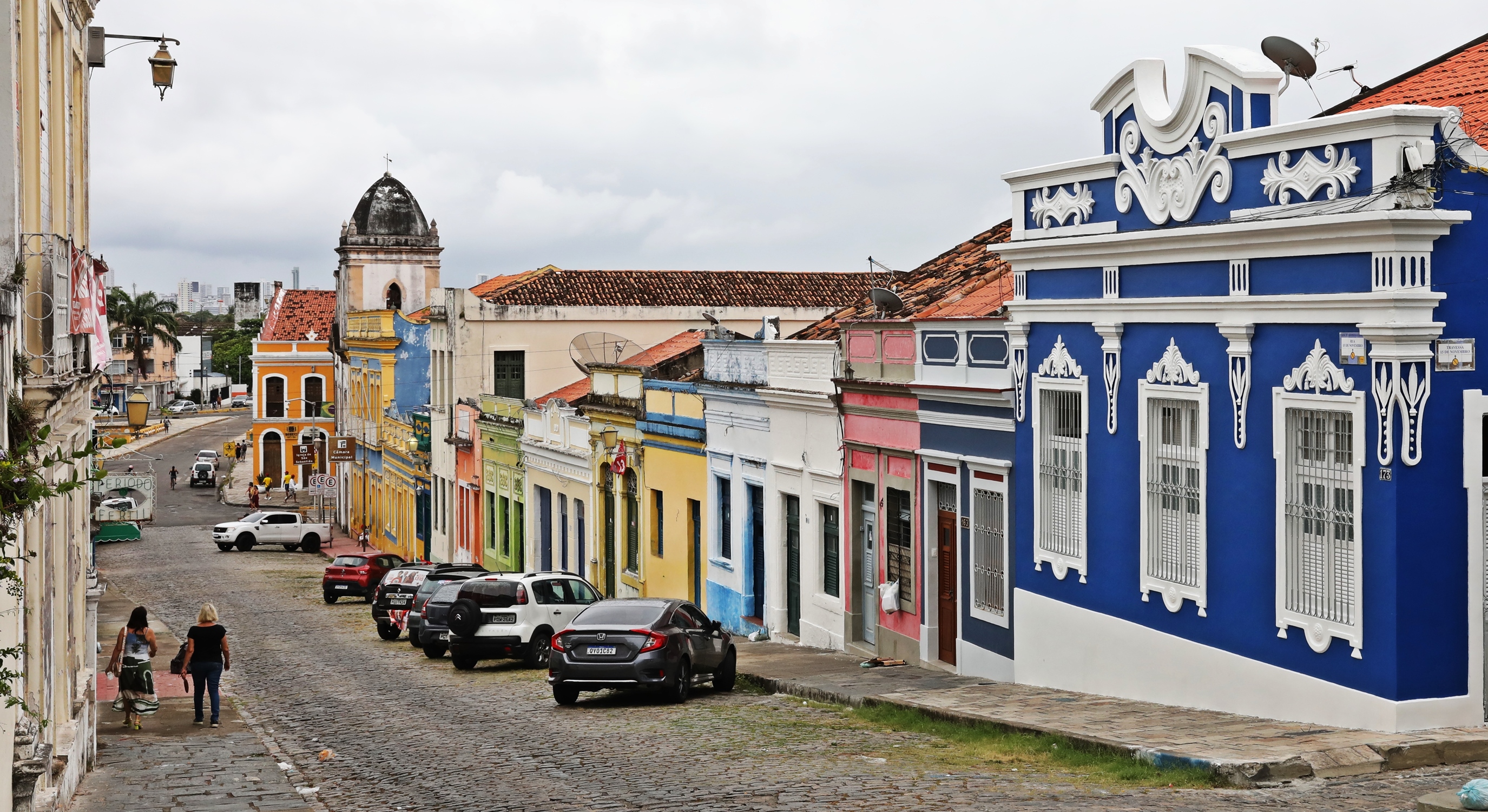
With a name meaning ‘Oh Beautiful’, how could you not expect Olinda to be a pretty town. It was built on a hill so that its narrow, cobblestone streets run and up and down throughout the historical district. They are made even more attractive by the colourful colonial homes that adorn their sides. It’s not a large area and the buildings are simple, but their colourful exteriors almost make you forget the lack of ornate decorations. Carvings on weathered wooden doors add even more character to this old neighbourhood.

At the top of the hill is Catedral da Sé (1540). With all of the colourful homes in Olinda we were surprised by its plain exterior and humble interior. Across from the church, the viewpoint, Alta da Sé, allowed us to look down upon the terracotta rooftops of Olinda and see as far away as high-rises of Recife.

Not far from the cathedral a 19th century astronomical observatory was built on the site where the Olinda Comet was first observed in 1860.

In addition to colourful colonial homes, there are many churches on the slopes of Olinda. There are said to be more than 30 churches, chapels and monasteries in the small Old Town. We walked by quite a few with the most impressive being Basílica e Mosteiro de São Bento (Basilica and Monastery of St. Benedict). The tall wooden doors and windows with carved stone frames draw you toward it. The interior is even more impressive with a grand, ornate golden alter and golden pulpit for the priest.  

The rest of the churches in town weren’t as elaborate and seemed a bit more worn down.

Walking through Olinda’s historic centre, not only do you get to enjoy the homes, palace and churches, but there is also a lot of greenery. The trees, flowers and bushes adds a layer of warmth to the town.

Olinda initially served as the capital of what is now the state of Pernambuco. The most grand building in town is the bright yellow palace that served as the former governor’s residence. For a few years in the 17th century, the Dutch ruled parts of the Brazilian coast including Olinda. When the Portuguese regained control, the capital was eventually moved to Recife, on the other side of the Beberibe River.

Olinda’s Old Town is a UNESCO World Heritage Site, which usually comes with an agreement to maintain the area. Somehow that part of the deal was lost in Olinda. Although many of the buildings are in quite good condition and are all date appropriate, there are many that are not well maintained. There’s garbage on the streets and there appears to be a lot of poverty in the city. These factors took away a little of the charm of Old Town.

Recife Antigo (Old Recife)

When Olinda was being established, a number of Portuguese fishermen set up shacks on the delta between the Capibaribe and Beberibe Rivers. Stone reefs not far from the shore provided protection and gave the city its name, Recife (Reef). The Portuguese realized that the stone reefs created the perfect place for a harbour and used them for exporting sugarcane to Europe.

During the short Dutch reign they established a large settlement in Recife, and made it their regional capital. Therefore, when the Portuguese regained control a few years later, the city of Recife was much larger than when they were forced out. In the early 1800s, the Portuguese moved the capital of Pernambuco from Olinda to Recife.

Walking around the historic centre of Recife you can tell it is a much younger capital than Olinda. Instead of the utilitarian buildings we saw Olinda, Recife’s historical area has grand, ornate structures typical of the period. Old Recife was built on a series of islands created by the many rivers flowing into the Atlantic Ocean in this estuary. Some people call Recife the Venice of Brazil because it has many bridges crossing between these rivers, but in reality, there’s not much similarity between it and Venice.

We began our tour of Old Recife at Praça Marco Zero (Ground Zero Square) on the outer island. Surrounding the colourful centre of the square are restored and unrestored colonial buildings. We walked along the streets for a few blocks on either side of the square to find a mix of Dutch and Portuguese colonial buildings. Some were beautifully restored, others were in the midst of restoration and some were falling into ruin.

Much of the area is a pedestrian zone making it a perfect place to stroll without worrying about traffic. Rua de Bom Jesus is a popular walking street where we saw the first synagogue in the Americas, Synagogue Kahal Zur Israel. It was founded in 1637 by Dutch Jews. When the Portuguese returned to Recife most of these Jews went to North America and the building suffered from neglect. Recently though it has been restored and is now open as a museum.

Today, there are many IT companies with offices on this small island and the restaurant patios were full with staff on their lunch break. It’s a great area to wander around the streets for an afternoon.

Across from Marco Zero Square is a boardwalk that runs along the side of the ocean. We watched for a while as an egret was struggling to swallow a fish it caught. The fish was obviously much too large for it to swallow, but he was not giving up on his lunch. After a while the egret eventually flew off with most of the fish still hanging out of its mouth.

Two bridges lead from this small island to one of the larger ones where the stately colonial buildings are even more grandiose. Praça da República (Republic Square) is a large treed square with a regal looking law courts building on one side and Santa Isabela Theatre on the other.

Throughout this island there are many large and small squares, each seemed to have its own colonial church. Old Recife is in a working part of the city’s downtown. We were there mid week and there were a lot of people out on the streets going to or coming from their lunch break. Unfortunately, there were also many miscreants in this part of the historical centre. There were quite a few people sleeping on the streets or hanging out in front of churches. There was also a lot more security and police in the area and we were careful to take care of our belongings.

It’s not the most relaxing atmosphere nor the most picturesque on this island, but several buildings were beautiful making it worth checking it our for half a day.

Boa Viagem

Recife is located on the shore of the Atlantic Ocean. Boa Viagem Beach is one of the most popular parts of town with a nice community beside it of the same name. Filled with high-rises and restaurants it’s a relatively safe part of the city. Similar to Fortaleza, Natal and João Pessoa, Recife’s coast is yet another long, sandy refuge on the edge of a busy city.

The second of the two-part federal election occurred when we were in Recife. We were in Manaus for part one. Even though the country seemed to be very divided politically, we didn’t notice much difference on election day. A few cars honked and waved the flag of the party they support and we heard a few cheers and boos when the winner was announced, but otherwise it was a normal day. That is until we were on a bus on our way out of the city two days later. Truckers were protesting the election results by blocking major highways in and out of the city. We saw a few fires burning of the side of the highway as our bus slowly drove by. For the first 6 hours of our journey that day, our bus was only moving at 20 km/hour.

How to get to Recife

Recife is the capital of Pernambuco and is very easy to access by car, plane or bus. The main bus station though is 30 km from downtown. We found Uber to be the best option for getting around the city. Note that rush hour traffic is very congested so plan your travel accordingly.  There is a metro system in Recife, but it doesn’t travel to Boa Viagem so we didn’t use it.

Where to stay in Recife

The large city of Recife is your likely base to explore both Olinda and Recife. Most people will stay near Boa Viagem and there are many hotels and restaurants to chose from. We stayed in a lovely inn, Hotel Pousada Casuarinas. The English speaking host was very friendly and helpful and the garden-like setting is very peaceful in the middle of this big city.

This article is now featured on GPSmyCity. To download this article for offline reading or create a self-guided walking tour to visit the attractions highlighted in this article, go to Walking Tours and Articles in Olinda.

Click on the link to read our Travel Tips For Brazil.

To read more of our adventure in Brazil, click here.

Coming Next – A Day in Salvador’s Historic Centre

Fediverse reactions

101 responses to “Exploring Old Towns Olinda & Recife, Brazil”

  1. as always, a vision of Olinda/Recife with great sensitivity and showing how they really are. Olinda’s churches are charming and everything around there breathes history and Brazilian flair. wonderful post. thank you so much.

    1. Thank you! They have such amazing historical buildings in both, and they’re so close but yet so different. It’s an interesting part of Brazil’s history, and it’s great that so much of it still stands. Maggie

      1. it is true, our architectural heritage is not and has never been a priority in relation to modernity. Of course, there are places protected by law, but the gradual transformation of history is a reality.

        1. I hope what’s left isn’t destroyed.

          1. me too. I believe that these are listed by the historical heritage. then they are protected.

  2. Instead of saying Recife is the “Venice of Brazil” I’d say it more like the “Amsterdam of Brazil”. Of course that is being very liberal with city names and appearances in general.

    1. I’m not sure why they feel the need to compare it to a city that is obviously quite different, at least we knew better so didn’t have high expectations of taking gondola rides through the city 🙂 Maggie

  3. The beauty and the history certainly speak volumes in a place like this. So does the poverty and political strife. Great post.

    1. Thanks, Brazil has so many amazing historical towns, but these big cities still have a large divide between wealth and poor.

  4. Another great write-up grouped with wonderful photos!

    1. Thanks so much 🙂 Maggie

      1. You are welcome! I look forward to Tuesdays to see what new delights you have to share! 🤗

  5. What a beautiful place to visit! I love the color of the houses and the greenery too. You get the best of both worlds with the beach too.

    1. History in the morning, a walk on the beach in the afternoon! Can’t do that at home 🙂 Thanks for taking the time to comment Lyssy! Maggie

  6. You are right, these two neighbouring places look and sound to have very different characteristics from each other. The connecting theme seems to be the colour though – the buildings of both places and, to be fair, in all of your recent posts, have that wonderfully attractive mix of colours. It’s all so alluring. Olinda in particular sounds lovely.

    1. They do love colour in Brazil that’s for sure. Just wait until you see the next city…..

  7. Old Towns can be so hit or miss. Sometimes, they are well maintained and other times, they are just old. Too bad Olinda is a little unkempt. Hopefully, they can save it before it disintegrates. Old Recife, looks like a prosperous location, du to its location next to the big city. Lots of colourful architecture. Thanks for sharing Maggie. Allan

    1. Yes, hopefully a bit more money can be put into Olinda. It’s not in bad condition, but could use a little more love. Both were great places to imagine what life would have been like back then. Thanks for commenting Allan, Maggie

  8. Another outstanding post. I have finished the list of adjectives, dear Maggie, to express how much I like your articles, which make me travel through my eyes, my mind and my heart❣️💙❣️

    1. Thanks so much Luisa, glad you’re enjoying our tour of Brazil 🙂 Maggie

      1. The pleasure is all mine, Maggie 🌹🌷🌹

  9. Recife looks interesting to explore but I think I like the smaller scale and brighter colours of the Olinda buildings even more, and the doors there look amazing!

    1. Yes, Although most of the buildings in Old Recife are heritage buildings, it does have a sense of being in a big city. Olinda has a more small town feel, partly because it is, but also because the buildings are more simple. There are a few great doors! Thanks for commenting Sarah! Maggie

  10. Thanks for a tour of places I won’t be getting to on my own. I always enjoy your stories.

    1. Thanks, glad you came with us to Olinda 🙂 Maggie

  11. I love loved the fabulous doors! Olinda’s ornate and the culturally unique doors are fabulous.Thank you!

    1. I hoped you’d like them 🙂 They seemed like they should be in a museum, not still being used as an outer door! Maggie

      1. Yes! I agree. They are of totally unique design and carvings. Thank you again.

  12. Beautiful write up and great captures. As always a great post, Maggie! Loved it!!!

  13. We absolutely love historic churches, and these look fabulous!

    1. Well you could fill your day with historic churches and not see them all I think! They were great historic areas to experience a bit of Brazilian history. Thanks for your comments, Maggie

  14. Absorbing post with fantastic photography throughout!

    1. Thank you so much!!

      1. You deserve it!

  15. Recife is where Peter Robb, the author one of my favourite books (A Death in Brazil) lived. I wonder if the Bangue, his watering hole, still resists in the old part of town.

    1. Oh rats, I haven’t read it! Is it called Mangue not Bangue? I found a Mangue.

      1. Bangue, with the B… close, but no cigar!

  16. Wow, just look at those beautiful cobblestone streets of the immaculately preserved colonial town of Olinda lined with houses and little cafes painted every color of the rainbow – it’s so cute. Given that Recife is a large city, whereas Olinda is a tiny town on the outskirts of Recife, I would love to visit both. Thanks for sharing and have a good day 🙂 Aiva xx

  17. wonderful

    ‘oficina 154’ sounds rather mysterious

    ✨🦋🐍🕊🐉🗝⚖🕯🤍⚛🎐🎋🙏✨

    1. Haha yes it does!

  18. Looking across from Olinda all you see are the high rises of Recife, and I’m quite averse to beachfront high rises but it seems to be the norm. Olinda is much more charming but there’s never enough money to preserve the old when building new is cheaper.

    1. That’s true, it must be a huge expense. It seems to be the norm in Brazil for the new parts of the city to grow right up to the beach. We did prefer the small beach towns for that very reason 🙂 Maggie

  19. So many wonderful photograph opportunities. I love the colors on the old buildings and the plaza. It is hard to believe it was colonized in the 1500s.

    1. I know, there are so many great historical towns in Brazil, and all much older than I would have thought.

  20. Olinda looks special indeed! I love all the colours on the old colonial style buildings.

    1. It’s a really cute old town, Brazilians do love to colour their buildings in bright colours. It makes for a great place to visit and take picture 🙂 Maggie

  21. This brings memories back of our time there. Olinda Church’s are so historic and such amazing areas . Thanks Anita

    1. Thanks Anita, Olinda is a great historic town isn’t it?! Maggie

  22. I never tire of looking at the Portuguese colonial architecture which has its own distinctive character compared to the Spanish of the same period.

    1. Me either. I was surprised at how different they are from Spanish colonial towns.

  23. Thank you. A great combination of words and images that are as delightful as usual. All the best.

  24. Gorgeous Maggie!
    How safe is it in Brazil right now?
    🙏🏼

    1. Thanks Cindy, it really depends on where you go. In the small beach towns we felt perfectly safe, day and night. In the cities though there are areas where you should never go. At tourist sites and beaches in the cities, when there are others around, generally it is safe. It felt the same as most other South American cities. At night though it’s best to use Uber/taxi and not walk. Many of the large cities’ historic districts have a lot of drug addicts hovering around and therfore a lot of police. During the day you have to be cautious and not go at night. Some cities are worse than others obviously. Long answer to say it depends! Other than the inner cities, Brazil is a great country. Maggie

      1. Sounds like just like any city Maggie. Thanks so much for letting me know. It looks like a such a beautiful, fun, colorful place and I’d love to see where lots of our friends are from!
        I’m heading to Mexico so there is that and I know there are precautions everywhere.💞

        1. They’re a bit more in your face than most cities, but yes all cities have those neighbourhoods. Stay safe and have fun in Mexico!! .

  25. I got a laugh out of the egret. The variety of colorful houses and other structures is quite charming. It must have been unnerving though, to see the fires, etc on your way out of town.

    1. That egret was hilarious and stubborn! At first we didn’t know why the bus was so slow because traffic is known to be very slow during rush hour. Then we started seeing fires and realized what was happening. We were a little worried since South American countries don’t have the best reputation for elections and protests/riots. But it wasn’t nearly as bad as it could have been.

  26. Olinda looks right up our street. Colourful houses, cobblestone streets, a rich history and an abundance of greenery? Yes, please. Recife looks delightful too, you captured some great moments of the egret with its precious bounty. It must have been fascinating witnessing some activity around the elections, glad that you didn’t get caught up in anything too unsavoury or violent.

    1. Yes when we realized the election would be happening when we were there we were a little concerned. But if road side fires and a slow commute was the worst, it wasn’t so bad. Glad we were in the capital, Brasilia, when they had their January 6th’. The egret was hilarious! Maggie

  27. I agree, the colourful colonial houses in Olinda are a sight to behold! And Praça Marco Zero in Recife is beautiful, but looks totally different from the scenes in Olinda (I think, as you said, probably because it is much younger than Olinda). Some of the churches here remind me a lot of the churches we saw while walking the Portuguese Camino – which only confirms the Portuguese influence.

    1. Yes you can really see the Portuguese influence in the buildings. It was quite striking to go from one to the other to see the different eras of the buildings. Really like we passed through time between them, and then on to the modern city!

  28. With a name like Olinda, how can I not add that to my travel bucket list!? Besides the beautiful name, it does look like a very pretty town. I love the colourful houses that line the cobblestone streets. It’s too bad about all the trash and how some of the buildings aren’t being maintained in the Old Town though.

    1. Exactly! It’s a great Old Town and would be perfect if it were a little better maintained. It’s strange because generally Brazil is very clean. I think that’s what made it more obvious in Olinda.

  29. The pictures and the description are so amazingly beautiful. Since I am from India, it also reminds me of Goa. I am sure Olinda is worth a visit!

    1. Thank you Deepak, the Portuguese colonial buildings are quite similar to Panaji, Goa. The Portuguese did have beautiful cities. Thanks for taking the time to comment. Maggie

  30. These old towns appear to be very charming. I get the feeling that one could be quite happy wandering about them quite aimlessly.

    1. That’s what we did. No need for a plan, just go where the Cobblestone streets take you 😊 Maggie

  31. Very interesting post and some beautiful, historic buildings. My cousin visited Recife a few years ago and I enjoyed seeing his photos.

  32. I really like those shots of Olinda’s colorful houses with the high-rise buildings of Recife in the far background. Photos with such contrasting things often turn out to be very interesting. The rundown churches did make me wonder if Olinda had quite a high poverty rate, which then you mentioned in a later paragraph, which is unfortunate.

    I love the look of the old buildings in Old Recife — I particularly think Praça Marco Zero and the surrounding streets look very appealing to stroll around.

    Quite an intense time as you were leaving Recife!

    1. We had hoped for a better sky to make that shot, but it still worked okay under a cloudy sky. Both areas were nice to walk around and offered something quite different from each other. It was probably the most pleasant around Marco Zero but it’s a pretty small area. The bus ride was different. At first we just thought traffic was really bad then when we saw the fires we realized it was the election. We were a little worried that it might get worse but thankfully it just made for a very long trip.

  33. I just love the bright colours of the buildings, but can see the poverty also, and was saddened by the state of some of the buildings. I’ve not been to Brazil except very briefly many many years ago. I’ve spent a lot of time in other parts of South America so I’ll probably not get there.
    Alison

    1. Brazil seems to be in transitioning, getting a larger middle class, but there is a lot of poverty and often it’s quite obvious. But we did love Brazil and it’s one of only a few that we’d return to. Thanks for sharing your thoughts, Maggie

  34. It is so interesting to see the difference in scale on two cities so close to each other. Recife is the vivacious, extroverted sibling while Olinda is the more quiet, classic beauty sibling. Both a different kind of beautiful 🙂

    1. Haha great description! It’s uite amazing what a different generation will create!

  35. I absolutely love all the churches and colours….the buildings remind me very much of churches in Portugal, which I suppose isn’t surprising. It’s so sad to see the divide between rich and poor, I always find seeing poverty one of the hardest things about travelling.

    1. It was crazy how many churches there were. More than one per block! The Portuguese do build beautiful buildings don’t they? Thanks for reading Hannah! Maggie

  36. Olinda is so charming! The bright painted walls, the winding streets, the closeness, then all those amazing churches.
    Sea air is tough on architecture.

    Recife reminds me of Durban, South, in its good times. But,.wow, I see there two cities in one!

    1. I haven’t been to Durban but looking on-line it does look similar to Recife. You’re right the sea air is not good for those old buildings. It must cost a lot in both money and hard work to keep them in good condition. Thanks for taking the time to comment Patricia, Maggie

  37. I love cities or towns that have a lot of colour! Looks quite vibrant!

    1. Then you’d love Brazil, they love colour! 😊

  38. What a spectacular city and guide. It made me want to travel to Brazil right now. I love hiding places

    1. We really loved Brazil. It has so many different places to see from the coastline to the historical cities to the wild jungle. Maggie

  39. Thank you for sharing your adventures. I appreciate your perspective of the places and people and even a glimpse into their politics. Your pictures are wonderful. Olinda was a very colorful and charming place, it seems.

    1. Thank you Linda, I’m glad Olinda’s charm came through 😊

  40. Your post brings back more happy memories 🙂

    1. Glad to hear it😊

  41. Quite a difference between the two cities. Olinda’s houses and smaller buildings seem to be freshly painted, so colorful, although not the churches. Recife looks more of an urban center. Some beautiful buildings, although not so well maintained. Great places to explore.

    1. It was a great place to explore and we were quite surprised that they were so different even though they are so close together. Maggie

  42. […] América Portuguesa and is now called Brazil. Established only 2 years after the colonial town of Olinda, Salvador was deemed to be important even before it was built. The Portuguese king decided that the […]

  43. Fantastic. Thanks for the hotel recommendation.Another great post!

  44. beautiful architecture of old town!

    1. Yes, there are some gorgeous old buildings in these historic spots.

  45. What I find interesting in your fabulous pictures are the details about their way of life. For instance, all the overhead electrical wires, etc. just seem to be connected helter-skelter. Except for the street scene below the two workers in Old Recife, there doesn’t seem to be a dense population. It would also be interesting to see photos of schools, factories, etc., whenever possible. Well done! Thank you!

  46. […] Coming Next – Exploring Old Towns in Olinda & Recife […]

  47. theres such a mix of shiny new, bright colours and crumbling buildings. amazing vision! great photos! great place to photograph

    1. It has so much character with the mix of buildings, you’re right it is a good place to photograph! Maggie

We'd love to hear from you, please leave a comment.

Destinations

Discover more from Monkey's Tale

Subscribe now to keep reading and get access to the full archive.

Continue reading