
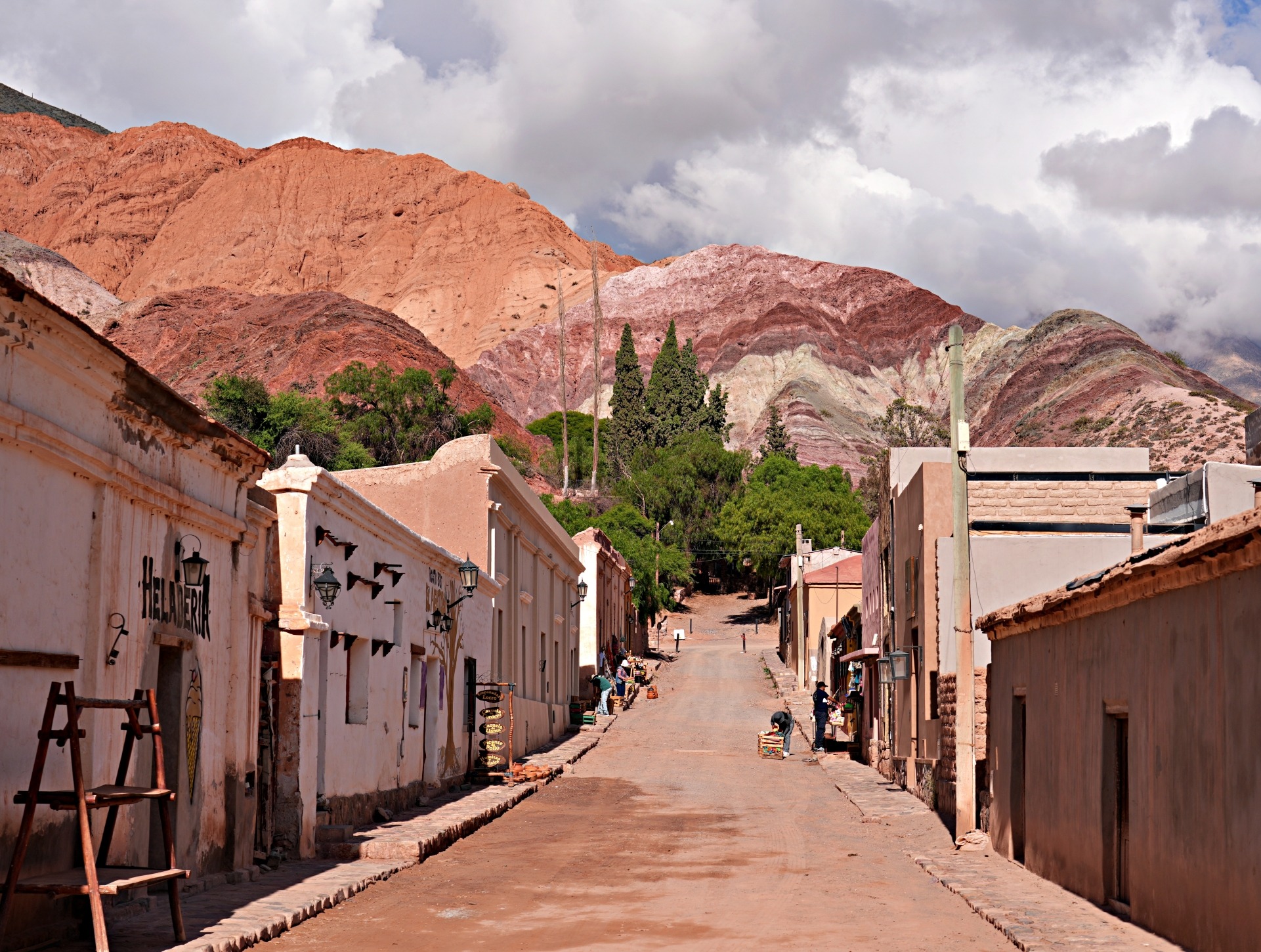
With humble adobe houses built at the foot of the Mountain of Seven Colours, the rustic village of Purmamarca was everything we hoped it would be. Its blend of vibrant mountains and indigenous culture makes Purmamarca a special place.
In fact, this is true for most of Jujuy Province, in Northern Argentina, where the landscapes are saturated with rainbow-coloured mountains, and flat-roofed adobe houses decorate its streets. Its small towns are home to the indigenous Kolla people, who bring their unique culture to their communities. The main towns, Humahuaca, Purmamarca and nearby Iruya in Salta, are bursting with delightful gems that made us fall in love with this region. We’ll take you to Purmamarca first.
Purmamarca
Located in Quebrada de Humahuaca, Purmamara is known for its main landmark, the Mountain of Seven Colours (Cerro de los Siete Colores). The view of this feature from town is spectacular, with a row of adobe houses in the foreground and the striped peak above. The scene is hard to beat.


What we didn’t realize, though, is that these hues extend beyond this one mountain. In fact, Purmamarca sits in a basin below a staggering display of polychromatic peaks.


Plaza 9 de Julio
From the main plaza, we had our first view of the amazing landscape in which this humble town was built. During the day, a local market takes over the pedestrian streets surrounding July 9th Square (Plaza 9 de Julio). But, instead of the typical Argentine fare of mate mugs, leather products and wine, vendors sell alpaca sweaters, shawls, and llama keychains, making us think we fell asleep on the bus and travelled to Bolivia or Peru.
Located on the 15th century Inca Trail, most of the locals living in these pre-Hispanic northern Argentine towns are Kolla, related to Quechua and Aymara in neighbouring Peru and Bolivia. Even though they migrated here many generations ago, they still speak Quechua and follow many of their ancestral traditions.


Seeing the llama sweaters on sale in the market, you may wonder why you would need one in the summer. The reason is that Purmamarca is located on a high desert Andean plateau at 2,324 metres (7,600ft). This means the sun is strong during the day, but temperatures cool down considerably at night.
Cabildo
Located on the edge of the square is the 19th century Cabildo. Not only is it the smallest town hall in Argentina, but it is also one of only 10 traditionally-built cabildos remaining in the country. Today, it houses the city’s cultural centre.

Santa Rosa de Lima Church
Surrounded by a large yard, the 17th century Santa Rosa de Lima Church takes up one full side of the square. Built with adobe walls and a cardon cactus ceiling, the church fits in perfectly with the rest of the town.
At its side is a 700 year old Carob Tree.


Cerro El Porito Lookout
Once we saw Cerro de los Siete Colores from street level, we were excited to see it from higher up, and Cerro el Porito Lookout provides the perfect vantage point. Not only did it allow us to look directly at the famous hill, but it also gave us a different view of the rest of the unique landscape.


The Mountain of Seven Colours, and others in this area, burst with a kaleidoscope of colours. The hues are the result of millions of years of change to the land. Rocks with grey, dark green, purple and white, lived under the sea during the Precambrian and Upper Cambrian periods, as much as 600 to 540 million years ago. Light grey and yellow are from 504 million years ago. The red and light pink rocks are the youngest, hailing from the Ordovician and Cretaceous Periods, a mere 144 to 64 million years ago.

Tip – The lookout platform provides a 360° panorama, but to see everything in the best sunlight, you may want to visit it twice. The best time to see the 7 colours is in the morning, and to see the town, go in the afternoon. To reach the lookout, you have to climb a set of stairs.
Entry is just over $1 USD; Opening Hours vary with the season, but it is typically open from just after sunrise until just before sunset.
Purmamarca Cemetery
The small town has a large cemetery where indigenous traditions are combined with Christian beliefs. There are vertical graves, large family tombs and a garden in the centre. Almost every grave is decorated with colourful flowers, letting us know they are well-tended. Like those we saw in La Paz and Sucre, some of the graves have items that the deceased used in life. It is believed this will help them be content in the afterlife.


Paseo de Colorado Hike
There used to be several hiking trails that let you explore these mountains, and we had hoped to do a few. Unfortunately, the government has recently closed all but one of these trails. The only hike remaining is Paseo de Colorado, a 3 km trek encircling the Mountain of Seven Colours.


The trail is easy with only a small gain in elevation and takes you by spectacular scenes that can’t be seen from town.


You may see side trails to other viewpoints, but all of them are closed. There are no closure signs, but when we started to go up one, we were called back down by one of the landowners.
Entry is $1USD. It is a circular route that can be done in either direction, and there is a ticket booth at both ends.
Peñas
Traditional Peñas are a lot of fun with live bands playing folk music to a full dance floor. The music is played on traditional instruments, including guitars, fiddles and various wooden flutes, and the lyrics describe their indigenous and gaucho heritage. Unlike many countries, folk music is mainstream in Argentina. We noticed that most restaurants, buses and taxis played either folk music or 80s pop, but hearing it in a peña is the best venue.
We went to two peñas in Purmamarca, and they were enjoyed by locals as much as tourists.


Located in the UNESCO World Heritage Quebrada de Humahuaca (Humahuaca Gorge), these mountains are just a small introduction to what this landscape offers. We’ll show you more in the coming weeks.
How to get to Purmamarca
The small mountain town is 188 km north of Salta and 65 from San Salvador de Jujuy, the capital of Jujuy. Buses leave from the main bus stations in both cities, but not all buses go all the way to Purmamarca. Some will drop you off at the turnoff to the town, 3 km away. If that happens to you, walk to the bus stop on the highway to Purmamarca and flag down a passing bus.
To reach Purmamarca from other towns in the Quebrada de Humahuaca, the best option is the Santa Ana Bus Company. They leave from the station in town and travel between the towns in the valley eight times a day. The schedule has recently changed, and the posted times were not current when we were there, so you may need to ask at the bus station. As well, our bus left 5 minutes early from the time we were told, so it would be best to arrive at the station early. You pay the bus driver in cash.
If you’re travelling to or from Chile, Andesmar Buses go between San Pedro de Atacama and Purmamarca once a day, and then continue to Salta.
There is luggage storage at the bus station if you only have time for a quick stop on your way further north.
You can find Purmamarca at the northern end of the map below. It is an interactive map, so you can zoom-in or click on a marker for a link to our post from that region.
Where to stay in Purmamarca
While it is possible to visit on a day trip from Humahuaca, we think you should spend at least one night in Purmamarca. It is ready for tourists with several locally run hotels and bed & breakfasts. The town is very small, and almost every hotel has a mountain view, so the exact location is not important. We stayed in the local Hosteria los Morteros. It is simple but very comfortable, clean, and the host is very kind and helpful.
If you prefer more luxury, there are a few boutique hotels in unique settings, just outside of the town.

Where to eat in Purmamarca
Purmamarca also has several good restaurants. Most sell local fare, including tamales, humita, tortilla rellena and empanadas, as well as llama stew, but you can also find typical Argentine grills and pasta dishes. Maybe you’ll be lucky like us and be treated to live music while you dine.


Note – Prices are listed in USD because the rate of inflation in Argentina is so high. As of 2026, any fees listed in pesos would be inaccurate within a few months. Becasue of this, many restaurants don’t list prices on their menus, or if they do, they have been written over many times as the value of the peso drops. Apart from hotels, most business will only accept payment in Argentine pesos.

Click on the link to read our Travel Tips For Argentina.
To read more of our adventures in Argentina, click here.
Coming Next – Humahuaca and the Mountain of 14 Colours
For pictures from other blogs go to Gallery at monkeystale.ca.
To read about more of our adventures go to Destinations.
If you like what you read, please comment or share (with credit) using the links below.




We’d love to hear from you, please leave a comment.