
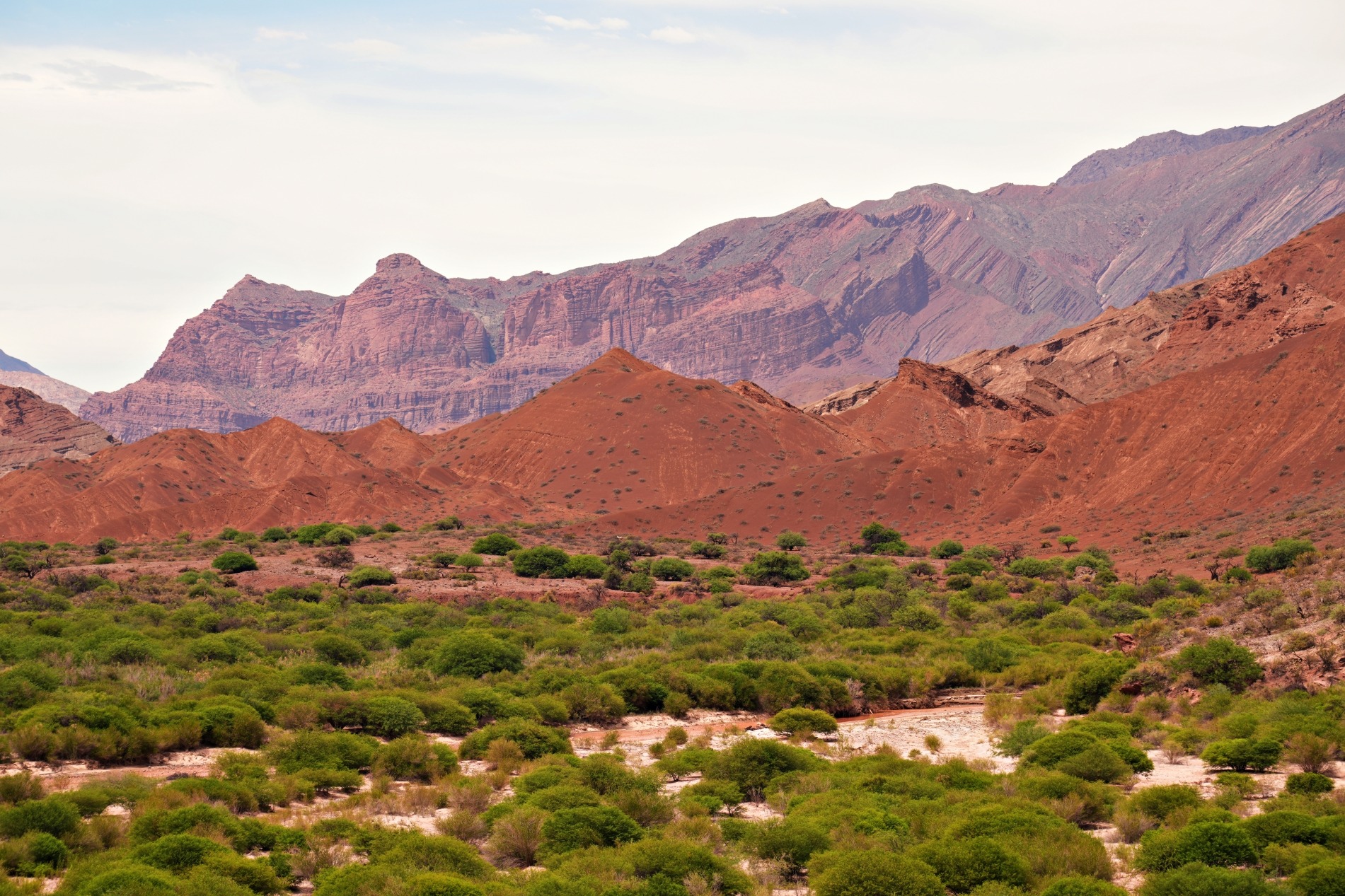
After exploring the pretty streets of Salta, it’s time to see the other stunning sites in the province. Not far from the city, a popular road trip is to visit the dramatic red cliffs in Quebrada de las Conchas. As you drive through the long gorge, the rugged terrain reveals layers of colours that make it a photographer’s paradise. The trip ends in the colonial town of Cafayate, in the heart of Argentina’s high-altitude wine region. Together, the canyon and the town will make this a memorable day.
Not long after leaving Salta, on Ruta 68, we passed green fields of tobacco, chia, corn and alfalfa. Then, the landscape dramatically transformed from flat, green lands to time-worn, colourful cliffs.


Quebrada de las Conchas
The Gorge of Shells (Quebrada de las Conchas) is a spectacular 70 km (43 mi) long valley formed where the Calchaquí and Santa Maria Rivers join to form the Las Conchas River. The red rock valley offers stunning views at every turn, and your eyes will be glued to the window to make sure you don’t miss a thing.
Conchas translates in English to shell because of the fossilized shells embedded in the cliff walls. In addition to the shells, fish fossils have been found from the Cretaceous period, when the valley was under the sea.


Millions of years ago, geological events shaped the dramatic landscape. They include earthquakes that caused tectonic plates to shift, volcanic eruptions that blanketed the land in ash, and wind and rain that eroded the surface. These events created layers of sedimentary rock in a spectrum of colours, ranging from deep red, purple and pink to orange and green. Their colours come from the mineral-rich earth that is especially high in iron and copper.


Rock Formations
As with many canyons, you can see a variety of familiar objects in the weather-worn cliffs. See if you can spot a toad (el sapo), friar (el fraile), obelisk, castles (castillos), the Titanic, or the Andes. Some require you to use your imagination, but others are quite easy to spot.
If you’re visiting on your own, highway signs indicate their locations, but they are all written in Spanish.


Garganta del Diablo
In addition to these shapes, there are a couple of tight gorges in the cliffs. Devil’s Throat (Garganta del Diablo) is a narrow slot that travels deep into the bright red cliff. An ancient waterfall once rushed down these walls, creating this tight canyon.


Amphitheatre
Not far away is the impressive Amphitheatre (Anfiteatro), where a narrow break in the cliff leads to an open cathedral with surprisingly excellent acoustics. This unique setting means that buskers often perform in the Amphitheatre. During our visit, we were entertained by a singer whose beautiful voice resonated perfectly with the cathedral-like walls.
Both the Devil’s Throat and Amphitheatre have been dry since the end of the ice age, so it felt pretty safe to walk to their end.


Relato Salvaje Movie Location
On the drive, we stopped at a location used in the Argentine movie, Relato Salvaje (Wild Tales). Both Puente Morales (Morales Bridge) and an abandoned car were key features in the movie. It didn’t mean much to us because we didn’t know the movie, but the Argentines in our group were excited to see the famous location.


Wine Tasting
Another popular activity in the valley is wine tasting. At 1,549 m (5,082 ft), the Torrontes grapes do well at this elevation and are the most common wine produced in the region. In addition to this elevation, the valley has other essential features for a good harvest, including mineral-rich soils and extreme temperature variations between day and night.
Torrontes is a white wine that is very sweet and tastes like a dessert wine to us. In addition to it, most bodegas also produce Malbec, Tannat and Cabernet Sauvignon. We were introduced to Tannat wine in Uruguay, where the grapes are grown at sea level, so we were surprised that they also do well at higher elevations.

We tasted Torrontes and Tannat wines, among others, at Bodega Tierra Colorada. Our favourite was their bold Tannat, so we’ll add it to our list of wines to look for at home.

If you enjoyed this, you may be interested in our wine tasting posts from Mendoza in Argentina, Colchagua and Elqui Valleys in Chile, Georgia, Armenia, Bolivia, Uruguay, Portugal, Bulgaria, and India.
Cafayate
The drive through Quebrada de las Conchas takes you to the town of Cafayate. The pronunciation of the town’s name is not what you expect. Argentines pronounce y as sh. So Cafayate is pronounced Cafashate. Even more confusing for us, in northern Argentina, ll is pronounced similar to an English j. We didn’t know for a while that our guide was talking about the camelids when she kept saying jama, for llama!
The town of Cafayate is small, but very touristy. Most who explore the gorge stop in Cafayate for wine tasting and lunch. Seeing the large number of tourists, we were surprised that the main square, Plaza 20 de Febrero (February 20th Square), was quite peaceful. At 1,680 m (5,512 ft), temperatures are cool, but the afternoon sun is very strong, so the park benches set under large shade trees were appreciated. The most interesting was the bulbous-looking Silk Floss Tree.
Anchoring the plaza is the yellow Cathedral of Our Lady of the Rosary (Catedral Nuestra Señora del Rosario). It was built in 1885 to replace the original church from the late 1700s.


Most of the buildings around the square and neighbouring streets are adobe constructions. They are cute, but almost all in the square are restaurants, serving lunch to busloads of tourists. Others are craft or tourist knick-knack stores, which makes the town lose its personality a little.


Away from the square, Cafayte is a sleepy mountain town. We enjoyed wandering its quiet streets that offered lovely mountain views at their end.


Underneath these tall peaks, you’ll find several bodegas. The green vineyards and red mountains combine to make a picturesque landscape. If you didn’t stop at a winery outside of town, there are several to visit in Cafayate.


Other activities
Most visit Cafayate on a day trip from Salta, but if you have time to stay overnight, there are a few activities to keep you busy. The small town has two museums, Rodolfo Bravo Archaeological Museum and Museo de la Vid y el Vino. Unfortunately, both were closed for siestas when we tried to visit. There are also several short hikes in Quebrada de las Conchas, but you need a car to reach their trailheads. Another option is to rent bikes in Cafayate and explore the gorge on two wheels.
How to Visit Cafayate and Quebrada de las Conchas
Located 90 km outside of Salta, Ruta 68 is paved and in good condition. If you have your own car, there are several pullouts so you can enjoy the view. There is also good signage to the popular sites, making it easy to visit on your own. If you don’t have a car, you can visit on a day trip with one of the tour agencies in Salta. We used Parada Norte Travel and were happy that their prices ($33 USD) were very reasonable after the high fees in La Rioja.
When to visit Cafayate
Summer is the most popular time to visit, but the area receives a lot of rain in January and February, and flash floods are common after heavy rain. There was a threat of rain for most of the day when we visited in November, and while it didn’t rain in the gorge, it had poured in Salta. When we returned to the city at the end of the day, the highway and many streets were flooded.
What and where to eat in Cafayate
There are several patios around the main square. Most offer typical Argentine grilled meat, but they also feature indigenous dishes such as tamales and humita. Tamales are corn flour shells filled with meat or cheese. They are usually steamed and served wrapped in corn husks. Humita looks similar because it is also wrapped in corn husks, but inside is a mixture of nicely seasoned ground corn and cheese.

Click on the link to read our Travel Tips For Argentina.
To read more of our adventures in Argentina, click here.
Coming Next – Purmamarca and the Mountain of 7 Colours
For pictures from other blogs go to Gallery at monkeystale.ca.
To read about more of our adventures go to Destinations.
If you like what you read, please comment or share (with credit) using the links below.




We’d love to hear from you, please leave a comment.