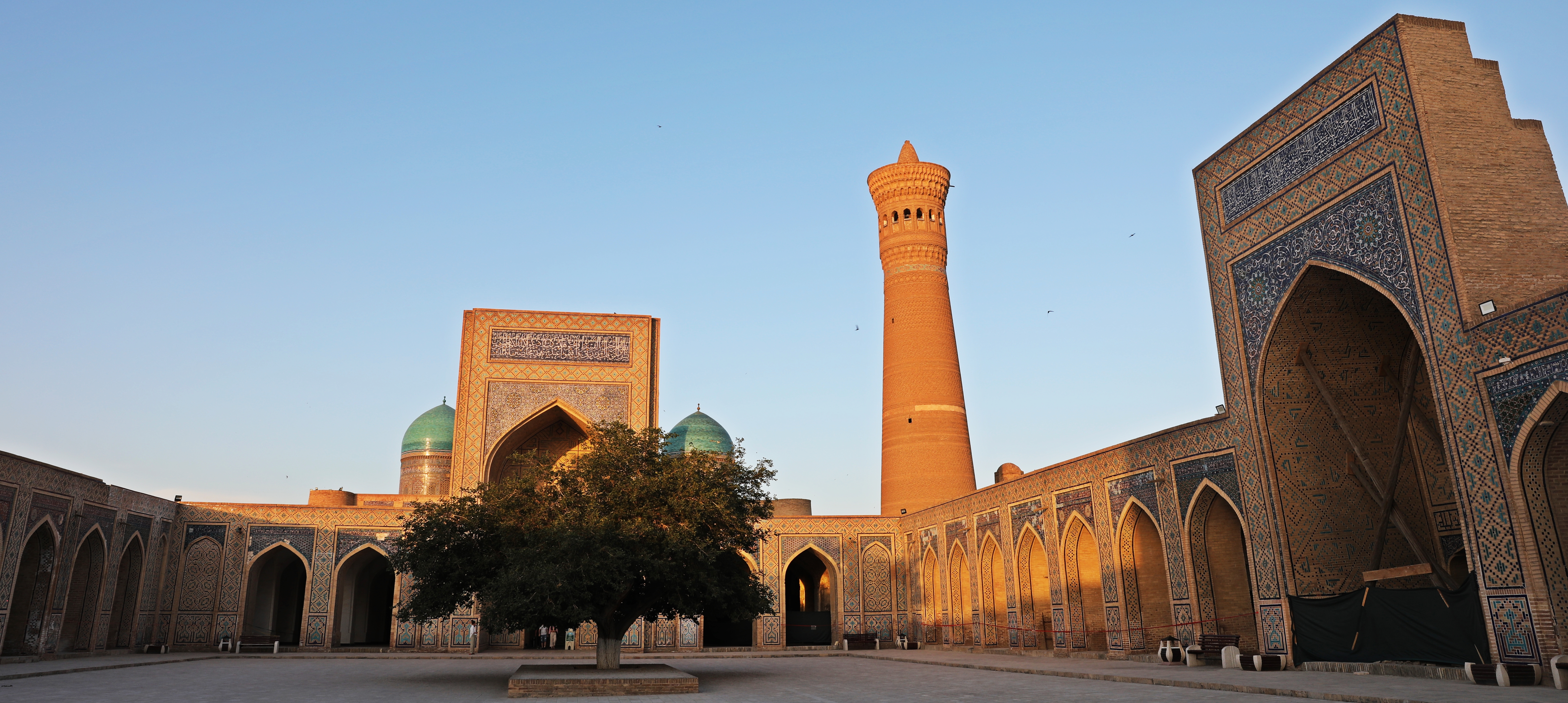
The tall minaret glowed from the final rays of the setting sun. Upon seeing the magnificent tower we understood how its awe-inspiring look impresses everyone who sees it, including the brutal warrior Genghis Kahn. 

It’s true that Bukhara doesn’t have the colour and glitter of Samarkand but what is does have is a deep history that exudes from the buildings in Old Town. Not many of the historical buildings have been restored. At first it made us disappointed in monochromatic Bukhara, but as we ventured deeper into Old Town we grew to love the authentic feel of this historic town.

Bukhara was considered one of the great trading cities along the ancient Silk Road. This prominent position caused it to attract a lot of attention. Over the centuries its leaders changed many times and included Alexander the Great as well as Emirs from Persia and Turkey, among others. Its religion changed as often as its rulers having been Buddhist, Christian and since the 9th century, it has been Muslim. In 1220 the city was decimated by Genghis Khan, whose army destroyed almost every building and killed many of its residents. The city’s turmoil continued until it achieved a bit of stability from the 16th – 19th centuries when it was ruled by Emirates of Bukhara Dynasty. Russian Czars took over control of Bukhara in the late 1800s and then it changed hands to come under Soviet control.

Because of its devastating early history, most of the Turkish-Islamic architecture that we see in the town today only dates back to the 16th century.

Note – In Central Asian languages kh is pronounced with a hard H as in Boo-ha-ruh

Kalon Minaret Complex

At 48 metres high, the majestic Kalon Minaret can be seen from a few different places in Old Town. Its distinctive crowned top, tall stature and detailed brick designs make it an iconic image of Bukhara. Built in 1127 it is one of the oldest structures in the city. It is so beautiful in fact, that apparently Genghis Khan saw it and was so enamored with Kalon, he told his army not to damage it.

In addition to its height and unique top, detailed patterns inlaid in the brick gives it even more beauty. It is said that the designers strove to ensure a sense of balance in the minaret, which they absolutely achieved.

The Minaret complex includes Khodja Kalon Mosque and Miri-Arab Madrasah. The inside of the mosque looks like many others we’ve seen in Uzbekistan, however this one hasn’t had much restoration. The best part though, are views you have of the minaret from inside its walls.

The mosque is actively used for prayers, so conservatives dress is required.

Across from the mosque is Miri-Arab Madrasah. It is still used as a school today so we were only allowed inside the first door.

Sunset was our favourite time to explore many of the sites in Bukhara because it gave the earth coloured buildings a red glow.

At night the minaret is brilliantly illuminated making it stand our even more. We were able to catch a picture of it below a crescent moon, a symbol of Islam.

Kalon Minaret Complex is an open square with no entrance fee or closing time.

Khodja Kalon Mosque Entrance Fee – 50,000 UZS ($4.40 USD); Opening Hours – 8am-8pm (although it was closed during these times when we first tried to visit)

Citadel Ark

The undulating brick walls of Citadel Ark let you imagine life during the days of the ancient Silk Trade Road. The rounded buttresses make it much more picturesque than most fortresses. Built with wooden logs sticking out as reinforcements, Richard thought the enemies could have easily climbed up and over the walls to ravage the complex. Maybe they did.

The only entrance to the Citadel Ark, other than scaling those walls, is framed by two tall towers on either side of a large, wooden door.  

A fortress wall has been standing on this site since the 5th century AD (CE). Its walls surrounded the palace which housed Bukhara’s Emirs for centuries. Much of what we see of the wall today however, is a rebuild because most of it was destroyed in the 1920s during the Bolshevik Revolution. There is a museum inside, but it includes only a small section of the restored palace. You can visit the Coronation Hall where there is a throne from the 1660s on display. Beside it is the Greeting Courtyard, where citizens waited to greet the king during important events.

The most interesting part of the museum is Dzhuma Mosque (Friday Mosque). You can just feel its history in the old wooden pillars and ceiling.

The museum was quite disappointing and even though the entrance fee isn’t very high, we didn’t feel it was worth it.

Entrance Fee – 40,000 UZS ($3.50 USD);   Hours – 9am-6pm

Labi-havz Complex

The old pond, Labi Havz, traces its roots back to the Old Silk Road trading days. Today the small cement pond is surrounded by restaurants and is a popular place for tourists to enjoy a relaxing meal. It is one of the last few remaining ponds in the city.

The complex includes two madrasahs and a khanaka (meeting hall).

Kukeldash Madresah

Across the street from Labi Havz, is the large 16th century Kukeldash Madrasa. Inside there is fabulous brick work on the domed ceilings but the main courtyard is in disrepair. Today, market stalls use the space to sell their wares. 

Nadir Devanbegi Madrassah

Beside the Labi Havz pond is a very colourful madrasah. Twelve small arches on its façade are decorated with blue glazed bricks and tiles. The madrasah was originally built to be a Silk Road caravansary and it has birds painted on the tympanum; the space above the arched entrance. Depictions of live animals are not usually allowed on Muslim holy buildings, but this one seemed to be okay. Inside, the cells have been decorated with colourful tiles and are now used by shops and restaurants.

Char Minar

This charming building with 4 stubby minarets is of disputed origin. It’s likely that it was the gate for a madrasah that is no longer standing. Some say the man who had it built was from Hyderabad, India and was inspired by Charminar in that city. They do look fairly similar. You can see our post about Hyderabad here. The name, Char Minar translates in English to four minarets.

An artificial crane nest is on top of one of the minarets as a remembrance of the city’s past inhabitants. There used to be a lot of artificial ponds, similar to Labi Havz, in Bukhara . These reservoirs were used by residents as well as by the cranes. The Soviets found the open ponds to be a health hazard, and had most of them filled in. Fewer ponds in the city meant that the cranes no longer nested on Bukhara’s towers.

Trading Domes

Throughout Old Town we saw many former Silk Road Trading domes. They came in multiple shapes and sizes. Many have exceptional roofs, both inside and out. With no colour added to them, they still were one of our favourite things to see.

Bolo-Khauz Mosque

This 16th century mosque has very interesting design. Dozens of wooden pillars support a stepped roof which covers a verandah. The pillars have crown-like tops made of tiles.

Its ceiling though, is the best part. It is bordered by a beautiful array of colourful tiles with wooden slats in between. When we visited, the mosque wasn’t open so we couldn’t see inside. Apparently it is only open during prayers.

At its side is a small minaret. Bolo-Khauz Minaret is a new addition, built in the 1917. The small minaret looks to be a copy of Kalon. In front of the mosque is one of the few remaining ponds in the city.

Ismail Samani Mausoleum

When you approach this small mausoleum you immediately notice the very pretty, detailed brick work on its walls. Inside the intricate brick details continue with round, square and diamond designs covering the walls and ceiling. Ismail Samani Mausoleum was built in the 10th century for Emir Samani. It was saved from devastation by Genghis Khan’s marauders because a flood had covered it in mud and Khan’s army deemed unimportant.

You can read more about Emir Samani in our post from Dushanbe, Tajikistan.

Old Town

Walking through the streets of Old Town, you will find many other historical buildings. Most are not restored and are not open to visitors. Others were not restored but were still used as small markets to sell mostly tourist items. Among those were Ulugh Beg Madrasah. Built in 1417 it was the first school built by the astronomer. Across from it is the pretty, pink scalloped tile designs on the entrance of Abdulazizkhan Madrasah.

Gaukushon Complex has a small version of Kalon Minaret. At its side is a mosque with an interesting roof. Dozens of small domes cover the building’s top. Nearby is a Magok-i-Attari Mosque that was originally built in 800 AD and rebuilt in the 1500s. The mosque is sinking, and you can see that it is a few meters below the level of the sidewalk.

Kosh Madrasah Complex is a set of two very similar madrasahs in a small square dating from the 16th century. Not far away is Chashma-Ayub Mausoleum that is linked to a story from the Bible. It is said to be the location where Job provided water to the community by creating a spring when he touched the ground with his staff. The site is commemorated by a 12th century building. Today it houses, quite appropriately, the Museum of Water.

Getting to Bukhara

Bukhara has an international airport, but most international flights arrive in Tashkent. Domestic flights are very inexpensive, especially if you only have carry-on luggage. The fast train (Aefroib) travels between Bukhara, Samarkand and Tashkent and is an extremely efficient and cost-effective way to travel. Getting to or from Khiva you can take the overnight train, or a share-taxi. It’s only 6 hours away so we didn’t like the overnight train option. We found share-taxis to be very convenient and it allowed us to see the desert landscape as we drove.

Getting around in Bukhara

The ride share app Yandex works very well in Bukhara. There are also a lot of taxis, but they don’t seem to like to match Yandex rates.  From the railway station to Old Town it is 18-20 km. Expect to pay 21,000- 25,000 UZS ($2.80-$2.20 USD) but taxis wanted to charge us 250,000 ($22 USD)! Luckily we had Yandex installed. Once you reach Old Town, all of the sites are within walking distance.

Where to stay in Bukhara

There are oodles of choices for guesthouses in Bukhara. Most of them seem to have very high ratings and low prices compared to the rest of the country. Try to stay in or near Old Town but be aware that some roads in Old Town don’t allow cars so you may have to walk with your luggage. We stayed in the lovely guesthouse Hotel Hanifa. The rooms have old-style decorations, and it is run by a lovely family. You can find it on-line.

This article is now featured on GPSmyCity. To download this article for offline reading or create a self-guided walking tour to visit the attractions highlighted in this article, go to Walking Tours and Articles in Bukhara.

Please visit the link for our Travel Tips in Uzbekistan.

To read our other posts from Uzbekistan click here.

Coming Next – Visit The Walled City of Khiva

For pictures from other blogs go to Gallery at monkeystale.ca

To read about more of our adventures go to Destinations.

If you like what you read, please comment or share (with credit) using the links below.

Fediverse reactions

112 responses to “Bukhara, A Silk Road City”

  1. More spectacular photos of spectacular buildings. The intricacy of the Ismail Samani Mausoleum is staggering. After seeing from so many photos of Central Asia that look hot and utterly dry, it’s kind of jarring to see trees and water! I agree with Richard about the Citadel Ark. Even I could invade that thing. What would you say it is – maybe a class 4 slab climb? Haha. You need to enter that shot of the minaret/crescent moon into a photography contest. You will win.

    1. It is utterly dry but they make good use of the water that they have. In Uzbekistan the further west you go, the drier it is. I think you’re right it’s class 4, but the bricks make it a bit easier and of course the huge holds on the logs.😊

    2. I forgot to give you a Central Asia update. You could visit Tajikistan, Kyrgyzstan and likely Kazakhstan (although we’ve only been to Alamaty) in July and August. The cities will be hot but most of the places you want to see are quite high so much cooler. Uzbekistan is much lower so is very hot in the summer. In fact some of the places in the other three aren’t open before June 1 due to snow. So don’t cancel that Central Asia trip yet! 😊

      1. That’s very useful info and I’m honored you thought of me! This comment tells me you have those countries under your belt, so I’m eager to read the posts!!

        I was looking at a world map yesterday and I was struck once again at how remote the capital of Kazakhstan is. If/when we go, we will also only go to Almaty. Makes you wonder if ANY tourists make it to the capital…

        1. We met a couple who did. They took a train and said it was very long with the same view of the open steppes the entire time. They didn’t sound very excited about the visit to the capital. We’re in the Pamirs in Tajikistan now. We looove Tajikistan. 😊

          1. Yeah, the humorous travel memoire Stans By Me said it was very flat and very boring.
            Ooh, the Pamirs. The husband would be very jealous. He wants to cycle them. Their proximity to the Afghan border makes me nervous, though. Stay safe!!!

          2. There are a few cyclists, but honestly the dusty, gravel roads are a huge turnoff for me thinking of biking here. Afganistan is scarily close!

  2. I keep returning to the Nadir Devanbegi Madrassah photos with the stylized birds at the entrance. The rarity of animal depictions in Muslim culture makes the birds seem even more exotic. They are quite graceful images.

    1. It is a lovely building and the birds (which I don’t think have been restored) make it even more special. 😊 Maggie

  3. Really really nice and great to be able to explore all these new locations via your posts!

    Thanks for sharing.

    1. Thank you, glad you’re enjoying them 😊 Maggie

  4. Gorgeous, Belated Happy Canada Day, Maggie.

    1. Thank you!! Happy Belated 4th of July!!

  5. Wow, what a spectacular place!

    1. It’s quite amazing!!

  6. These are really lovely buildings, I’m continually impressed by the detailed tile work on so many of them. It’s sad, though, to think about all the destruction that has occurred over the years and the old structures we’ll never get to see because they’ve been destroyed.

    1. That’s so true, when uou read the history it seems as if they were constantly being invaded by someone. What’s left really makes you wonder what it was like back then.

  7. Thanks for the tour of a place I’ll never see in person. You’re an excellent tour guide!

    1. Thanks!! Glad you’re enjoying Uzbekistan!! Maggie

  8. The Trading Dome appears to be a collection of sand dunes from certain angles. I’m in awe of the unbelievable skills of the architects who laid out plans for the intricate designs of these ancient buildings, but the builders had to be amazing at their craft, too!

  9. A city seeped in history! Great to see these photos!

      1. Thank you for sharing them!! 😉

  10. This was my favourite of the cities we visited in Uzbekistan – not as ‘museumy’ as Khiva nor as busy as Samarkand. You’ve captured its atmosphere beautifully and taken me back to our time there through all these photos of its wonderful architecture!

    1. Thanks Sarah, Bukhara is a treasure. At first we thought it toppling but when we saw the first trading dome and the Kalon Minaret, it all changed. 😊

  11. It is a historic city. I’m not sure if you have tried the Mughalai food in India, many claim it traces its root to Bukhara, especially the Dal Bukhara which is slow-cooked over low heat for many hours.

    1. I’m not sure, it doesn’t sound familiar, but maybe we did. We didn’t love the food in Uzbekistan, there was definitely no resemblance to anything we’d had in India.

      1. Well, the food you find in Uzbekistan will be different. The influence is certain parts only, not the complete food like slow cooking. Also, this slow cooking style can be found only in certain regions or type of food. So it is likely you might not had chance to experience it.

  12. most impressive

    💫🌿✨🦎☀️💖☮️⚛️♾️🦀🐉🙏🏻😌🙋‍♂️

  13. Wonderful article! Thanks for the lovely walk down memory lane 💗💗💗

    1. Thanks Luisa!! Maggie

      1. You’re more than welcome, dear Maggie 🌹

  14. I am completely blown away! The brick and tile work are utterly amazing. And for these buildings to have stood the test of time is a testament to their builders who must have truly been masters. I appreciate that you have shown us the details of the structures up close – the Kalon Minaret – wow! Your posts are such a pleasure to read, and I thank you for sharing them.

  15. Great captures and such wonderful history Maggie! Thanks for sharing❣️

    1. Thanks Cindy!!

      1. Indeed, my pleasure Maggie❤️

  16. We’ve been dreaming of visiting Uzbekistan for years! These beautiful shots are only making us more excited for our visit, which will hopefully go though soon!
    All the best
    Stephanie and Jerome
    Strafari

    1. Uzbekistan was better then we hoped it would be. I hope you’re able to visit to see for yourself!! 😊 Maggie

      1. Oh interesting! How so?

        1. We had seen pictures which enticed us to go but of course in person it is so much better.

          1. Oh wow, we’re even more excited now! Thanks for answering!

  17. I felt like I was taking a walk back in time on that part of the Silk Road. Thank you for the intricate journey in architecture and in history!. The Tamir Ark and its interesting walls… Wow, what a construction that must have been when it was originally done.
    Tympanum, Nadir Devanbegi Madrasah has spectacular mosaic work. I think it is the only one (that I noticed) of the Madrasahs that have such lavish images of birds on the front top section. Awesome!!
    I found it interesting that so many columns were hewn from wood. That feature takes a great deal of skill. And many of those wood columns appear to be original. How cool.
    Safe travels!
    Thank you for a wonderful journey/ share.

    1. It was all so cool! The Ark, the mosques, the doves. It’s almost too much to believe it is real 😊 Thanks Suzette!! Maggie

  18. What a truly extraordinary place, Maggie. It felt like being on a film set looking at some of your photos. Just stunning!

    1. It was quite unbelievable in person too! Thanks Jo! Maggie

  19. What an inspired destination this has proved to be. Fabulous architecture, amazing sights, absorbing history. It’s so fascinating to pick up somewhere from one of the ancient trade routes and learn of its history – histories where “overnight communities” existed as the travelling traders passed through town. Great reading, Maggie.

    1. Thanks! Bukhara really felt like we were on the Silk Road. Can you imagine the history that has gone through those Trading Domes?! It was a really great destination! Maggie

  20. More amazing architecture and tiles! The age and the design of those buildings just blows my little mind! Thanks for the inspiration. Mel

    1. Me too! It’s incredible what they were able to build so long ago! Maggie

  21. Such a fascinating place. I actually love all the monochromatic detailing.

    1. At first we didn’t but it didn’t take long to love it. And it’s so beautiful at sunset. 😊

  22. I love everything about this post and all of your UZ posts!!!

    1. Taking notes?? 😊😊

      1. Lol of course!!!

  23. Fabulous architecture Maggie. I do love the curving fort wall, but like Richard wonder what kept attackers from climbing the logs—boiling oil? Allan

    1. Ha maybe! That would be about the only thing to stop them!

  24. The architecture is so impressive. The curves in the Citadel Ark made me gasp. Such beauty everywhere!

    1. I know, it made me gasp too!! 😊

  25. I probably sound like a broken record but the intricate detail is amazing.

    1. I know, I feel like my descriptions are broken records but it’s so true 😊

      1. Oh no, not at all; you give wonderful descriptions of your travels.

        1. Thanks, but I wasn’t fishing for a compliment 😊

          1. I’m sure you weren’t; but you deserve them! 😊

  26. Wow, what a truly amazing place, Maggie, especially the wonderful Bolo-Khauz Mosque. I love its Old Town District and the amazing hand-woven textiles that Uzbekistan is famous for. I would love to get lost in the alleyways and trading domes of the busy, bustling city of Bukhara! Thanks for sharing and have a good day 🙂 Aiva xx

    1. Thanks Aiva, there are quite a few of the trading domes so you could spend quite a bit of time in them 😊 Maggie

  27. Another fairytale-like destination Maggie. The level of craftsmanship on the Kalon Minaret is incredible. And yet I think the Abdulazizkhan Madrasah steals the show, what a visual feast. Love the word “scalloped” to describe it, very apt.

    1. Thanks Leighton! It was like a fairytale, so many buildings that really let you know its history. I loved the pink scalloped tiles on that madrasah, they are so unique and pretty and yet it barely gets mentioned in any reports on Bukhara. Glad you liked it too😊

  28. You’re right about how Bukhara has its own appeal and interesting history. The architecture is beautiful. I think the Kalon Minaret Complex looks even more stunning at night.

    1. Yes, it was quite impressive in the day, but as the sun went down and the lights came on it was quite stunning 😊

  29. These sights are just so impressive! I love all the little details.

    1. Thanks Lyssy, it was such a great Silk Road city 😊

  30. At first glance, I could see being disappointed at the monochrome simplicity compared to that opulence of before. But then to step inside and see that beautiful brick work and interior detail would quickly ease that disappointment. I love the colorful ceilings and the array of old pillars. And to delve into a little of the history was fascinating.

    1. Thanks, yes sometimes the lack of colour lets you see the other details intheir workmanship. 😊

  31. Your Central Asian posts are such a visual feast you take amazing photographs- what camera do you use if you dont mind me asking. I also really love the colour of the domes- like a specific teal or turqoise but its just a beautiful shade 🌷

  32. More fabulous photos of striking buildings. I also like the glow of the earth-colored structures created by the setting sun.

    1. Thanks Tanya, the red glow on the buildings was so beautiful. We hoped there would be some glow but it was much better than we thought! 😊

  33. You are solely responsible if I suddenly book a trip to Uzbekistan! I know it has many amazing sites. But your photos from Tashkent, Samarkand, and now Bukhara really put the country on top of my wish list right now. I’ve said this but I’ll say it again: the level of detail is spectacular! Did you find Bukhara less touristy than Samarkand in general?

    1. Haha!! I will take full responsibility! Bukhara did seem to have fewer tourists, at least fewer large bus loads. As you can see, it was less ‘perfect’ which added to it rather than take away. But it’s also good to have Samarkand the way it is too. The uniqueness and differences in the three main cities made Uzbekistan even better and made us love each city in a different way. Samarkand is touristy but there still weren’t many tourists and the city still felt very local not overdone.

  34. Wow, Bukhara has some wild history! The Kalon is indeed very unique – nothing like what I’ve seen from your previous posts. Lovely close up photo to show the detail on this structure. The Citadel Ark and Trading Domes are also quite unique … but my favourite must be Abdulazizkhan Madrasah – wow!

    1. The amount of khans, emirs and mauraders in this area makes it seem like there was never peace! The Old Town has so many amazing structures and it was so different from Samarkand which made it really special in its own way. The entrance to the madrasah is so pretty! I loved it too. 😊

  35. Kuriacose Joseph Avatar
    Kuriacose Joseph

    Wonderful description with pictures of this fascinating place. You must also feel like the explorers of old!

    1. Yes we did feel like we were on the ancient Silk Road! It has such a great history and you can really feel it in the Old Town. Thanks for sharing your thoughts, Maggie

  36. Once again, I got goosebumps reading and viewing the photos of this stunning place. The domes, the crazy shapes at the citadel ark, the incredible minaret … I could go on. You guys (Richard?) did a superb job of photographing these wonders – the perspectives, the details, everything.

    1. Thanks Lex, yes Richard takes such amazing pictures. Bukhara is less colourful than Samarkand but no less impressive 😊

  37. Just beautiful, everywhere you look the architecture is awe inspiring. That minaret is so striking 🙂

  38. Oh, I left a piece of my heart in Bukhara. The Jewish quarter, a random football game, being invited for tea in an old madrasah, the old town… I love that city. I wonder if there’s still a (very illegal) rooftop overlooking Po-i-Kalyon. They had very cheap beers for ‘sundowners’. Thanks for the memories!

    1. The rooftop bar looked to still be there but it was always closed. Not sure if it was a covid thing or what. Glad to bring back the good times 😊

      1. Ah, too bad.

  39. Spectacular. I love the warmth of the stone and how the simple architectural lines are embossed with intricate designs.

    1. The architecture in Bukhara is some of most interesting that we’ve seen. Thanks for your comments. Maggie

  40. Just wonderful. Every post you do makes me want to go to Uzbekistan even more. Also looking forward to Tajikistan!
    Alison

    1. Thanks Alison, we’re in Tajikistan now, it’s filled with beautiful lakes and mountains. We’re loving it.

  41. Wow, what stunning architecture! So very detailed and you’ve captured it beautifully.

    1. Thank-you! The architecture in Uzbekistan is unbelievably beautiful 😊

  42. What a fascinating place. I loved the Kalon Minaret, all the ceiling photos are wonderful. It’s amazing that everything has stood the test of time.

    1. Yes Bukhara is such a great place for historical architecture. A lot was damaged over the years but what’s left is incredible. 😊 Maggie

  43. […] wall differs from Bukhara‘s wall because it surrounds the entire Old Town, where the one in Bukhara was just to protect […]

  44. I have to say… How good is Bukhara?? It’s the quintessential Uzbekistan historical experience! Such a magical town in those Ark Walls! Loved it and you’re photos are awesome too!

  45. Finally getting caught up on reading blog posts. This is such stunning beauty. Overload on the eyes! Bravo!

    1. It is an overload load on the eyes, you’re right. 😊

  46. I understand why they changed the Nadir Devanbegi to a madrasa 🙂 It was too beautiful for a caravanserai.

    1. It is too beautiful, you’re right!

  47. What a fascinating city, it appears to be carved out of the desert landscape. The few areas of color and tile really stand out. A shame that the cranes moved on.

    1. Bukhara is such an amazing, historical city. I’d love to walk through those trading domes again! It is too bad about the cranes, but actually the Soviets made a good decision to close up the bacteria infested water. I didn’t write about this, but in southern Uzbekistan we saw hundreds of real stork nests filled with baby storks, so they didn’t go far. 🙂

      1. Glad to hear that the stork are thriving. It’s rare to see nest filled with baby birds anywhere, usually well hidden.

  48. the architecture is amazing!

  49. […] To read our story from Bukhara read our post Bukhara, A Silk Road City. […]

  50. […] To read our story from Bukhara read our post Bukhara, A Silk Road City. […]

  51. […] into a domed foyer. The brick ceiling in this first room reminded us of the Trade Domes we saw in Bukhara, […]

We'd love to hear from you, please leave a comment.

Destinations

Discover more from Monkey's Tale

Subscribe now to keep reading and get access to the full archive.

Continue reading