Ruta de las Flores (The Flower Route) connects a series of cute towns set on a high plateau between the peaks of El Salvador’s volcanoes. Blooms of wildflowers coat the area’s hills and valleys in a multitude of colours between November and February. Although the flowers are how this area got people’s attention, it is the small, artisan towns with vibrant markets and frequent festivals that keep people coming throughout the year.

Ruta de las Flores is located in the blue box in the map of El Salvador below.

Click on the link to go directly to Travel Tips For El Salvador.

The five towns that make up Ruta de las Flores are Ataco, Apaneca, Salcoatitán, Juayúa and Nahuizalco. The larger cities of Ahuachapan and Sonsonate are located at either end of the route and provide access to the area. Unfortunately, we were there in April when the blooms were mostly finished but we did get to enjoy the atmosphere of the towns. We visited all of them except Nahuizalco and Ahuachapan and are excited to show you what to expect when you visit Ruta de las Flores.

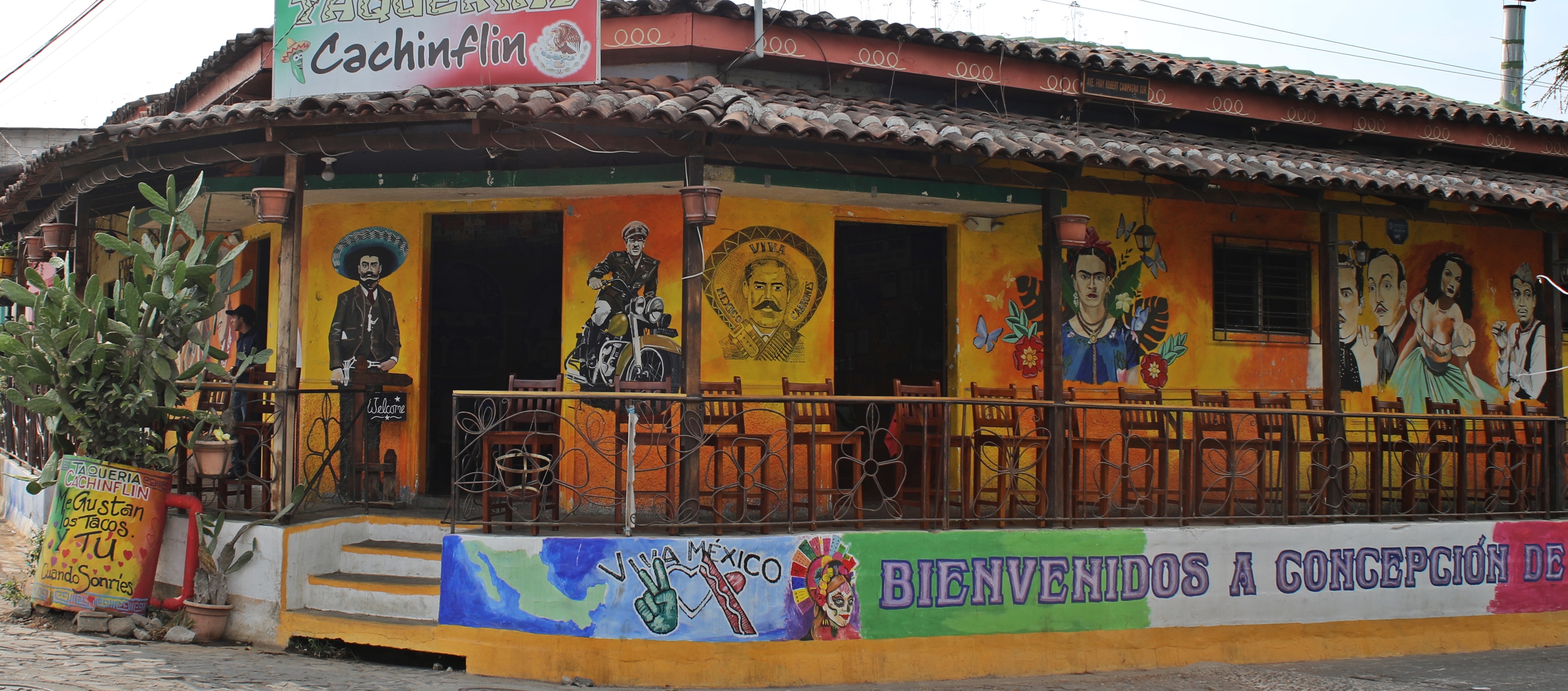
The small, colourful town of Ataco (1,225 m/4,020 ft) has a unique location inside the crater of an extinct volcano. Many artists live in Ataco and their paintings, weavings and crafts are for sale at the many small shops in town. Colour comes from the painted homes and also from the street art that decorates many of the buildings in town. Of the five towns on Ruta de las Flores, we think Ataco is the prettiest.

Ataco was originally settled by the indigenous Pipils people. They migrated from central Mexico to El Salvador in the 11th century and some decided to make Ruta de las Flores their home. Pipils speak Nahuat and in this language Ataco means ‘Place of High Water Springs’. Nahuat likely originated from Nahuatl, spoken by indigenous Mexicans such as Mexicas (Aztecs). Like the rest of the region, Ataco was colonized by the Spanish in 1543 and the name was formally changed to Concepción de Ataco. 

One of the nicest features in the small town is the garden-filled main square, Fray Rafael Fernandez Park. Providing shade to much of the park are two large ceiba trees. They are unlike any trees we’ve ever seen. Their huge limbs seem to grow into each other. It may be an example of inoculation where two trees growing close to one another morphological join. Whatever it’s called, these trees are a work of art

On the edge of the park is the large Immaculate Conception of Maria Church. The wooden ceiling inside the sanctuary reminded us of the mission churches in the jungles of Bolivia.

Surrounding the square are low roofed buildings with verandahs in front. Cafés and restaurants fill the verandahs with tables and chairs and make great places to stop for a coffee. Farmers have been growing coffee beans on the slopes of the volcanoes since the mid 1800s and it is now one of the main economies in the region. The coffee here is very good. It’s dark with a hint of chocolate flavouring and is not as bitter as other coffee we’ve had in Central and South America.

On the streets surrounding the main square some of the heritage buildings house crafts and artisan shops. At night, there’s more action in the town as busy markets spill out onto the streets and the parks are filled with families. There is an energetic buzz in the town at night.

For a bird’s eye view of Ataco, head up an easy trail to Mirador del Cruz de Cielito Lindo (Cross From Sweet Heaven Lookout) located just above Iglesia el Calvario. From there you have a panoramic view of the town and the jungle covered volcano walls surrounding it.


The next town east of Ataco is Apaneca (1,400m/4,699 ft). The town’s name is also a Nahuat word that means ‘River of the Wind” in English. We think it is the second nicest town on the route. 

In 1577 a Franciscan monk built a church in the already established indigenous village. Today the very large San Andrés Church seems a little out of place in the centre of this humble town. Beside the church is a cute plaza surrounded by craft shops and restaurants.

The main reason we visited Apaneca was to see Laguna Verde (Green Lagoon) (1,540 m/5,052 ft).  Its located 5 km (3.1 miles) from town and involves a 170 m (560 ft) elevation gain. We walked to the lake, but if you don’t want to walk you can also take Uber, or rent an ATV. El Salvadorians seem to love the ‘adventure’ of driving an ATV up the partially paved road to the lake. Many were wearing ski goggles although the road was rather smooth and not very dusty. 

We’re not sure it was worth it though. Instead of being a picturesque volcanic crater lake, it is a very small lagoon.


The next town on Ruta de las Flores is Salcoatitán. The main feature in town is Parque la Ceiba where we found a massive, ceiba tree that is over 350 years old. This one has long branches extending out to provide a lot of shade underneath.

The town is very small, though so there is not much to see other than a few colourful homes and of course a Catholic church or two.


The pre-Columbian city of  Juayúa (1,060 m/3,480 ft) is the largest of the five in Ruta de las Flores. It is a very busy city without the charm of the smaller Ataco or Apaneca. Its Nahuat name translates to ‘River of Purple Orchids’. We’d rather call it this since it took us forever to learn how to correctly say Juayúa. It is pronounced Hoo-A-Yu-A (or as we remembered it, ‘Who-a You-a’).

The city hosts a food festival every weekend which is very popular with El Salvadorian tourists. We arrived mid week so missed out on the festivities.

Juayúa’s Central Park is the city’s nicest spot with large trees and several park benches. The main feature is Santa Lucia Church that is sometimes referred to as Cristo Negro. When the Spanish were attempting to convert the local indigenous people to Catholicism, they often modified indigenous’ beliefs to align with Catholic stories. One of those involved their important black warrior god Ek Chuah. He was so important to the people that they went on pilgrimages to Esquipulas, Guatemala to see it. The Spanish morphed this god into their Christian stories and eventually it became Cristo Negro (Black Christ) rather than Ek Chuah. In the late 16th century, priests brought an icon of the Cristo Negro of Esquipulas to Juayúa and established a hermitage. Eventually that building was replaced by today’s Church of Santa Lucía Church which is why it has the nickname Cristo Negro.

Backpackers flock to Juayúa because it is the starting point for the Seven Waterfalls Hike. Unfortunately, most of these backpackers don’t even bother to explore the other towns on the route. They don’t know what they missed.

Since there is so much hype about this hike, we thought we should do it too. We joined a guided tour and went with them into the jungle.

Once on site we realized that the ‘trail’ travels through the river, literally. So, wearing our shoes and socks, we stepped into the shin deep water and made our way up river. Waterfalls 1 (La Toma/The Taking), 3 (Cascada Arcoirus/Rainbow Waterfall) and 5 (Novena Ocho/Ninth Eight), are quite similar. These wide waterfalls are quite pretty as they drop straight down over sheer cliffs. 

Waterfall 4 (Cascada Escalata/Rock Climbing Waterfall) is the reason there is so much excitement about this hike. True to the name, the route climbs straight up the waterfall. Our guide set up a rope for everyone to use, but the climb is not difficult. The rope seemed to more of a gimmick than anything, but it was still fun to climb up a waterfall.

We then walked across the middle of waterfall 6 (Borbollan/ Bubble) so that any remaining dry parts to our clothes were now completely drenched.  Waterfalls 2 (Cascada Seca /Dry Waterfall) and 7 (Cascalita/Little Waterfall) were so small we almost didn’t notice them.

After walking up and through these seven waterfalls our guide had a little more in store for us. We walked in our soaking wet shoes up and down the dusty hiking trail and passed two small waterfalls until we reached the prettiest of them all, Los Chorros de la Calera (The Limestone Jets). At this one, the water drops straight down over a wide cliff forming a nice swimming pool below. The thick vegetation adds to the pretty scene. This waterfall can be reached on its own without talking the Seven Waterfalls Trek and is a very popular trip.

It was fun, but not as much as we had hoped or been told it would be. 

Even though the walking is not difficult, you will never find all of these waterfalls on your own. There are a few guides in Juayúa offering group or private hikes. In spring 2024 the cost for a group hike was $15 USD per person and $150 USD for a private hike.

You can’t swim in any of the seven waterfalls, but you can swim in Los Chorros de la Calera.


Ruta de Flores ends in the busy city of Sonsonate. We walked around its downtown area stopping at the market. The busiest vendors were the cobblers’ and tailors’ stalls who were set up on the side of the road.

We didn’t have to take the local colectivos (share-taxis), but we did in other parts of El Salvador.

You will likely need to take a bus from Sonsonate to your next destination, but there really is no other reason to spend time in the city.


If you want to see the flowers, the best time to visit is between November and February. Rainy season runs between May and October and is not a very good time to visit. We were there in April when there weren’t many flowers but there also wasn’t much rain.

To reach the towns of Ruta de las Flores you could rent a car in San Salvador, Santa Ana or a scooter in one of the beach towns.

The other options are to take a chicken bus from San Salvador to either Ahuachapan or Sonsonate. From Sonsonate bus 205 runs frequently, but it is better us to take the Select Bus. For only $1.30 you have an air-conditioned bus and your luggage can go underneath as opposed to the chicken bus where you need to bring it on-board. Select Bus leaves from across the street from the Chicken Bus Station in Sonsonate. Both buses arrive at Terminal de Occidente (westside bus terminal) in San Salvador.

If you’re in Santa Ana, you can take a chicken bus directly to Juayúa. From El Tunco, you need to first get to La Libertad where you can take a chicken bus to Sonsonate.

Getting between the towns on the Ruta de las Flores is also easy because chicken buses run between them all day long. For each town, the bus stop is on the highway on the edge of the town. Some chicken buses run only between Ahuachapan and Apaneca, or between Sonsonate and Juayúa. Check with the driver if you’re not sure. They leave every 30 minutes, from 4:30 am until 6:00pm.

These buses are a fun way to see El Salvadorian life. People use these buses regularly whether travelling to work, home from shopping or to visit family. There’s always a lot of action on board between the vendors selling all types of food to the flashing lights and loud music played by the driver.

Ruta de las Flores is one of the safest parts of El Salvador. In fact, recent changes in government crackdowns on gang violence has made the entire country a lot safer. Even with this decrease in crime, always use safe practices such as not carrying a lot of cash or expensive jewelry or walking alone at night when travelling in El Salvador.

Read from another device.

To read more of our adventures in El Salvador, click here.

Fediverse reactions

100 responses to “Ruta de las Flores – El Salvador”

  1. The waterfalls hike looks like a lot of fun.

    1. It was fun, and refreshing! 😊

  2. I just love how all these towns share the presence of colourful colonial buildings, indigenous history, and vast coffee plantations. Walking around these towns seems like a continuous discovery of the indigenous culture, locals’ traditions and values. I hope you had a wonderful time losing yourself in the middle of the streets filled with artisans, traditional handicrafts, picturesque murals and colourful houses. Thanks for sharing, and have a good day 🙂 Aiva xx

    1. Thanks Aiva! It was a fun area to visit, so unlike what our expectations of El Salvador were before going. These towns have found a good mix between tourism and maintaining their culture, although there are not man international tourists yet. Maggie

  3. Beautiful geography, especially your pictures of those trees! Thanks for sharing your interesting experiences of the flower route communities.

    1. Those trees were unlike anything we’d seen before! Thanks Lynette, Maggie

  4. A colorful adventure. Thanks for the tour. I wouldn’t mind being sprayed by those waterfalls right now!

    1. They are refreshing! 😊

  5. Such a unique area to explore, that’s too bad you just missed all the blooms. Those Cebia trees are pretty neat! Your trek to the waterfalls was really an immersive experience haha.

    1. You are hilarious! Yes, we were going all in!

  6. You are sharing a different corner of the world now. 😃

    1. Yes it’s far from our European adventure😊

      1. Speaking of European, i did not know the origin of the word verandah till now. I was satisfied with the French origin in our language but, in this version, to us verandah is always a porch with some form of glass enclosure. This is why i was convinced that the French etymology would have been related to “verre” – glass 🙂

        Those trees in Ataca are spectacular indeed!

        1. The only verandahs I know are open balconies that wrap around the house. The trees are truly a work of art 😊 Maggie

  7. You have toured all corners of the world! Lovely place and beautiful pictures, Maggie!

    1. We’re trying to😊 Thanks Indira, Maggie

  8. Very interesting and colourful towns. (Suzanne)

    1. It is a great part of El Salvador to explore for a few days. Thanks Suzanne, Maggie

  9. I always like to see colonial buildings. I somehow didn’t expect El Salvador to be so nice interesting!

    1. We didn’t know what we’d see there either, but it has a few cute areas. Thanks for your comment, Maggie

  10. Such great work to grow their tourism and it’s really lovely

    1. Yes, it has a good mix of toeuism while retaining their own culture. Thanks June, Maggie

  11. These towns look lovely, my camera andni would be very happy in Ataco in particular!

    1. You both would be very happy! 😊

  12. This looks like a fun trip. Love the history you researched about the towns and the people who live there. Thanks for the tips.

    1. Thanks Rebecca, they have a long history in these towns and it was fun learning about it. Maggie

  13. The geography and art is beautiful, Maggie. I love that you are in Central America. I’ve only been to Costa Rica.

    1. Thanks Mary, this is our second trip to Central America. El Salvador may not be on everyone’s list right now, but we found a few worthwhile sites to see 🙂 Maggie

  14. A beautiful sampling of the area Maggie. I think I like the look of Ataco the best. There is something magical about those evening and night shots. Have a great Tuesday. Allan

    1. Ataco really has a fun atmosphere at night, glad that came across in the pictures. Thanks Allan, Maggie

  15. The waterfall hike looks interesting, were the rocks not slippy? Gill scrambling is a popular pursuit in the Lake District ( not by me!) but I suspect the water is a lot colder here than El Salvador!

    1. The water was refreshing, but at least the air temperature was hot. I think the rope was used mostly because the rocks were slippery. We did have to be careful but we had on hiking shoes so it wasn’t bad, but at least one had flipflops and I think she found it very difficult. Thanks Jim! Maggie

  16. What an amazing trip! Isn’t it the way with waterfalls…you’re told they’re magnificent but when you arrive, it’s a different story. After trekking to the spectacular Angel Falls in Venezuela, this fall is hard to beat. Although, I did go to Niagra while in Canada and that was a very special time.

    Love all the colourful photos of Ruta de las Flores.

    Is El Salvador safer than Mexico for foreign travellers?

    1. El Salvador is a lot safer than it used to be because the government arrested over a thousand gang members. There are very few if any kidnappings etc, but it is still Central America so you have to watch pick pocketers etc. I would say parts of Mexico are a lot less safe. Overall where tourists are in Mexico though, it is safe because there are so many police. The cartels still commit violent, horrendous acts and don’t care if a bystander is in the way, but they’re not usually in tourist areas.

      1. That sounds a little better than a decade ago – maybe I will get there eventually.
        As for pickpocketers, they’re everywhere and I say, where there’s a tourist, there’s a pickpocketer.

        1. That’s probably true sadly. Mexico has a lot of great sites so keep it in mind 😊

  17. Wow, I love this essay about this corner of El Salvador. Now I have to go. I did get to Suchitoto, which at the time was billed as a tourist destination and I’m happy to say it wasn’t. I was the only non-Salvadoran in town except for a Peace Corps worker who never left his chair at the coffee house during my three days in town. LOL

    1. We’re talking about Suchitoto next. There still aren’t very many tourists, I think we saw 3 or 4 others. There were quite a few tourists, but they were almost all El Salvadorians. You’ll have to return for a trip to Ruta! Maggie

  18. Wonderful pictures and descriptions as always Maggie! I love the colorful murals and street art of Ataco.

    I noticed the cobble stone in Ataco seems to be the oldest (back to the Spanish historical periods) than in the other cities which seem to have more modern paving. Also from the lovely birds eye view of Ataco, that city seems to be very well laid out with wide streets in the planning. Amazing!!

    I noticed that the churches have different style crosses. Iglesia el Calvario has two different crosses on the roof. And Immaculation Conception of Maria has the regular crucifix on the front in the three red crosses at the entrance. However; on the roof ( Immaculation Conception of Maria) the cross looks like an Apostles’ cross (blooming cross). I have never seen that style of cross on a church except in Europe. Fascinating. Not a question, it was just an interesting sight.

    I love the little coffee areas in your photos. Must be a great place to enjoy coffee as you mention!

    I liked your mention of he good vibes at night in the parks and plaza (Love that waterfall at Fray Rafael Fernandez Park) at night. WOW!

    What fun the waterfalls sounded like they were. The fabulous pristine water of Los Chorros de la Calera was superb. I noticed some markings, on the rock at the edge of your Los Chorros de La Calera photo. It that local/prehistoric carvings or just natural formations from erosion? I wonder?

    Great photo of the chicken bus, you mention them before, it was fun to see what they look like. An enjoyable journey from your words and photos Maggie, as always. Thank you. Safe travels.

    1. You are always so observant 🙂 I think they’ve replaced and were replacing a lot of the cobblestones in the other town. I’m not sure why, but our feet actually appreciated walking on more solid ground 🙂
      The Immaculate Conception Church had to be rebuilt in the last decade or so because it was damaged in an earthquake. I wasn’t able to find out much about the difference between the old and new churches.
      I honestly don’t know about the markings on the rock bellow Los Chorros. Some I think are vandalism engravings as we saw others along the way, but other marks are most likely natural wear and tear. Just after taking the pictures a bunch of people filled the pool for a soak so we didn’t pay much attention to it.
      The chicken buses were usually a lot of fun and very entertaining 🙂 Thanks Suzette! Maggie

      1. Oh, thank you for the extra information. I enjoy delving into history and architecture. Thank you for your patience and kind replies.
        I imagine that the chicken buses are full of local excitement and bustle. Awesome! Thanks again. Safe travels, Maggie!

  19. Your photos are wonderful! I especially enjoyed the old trees and the waterfalls.

    1. Thanks Kymber, those trees were so fascinating, glad you enjoyed them. Maggie

  20. An artist colony inside a volcano crater… that street looks so inviting, beautiful photo. The waterfalls look like a challenging climb but beautiful. I remember ceiba trees in Central America, but this one seems so unique.

    1. The ceiba trees in Ataco are unlike anything else we’ve seen, they’re as artistic as the town. And yes, an artists colony inside a volcano crater – how quaint 🙂 Maggie

  21. Those are great photos of the cascades, Maggie, and the churches lit at night. The street art in Ataco is pretty special too.

    1. Thanks Jo, it is a really special part of El Salvador. Gorgeous nature and cute, colourful towns. 🙂 Maggie

  22. Gorgeous, Maggie

  23. I love the main squares/plazas in Latin American cities, they are so charming and a great place to people watch. The big Ceiba trees are pretty cool indeed!

    1. They’re usually where all the action happens aren’t they?!

      1. Yep totally agree! X

  24. I really like the look of those towns, particularly the first one. The buses look pretty good too, we’d enjoy travelling by those and the collectivos. But topping it all are those amazing trees, I’ve never seen anything like that either.

    1. The buses are quite fun, a good way to see real life. They reminded us of the buses in Sri Lanka. I forget if you’ve been there. But you’re right those trees stole the show for us. We kept returning to see them in different light How’s being home? Maggie

      1. Yes, we toured Sri Lanka back in 2015 (I think). Home is….well, we’re busy catching up with family and friends but after just 8 days we’re itching to get travelling again.

  25. The ceiba trees are amazing! We’ll be visiting Central America in January and I sure hope we get to see some. The waterfalls also are so pretty, and look like a refreshing place to relax.

    1. Where are you going in Central America? They’re called Ceiba in Mayan regions and Kapok in other regions. We saw Kapoks on the Amazon, but it was different from these. I’ve neve seen trees like this before.

      1. Panama, Costa Rica and Guatemala. We’re still in the planning phase.

        1. We’ve been to all three and loved them all. Guatemala was on this recent trip so posts are coming soon. Ask away if you have any questions. 😊

          1. Will do; thanks Maggie!

  26. These are such lovely little towns. I love how colourful many of the buildings are, especially in Ataco, and the large ceiba trees. The Seven Waterfalls hike looks scenic and it sounds fun having to wade through the river for part of the trail.

    1. It was a surprisingly great spot in the middle of El Salvador. Thanks Linda! Maggie

  27. I want to live in the crater of a volcano! I bet there aren’t many people in the world who can say that. It must have been a massive volcano if there’s room for an entire town inside.

    The waterfalls hike looks pretty but I’m getting blisters on my feet just reading about walking all that way with soaking wet shoes and socks.

    1. The town is not large, but the volcano must have been huge! The hike was fun but walking in wet shoes and socks, which then got very dirty on the dusty trail, was not. 😊

  28. I haven’t been to El Salavador, but the atmosphere is very similar to that of other countries in the region, with lots of colour and noise everywhere. The central squares and churches define the town’s rank according to their stature, and are cherished by the population.

    1. It is much like other CA countries, but El Salvador is still quite rough in spots. Even the tourist sites are not easy to reach by non locals, but they’re working on it. 😊

  29. nice to know. Thank you for sharing

    1. Glad you enjoyed it. Maggie

  30. I’ve read about the cute towns of Mexico and Colombia, but this is the first time I read about those in El Salvador. This corner of the country seems to be quite fun to explore. And with those waterfalls, I can picture this region’s popularity grow as personal safety conditions improve.

    1. We really weren’t sure what we’d find we arrived in Ataco but boy were we surprised. We didn’t expect such cute, courful towns either. There isn’t a lot to do in the country but these cute towns are worth a visit. I hope this safe time is permanent and not just a blip. The people had such an awful time for decades and deserve a safe place to live. Thanks Bama, Maggie

  31. What an interesting tour of an area I knew absolutely nothing about. Those ceiba trees in the park are incredible – like you, I’ve never seen anything like them! The churches are also incredibly beautiful and the waterfall hike looks a lovely way to get out in nature (but wet socks and shoes – ouch!). I’d love the experience of riding a chicken bus too!

    1. The Ceiba trees still stays in my memory, I kept following the path of the interconnected branches in my mind. Chicken buses are really fun. The music is blaring, the shocks are gone so everyone is bouncing in their seats with their groceries and shopping items while people walk the aisles selling anything you could imagine. You have to do it at least once 😊

  32. El Salvador is one of those places that I knew nothing about so this was a delightful introduction to it! Looks beautiful and colorful in every way 🙂

    1. We didn’t know much about it either. Although there are a lot of tourist sites yet, Ruta de las Flores showed us the potential of this country. Maggie

  33. I had heard from another blog buddy that El Salvador has become much safer recently. That’s great news, and this part of the country looks especially appealing, from the colorful buildings and artisans to the waterfalls. I have to ask: Which mode of transport do you prefer – colectivos or marshrutkas?

    1. Haha, well colectivos are easier to spell 😊 Personally, the chicken bus is my new favourite 😀. El Salvador has become a lot safer Maggie. There aren’t a lot of places to see yet, but the few they have are really nice. Maggie

  34. I’ve not been to El Salvador so this was a lovely sneak peek. I’d go just for Ataco, and the waterfalls! Could you walk between the towns?
    Alison

    1. Ataco is a great, lively spot and the people are very friendly. You could technically walk between the towns but they are about 10 km apart and there are no paths, just the main highway.

  35. I am immediately captivated by the town of Ataco. Everything from its location in the crater of an extinct volcano to the local coffee beans with hints of chocolate and the colourful and creative vibe that permeates the place is so appealing. Oh, and the incredible Ceiba trees! The 7 waterfalls hike is quite impressive and you are right about Los Chorros de la Caler being the prettiest.

    1. Ataco is a great little town. We couldn’t believe it when we first arrived. And then, we couldn’t believe that the only other foreign tourists we saw were in Juayúa, the least interesting town of the bunch! El Salvador doesn’t have a ton of places to see yet, but what they have are pretty cute. Thanks Leighton 🙂 Maggie

  36. The Ceiba trees are amazing! The one in Ataco looks like it has been trimmed to fit the square. Love the Latin American charm of the towns you’ve visited. > I’ve subscribed again to your blog. Hopefully, this time, your posts will appear in my WP Reader.

    1. WP is playing games again 😊 Ataco is a great city with so much character. The Ceiba trees are unlike anything I’ve ever seen. Thanks Rosaliene, Maggie

  37. […] In many ways Suchitoto reminded us of Ataco, another colonial El Salvadorian town. You can read about Ataco in our post Ruta de las Flores. […]

  38. Small Colonial towns are always so charming and you can not tire of discovering new ones. The waterfall hike looks fab.

    1. I’ll never tire of these colourful colonial towns. The waterfall hike was fun, and refreshing 🙂

  39. None of those climbs look easy to me. If that’s you climbing waterfall 4, I can see why they seem easy to you 🤣. As usual, interesting places.

    1. 😊 Haha, they weren’t too bad, but yes that’s me 😊

  40. No wonder why Los Chorros de la Calera is the prettiest one, good that the guide left this one at the end🙂

    It sounds that you traveled a lot by bus. I wonder how safe it is to rent a car?

    1. I think renting a car is safe, but driving may not be. They have many different rules and cutoms on their highways that would make it very scary to drive. We went everywhere by bus or Uber and it was very easy. The waterfall hike is more about the adventure than the pretty falls so it is a good thing they leave Los Chorros to the end 😊

      1. Thank you🙂

  41. […] Coming Next – Rutas de las Flores, El Salvador […]

  42. This looks like a beautiful part of the country. It sounds as though sandals would have been what to wear to visit all the waterfalls.

    1. Probably, one lady wore flip flops and it was very difficult. Ruta de las Flores is a gem in El Salvador. Thanks Tanja

  43. Well, you’ve piqued my interest in a country I know nothing about other than it exists and I know roughly where it is on a map! looks very rewarding

    1. There’s not a ton of things in the country, but what they do have are very charming.

  44. […] El Salvador – There are a few rustic but quaint colonial towns in El Salvador. You can read about them in two separate posts: Visit Colonial Suchitoto and Ruta de las Flores. […]

We'd love to hear from you, please leave a comment.

Destinations

Discover more from Monkey's Tale

Subscribe now to keep reading and get access to the full archive.

Continue reading