
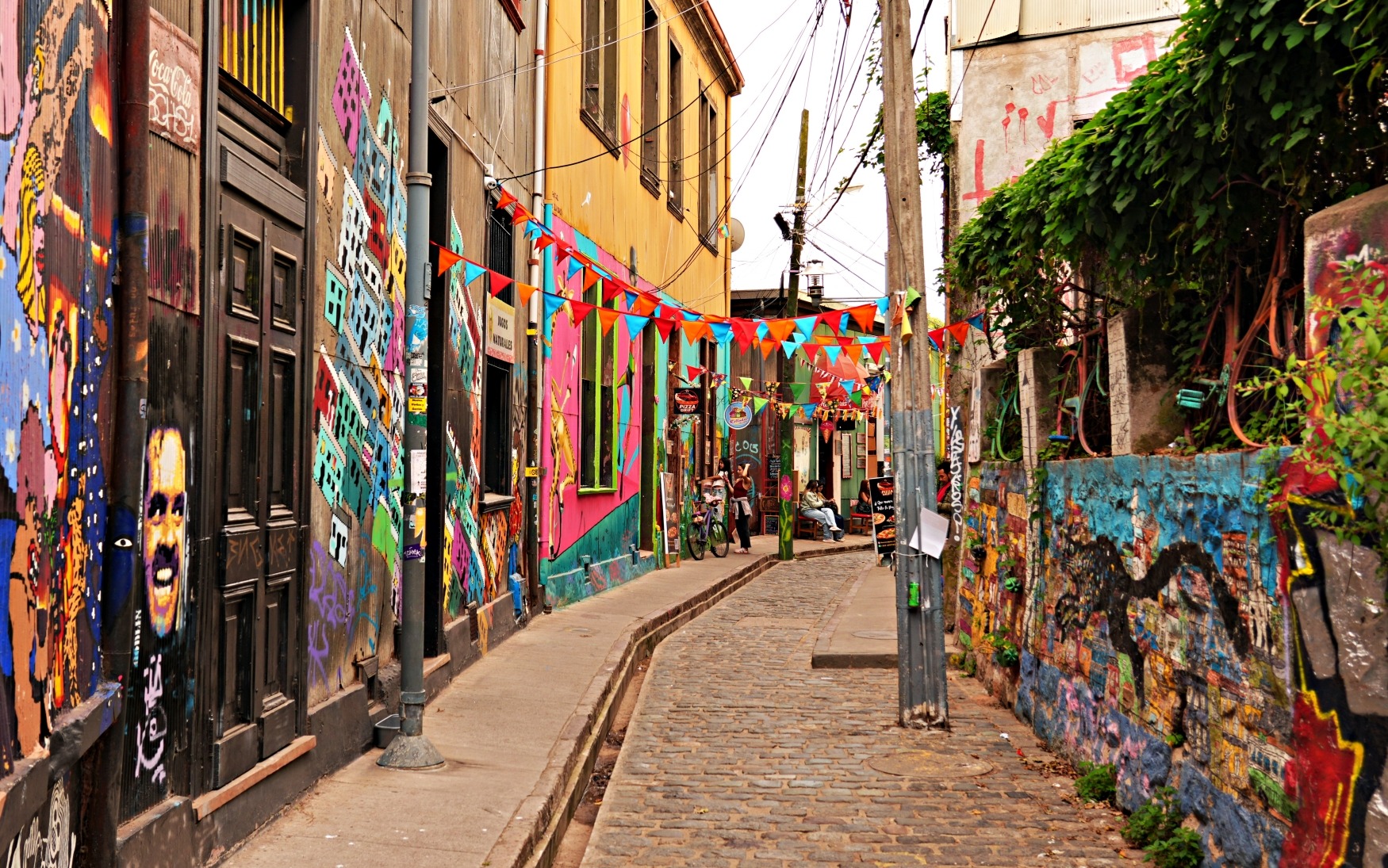
Appearing as a patchwork quilt, spread across the many hills, Valparaiso’s vibrant neighbourhoods make it Chile’s most colourful city. Not far away is the popular beach destination, Viña de Mar. The two cities combine to make the perfect destination for your next trip to Chile.
Valparaiso’s Beginnings
The deep port on the Pacific Ocean is what first brought conquistador Juan de Saavedra to this spot in the 16th century. He named it Valparaiso after his hometown in Spain, Valparaiso de Arriba. Today, it is commonly called Valpo.
Two centuries later, this same port is the reason for the city’s golden age. Before the Panama Canal opened, cargo steamships travelled through the Strait of Magellan to get between the Pacific and Atlantic Oceans. As the ships passed Chile’s long shore, Valparaiso and its deep port were perfectly situated for them to stop and restock. The ships brought goods and merchants from all over the world, which led to a boom in the 19th and early 20th centuries.
You can read about our time on the Magellan Strait in our post Explore Punta Arenas and the Magellan Strait.

Expats from England, Germany and France rushed to Valparaiso to take part in the money-making, and the city flourished. It earned the nickname the ‘Jewel of the Pacific’. These immigrants not only influenced the economy but also the architecture.
The Port of Valparaiso is located at the base of a long mountain spur that climbs almost directly from the sea. As the city grew, plazas, warehouses and government offices took over the limited flat land, called El Plano. Since there wasn’t much room left, sailors began building their homes on Cerros Alegre and Concepción immediately above the port. As the city expanded, communities climbed higher and higher on those hills. Those early buildings were built of corrugated metal and decorated in colourful paint left over from the shipyards.
Tip – Cerro translates in English to Hill.

Today, the city is spread across 42 hills and coloured in every shade imaginable. If they are not painted in bright colours, then their walls are decorated with wonderful murals. It is almost as if they are competing for your attention. These colourful homes and undulating hills give Valpo its unique patchwork appearance.

Once the Panama Canal opened, ships no longer needed to make the long journey around South America, so the port lost business. Once the money dried up, the population left.
The city experienced a resurgence when the country’s Congress was moved to Valpo in 1990. Today, it has grown to be second largest city in Chile with a population of over a million, and it has reinvented itself as a vibrant centre for arts and culture.


Cerros Alegre and Concepción
The two primary tourist hills are the originally settled Cerros Alegre and Concepción. The undulating terrain and lack of city planning resulted in a maze of streets, ramps and stairways that navigate their way up and down those hills. Lining their side are some of the most colourful homes in the country.
The best way to explore these streets is on foot. We started our day with a plan. We had an organized list of streets and our route mapped out. That plan was soon dropped, and instead, we let ourselves wander up and down the jumble of colourful streets, lanes and stairs that cover the two historic hills.


Street Art
Not only are the buildings painted in bright colours, but many also act as large canvases for local artists. The street art came in various forms. Some display political opinions, while others celebrate Chile’s cultural diversity. Many seem to be painted just to bring a smile to your face.


Why is Valparaiso so colourful?
It began in the 1940s when poet Pablo Neruda returned to his hometown of Valparaiso from Mexico and invited Mexican artists to join him. They began decorating the city in a kaleidoscope of colours. A few decades later, during Pinochet’s rule, the local population used street art as a vehicle for political activism. The city’s narrow lanes and stairways seemed to be purpose-built for these illegal protest messages.
After Pinochet’s government collapsed, the city of Valparaiso legalized street art, and the entire city became a canvas. In fact, the local municipal government has even provided financial funding to some of the art projects.


The Lanes
As you wander through the colourful streets, there are a few places you won’t want to miss. Some of the highlights to keep on your list are the Pasajes Gálvez, Templeman, Dimalow, Papadu and Atkinson.


Decorated Stairways
Don’t forget to see the stairways; Piano, Fischer (also called Colourful Stairs/Escalera de Colores) and Papadu Stairs are favourites.


Tip – To make it easier to understand the names, pasajes are narrow pedestrian lanes and usually begin or end in a street of the same name. Paseos are more open than pasajes. Calles and Avenues are large streets where cars will drive, but will still likely be brightly painted. Getting between them are escaleras (stairs).
Terraces
Many of the streets and lanes open up to large terraces offering views of the city and ocean. Look for terraces on Atkinson and Dimlow.

Don’t miss the terrace on Paseo Yugoslavo and its eclectic Palacia Babarizza. In addition to the palace, there are great views of the harbour and neighbouring Cerro Cordillera.


Ascensors
While stairs help you get between the different blocks, funiculars, called ascensors, make it easier to get from the waterfront to the top of the hills. (They are sometimes called elevators). The funiculars are over 100 years old and were built out of necessity for the vertically growing city. At one time, there were 27 funiculars in Valparaiso, but only 16 are still in operation today. The first used hydraulic counterweights to operate, before converting to steam or coal and finally electricity.
These funiculars are much steeper than others we’ve taken; the steepest goes up a 70-degree slope. One of the most popular is El Peral because it travels between Plaza Sotomayor and Paseo Yugoslavo.
They are only 100 CLP (10 cents) per ride. Since they only accept cash, you should keep small change handy.


Plaza Sotomayor
Between the Pacific Ocean and the hills is a small flat area called El Plano (The Flat). This is where the main square, Plaza Sotomayo, the customs, navy and government offices were built. This area feels completely different than the colourful buildings we saw on the hills. Instead of modest homes, the main building on the square is the palatial-looking Armada de Chile. Opposite it is the Monument to the Heroes of Iquique, a battle during the War of the Pacific.


There are a couple of other buildings around the square that are worth a look. One is Hotel Reina Victoria, which is looking a little rough. The other is the former building of the South American steamship company. It has an odd glass skyscraper in its middle.
For perspective on how steep the hills are, look up to see Paseo Yugoslavo above.


Port of Valparaiso
In front of the plaza is the Port of Valparaiso, where large cargo ships share the water with local fishing boats.


Boat Tours
The best way to understand the city is to see it from the water and there are several local lanchas (boats) offering half hour tours. Sitting on plastic chairs on the deck of a simple lancha, we cast off into the harbour. Our boat travelled beside tall tankers, port cranes and Chilean navy ships.


The best part was the view of the city from the water. From there, you can see the Lego-like hills that rise almost directly from the water’s edge and are covered in colourful neighbourhoods. It was a great 30 minute ride around the harbour.

Tip – If you head down to the Pratt Pier, across from Sotomayor Plaza, you won’t be able to miss the many touts selling boat rides. They’re very inexpensive at 5,000 CLP ($5.50USD). They leave when the boat is full, but we didn’t wait long before our tour began since there are many Chilean and foreign tourists.
Safety in Valparaiso
In general, Chile is one of the safest countries in South America, but Valparaiso is one city where you should pay more attention. There are a lot of pickpoketers in the tourist areas. Our guesthouse owner described them as 14-16 year old boys, who are very skinny, wear jeans and non-flashy shirts, usually from a soccer (football) team. These kids stay in the shadows and don’t draw attention to themselves, but are always watching. Once we knew what to look for, we did see them. It is best to keep your phones, money, etc hidden in a zipped pocket, or a protected purse or backpack. As well, avoid the city’s downtown and a few neighbourhoods on the outskirts of the tourist zone because they are not as safe.
Getting to Valparaiso
If you have a car, it is an easy 90 minute drive from Santiago, but make sure your Valparaiso hotel has parking. Just because it’s close, though, don’t make it a day trip because the city is worth more time. If you don’t have a car, it is still very easy to reach the city. Many bus companies travel between Santiago and Valparaiso or Vina del Mar. They use Terminals Alameda, San Borja and Pajaritos, so use whichever is closest to you. They all arrive in Terminal Rodoviario in Valparaiso. From the bus station, you can take Uber or a taxi to your hotel.
Valparaíso and Viña de Mar are located in the middle of the country in the map below. It is an interactive map, so you can zoom-in or click on a marker for a link to our post from that region.
Viña del Mar
A great day trip from Valparaiso is the resort city of Viña del Mar. Nicknamed the Garden City, Viña del Mar lives up to the expectations of this name. Gardens are abundant, and where there is no garden, the streets are decorated with hanging baskets, palm trees or flowering Jacaranda trees.


Most come to Viña del Mar for the beach, which we did visit, but we also found a few other gems as we wandered the streets of this pleasant city. Only 5 km from Valpo, it has a completely different vibe. Founded in the 1800s as a beach resort city for elite Chileans, Viña del Mar grew to be the fourth largest city in Chile. Viña, as it is commonly called, is bursting with tall apartments and hotels for its many visitors.
Flower Clock
In keeping with the garden theme, Flower Clock (Reloj Flores) is an Instagram favourite. The working clock, though, is just off a busy intersection, not in a large garden as we hoped.

Beaches
The main city beach is Acapulco. Its golden sand was filled with sunbathers on a warm November day. Even in mid-summer, the water is cool due to the effects of the Humboldt Current. The riptides are also very strong, so it may not be the best family beach. There are several other beaches outside the city, such as Playa Reñaca and Play Negra, if you are coming for a relaxing vacation.


In addition to the beach, the city has a nice waterfront, offering views of Valpo, climbing the hills.


Castles
For some strange reason, this resort city has a few castles and palaces. The first we saw was Castillo Wulff, which sticks out into the water on a rocky pinnacle. Looking like the dictionary definition of a castle on the sea, it was built in 1906 and lived in by the wealthy German philanthropist Gustavo Adolfo Wülff Mowle. After Wulff passed away, the building exchanged hands a few times, including a stint as the Chilean Naval and Maritime Museum. Today, it belongs to the the city’s department of heritage.


On the hill above Wulff Castle is another that looks like it was built by the architects from Sintra in Portugal. Castillo Brunet is a fantastical looking castle built by another eccentric millionaire, Rafael Brunet. Today it is an event centre.
You can read aboutthe castles in Sintra, Portugal here.


Not far away from Castle Brunet is another esteemed occupant. Built in the 1920s, the Presidential Palace of Cerro Castillo is the summer residence of the Chilean President.
The hillside below the palace has a few colourful buildings, but it is nothing like Valparaiso.


A few blocks away is an old mansion that has been turned into the Francisco Fonck Museum of Archaeology and History. Standing in its front yard is an original Moai statue from Rapa Nui. The sign in front says it was donated by Easter Island to Chile, but calling it a donation is debatable. We’ll show you many more of these moai in our posts from Rapa Nui (Easter Island). Another palace is located in Parque Quinta Vergara, but the park was closed when we visited.


Getting To Viña del Mar
The easiest way to travel between the two tourist centres is by metro from Bellavista Station in Valparaiso to Viña del Mar or Miramar Stations. You can use your credit card to enter the turnstiles or pay with cash at the ticket office.
Not far from the station in Valparaiso, you’ll pass part of the city’s old, elegant buildings. It’s not nice enough to make a special trip, but they’re nice to see when you walk through.

Where to stay in Valparaiso
There are so many hotels and guesthouses in Valparaiso, you are spoilt for choice. Most are located on either Cerros Alegre or Concepción. This is the safest part of the city and is the location of all the best streets. We stayed in Casa California. It is a quiet, comfortable retreat in this touristy city. You can find them on Booking.com here.
Where to eat in Valparaiso
As with hotels, there are many resatuarants on Cerros Alegre and Concepción that offer typical Chilean dishes as well as international cuisine. The ones on Paseo Atkinson or Paseo Dimalow offer amazing views. There are also quite a few near Pasajes Dimlaw, Urrioloa, Templeman and Callee Papadu. You will likely find a few on your walk through the city that will make you want to return.

Click on the link to read our Travel Tips For Chile.
To read more of our adventures in Chile, click here.
Coming Next – Elqui Valley – Day Trip from La Serena
For pictures from other blogs go to Gallery at monkeystale.ca.
To read about more of our adventures go to Destinations.
If you like what you read, please comment or share (with credit) using the links below.





We’d love to hear from you, please leave a comment.