
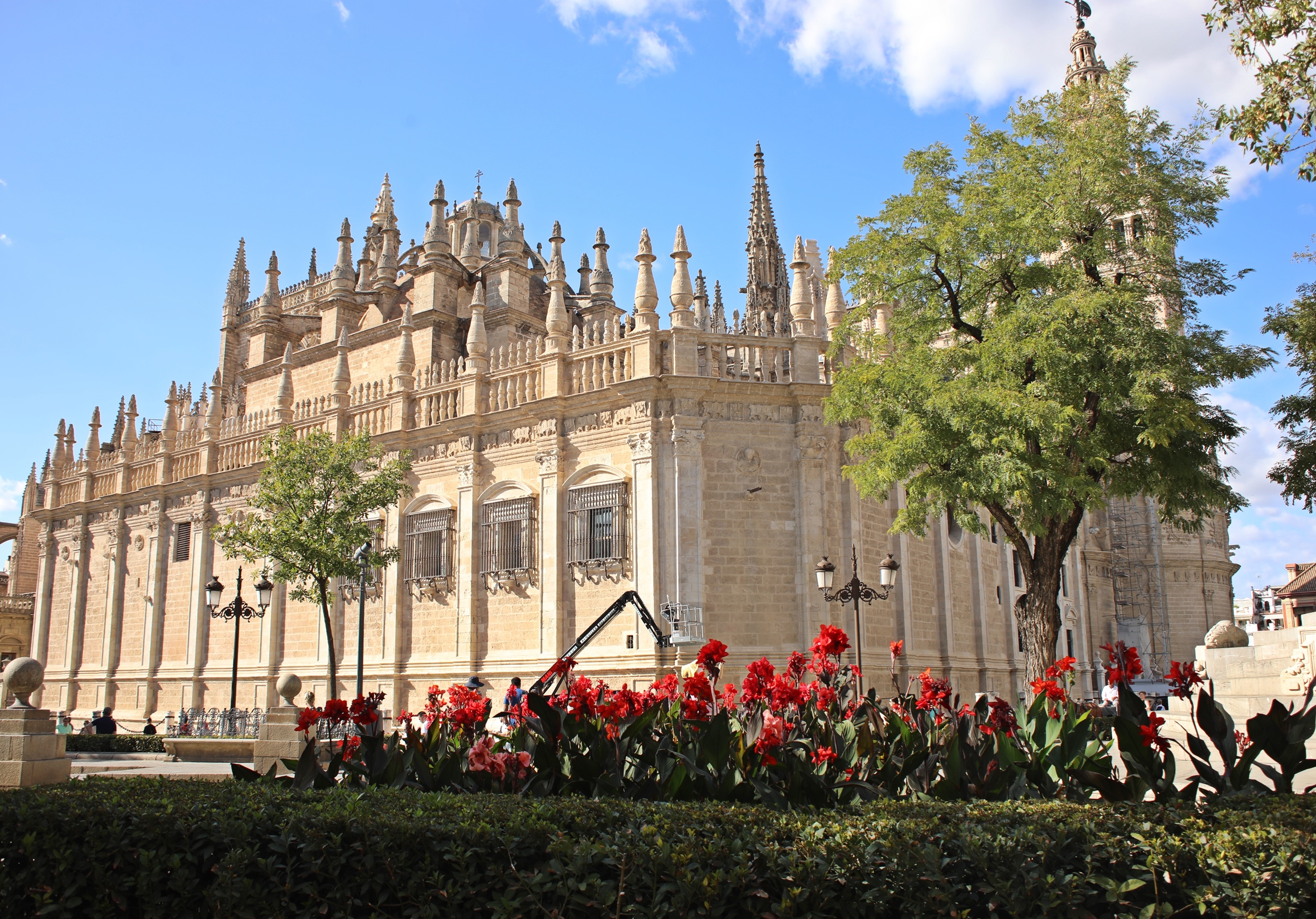
Seville is famous for its many lavish buildings, the designs of which were influenced by the city’s varied inhabitants. In addition to the most well known ones, the cathedral and alcázar, its historic downtown is filled with many more.
Seville’s location along the banks of Guadalquivir River made it highly sought-after. As one of Spain’s main navigable rivers, the waterway attracted the Romans, Visigoths and Moors among others. The legacies of these past rulers can be seen today in many of the buildings and monuments. Let’s take a walk around the city and explore these architectural wonders together.

Triumph Square
Most will begin their tour of the city in Triumph Square (Plaza del Triunfo) in the middle of the historic centre. Its main occupants are two of Seville’s most recognizable buildings, Seville Cathedral and Royal Alcázar. Instead of a large, open square that shows them off, they are being squeezed by the encroaching city, leaving them little breathing room. When you are in the square, it is actually difficult to step back far enough for a full view of either building.

Seville Cathedral
If your jaw doesn’t drop when you see the Seville Cathedral’s elegant doors and rooftop, we’re not sure what would impress you. Its grand facade is ornamented with so many decorative details, you don’t know where to look.


A 12th century mosque was originally located on this spot. When they conquered the city, the Spanish immediately converted that building into a church. Over a century later, the Spanish began planning a major expansion. Around this same time, the building sustained significant damage from an earthquake. The massive Gothic church that we see today was built on the foundation of that mosque.
Construction on the cathedral began in the 15th century and continued for more than 100 years. Over that large span of time, the architects changed many times and hailed from different countries. Each brought different ideas with them, resulting in a variety of styles and designs in the final product. The cathedral was built to be a declaration of the supremacy of the Christian world. Throughout those many years, this objective was always maintained. As a result, it is the largest Gothic and second largest cathedral in the world. St. Peter’s, in the Vatican, is the only one that is larger.
Before entering the church, walk around its perimeter to admire its artistic doors. As you do, it will seem as if each is more stunning than the one before. Here are a few of the fifteen elaborate doors on the cathedral.


The rest of the building’s exterior was not spared from decorations. Dozens of small and large spindles, steeples, peaks and towers decorate the large roof. Look close to see some of the fabulous waterspouts just below.


As you might expect, there is a lot of open space in this massive building. That doesn’t mean that there isn’t a lot to see. Tall, stone pillars leadup to the barrel vaulted ceilings of the three naves. Marble floors cover underfoot. Around the edges are eighty ornate chapels with golden or marble altars and stained glass windows. None of them compare to the large golden altar at the front of the church.
In the centre of the nave is the choir with decadent wooden seating below two large organs. The current organs replaced those destroyed in the 1755 earthquake.


The cathedral also has a reminder of Spain’s Age of Discovery. Christopher Columbus’ exploration of the new world brought a lot of wealth to Seville in the 15th century. His tomb has a prestigious place near the main entrance of the church. It is supported by four statues that represent the four kingdoms of Spain at the time: Castille, Aragon, Navarre, and Leon.
There was a bit of controversy for a while regarding the contents of the tomb. Recent DNA tests confirmed that the remains are indeed that of Christopher Columbus.

Standing beside the cathedral is a tall bell tower with a commanding presence. Giralda Tower is all that remains of the former mosque. Parts of the Almohad-built minaret date back to 1184. Almohad elements such as lattice style plasterwork and horseshoe-shaped windows are what makes this bell tower uniquely beautiful. The same design was used when building Koutoubia Mosque’s Minaret in Marrakesh, Morocco. You can see pictures of that minaret here. (Coming Soon)


Climbing to the top of Giralda Tower is one of the best activities to do when visiting the cathedral. Instead of a typical spiral staircase, 35 ramps lead to the upper level. Having ramps instead of stairs allowed the mullah to ride a donkey for each of the five calls to prayer.
At the top, a walkway travels around the upper balcony allowing you to see all of Seville as well as details on the cathedral’s roof.


Between the cathedral and the tower is Patio de los Naranjos (Orange Tree Courtyard). It is a small yard with a few healthy orange trees. As you enter the courtyard, don’t forget to turn around to see yet another spectacular cathedral door.

Tip – You can buy your ticket on-line or at the door. In the busy seasons you may need to buy tickets in advance. In October we didn’t have advance tickets, so we stood in line for about an hour.
Royal Alcázar of Seville
The outer wall of the alcázar has a medieval castle look that is in stark contrast to the elaborately decorated cathedral only steps away. We actually didn’t even notice the main entrance, Lions Gate (Puerta del León), at first because it’s tucked away in a corner of Triumph Square.

The word alcázar comes from the Arabic word al-qaṣr, which translates in English to fort or castle. In Spain, it usually refers to one that it is of Moorish origin. Royal Alcázar of Seville (Real Alcázar de Sevilla) is not actually a castle, but rather a collection of palaces contained inside a large wall. The first palace was built by the Moorish Umayyad Dynasty in the 10th century on the remnants of a Roman fortress.
In the 12th century, the Almohad Dynasty made Seville the capital of Moorish Andalucía (Called Al-Andalus in Arabic). They built a palace on top of the previous one that had badly deteriorated by then. Moorish leaders continued to live in Alcázar until the 13th century when Christians conquered Seville and moved into the complex. Throughout all of these dynasties, the original buildings were demolished, redecorated and remodelled many times. As a result, when you wander through this massive site, you can see a large variety of design styles including; Moorish, Renaissance, Baroque, Romantic and Mudéjar.
The oldest part of the complex is Patio del Yeso (Plaster Palace). Built by the Almohads, you can still appreciate their archetypal lattice-style designs in the arches and walls.

The further you travel in the complex, the more extravagant the designs. Palacio Gótico was built by King Alfonso X in the 13th century. Apparently, it was elaborately decorated to show Christian dominance over Muslims. Unfortunately, this part of Royal Alcázar was damaged in the Lisbon earthquake so, we can’t see much of that original décor. Today its design is a mix of genres and seemed rather plain to us. The best parts are the 15th century azulejos that decorate its walls.


The most extravagant part of Alcázar is Mudéjar Palace, also called King Pedro Palace (Palacio Rey Don Pedro). This 14th century palace was built overtop Moorish buildings. Its name comes from the Mudéjar architecture style found in the designs. This style is a blend of Moorish or Islamic elements with Christian motifs and can be found throughout Andalucía.
Its main entrance in Patio de la Montería (Hunting Courtyard), hints to the Mudéjar details inside.

Once you go through this main gate, you’ll be overwhelmed by the incredible décor. Ornate horseshoe arches are trimmed with intricate carvings and accented by finely painted designs. These arches lead to even more elaborate courtyards.


On the side of each courtyard are rooms that continue the opulent theme. In addition to the intricate plasterwork on the walls, the wooden ceilings are elegantly carved. Even the window shutters are fancy. It seems as if no spot was left bare.


The newest section of the palace is on the upper floor. It was remodeled in the 15th century by Spain’s first monarchy, King Ferdinand and Queen Isabella. It is still the official residence of the royal family when they are in Seville. Because of that, entry requires an extra ticket and no pictures are allowed. You’ll have to visit it yourself to see what’s inside.
At the back of the complex are the beautifully manicured Alcázar Gardens. It’s a lovely yard with manicured hedges, trees, flower beds, fountains and even peacocks. There’s a wrap-around balcony that allows you to see the steeples of Seville Cathedral poking above the palace buildings.


Tip – Buy your ticket ahead of time on-line. Tickets are sold on timed entries. In busy seasons you will need to buy tickets weeks in advance. In October, we could book a few days in advance, but as the date approached, there were fewer and fewer time slots available.
Although these are the top two sites in Seville, there is so much more to see in this wonderful city. Here are a few other noteworthy sites to see when you visit Seville.
Torre del Oro
Standing on the edge of the Guadalquivir River is the polygonal-shaped Tower of Gold (Torre del Oro). The former defensive tower was first built by the Moors in the 12th century. It was then remodeled several times over the next few centuries. The tower was originally a part of the city wall and was attached to a thick chain that crossed the river. When enemy ships tried to enter, the chain was pulled preventing boats from getting through. For a defensive tower, it is quite attractive.


Plaza de España
This elegant 20th century building forms a semi-circle around a large, tiled square. Built for the 1929 World’s Fair, it was meant to impress anyone who visits. There are decorative elements anywhere you look, including the lamp posts and fences encircling the duck pond.


Our favourite part of the plaza was the azulejos-covered seating that wraps around the building at sidewalk level. Each represents one of Spain’s 52 provinces.


Somehow though, the site seemed to lack a personality. Although it is very picturesque, it seemed a little too perfect.
Lebrija Palace
There are a few old palaces and mansions in Seville that operate as museums. We visited Lebrija Palace. It was built in the 16th century, but the designs and décor we see today are from the 20th century when it was home to Duchess Lebrija. She collected artwork from around the world and filled her mansion with them.


The most stunning features are the Roman mosaic floors. At first we thought it was awful of her to take these floors from their original location and place them in her home. Then we were told that most were saved from destruction at a time when these works of art were not appreciated. If it weren’t for Duchess Lebrija, these masterpieces may have been lost forever.


We were able to explore the main floor on our own, but the upper floor of Lebrija Palace is a private residence and can only be visited with a guide. Pictures aren’t allowed in this section, so we can’t show you the collection of unique antiques from around the world.
Seville Bullring
Plaza de Toros de la Real Maestranza (Seville Bullring) is the largest bullfighting venue in Spain. We weren’t interested in seeing a bullfight, but were impressed with the size of this 18th century building.


After exploring the major sites, there’s also an entire city to see. Just wandering the streets in the historic neighbourhoods of Santa Cruz, Alfalfa, El Arenal and Triana will take you to many charming scenes.


There are walkways on either side of Guadalquivir River allowing you to take in the scenes from both sides.


It wouldn’t be a Spanish city if there weren’t a lot of churches. As we walked through these neighbourhoods we saw many churches in a wide variety of architectural styles. Some were in large squares, while others were on the sides of narrow streets.


How to get to Seville
The popular Spanish city is very easy to reach. It has an international airport, receiving flights from many European countries. The city is also connected by train to major centres around Spain and to the smaller cities in the region. You can also travel from Seville to many destinations by bus. There are two bus stations as well as a terminal at the airport so make sure you know which station the bus will be using before booking.
Seville is on the left side of the Andalucía map below.

Where to eat in Seville
In the city’s historic downtown you can’t walk a city block without finding at least one patio on the sidewalk or squares. There are many places around the cathedral and alcázar, but they will be pricey. More reasonably priced restaurants are in Triana, on the other side of the river. If you’re in Santa Cruz, you should visit El Rinconcillo, the oldest bar in Seville. Here you can have Ibérico Ham. It’s a cured ham, severed in thin strips on a plate or in a sandwich. Huge legs of ham hang above the bar. It is very common throughout Spain. After seeing it in the bar, we saw it everywhere, including the deli section of grocery stores.
Outside of the tourist districts most restaurants close for siesta. Hours vary, but it is usually between 2 and 7 or even 8pm.


Where to stay Seville
Depending on your budget there are a wide variety of options. The cathedral and alcázar are considered city centre so staying walking distance to those would be the most convenient, but likely the most expensive. Across the river in Triana is another great part of the city to stay. Communities that are further away, are still well connected by the city’s transit system and are an inexpensive option.

Getting around in Seville
City buses, trams and the metro connect the suburbs to the city. Many of the buses travel through the Plaza de Armas, a few blocks away from Torre del Ouro. MetroCentro tram travels right into the historic centre for those who don’t want to walk. You can purchase Tarjeta Turista. These tourist transit cards are prepaid cards and provide a discount for public transit and for a few attractions.


This article is now featured on GPSmyCity. To download this article for offline reading or create a self-guided walking tour to visit the attractions highlighted in this article, go to Walking Tours and Articles in Seville.
To read more of our adventures in Spain, click here.
Coming Next – Best Day Trips From Seville
For pictures from other blogs go to Gallery at monkeystale.ca
To read about more of our adventures go to Destinations.
If you like what you read, please comment or share (with credit) using the links below.





We'd love to hear from you, please leave a comment.