
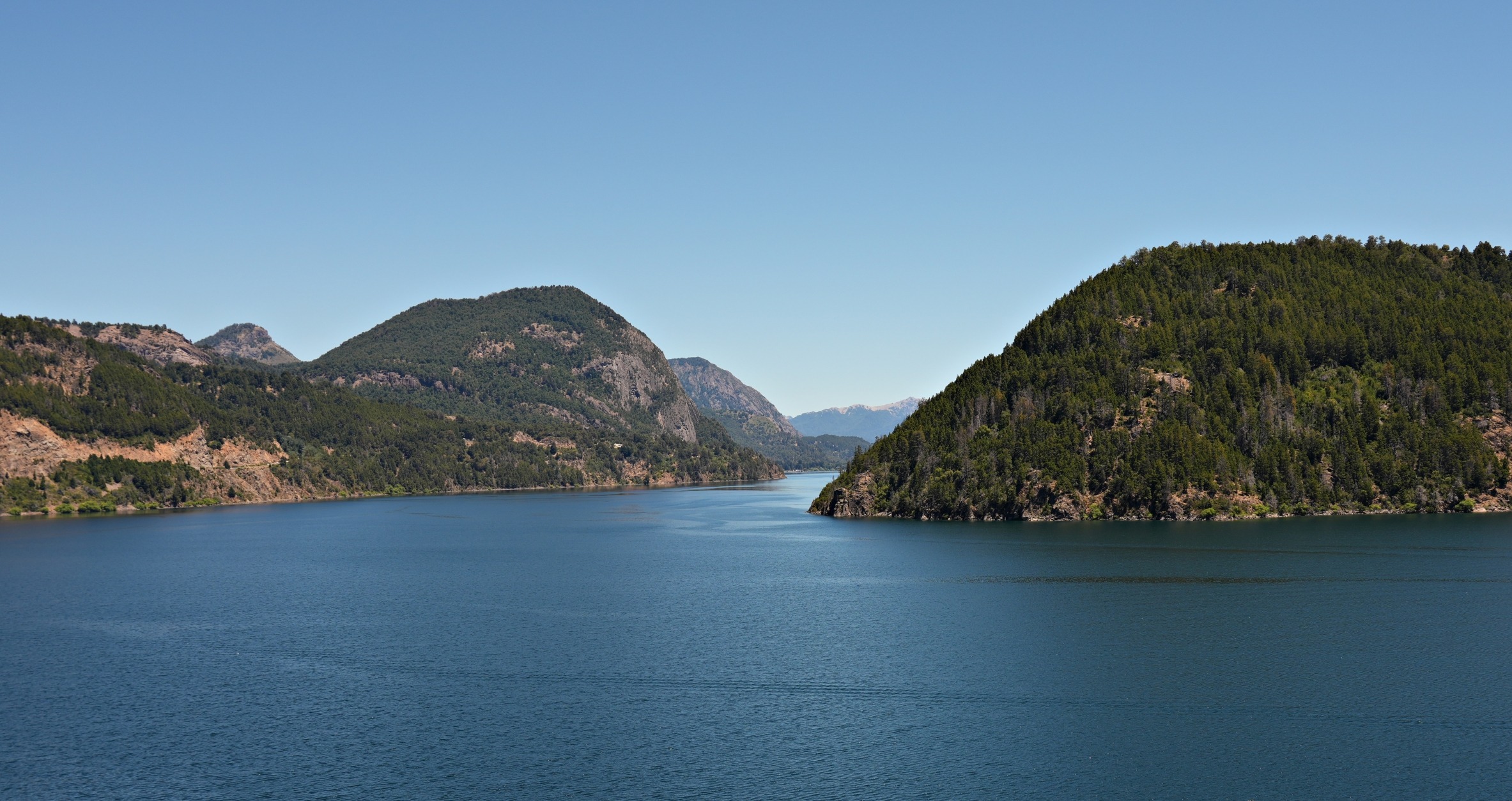
This famous roadtrip in Argentina’s Lake District weaves between fjord-like lakes and tree-covered mountains, giving it the name, Seven Lakes Route (Ruta de los Siete Lagos). With a high proportion of views per kilometre, it sets a high bar for other scenic drives. Touted as one of Argentina’s prettiest drives, after seeing this one for ourselves, we have to agree. The Seven Lakes Route makes a great day trip from Bariloche
Like the rest of Argentina’s Lake District, this landscape was created millions of years ago when glaciers moved down the mountains, carving deep valleys. But these pristine landscapes seem too pretty to have been created by destruction.
The Seven Lakes Route travels Ruta 40. This is the same highway that travels between El Calafate and El Chalten, further south in Patagonia.
Bariloche and San Martin de los Andes are located in the lower half of the map below. It is an interactive map, so you can zoom-in or click on a marker for a link to our post from that region.
Nahuel Huapi Lake
We began our journey in Bariloche, located inside Nahuel Huapi National Park. Everyone we spoke with said the views on the drive don’t begin until after you pass the first settlement, Villa Angostora. This gave us low expectations for the first part of the drive, but we found those naysayers to be wrong. The drive around Lago Nahuel Huapi is, in fact, teeming with gorgeous landscapes.

When we were in Bariloche, we didn’t realize that Nahuel Huapi Lake is so large. We assumed we were looking at the opposite shore when in fact, it was the large Huemul Peninsula. It juts far into the water, creating one of the lake’s many arms. Once we drove around to the other side of the peninsula, we could see Bariloche and Cerro Catedral, far away on the other side of the lake.


Villa la Angostura
The first stop of the day, Villa la Angostura, is mostly used as a quick break by tourists travelling on the Seven Lakes Route. It is quite touristy with a long string of alpine-style buildings that house mostly tourist knick-knack shops, but it didn’t look overdone, like we saw in Colonia Suiza.
Views of the large Nahuel Huapi Lake continue even after passing through the village and it’s not even considered one of the seven lakes.


Seven Lakes Route
The official Seven Lakes Route (Ruta de los Siete Lagos) begins after Villa la Angostura, so prepare to be treated to phenomenal views of lakes and mountains for the next 110 km. Here are the highlights from the drive.
1. Espejo Grande Lake
Translated in English to Large Mirror Lake, Lago Espejo Grande wasn’t living up to its name when we visited. Even though it wasn’t a mirror, we think you’ll agree, it is a lovely lake.
Between Espejo Grande and Correntoso Lakes, you can see the pretty Laguna Bailey Willys and a gentle river.


2. Correntoso Lake
Acting like a mirror, the flat water of Correntoso Lake provided the gorgeous reflections we missed in Espejo Grande. The mountains behind reflected beautifully off its surface. The funny thing is, Correntoso translates in English to current, and yet it was very flat.
The nearby Traful Lake is too far away to see from the road, but the meandering Pichi Traful River let us know where it lies. In the Mapuche language, it means Little Confluence River.


3, 4 and 5. Villarino, Falkner and Escondido Lakes
The road is almost all that separates Villarino and Falkner Lakes, but since the latter has a beach, it was the more popular choice for visitors. At its far end, a castle-like mountain looks to be protecting Falkner from above.
Escondido Lake is a tiny lagoon hidden behind the trees, and honestly, Laguna Bailey Willys (above) is much more picturesque, so it should be on the list instead.


6. Machónico Lake
Not long before reaching Machónico Lake, the drive leaves Nahuel Huapi National Park and enters Lanín National Park. Machónico Lake is a long body of water, bookended by Cerro San Francisco at one end and ski runs at the other. Machónico is a Mapuche word for the crabs that are found on the lakeshore.


Between the lakes, the hillsides were covered in trees which add even more beauty to this region. Since we learned in Bariloche that many of the evergreen trees are invasive, it was a little more difficult to admire some of the views.


7. Lacar Lake
The penultimate Lacar Lake has a kink at one end, so you may think it has an arm rather than being a long, straight lake. Its blue water makes a nice entrance to the town of San Martín de los Andes, located along its shore. Lacar is also a Mapuche word, but its origins are not clear. One theory translates it to Dead Witch Lake.


San Martin de los Andes
Most people who travel the Seven Lakes Route end their trip in San Martín de los Andes. The small town has a spectacular setting placed on the edge of Lacar Lake (Lago Lacar).
It was quite breezy and cool when we stopped at San Martin’s pebbly beach, but people were still enjoying the peaceful view. So were the chimango caracaras. We first saw these birds in Uruguay, where we watched them hunt in the fields. Here, they were pestering picnickers, looking to steal their lunch.
The far end of the beach hosts the small Lago Lacar Marina.


At first, San Martín de los Andes seems to be chocolate-box perfect. The problem is that it is very touristy, but it’s difficult to blame people, including us, for wanting to spend time here.
Most of downtown San Martín is ready to serve the many tourists who arrive in the city each day. With several alpine-style souvenir shops to choose from, the cutest belongs to the Mamusia Chocolate Shop. Although most chocolatiers in the region boast their German roots, this one is run by a Polish family.


In the town centre, the quaint San Martín Square is home to City Hall, San Jose Parish Church, and of course, a statue of the hero, San Martín after whom the town is named. José de San Martín is credited with leading revolutions against Spain and achieving independence for Argentina (1812), Chile (1818), and Peru (1821). For this, he is often referred to as The Liberator.


One of the nicest things about San Martín de los Andes is its many trees and gardens, including its rose garden. Beside it, we noticed a monument for the Mothers of Plaza de Mayo. This movement started in Buenos Aires by the mothers of those who went missing, were tortured or murdered during Argentina’s time under a ruthless dictator in the 1970s and 1980s. We saw similar monuments in other cities in the country, too.


We also saw several monkey puzzle trees that we first spotted in Bariloche. They can be seen lining the streets and in parks in San Martin as well. There were also a few black-faced ibis and a statue on the sidewalk showed us that we’re not the only ones who love this peculiar-looking bird.


In addition to the shops, there are many options for lunch, either in town or at one of the food trucks near the beach.


We had actually intended to take a public bus and stay in San Martin for a few days, but we’re glad we visited on a day trip as we did. For one thing, the bus would not have stopped at any of the viewpoints, and the drive is the best part of visiting. As well, while we found San Martin cute, it didn’t offer enough to keep us interested for an overnight stay.
Our plan was to do one of the nearby hikes, but they spend most of the time in the trees. A better option is to hike on the trails closer to Bariloche that take you to more spectacular viewpoints. But, if you want a few relaxing days in the mountains, San Martín de los Andes may be a good option for you.
The return to Bariloche follows the same road, but the afternoon light will make the lakes look a little different, so don’t fall asleep on the drive back.
How to visit the Seven Lakes and San Martin de los Andes
If you have a car, you can easily drive, but be aware that the road is overloaded with stunning views, so keeping your eyes on the road may be difficult. Rest assured, there are several pullouts to stop and have a proper look, but there are also many places with lovely views and no place to stop. It is a busy road with tour buses and rental cars, so take care.
If you don’t have a car, taking a tour is the easiest option, but you do not need to book in advance online. The weather is unpredictable, so wait for a day with a good weather forecast. Also, it will be at least $10 USD more expensive online, and there are so many tour offices in Bariloche that you will find one on the day you want. Most agencies are found on Mitre Bartolome Street near the arch. We read online that we would have to pay park fees, but we were never asked to do so.
When to visit the Seven Lakes Route
The warmest and most predictable weather, and therefore busiest season, is Austral summer (December to February). Spring and summer are also good options, but it will be much cooler. In Spring, you may be able to see alpine flowers in bloom, and in autumn, the trees will show their fall colours.
Where to stay
If you do the drive on a day trip, then Bariloche is the best option. If you have a car, you could spend the night in San Martin de los Andes, but there are also several lakeside campsites in the area.

Click on the link to read our Travel Tips For Argentina.
To read more of our adventures in Argentina, click here.
Coming Next – Cerro Torre Hiking Guide
For pictures from other blogs go to Gallery at monkeystale.ca.
To read about more of our adventures go to Destinations.
If you like what you read, please comment or share (with credit) using the links below.



We'd love to hear from you, please leave a comment.