
Touring a foreign city with a local allows you to not only see the sites but delve further into its history, its culture and begin to understand its personality. We were able to do just that recently as we toured Kraków, Poland’s famous historical city.
To find where Kraków is located, please visit our interactive map of Poland.
Monkey’s Tale photographer, Richard, grew up in Poland and spent his university years in Kraków. He ‘volunteered’ to be a tour guide on our trips to his hometown, sharing with Maggie its history, myths and legends.
Note: We updated this post in 2026.
Old Town
Kraków served as Poland’s capital from 1038 until 1596, when a Swedish king relocated it to Warsaw. A large part of what makes its Old Town (Stare Miasto) so magical is that it was not destroyed during WWII. As a result, when you visit its large historic centre today, you’re able to enjoy its original architecture. It’s so impressive, in fact, that UNESCO has designated the entire historic centre as a World Heritage Site. Making it even better, all of that history is draped in fascinating stories.


Like many cities of its time, a 13th century defensive wall surrounded Kraków’s Old Town. Its 4 km (2 1/2 miles) length included 47 towers and 8 gates. Due to maintenance costs and lack of need, in the 19th century most of the wall was dismantled. In its place, however, the city turned it into a green space that wraps around Old Town. Planty Park has a walking/biking path between the tall trees and is a really lovely use of the land.

Floriańska Gate
Only Floriańska Gate remains of that old wall today. The beautifully maintained townhouses that frame the gate’s tall white tower make it one of the city’s most popular and most photographed streets.


On the other side of the gate you’ll find the large Barbican, which provided another level of protection to the city. Together, these remaining historical features allow you to imagine how the fortified city once looked.


Main Market Square
Set in the middle of Old Town, Main Market Square (Rynek Główny) is Europe’s largest medieval square. The 3 and 4 story row houses around its edge have ornamented windows, doorways and roofs, as if purposely built for photographers. Today, these buildings are mostly restaurants with patios that extend out onto the square, providing the perfect spot to enjoy a meal or a Polish beer.
On each corner, small kiosks sell pretzels, which, to North American Maggie, are the quintessential Polish sight. Richard noticed on this trip that most of the pretzel sellers are Ukrainian, likely newly relocated due to the Russian invasion.


Sukiennice
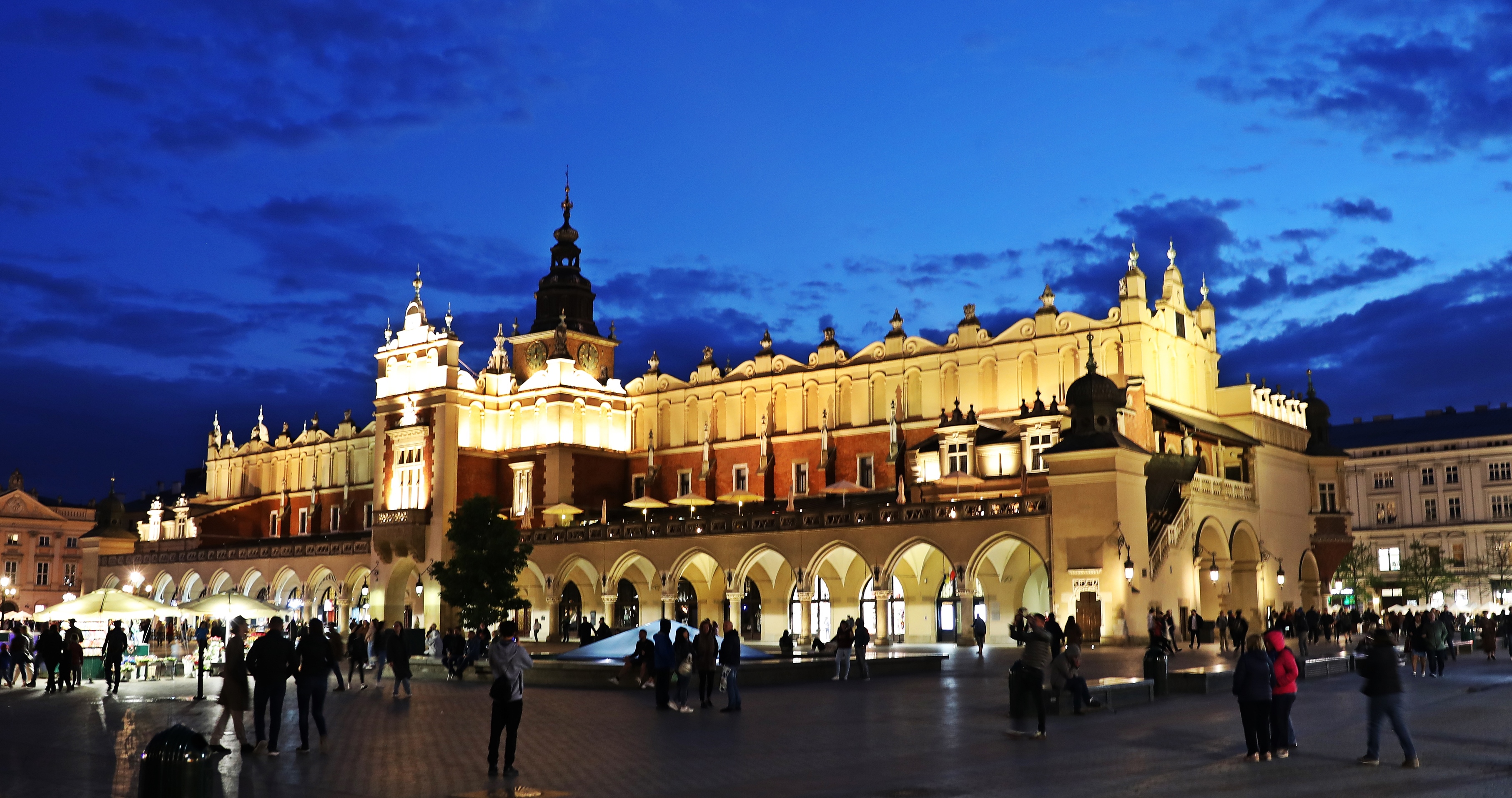
Taking centre stage in the large square is the Sukiennice, or Cloth Market. Built in 1257, its name tells you what used to be its primary good for sale, but in the Middle Ages this international trading centre sold a variety of items including spices and salt in addition to fabrics. Today, though, its stalls sell mostly tourist trinkets, but it is still is a fabulous building, both day and night.


A 16th century fire led to new design features on the old building, including a parapet, or decorative attic, adorned with mascarons. It’s fun to spot these funny looking characters high up on the building. While the parapet is pretty, its function was to help prevent future fires from spreading to other buildings, therefore you can see them on other buildings in Old Town.


St. Mary’s Basilica
A variety of legends and folklore accompany Kraków’s historic buildings. The most famous belongs to the main church, St. Mary’s Basilica. As soon as you set foot on Rynek Główny, you’ll notice the large church with two towers. Upon closer inspection, you’ll realize that its two towers are quite different. One is tall with Gothic spires; the other is short with round Renaissance cupolas. The unusual, mismatched towers give the church a distinctive look, and of course they come with a great story.

As the legend goes, when the church was being built in the 13th century, two brothers were hired to build the towers. Being brothers, they soon competed to see who could build a taller tower. Partway into the contest, the younger brother realized that the broad base of his brother’s tower would allow it to be built much higher. In a fit of jealous rage, the younger one killed his brother and instructed the workers to cease construction of his brother’s tower and top it with rounded cupolas.
He then continued to build his own tower, and once completed, he topped it with pointed spires that reached even higher. Then, the younger brother became consumed by guilt. He confessed to the murder and stabbed himself with the same knife before jumping off his tower to his death. That knife now hangs in the Sukiennice.


The shorter tower is a bell tower that still rings to this day. The taller one has a more interesting use and is accompanied by another legend. After construction was completed, the tallest tower became a watchtower. If the citizens needed to be warned of fire or enemy attack, a bugle call (Hejnał mariacki) was played out of four different windows at the top of the tower. According to the legend, in the 12th century, a watchman saw a Tatar army approaching the city wall. As he was playing the warning song, the bugler was shot in the neck with a Tatar arrow and the song was cut short.
To commemorate this event, the same song is played by a bugler in the tower who cuts off the song mid-note as if he were shot by an arrow. You can hear him play every day, on the hour.

We recommend climbing to the top of the Watchtower to see the city from above. Surprisingly, the small windows provide an excellent view of the Old Town’s main features.
Tickets can only be purchased on the day of your visit from the ticket office across from St. Mary’s Church. They only sell 160 tickets per day, so you should arrive early as there is often a line-up. It opens at 10 am. It’s not well marked, but the tower entrance is across from Floriańska Street. You can also visit the church sanctuary. Tickets are sold in the same office.


The primary reason for visiting the cathedral, though, is to see the opening of the 15th century Altar of Wit Stwosz (Veit Stoss), also called the Altar of Dormition. Finely carved with images of Jesus and Mary decorate the five wooden altar wings. Being there at the opening allows you to see the reveal of this wonderful artwork. It is open Monday to Saturday 11:50 to 6:00 pm, and Sunday 2:10 to 6:00 pm, but is closed for Easter weekend.
Church of St. Adalbert
One of the cutest buildings on the square is the city’s smallest and oldest church. Church of St. Adalbert (Wojciech) was built in the 11th century, so it predates the square. That detail explains why it sits on an angle to the rest of the buildings. Between the oddball angle, its small size and green dome roof, this church is one of our favourite sites in the square.


Town Hall
On the other side of the Sukiennice is a lone brick clock tower. It is all that remains of the 14th century Town Hall; the rest of the building was demolished in 1820. We climbed to the top to take pictures of the city, but it was disappointing. The windows are covered in glass that is smudged with fingerprints, so it’s not great for taking pictures.
Entrance is free on Monday and is the only day we recommend you go. Even though the entrance fee isn’t very high on the rest of the week, it’s not really worth the climb.


Mały Rynek
A smaller, but no less pretty square, immediately behind St. Mary’s Church, is Mały Rynek, Little Market Square. It doesn’t get as much attention as the bigger square, which is good for you so you can visit it without the crowds. During the Middle Ages, meat could not be sold in the Main Market Square, so it was sold here. Today, it is home to temporary markets during festive seasons such as Christmas and Easter.
Wawel Castle
Every good medieval city has a castle, and Kraków is no different. Standing proudly on the top of Wawel Hill is the majestic Wawel Castle (Zamek Wawel). The gentle Vistula River below adds to its picturesque setting. Home to three dynasties of monarchs, the castle dates to the 11th century and continued to grow with new additions over the next few centuries. Even with this long history, the castle we see today is in fantastic condition and is an imposing sight along the river.


You can walk on the castle grounds for free, to see inside, though, you must join a tour. There are several tour options to choose from, including courtyards, palaces, halls, a church and residences.


When the mythical ruler, King Krakus, lived on Wawel Hill, a fierce dragon inhabited a den below and terrorized the people of Kraków. Although many attempted, not even the strongest knights could slay this dragon. It wasn’t until Skuba, a shoemaker, came up with the solution. He decided to trick the dragon into eating a fake ram stuffed with sulphur. This caused the dragon’s throat to burn from the sulphur, so he drank from the Vistula River. The water mixed with the sulphur caused the dragon’s stomach to explode, killing him instantly, and the city was saved. You can visit the dragon’s den below the castle, but watch out for his fire.

Churches
Old Town Kraków is home to at least 42 historic churches. One of the most interesting is St Andrew’s Church. Built in the 11th century, it has impenetrable walls and high windows, so it barely looks like a church. This design allowed it to protect Kraków citizens during invasions. The most famous occasions were when the Tatars invaded in the mid 13th century. During these attacks, the Tatars burned the city to the ground, but the citizens inside the church remained safe. After each raid, these citizens rebuilt the city.

Immediately beside St. Andrew’s is St. Paul’s and St. Peter’s Church. The church is relatively young compared to others in the city, but its ornate Baroque exterior makes it stand out.


In addition to it, we came across many more of the 42 historical churches in Old Town. Here is just a sampling of their ornate interiors.


Wierzynek Restaurant 1364
Located on Main Market Square, the restaurant is famous not just for being the oldest restaurant in Poland, but also for its interesting beginning. In 1364, Kraków merchant Mikołaj Wierzynek hosted a 20-day lavish feast for Polish King Casimir the Great. He was hosting many European leaders who had arrived to negotiate a Peace Treaty. The restaurant’s name honours that first meal.

Jagiellonian University
Not far from the square is the oldest university in Poland. Jagiellonian University was founded by Casimir III the Great in 1364. It had illustrious students, including Copernicus.

Outside the walled city
As the city grew, new communities expanded outside of the walled city. Because the city wasn’t destroyed in WWII, much of this area still exists. As a result, as you walk away from the centre, its like walking through a time machine of historic architecture, and you can see the changes over time. The two below are just outside the wall, on the other side of Planty Park.


Others line Plac Jana Matejki and its neighbouring streets. Not far away, you’ll see the beautiful theatre.


Kazimierz
Jews arrived in the city in the mid-14th century and settled in the Kazimierz neighbourhood. The community grew in population until the beginning of the 19th century. Before World War II, Kraków had over 64,000 Jews, a quarter of the city’s population. Today, Kazimierz is a popular place, both for its historic homes, shops and museums, and more recently, for dining at one of its many restaurants.
At the heart of Kazimierz is Poland’s oldest synagogue, dating from the 1400s. This neighbourhood is one of the places where the movie Schindler’s List took place.


Kopiec Kościuszko (Kościuszko Mound)
From the top of St Mary’s Basilica’s watchtower, we saw a small grassy knoll on top of Sikornik Hill. Kościuszko Mound is a man-made 34 m (111 ft) tall grassy knoll. It was erected in the 1800s as a tribute to the beloved Polish hero, Tadeusz Kościuszko. He was a national leader and general of both the Polish and American armies fighting for independence. From the top of the mound, we were treated to panoramic views of Kraków and on a clear day you can see the Carpathian Mountains in the distance.
Australian readers may recognize the name. When Polish explorer Paweł Strzelecki first saw Australia’s highest peak in 1840, he named it Mt. Kościuszko because it reminded him of Kościuszko Mound. It is prononced, kosh-CHYUUSH-koh.
You can reach Kościuszko Mound by car or by public bus or tram.


There are three similar mounds on the edge of the city. One is said to be the burial site of Princess Wanda, daughter of mythical King Krakus. She was said to be very beautiful and attracted the attention from German Prince Rytygier. The Prince said if she didn’t marry him, he would invade Kraków. Wanda didn’t share his love and didn’t want to marry him, so to save the city, she killed herself by drowning in the Vistula River. Another mound is said to be the burial site of her father, King Krakus.
The final mound is for Józef Piłsudski, a statesman who fought for Polish independence and with whom Richard has a connection. Richard’s grandfather served under Piłsudski in WWI, and Richard’s father was one of many men who brought a wheelbarrow of earth up to the top of the hill to make the mound.
Nowa Huta
Built as a ‘workers’ paradise’ during communist rule, the neighbourhood of Nowa Huta (New Foundry) housed workers from the nearby metallurgical factory. Although still in operation, the factory’s production is vastly reduced, and it is no longer the area’s main employer.
Nowa Huta is still mostly composed of those original unadorned Soviet-style apartments, so you can see how these communities were once laid out. While built for functionality, the complexes always included access to green space. Apartment buildings surrounded an inner treed courtyard, and long, treed boulevards ran between these complexes. Those greenspaces remain today, giving it a nice community feel.


Away from these apartments, that sense of community continues with tall trees, parks, ponds and rose gardens. While there isn’t a large attraction in Nowa Huta, it’s nice to visit and see how this once coal-stained neighbourhood transitioned into a welcoming community.


When to visit
The city is a year round destination, but there are a few times to consider. Religious holidays such as Christmas and Easter are widely celebrated in the city with parades and markets. It is a fun time to be there, but it is also very busy. For quieter times, May/June and Sept/Oct will have the fewest visitors.
How to get to Kraków
Fly – Most will land at John Paul II Kraków-Balice International Airport (KRK). Another option is to fly to Warsaw Chopin Airport (WAW) and take a train or drive to Krakow. (3 hours) The city is also not far from Katowice Wojciech Korfanty Airport (KTW). Trains run frequently between Katowice airport and Kraków Main Train Station.
From Airport to Downtown – PKP Trains run frequently from the airport to the city centre. You can buy your ticket from a machine, or there are usually English-speaking agents at the kiosk on the platform. This train goes all the way to Salt Mines.
Train – PKP Trains connect the city to the rest of the country, and a few international destinations. They are very efficient and typically run on time. Most visitors will use the main train station, Kraków Główny, which is within walking distance of Main Market Square. You can find schedules and purchase tickets on the Koleo app.
Drive – If you’re already in Europe, Kraków lies on major thoroughfares such as the European Motorway system connecting it to Polish cities and to nearby Slovakia and Czechia. If you drive, though, be aware that there isn’t much parking in Old Town.

Getting around Kraków
The Old Town is very walkable, and to reach places outside the centre is very easy by public transit. The tram and bus systems are integrated with Google Maps, including schedules and prices. You can use your credit card on buses/trams. They are free for anyone over 70; you may need to show your ID.
When walking, expecially in the historic centre, pedestrians have the right of way, but you should still stay aware. This is espeically true when bike and pedestrian paths cross.
Where to stay in Kraków
Since most of the things you want to see are in Old Town (Stare Miasto), you’ll want to find a hotel nearby. It can be quite noisy right in the centre, though, so we often stay on the other side of the Planty, such as the neighbourhoods of Piasek, Kleparz or Kazimierz.
Where to eat in Kraków
The city’s historic centre, including the Main Square, is loaded with restaurants offering everything from typical Polish dishes to international options. They are very busy, and many have line-ups during the high season. Walk a few blocks away, though, and similar restaurants offer a quieter atmosphere, such as Karmelicka, Plac Jana Matejki and Długa. The recently revitalized Kazimierz has a wide selection of restaurants and cafes. Our favourite is not Polish at all, but a Georgian restaurant. We visited Tbilisuri Restaurant in Kazimierz so often that the staff knew us. Other, simpler cafes can be found in Stary and Nowy Kleparz (Old and New Markets), on the other side of the Planty. A local favourite, Bar Mleczny restaurants always serve delicious traditional Polish dishes at a fair price, one is in the Old Town on Grodzka, another is in nearby Piasek.


This article is now featured on GPSmyCity. To download this article for offline reading or create a self-guided walking tour to visit the attractions highlighted in this article, go to Walking Tours and Articles in Krakow.

Here’s a link to read more of our adventures in Poland, and a link to our interactive map of Poland.
Coming Next – Day Trips from Kraków: Wadowice, Kalwaria Zebrzydowska, Tyniec and Wieliczka
For pictures from other blogs go to Gallery at monkeystale.ca
To read about more of our adventures go to Destinations.
If you like what you read, please comment or share (with credit) using the links below,




We’d love to hear from you, please leave a comment.