
Many drive right past Ceske Budejovice on their way to visit the fairytale castle of Cesky Krumlov, further south. Ceske Budejovice, though, has many charms of its own and we think you’ll be very happy if you spend a couple of days in this quiet medieval city. While you’re there, take a great half-day trip to the village of Holasovice, where you can see a traditional Central European farming village.
To find where Ceske Budejovice and Holasovice are located please visit our interactive map of Czechia.
Ceske Budejovice
Founded in the 13th century as a Royal City, Ceske Budejovice (Ceské Budějovice) enjoyed a strategic position on the ancient salt route between Prague and Linz, Austria. As technology evolved, the city found itself on Europe’s horse-drawn railway line, and its wealth and importance grew. In addition to these trade routes, Ceske Budejovice’s proximity to profitable silver mines brought even more wealth.
Remarkably, the fortified city was barely touched during the Hussite War, but the damage sustained during the Thirty Years’ War and a 17th century fire was more extensive. When the city was rebuilt, it retained its Gothic and Renaissance foundations and cellars, while newer Baroque buildings were built on top. As a result, you can see many architectural styles as you explore its charming, historic downtown. Today it is the capital of South Bohemia.
Old Town Streets
Before visiting the main attractions, wander up and down the streets in its large historic centre. Here you’ll find burgher houses (townhouses) in a variety of shapes and colours. Many have thick-walled porticos at their base, which add a distinctive look.


Our favourite is Panska Street, where its medieval roots don’t feel very far away. At the end is Rabenstenjski Tower on a square of the same name. It was named after a 14th century monk from the nearby Dominican Monastery, and is now open as an art gallery.
Rabenstenjski translates in English to Raven.


You can still find remains from its time on the salt route including Solnice. Today, it’s a restaurant, but the building began as a salt warehouse.

Přemysl Otakar II Square
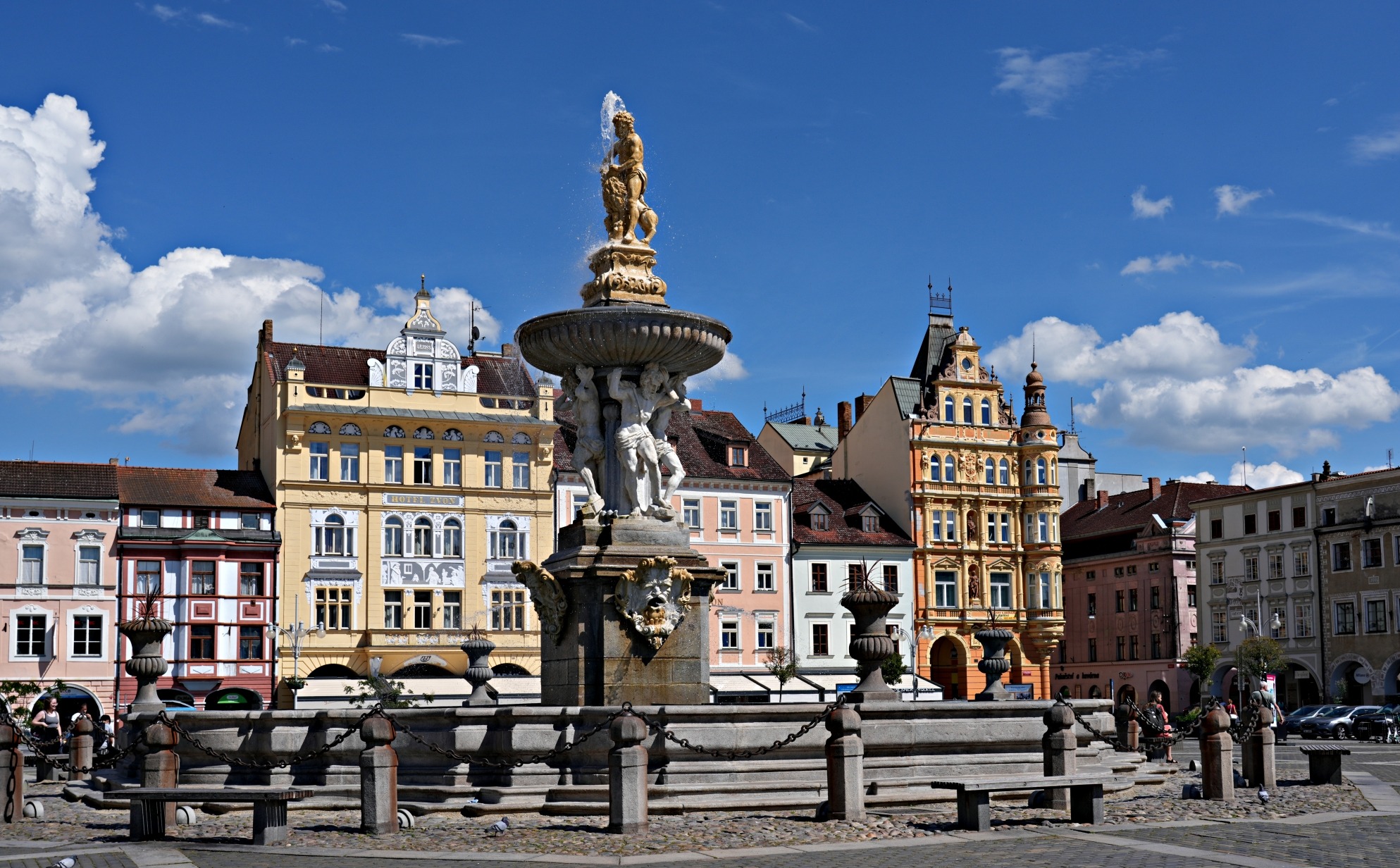
Surrounded by restored burgher houses, Přemysl Otakar II Square is very pretty. Although the square is large and quite spread out, the pastel colours make it feel warm and inviting. Even the tall Black Tower hovering above doesn’t take away from its quaint atmosphere.

What does steal your attention, though, is the ornate Baroque Town Hall. First built in 1387, the town hall was rebuilt in 1730. The four ornamental statues representing Justice, Courage, Wisdom and Prudence make it look more like a theatre than a Town Hall. Giving it even more character are the dragon gargoyle-drain spouts coming off the roof.


At the centre is the Baroque Samson Fountain, with a statue of Samson fighting a lion. It once supplied water to the city.
While most of the homes around the square have an understated elegance, there are a few elaborate ones. One is Včela Palace. The Renaissance building was added in 1896 as the German Association Credit and Pawn Association.


St. Nicholas Cathedral
First built in the 13th century as a parish church, it was then rebuilt several times after sustaining damage from various causes. St. Nicholas gained cathedral status in the 18th century.
Beside it, the 16th-century Black Tower was built to display the city’s wealth and served as both a bell and watch tower. At 72 m tall, it can be seen from many parts of Old Town. You can climb 225 steps to its observation deck at 46 m.
It’s open 10 am to 6 pm, every day except Mondays.

Behind it is the small but tall Chapel of the Lord’s Deathly Hallows (also called the Chapel of the Mortal Agony of Christ). The chapel was added in 1731 over top of an ossuary that held the remains of several hundred citizens.

Rivers and Canals
Ceske Budejovice sits at the scenic confluence of the Vltava and Malše Rivers. In addition to the rivers, the original moat that encircled the city is now a calm canal (Mlynska Stoka). In fact, if you look at a map of the city, you can see how the canal and rivers surround the Old Town. The city has put these waterways to good use with walking paths and parks along their edge. It is a nice place to take a stroll or linger in one of the many cafes built along its edge.


Dominican Monastery
The picturesque Dominican Monastery has one of the best locations along the canal. Its onion roof and stone walls make it picture-perfect from every angle. Construction of the monastery began in 1285 and continued for almost 100 years. Although the monastery is no longer operational, its church is still active.
The monastery’s former rose garden is now home to a local cafe.


Positioned along the canal, it also served as part of the city wall. Crammed between monastery buildings, you can see one of the old bastions, that was part of this wall.

Iron Maiden Tower
Also along the canal is Iron Maiden Tower, one two the remaining towers from the Medieval city wall. The other, Rabenstenjski Tower, we saw earlier.

Water Tower
Set on the highest point in the newer part of the city, on the side of the Vltava River, is the 300-year-old Baroque Water Tower (Vodárenská věž). It is located outside of the historic centre, but pipes connected it to Samson Fountain in the main square, several blocks away. The tower was in use until the early 20th century.

Budweiser Budvar
The town of Ceske Budejovice is famous for its Budweiser beer. But it’s definitely not the one from the US. In fact, this state-owned Budvar Brewery is in litigation over the use of its name. We tasted it a few times and are happy to report that it is far superior to the US version of Budweiser.

Where to stay in Ceske Budejovice
To get to the famous Cesky Krumlov Castle from Prague or Pilsen, you have to pass by Ceske Budejovice, so why not stay overnight in this charming city? The large Old Town does not have many hotels, and in fact, when we visited on a weekend, it was difficult to find a place. So, our advice is to book in advance.
Where to eat in Ceske Budejovice
While there may not be many places to stay, there are oodles of restaurants and pubs to choose from. Some are around the square; others are along the river or canal. Most have a selection of local meals, but they usually have international options if you don’t feel like having a rich, meaty meal.
How to get to Ceske Budejovice
Trains run between Prague and Ceske Budejovice a few times a day (2 hours). There is also a bus that may be quicker because it makes fewer stops. You can get between Ceske Budejovice and Cesky Krumlov (1 hour) by train or bus. The stations are close to each other in Ceske Budejovice, but in Cesky Krumlov, the train is 1 km from Old Town while the bus stop is around 350m.
Day trip to Holasovice
Not far from Ceske Budejovice is the quaint 13th century village of Holasovice. The village was under the rule of Cesky Krumlov Castle who controlled the taxes. Even these tax rates sound charming; they were based on a jiter, a plot of land that an ox could plow in a day.
After the 16th century plague killed all but two people in the village, a new population moved in to take advantage of the fertile lands. These new settlers were from the lands belonging to the Vyšebrod Monastery and were of German heritage. During the 18th and 19th centuries, although new homes were built, the plots of land and their orientation did not change, retaining the village’s traditional pastoral look today.
Holasovice is a UNESCO World Heritage Site because together, the well-preserved buildings and their original layout represent a traditional Central European village.

The village consists of an assortment of vernacular 18th to 19th century homes in a style called South Bohemian Folk Baroque. Most are white, but their eaves and windows are accented with different colours. What makes it special is that most are family homes, so it feels very authentic and not touristy. In fact, only a few operate as businesses, with a restaurant, a café and a museum.
They reminded us of Viscri in Romania. To see those, visit our post Transylvania’s Fortified Churches.


Central Square
In the centre, the large lawn has a fire hall, a pond and the small Chapel of St. John of Nepomuk.


The houses may look small from the front, but they extend far back, showing the many extensions made over the ages. Since they are private houses, we couldn’t see inside many of their yards. The cafe is open on the side, though, so we could see how large their yards are behind those gates. These enclosed spaces contained stables, workshops, or granaries.


Many people stop by on a half-day bike trip from Ceske Budejovice. The rolling hills and empty country roads are very popular with the local cycling community.

Getting to Holasovice
If you don’t want to bike, it is very easy to reach Holasovice by public transit. Located 16 km from Ceske Budejovice, local Bus 135 leaves from the main bus station. It is located in Mercury Mall, across from the train station. You can find the schedule on GWbus.com or in the app Mapy.cz or on the government website.
If you drive, the country roads are paved, but for Canadian, they are very narrow and a little scary to drive and even more so to bike.

Here’s a link to read more of our adventures in Czechia, and a link to our interactive map of Czechia.
Coming Next – Cesky Krumlov: Visiting the Fairytale Castle and Town
For pictures from other blogs go to Gallery at monkeystale.ca.
To read about more of our adventures go to Destinations.
If you like what you read, please comment or share (with credit) using the links below.




We’d love to hear from you, please leave a comment.