
Jaipur is famous for its pink buildings and wall that surrounds it historic centre. Visitors also love to visit its hillside forts with colourful doorways. We visited all of those and more. Come with us as we show you the sites in the Pink City of Jaipur, India
Pink City Gates
The old town of Jaipur received the nickname, the Pink City for its peach-coloured buildings and tall, pink sandstone walls. One of the best ways to enter the Old City is through one of the wall’s seven large decorated gates. Although the gates are now used by cars, they are tall enough to have once allowed elephants to enter.


Hawa Mahal
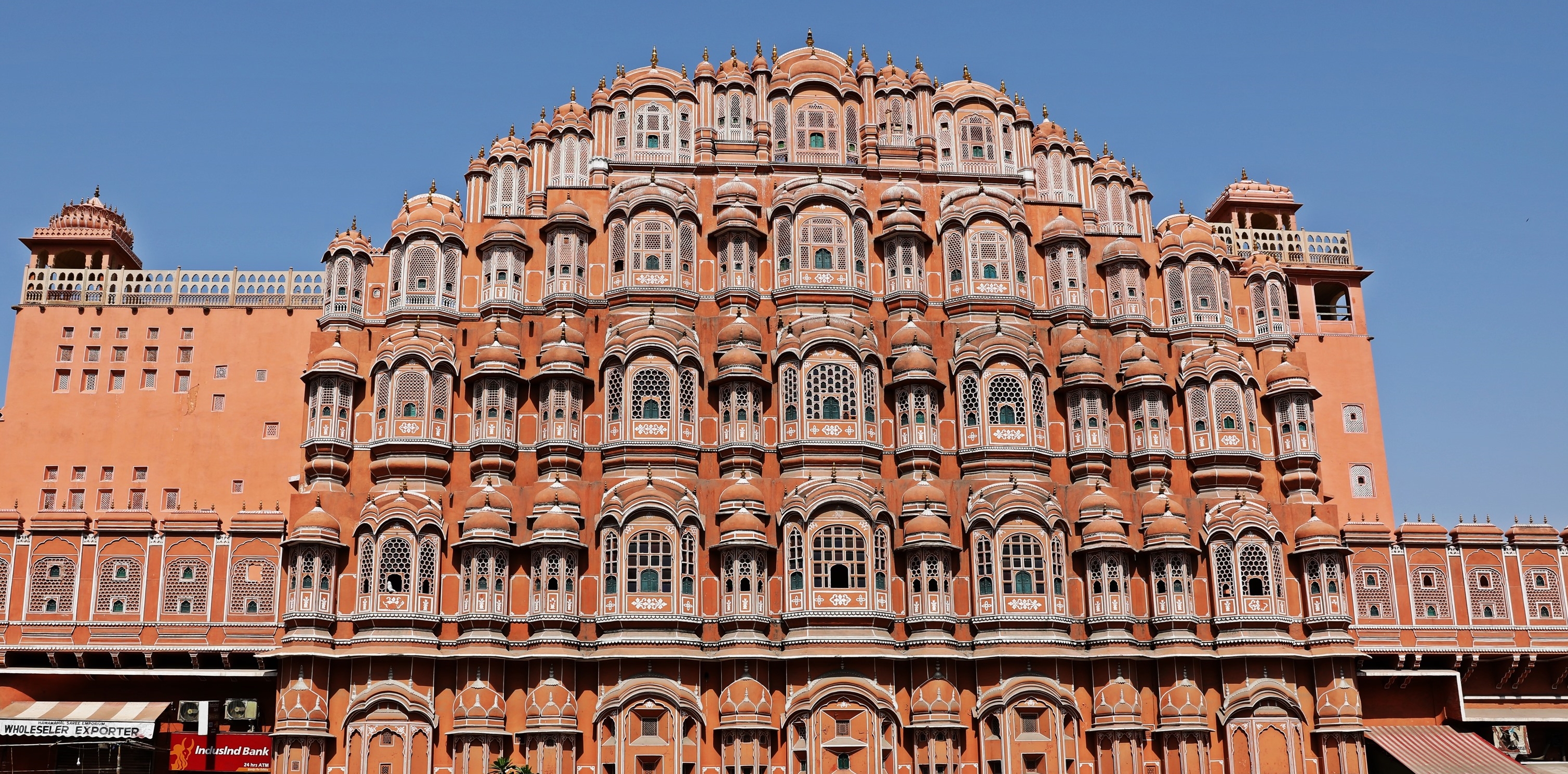
In one corner of Old Town is the iconic Hawa Mahal. It’s a stunning skinny pink building, entirely fronted by bay windows. Its five stories are successively smaller and each is filled with rounded windows that give it the appearance of a honeycomb. The building is made of pink sandstone and each of the 953 windows have beautifully carved lattice designs.
The Maharaja built Hawa Mahal as a place where the palace women could watch city life happening outside of the palace. The lattice protected the women from being seen, but also allowed a breeze to pass through, keeping the rooms cool in the hot Rajasthani summers.


Seeing it from the side, we could see how skinny it is. The building is only one room wide since its only purpose was to be a frame for the windows. It was very hot when we were in Rajasthan, and especially in Jaipur. Richard liked to say it was like walking in a pizza oven. It would have been nice to have a shaded area with a constant cooling breeze like Hawa Mahal.

City Palace
Between Hawa Mahal and the City Palace you will pass through a few elaborate old gates. The exterior of the palace is quite plain, but these gates give it a more impressive feel.


Once you pass through those gates, you will see that City Palace is worth a visit. You will be charmed by the many lovely courtyards with decorated towers, pavilions and halls. The ornate decorations and furnishings are fitting of such a grand building. The palace was home to Maharajas for over 200 years and each added their own rooms and unique design styles.


One courtyard, Pritam Niwas Chowk, has four stunning doorways that are beautifully painted with designs representing each season. Peacock Gate is the most popular and represents autumn. Rose Gate is for winter. Green Gate represents spring and Lotus Gate is for summer. We think they are the most ‘Instagrammed’ spots in Jaipur and had to wait a long time for the selfie takers to move on.


Another courtyard has a large Hall for Public Audience, with pink columns reaching up to arches on a pink ceiling. Leaders would hear from their public in these places so their elaborate designs were meant to show superiority to their subjects. A Maharaja from a more recent century built an indoor Hall for Public Audience. It’s a regal room with large chandeliers and elaborate mouldings.


Pink City Market
Inside Jaipur’s pink walls are what remains of the Pink City. Many of the old red sandstone buildings are gone, but an old market that covers several city blocks is still standing. The buildings of the market are also pink and have colonnaded sidewalks with small shops along the sides.
If you’re looking for a specific item, it’s quite easy to know where to go. The shops are grouped together by their products. One section sells silver another sells bicycles. Further on is a section with hardware and another with clothing.


The market is a great place to people watch as many of the local Rajasthanis come here to shop or just go about their day.


Albert Hall Museum
Albert Hall Museum is a heritage building set on a busy intersection just outside of the Pink City. It’s a lovely building built in the Indo-Saracenic architectural style. The design includes arched windows and doorways and a multi-level roof with large chhatris. In front is the statue of one of the last Maharaja of Jaipur. Despite its central location, the complex is surrounded by a peaceful garden that can transport you away from the bustling city for a few moments.


Amer Fort
One of the most visited sites is located on the outskirts of Jaipur. The imposing looking Amer Fort (also spelled Amber) was built in the 16th century. The royal family lived in the fort for 150 years before moving to City Palace in Jaipur city. Situated part way up a hill, the red sandstone fort shines in the morning sun like a beacon.
To get into the fort, you can either walk up a winding sidewalk or ride up on an elephant. We chose to walk but did enjoy the site of elephants entering through the decorated Sun Gate.


Once you enter through Sun Gate, take your time explore the fort’s many lovely courtyards. Surrounded by stunning architectural features, each one has something different to offer. In one courtyard is the beautiful, open-air Hall for Public Audience with large marble columns. Next to it is the elaborate gate of Ganesh Pol. It is colourfully painted with Mughal-style decorations on the walls, the gate and the small faux doors on either side.


Beyond this gate is the Maharaja’s private quarters including the pretty white marble Jai Mandir. Inside, is Sheesh Mahal also called The Hall for Private Audience. It’s an exquisite open-air room with mirrors and glittering paint covering the walls and ceiling.


In some places the fort is quite worn out, reminding you of its age. One thing we haven’t seen before in an Indian fort is a toilet. Amer Fort has over 100 toilets spread throughout the large fort. It did seem odd to find so many toilets in a country where now a days, public urination is a common occurrence.


Nahargarh Fort
From Amer Fort you can see the surrounding mountains with the long, stone Amer Wall running along their ridges. The wall can be seen from many points and is an impressive 36 km long, making it the second longest wall in the world. Built into a large section of the wall, right above Amer fort, is Nahargarh Fort. Nahargarh means ‘abode of tiger’ so is sometimes referred to as Tiger Fort.


When you visit, the first few sections of the fort are very basic. This area was used as a defensive rampart and has many arrow windows and soldier lookouts. From the fort we had great views of the long Amer Wall with its round bastions. Looking down, we could see Amer Fort and were able to appreciate it size.


We found a secret passage that leads to a small palace at the far end of the fort. This palace, the passage and even a tunnel from Amer Fort were built as an emergency hideout for the Maharaja and his family in case of attack at Amer Fort. In the secret palace we found a lovely garden with marble chhatris which looked out on to the valley below.


Jal Mahal
Below Amer Fort is the pretty Jal Mahal or Water Place. It has a very unique location in the middle of Man Sagar (Lake) and almost appears to be floating. We can see one story of the sandstone palace above the water, but there are another four stories below water level. It was used as a summer resort for the Maharaja and his family.
Nearby, is a Rajasthani stepped tank. Meena Ka Kund is a large square tank with multiple tiered symmetrical steps leading to the base of the tank. These tanks used to contain the water supply for the area and the steps allowed access to the water no matter how full or empty the tank. The symmetry of the geometric shapes makes these structures very interesting and photogenic. Whether it was because it was dry season, or the stepped tank is no longer used, the slimy green water at the bottom spoiled the view.


Royal Gaitor
The Royal Gaitor is a small collection of cenotaphs for the Maharajas’ families, dating back to the 1700s. There are dozens of gorgeous white marble mausoleums with elegant columns and domed roofs. A few are even multi leveled. It was especially nice to visit because it’s not included on most tours. After the busy palace it was nice to visit a quiet site with few tourists.


Naila Bagh Palace
We couldn’t leave Rajasthan without staying in one more elaborate, historical hotel. We knew we had chosen well when we entered the reception room of Naila Bagh Palace Hotel. The former mansion’s grand chandelier filled the room. The walls were decorated with old family portraits and antique furniture. The decadence continued in our room. There were two sitting areas, marble floors and a large bedroom with a vaulted ceiling and stained-glass windows. We felt like royalty.
You can find it on Booking.com


To read more of our adventures in India, click here.
Coming up next: Darjeeling and Sikkim’s Buddhist Villages
For extra pics from this trip go to Gallery/Western India. For extra pictures from other blogs go to Gallery at monkeystale.ca
To read about more of our adventures go to Destinations.
If you like what you read, please comment or share it using the links below






We'd love to hear from you, please leave a comment.