
Sucre is undeniably the prettiest city in all of Bolivia. It was once very wealthy due to its proximity to the silver mines in Potosi. As a result, its historical centre is filled with stunning 16th century Spanish architecture making Sucre a great place to pretend you’ve stepped back in time.
Sucre is called ‘The White City’ because most of the homes, churches and government buildings in its historical centre are white. As you wander through the small streets in Casco Viejo (Old Town) you’ll fall in love with Sucre. Street after street is lined by white homes with small second-story balconies and intricate adornments on their gables. At their bases are brown stones which come right to the sidewalks. The many elaborate churches in the city add even more beauty. Established by the Spanish in the 1538, it seems as if they put their best architects to work on building this pretty city.


In addition to its many charming neighbourhood streets there are many must-see spots in the historic centre.
Plaza 25 de Mayo (25th of May Square)
As you enter Plaza 25 de Mayo, your eyes are immediately drawn to Sucre Cathedral. Its tall, white bell tower rises majestically from one end of the long building. Then you see the gorgeous stone façade that surrounds the main door.
We were there on a Sunday morning and heard the many bells loudly chime; calling everyone to mass. Inside, the high domed ceiling and pergola-style alter match the building’s elegant exterior.


Immediately beside the cathedral is Casa de la Libertad. The ornately designed government building is where the Act of Independence was signed in 1825. The rest of the square is bordered with even more well maintained colonial buildings.


Inside the plaza, stone tiled pathways take you by immaculate gardens and under manicured trees. The square was always busy with people. Some were meeting with friends on park benches, others were going for walks and many were getting snacks from one of the many vendors.


The plaza was a busy spot at night too. Many of the buildings were lit up making it look magical.


San Felipe Neri Monastery
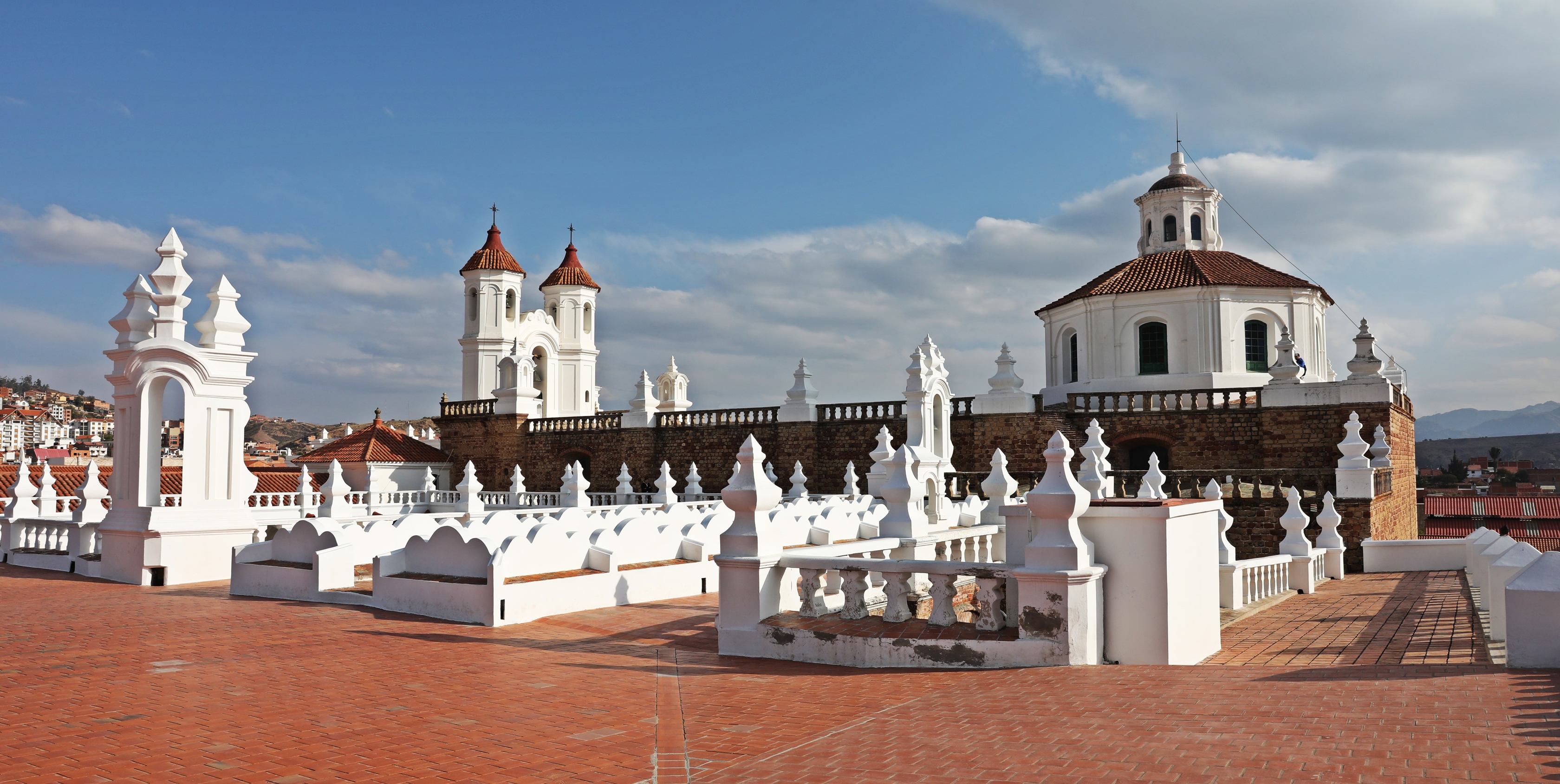
An imposing, red stone wall surrounds San Filipe Neri Monastery. Looking up at the top of it gives you a hint of what’s inside. Above the wall you can just see the tips of the domed roof and some of the bell towers that make up the monastery.

Enticed by this glimpse of the roof tops, we decided to take a tour of the monastery. It is a massive building, taking up an entire city block. As you enter, you’re led to a long corridor with white arches that lead to a cobblestone courtyard. Around the edges of the corridors are many doors leading to what would have been the monk’s residences. The monastery is now used as a school for girls. The rooms are classrooms so we couldn’t see inside.

We were allowed to go on the roof where we had an amazing view of the terracotta roof of the dome surrounded by many bell towers. There are multiple levels to the roof, each separated by elaborate walls and railings. There were so many features to look at, much more than we had anticipated.
We also had a bird’s eye view of the rooftops in the city and the cathedral at Plaza 25 de Mayo. It is such a fabulous roof and our favourite part of the tour.


Plaza de la Libertad (Liberty Square)
This small but lovely plaza sits in front of the beautiful colonial theatre building. At the other end of the park is Santa Barbara Church and Hospital. Built in 1554 the church has a stunning Spanish-style bell tower.
The rest of the square’s colonial buildings are now used as government buildings. Sucre is the constitutional capital of Bolivia, while La Paz is the administrative capital. We felt that Sucre has the style suited to a capital city more than La Paz.


When we were there farmers were walking through the streets toward the plaza with their prize winning llamas. It doesn’t get any more stereotypical than that!


Recoleta
This cute neighbourhood is located on the slopes of Cerro Churuquella above town. We loved the walk from Plaza 25 de Mayo up the hill to Recoleta. The lovely neighbourhood streets have beautiful one and two story colonial homes. Most of the homes are white with brown stone bases. It seemed as if every street corner we passed had a different church.


At the top of the hill we found a small lookout that gives great views of the city. From here you can see an endless stream of terracotta rooftops. In the distance the cathedral pokes above them all.
Behind the lookout is Convent de la Recoleta on the side of Plaza Pedro de Anzúrez. Built in the early 1600s it is a well maintained, simple yet gorgeous white building.


On the walk back down the hill we noticed several bromeliads growing on the electrical wires. Apparently bromeliad seeds are dropped by birds or carried in the wind and land on the wires. The seeds somehow find enough water and soil to grow into small plants on the wires. We were told that this is a common site in parts of South and Central America.


Cemetario General
After visiting the General Cemetary in La Paz we weren’t sure if we needed to visit the one in Sucre. We’re glad we did though because the two are quite different. As soon as we walked in to the cemetery we saw the main difference between the two. In Sucre there are lovely gardens, large trees and manicured hedges throughout the large complex.
Both cities have many vertical burial chambers, each with a small glass shrine in front filled with personal favourites of the deceased.

Another big difference is that in La Paz, the cemetery was mostly used by poor people. In Sucre however, the cemetery is used by every one and has different areas depending on the deceased’s job or stature. Wealthy citizens have large mausoleums and famous actors and musicians are honored with elaborate memorials. In Sucre, there are specific areas for different professions. We saw indoor vertical crypts with the title of the professions of those interred there such as: teachers, lawyers and miners.
Something that we didn’t notice in La Paz, but definitely saw in Sucre were professional mourners. Sitting on benches in front of crypts, people’s jobs were to pray and mourn for someone else’s family member.

When we were there a funeral service was taking place. It must have been for an important or wealthy person. A large band was playing songs, and there were guards standing on duty.
As odd as it sounds, the cemetery is a nice place to visit.

Where to stay
There are many hotels, hostels and guesthouses for all budgets in Sucre. Try to stay in or near Casco Viejo.
Where to eat
Cochabamba may be called the Culinary Capital of Bolivia, but Sucre is no slouch. We actually had more delicious meals from excellent restaurants and coffee shops in Sucre than we did in Cochabamba. Most are located in Casco Viejo.

This article is now featured on GPSmyCity. To download this article for offline reading or create a self-guided walking tour to visit the attractions highlighted in this article, go to Walking Tours and Articles in Sucre.
To read about our other adventures in Bolivia click here.
Coming Next – A Miner’s Life in Potosi
For pictures from other blogs go to Gallery at monkeystale.ca
To read about more of our adventures go to Destinations.
If you like what you read, please comment or share (with credit) using the links below




65 responses to “Sucre – Bolivia’s Prettiest City”
I am always fascinated by your explanations and your incredibly good selection of photos💙💙💙
Thank you Luisa, as always, I appreciate your kind words 😊 Maggie
You’re more than welcome, dear Maggie ❣️
That does look a lovely place to visit!!
Yes it is! 😊 Maggie
‘The prettiest city’ is always a big claim, but by George, I think you’re right!
And you got some llamas in there too.
Loved reading your post!
Haha yes, it’s a big statement but Sucre lives up to it I think. The llamas added the final touch 😊 Maggie
Sucre is indeed a beautiful city and your photos captured it well Maggie. So much white and terracotta allows the people and plants to provide the colour. We too love to explore local cemeteries. Not sure what I think about paying a professional mourner. Thanks for sharing. Happy November. Allan
I had never heard of professional mourners before either and found it a very strange job. Richard had heard of them, but had never actually seen them in action. Thanks as always for your comments Allan.
With a name like “Sucre” the town is just as sweet. I wonder where the wealth came from for the ornate architecture.
Love the Sucre Cathedral and your excellent photos of it’s entrance.
As always your well-described journeys take me along as well enjoying the food to a scenic view of terra cotta rooftops to bromeliads on a wire!! Awesome 👍
The Incas and then Spanish reaped all of their wealth from the silver mines in nearby Potosi. It sure allowed them to leave a beautiful city! The bromialids were fascinating too 😊Thanks for reading and commenting Suzette, Maggie
Excellent! Thank you for the information. I really appreciate it. Happy Tuesday.
Wow, what a beautiful city! I’m really enjoying this tour of Bolivia. I’m also intrigued by the bromeliads on the wires. It just seems so unlikely that a bird would drop a seed and it would stay balanced there and start growing. That’s so bizarre.
I know, those seeds must have velcro on them. We saw a few in Costa Rica too but not as large as in Sucre. Thanks for following the Bolivia journey Diana, Maggie
I can see why this is the prettiest city! I love that intricate detail on the white buildings. The monastery is especially striking! There is something really uplifting about the band at the funeral in the bright yellow- makes it feel much more like a celebration of life.
Yes there were so many things that individually were lovely but all together in one place really made it a great city. Thanks Meg, Maggie
What a beautiful and fascinating place. It is so well kept. I loved the prize winning lamas with their happy farmers.
The farmers were so proud of their llamas! They and the llamas were so cute! Maggie
Pretty indeed. Thanks for sharing!
Great photos! You are seeing and experiencing so much on this trip.
Wow, what a charming place, I very much like your night photos from Sucre – they certainly show the city from a different perspective. With its beautiful whitewashed buildings with tranquil patios, terracotta roofs and well-preserved downtown area it looks like a very pretty city indeed. Thanks for sharing and have a good day 🙂 Aiva xx
Thanks Aiva, I love it when these traditional plazas are lit up at night. It really adds another dimension to the lovely features. Maggie
It is such a picturesque town. And Plaza 25 de Mayo really looks festive during the evening. How interesting are those bromeliads on the wires (and that they’re still growing). You are really exploring Bolivia in depth – I like that!
The bromeliads were so interesting! And there were a lot of them. We spent almost 40 days in Bolivia and loved it all! Thanks for sharing your thoughts! Maggie
Fascinante! Vale un Potosí!
▪◾◼◾▪▫◽◻◽▫▪◾◼◾▪▫◽◻◽▫▪◾◼◾▪
▫◽◻◽▫▪◾◼◾▪▫◽◻◽▫▪◾◼◾▪▫◽◻◽▫
Haha Yes it is worth a Potosi!! 😊
It all seems very Spanish to me, apart from the people, but of course, it is! Reminiscent of Seville in many ways but the roof top of the monastery is very special. Great shots again!
It did feel like we went to a remote part of Spain, all of it was great and yes the roof was incredible. Thanks for sharing your thoughts Jo! Maggie
🤗🤗
Loved all of it. I come from White City in West London and I can honestly say it’s shit
Haha thanks for the warning! Check out this one though 😊 Maggie
Looking forward to visiting Sucre. How many nights did you stay? Great photography as always. Cheers!
Thanks, you’ll love it. We were there for three nights, we could have easily stayed a little longer.
The city is proof positive that the presence of great wealth brings great splendor. Sucre looks like it could have been transplanted from Spain.
So true, wealth certainly made Sucre pretty. It really didn’t feel like we were in Bolivia, at least until we saw the man crushing ice with an old hand-powered device. 🙂 Maggie
What a picturesque place! 😍
Sucre looks like a charming town. I have seen many videos from Bolivia over the last two years and I think some of the towns with their colonial past make me write their name on the top places to visit in S America. Someday! I really like the streets that descend down the hill.
Looks and sounds a lovely city. Once again we are very tempted by Bolivia through your posts
You should be tempted, we were really impressed by it! Although we love most of the countries in SA 😊
I share your love for Sucre, I agree that it is certainly the most elegant city in Bolivia and it is unfair that its rank as capital is contested, but that’s another story. The altitude must also be considered, it can be a bit tiring. On the other hand, the light is more transparent and clear, making the colours more vivid.
I especially enjoyed the touch of bromeliads growing around wires. The name Sucre (“sugar” in French language) was a puzzle to me, so I looked it up. The city was named for Antonio José de Sucre, a revolutionary leader, on July 12, 1839.
Ha yes, we thought it was sugar too until we started speaking Spanish and remembered it is azugar. Sucre was a very important person. Down here. Thanks for adding to the story 😊 M
Sucre looks so charming and clean with all those white buildings and small streets. I love the views from the roof of the monastery.
We ended up loving our trips to monastery roofs the most! Interesting features on them and great city views! Maggie
Oh wow, it looks like an amazing place. The San Filipe Neri Monastery looks breathtaking, I really need to get to Bolivia one day!
Yes you do! There’s so much to see 😊 Maggie
Beautiful photos of a city that looks incredibly pleasant and walkable and pretty. I like bell in San Filipe Neri Monastery. Simplicity meets practicality. There are professional mourners? That sounds like a great way to make a little extra dinero.
I know! It’s not a difficult job, if I were Catholic I’d do it 😊 Maggie
Are those bromeliads? We’ve seen so many in Peru (although much smaller) and were wondering what are they. Mystery solved now lol
I love the colonial style with all their fine intricacies, a fine city all together.
I see lots of people wearing a mask, is it mandatory?
I don’t remember seeing them in Peru, aren’t they fascinating plants! Masks are not mandatory in Bolivia but are used a lot, even outside. Some stores, banks and government offices do require them. Peru they are still mandatory everywhere, or were in August.
What delightful architecture, Maggie and Richard! Thank you for sharing the stunning photos! <3
Thanks so much Cheryl! Maggie
We really enjoyed our time there. These are spectacular photos. Anita
Thank you Anita! We appreciate your support! Maggie
I love how in every trip, you not only visit the major sights, but also places most foreigners don’t think of seeing, like Sucre. Based on your photos alone, I like the architecture and the ambiance of this city. They just look refreshing!
Refreshing is a good word, it was so different from the rest of Bolivia and I think is exactly what we needed. A pretty, clean, organized city with friendly people and good food . 😊 Maggie
it’s hard not to love Sucre. you are right i think its the prettiest city in Bolivia, i adored it there
One of the cities in Bolivia that I would return to. Maggie
What a magnificent town! The Casa de la Libertad is astonishing 🙂
Thank you, yes Sucre is a beautiful city. Thanks for reading and commenting. Maggie
This is a great, wonderful and impressive post. I would like to travel there and to see all this attractions. Thank You ! Diana
Bolivia has many great places to visit, you would love it😊 Maggie
[…] Sucre is undeniably the prettiest city in all of Bolivia. Its historical centre is filled with stunning 16th century Spanish architecture. Street after street is lined by white-washed homes with small second-story balconies. At the centre, the lovely tree-filled Plaza 25 de Mayo is surrounded by gorgeous Spanish colonial buildings. You can ever climb up to the roof of one of the monasteries for a better view of this charming city. For more information read our post from Sucre. […]
[…] Coming Next – Sucre, Bolivia’s Prettiest City […]
[…] Sucre is undeniably the prettiest city in all of Bolivia. Its historical centre is filled with stunning 16th century Spanish architecture. Street after street is lined by white-washed homes with small second-story balconies. At the centre, the lovely tree-filled Plaza 25 de Mayo is surrounded by gorgeous Spanish colonial buildings. You can ever climb up to the roof of one of the monasteries for a better view of this charming city. For more information read our post from Sucre. […]