
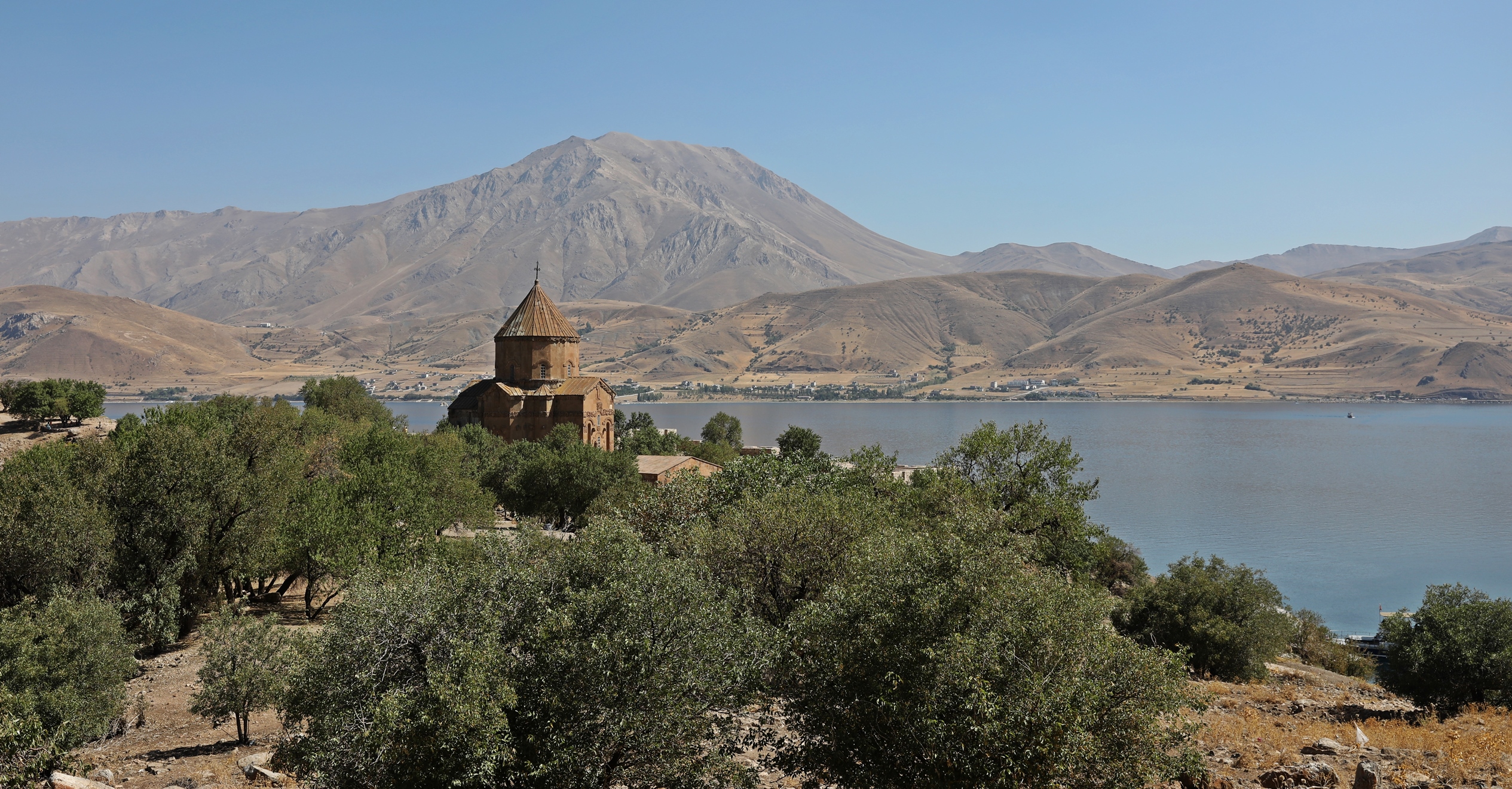
Looking out over the deep blue waters of Lake Van is the picturesque Church of the Holy Cross. Standing on this spot since 921 AD, it is one of the few remaining Armenian sites left in Van. Although it is not large, the church is a gorgeous example of Armenian history in Turkey.
Lake Van (Van Gölü)
Located in the Armenian highlands in Eastern Turkey, Lake Van is the country’s largest Lake. In addition to that claim to fame it is also a saline soda lake and one of the world’s few endorheic lakes. A volcanic eruption sealed off its output streams leaving it with no outflow. A lake with no outflow is endorheic. The city of Van as well as a few historic sites are located around the shore of this large lake.

Church of the Holy Cross (Surp Haç Kilisesi)
While ancient civilizations have lived around Lake Van as early as the Iron Age, we were most interested in seeing a small 10th century Armenian church set on an island in the lake. During the Middle Ages this region was a part of Armenia’s kingdom. One of their kings built a palace on the lake’s Akdamar Island. During that time, Armenian monks built the Apostolic Church of the Holy Cross and a monastery on the same island.
Over the centuries there were many conflicts in Turkey between the Christian Armenian population and Muslim Ottoman rulers. The worst ones occurred in the late 1800s and during World War I when Ottoman rulers ordered the evacuation or execution of millions of Armenians. They also called for the destruction of Armenian heritage buildings and monuments.
The Church of the Holy Cross and monastery were used by Armenian monks until the late 1800s, but they were forced to desert it during WWI. After they left, most of the buildings on the island were destroyed. Today, the church is the only remaining Armenian building on Akdamar Island.
To reach the island we hopped aboard a small ferry. The 3 km trip allowed us to admire the arid hills scattered with villages that surround the large lake.


As we approached Akdamar Island we could see the unassuming church perched on the side of a small hill. Its distinctive conical roof and circular drum made it easy to spot. This shape is typical in Armenian architecture and reminded us of the buildings we had just seen in Erzurum.


Although quite badly damaged by vandalism, the Church of the Holy Cross was not completely destroyed and in 2005 it was restored. Remarkably, a few of the original carvings and paintings on the church and the gravestones remained intact, but many had to be rebuilt.
Once we got closer we realized that it’s not nearly as plain as it looks from afar. Built in 921 AD from pink volcanic tufa stones, the outside of the stone church is wrapped in gorgeous bands of art depicting stories from the Bible and scenes from daily life. Between these band are large reliefs and sculptures of prophets, Bible stories, animals and grape vines.
The artwork located higher up on the church are mostly originals, but many of the large reliefs lower on the walls had to be completely restored.


We entered the clover-leaf shaped church into a small foyer with domed arches. This room is quite plain, but once we walked into the main sanctuary, we were taken aback by the mystical feel of this ancient hallowed space. Its old walls with restored and weathered artwork give it a very sacred aura. The walls lead up to a tall domed ceiling that is wrapped in small windows that let in a remarkable amount of light.


There used to be a monastery near the church. Now only the remnants of its walls let us know where it once stood. These ruins are a reminder of the devastation this beautiful building was lucky to survive.

The yard around the church contains an ancient cemetery. Many of the gravestones have weathered engravings of crosses. Some of them are quite obvious, while others are barely noticeable; having been almost completely worn away.

The rest of the yard is filled with almond trees that were planted by monks many years ago. We wished we had visited in the spring when the trees were in bloom. It would have been an even more beautiful view than the one we had.

How to get to Akdamar Island
Minibuses leave from the lot next to the bus station (Otogar). Take a minibus with the name Gevas/Akdamar in the windshield (35 TRY/ $1.20 USD). It will drop you off at the ferry terminal on Lake Van. (The Turkish word for mini-bus is dolma). The ferry costs 115 TRY ($4 USD) for a return trip and takes about 30 minutes to travel to the island.
There is a small canteen on the island selling snacks and drinks. We didn’t need to buy anything though because a Turkish couple surprised us by giving us some of their delicious pastries. We have many examples like this of the warmth and kindness we were shown by Turkish people we met throughout the country.
Foreigners Entrance Fee to the island – 290 TRY ($10 USD); Open – 8 am – 5 pm
Van Fortress (Van Kalesi)
Long before Armenians populated the land around Lake Van, it was inhabited many other civilizations including the Urartu Kingdom. They were important rulers of these lands for a couple hundred years during the Iron Age. Spread across a long rocky outcrop 100 m above the ground, is a fantastic Urartu fortress built from the 9-7th centuries BCE.
One side the fortification is protected by an impenetrable rock wall. On the other, broken cliffs allow you to see more of the castle and provide an awesome view of this ancient structure.


The museum’s walkway allows you to climb up to the top of the castle, passing between the broken terraces. At the top, all that are left are the fragments of walls of what were once royal buildings of the Urartian Kingdom.
At over a kilometer long, the ridge top gives you many vantage points to see not only the fortress remains, but also the city of Van and Lake Van.


With no safety rails you can get close to the cliff edge and truly appreciate how shear the walls are. Looking straight down from the edge, you can see some of the historic buildings left from other civilizations that lived in this area.


After exploring the top of the fortress we walked around to the other side which is not a part of the museum. At the base of the cliffs are are eight rock-cut tombs, a few dating as far back as the Urartian period. In addition to the tombs there are many other rock chambers that were used for storage and animal stables.
Halfway up the shear cliffs in the picture below you can just make out an ancient clay tablet. It has inscriptions in cuneiform script from the Urartian ruler. On the tablet it states that he was responsible for building the fortress. It’s quite remarkable that words written thousands of years ago are still in existence today.


On the fields beside the cliffs are the ruins we had seen from above. They are the remnants of some of the many civilizations that occupied the castle and the area. Two 13th century minarets from the Seljuk period stood beside a few stone walls. Further away, on the edge of the field are 16th and 17th centuries Ottoman mosques Hüsrev Paşa and Kaya Çelebi.
Even though much of the site is in ruin, there is so much history at this one location, it is well worth a visit.


Entrance fee – 10 TRY (35 cents USD) ; Hours – 8 am – 7 pm.
How to get to Van
There is a domestic airport in Van. Internal flights in Turkey are generally quite inexpensive, but often connect through Istanbul making what should be a short flight much longer. Also note that there are two airports in Istanbul, located on opposite sides of the city so pay attention if you have a connecting flight. Van is also easily reached from many cities by car or bus. The highways in Turkey are excellent as is their bus system.

Where to stay and eat in Van
Van is not a large city, but it is quite spread out. Most restaurants and hotels are located in the city centre, near Kazim Karabekir Blvd.

Click on the link to read our Travel Tips For Turkey.
To read more of our adventures in Turkey click here.
Coming Next – Mardin’s Medieval Old Town
For pictures from other blogs go to Gallery at monkeystale.ca
To read about more of our adventures go to Destinations.
If you like what you read, please comment or share (with credit) using the links below.




We’d love to hear from you, please leave a comment.