
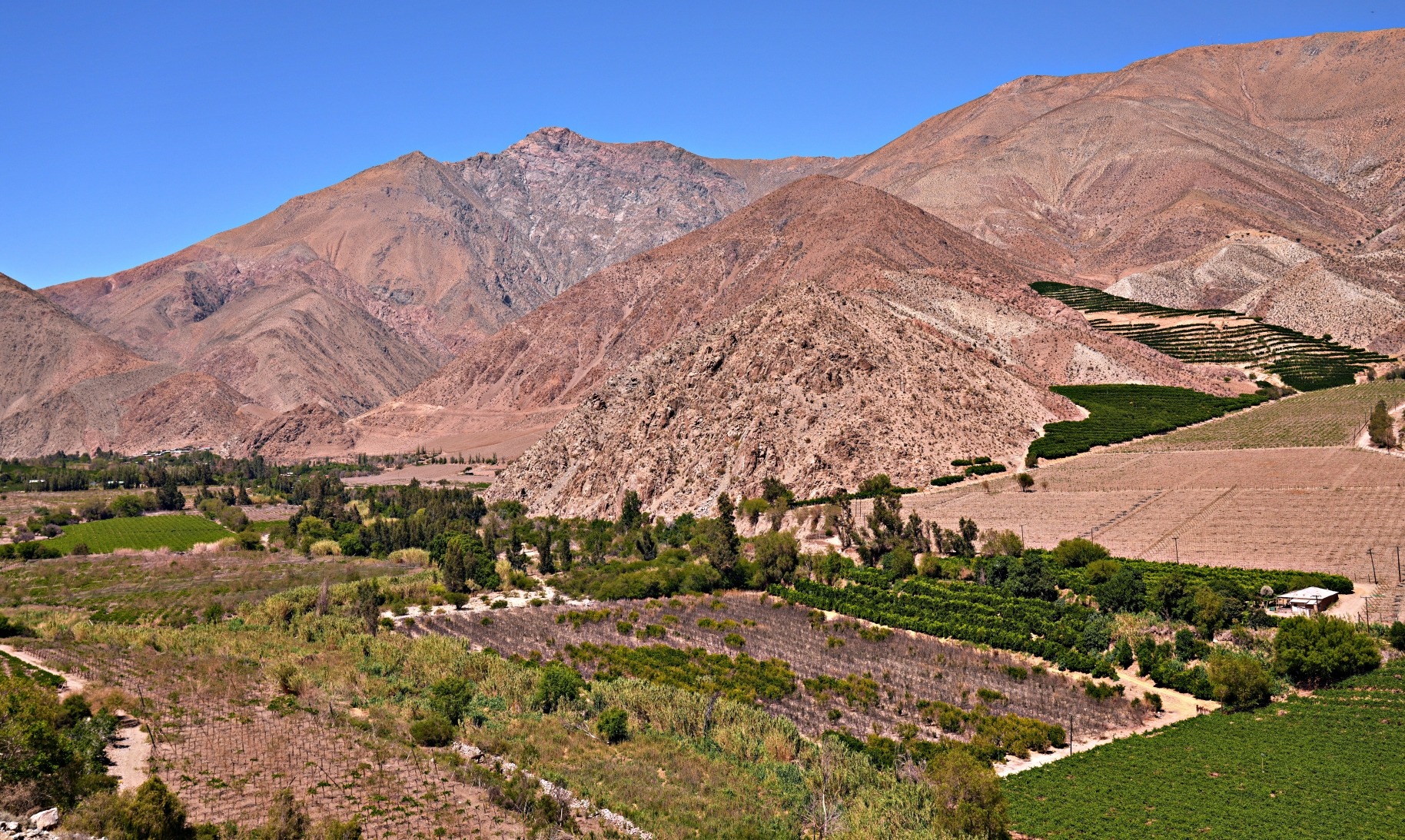
Located high in Chile’s Andes Mountains is the arid Elqui Valley, home to Chile’s pisco producers. Since it is located just above the colonial city of La Serena, we were able to explore the Elqui Valley one day and the streets of La Serena the next. Together, these two gave us a wide variety in scenery and history.
Elqui Valley
The valley’s main claim to fame is its pisco and high-altitude wines, which is what brought us to the region. What we discovered, though, is that there is a lot more to see than just vineyards.
As we drove out of La Serena, we saw the brown hills in the distance, but noticed that the flat lands below were very green, covered in fields of potatoes and papaya trees. This region is along the Pacific Coast, so has a temperate climate and nutrient rich soil, but doesn’t get much rain. Driving higher into the Elqui Valley, the potato fields were soon replaced by vineyards.

Puclaro Reservoir
Our day began with a view of the very pretty Puclaro Reservoir on the Elqui River (Embalse Puclaro). The man-made lake provides irrigation for the farms we passed as well as for city of La Serena. It is a very pretty lake, but when it was formed, several villages were flooded and had to be relocated to higher ground, above the new lake.


As we drove higher up the Elqui Valley (Valle de Elqui), we passed many pretty scenes where the arid mountains contrast the green oases that fill the valley bottom. One of the most picturesque was from the ridge above the Claro River. Vegetable gardens and vineyards fill in the river valley, but high on the hill we saw different crops. Newly planted commercial avocado orchards have become very controversial because they are taking the water from the small farms in the valley below. Their arrival in the valley has been the source of many disputes between the local farmers and the wealthy avocado growers. It reminded us of the problems we saw in Mexico’s avocado region.


Wine Tasting
The elevation of Elqui Valley is well suited to growing moscatel grapes because it has a strong sun, but cool evenings. With most vineyards placed around 2,000 m (6,500 ft), it is home to the highest elevation wine-producing region in Chile. Historically, most of the wineries in the Elqui Valley produced pisco, but recently a few added wine to their offering. One of those is the family run Cavas del Valle in the village of Pisco Elqui. This winery does something unique in the valley by making white wine with moscatel grapes instead of the typical pisco.
We sampled a selection of wines at Cavas del Valle, and they were very nice. Although we’re not typically fans of sweet wines, we tasted their sparkling and rosé made from moscatel grapes. They were nice, but we preferred their more traditional carmenère, malbec and shiraz.


The high elevation reminded us of our wine tasting in Cafayate in Argentina. You can read about that experience here. We also visited a winery in Colchagua Valley, Chile. You can read that story here.
Pisco Elqui
Cavas del Valle is on the edge of the town Pisco Elqui. It was originally called La Union, but was renamed Pisco Elqui as a marketing strategy. It sits in a green oasis at the foot of the arid mountains, which makes the rustic town very photogenic. The main square has palm and jacaranda trees to contrast the stark, brown mountains.


Montegrande
Not far away is the little town of Montegrande. The main reason to stop is to visit the museum for author Gabriela Mistral. The Nobel Laureate was born in nearby Vicuña and went to school in Montegrande in the late 1800s. Her writing included messages of peace and social justice, with an emphasis on the rights of women and the indigenous.
The museum in Montegrande is held in the one room school house where she was a student and later, a teacher. There’s not much to see but entry is only 1,000 CLP ($1USD).


In Montegrande’s central plaza is a charming chuch with a wooden bell tower. The interior is very simple, but its blue ceiling is rather unique for the area.


Pisco Tasting
With origins dating as far back as the 17th century, Elqui Valley has a long history of growing grapes. The high elevation yields very sweet wines, and like many at the time, producers were unable to export it over long distances. They decided to distill it and began making the brandy called pisco. This is similar to the story of port’s beginnings in Porto, Portugal.
You may have already heard of pisco from Peru, and there’s a friendly rivalry between Chile and Peru as to who first made pisco. While in the valley, we wanted to taste Chile’s version and stopped at an old family run winery, ABA Pisquera. They have a lovely garden that surrounds a large water reservoir. It was planted to attract pollinating bees to their vineyard.
When we walked by the vines, we saw that the grapes were still only flowers and were months away from being ripe. Remarkably, these flowers were budding even though they only received 3 days of rain between May and our visit in November.


Instead of typical wooden barrels used in wineries, the distillery uses copper stills to extract the alcohol. Since pisco ranges from 35-40% alcohol, it is not drunk as a shot, but instead is served in a cocktail. The most common is pisco sour, a mixture of pisco, sugar and lime juice. In Peru, they put whipped egg white on top, but in Chile, that is not always done.
At this winery, we sampled several flavours including lime, mango, pomello, and maqui (similar to blueberry). Mango was our favourite, followed by the traditional lime.


Vicuña
If you’re in the valley, you should also stop in the cute colonial town of Vicuña. There aren’t any major sites, but its church is remarkably ornate for the humble town. As well, there is an odd tower, Torre Bauer, in the central square. It was built in the early 1900s by a German immigrant who eventually became mayor of the small town.


How To Visit The Elqui Valley
Unless you have a car, it would be difficult to visit the valley on your own. We took a day tour with EcoTours in La Serena and were very pleased with their service. The price for our day in Elqui Valley was 38,000CLP ($40USD), which included wine and pisco tasting, a full lunch with more pisco and wine, and the sites mentioned in the post above. You can find them here. We did not receive compensation for this mention.
La Serena
The easiest way to visit Elqui Valley is from the city of La Serena. We didn’t know what to expect from La Serena and what we found was a pleasant city with shaded parks and reminders of its colonial times.
La Serena History
Located at the mouth of the Elqui River, the coastal city of La Serena had very dark beginnings. Not long after the city was founded in the 16th century, local indigenous Diaguita tribes destroyed it and killed almost all of the residents. Within a few months, Valdivia, who founded Santiago, sent Captain Francisco de Aguille to the same location to re-establish the city. The first one was named Villanueva de La Serena. To change things up, they named the second one San Bartolomé de La Serena.
The reason the Spaniards wanted a settlement here so badly was the access it provided to mining. But of course, mining means wealth, and that brings pirates, and in 1680, most of the city was burned to the ground during a pirate attack. San Francisco Church was one of the only buildings left standing after these attacks. Built in 1563, it is the oldest church in the city.

La Serena Old Town
Its colonial downtown is very walkable and there are several streets worth exploring. It may not be as quaint as other heritage centres, but La Serena has a nice mix of elaborate and humble colonial buildings.


Plaza de Armas
As with most Spanish colonial towns, the grid like streets make it easy to navigate, and once you’ve explored a few blocks, you will likely end up in Plaza de Armas. It’s a nice, large park, surrounded by colonial buildings.
At the head of the plaza is La Serena Cathedral with a tall belfry. It is known for its wooden ceiling and pillars, but it was closed, so we couldn’t see inside.


Avenue Francisco de Aguille
In the middle of the 20th century, an open-air style museum was created in the meridian of Avenue Francisco de Aguille. It included many classic Roman statues brought from Italy. In times of unrest, though, these statues have been vandalized. When we saw them, most were covered in red paint. It made the city feel less cared for, which is too bad.


Heritage Churches
There are quite a few colonial churches in La Serena’s historic centre. The most well-known are the five limestone ones: the Cathedral, Santo Domingo, San Agustin, and La Merced. They were built in the 1700s and gave the city the nickname ‘The City of Towers’.


The Archaeological Museum
Held in a wonderful building, the 19th century baroque stone gates are the Archeological Museum’s (Museo Arqueológico) best feature. It houses a collection of artifacts, including some from Rapa Nui and Atacama. We would be visiting both locations in the coming weeks so, we were hoping to visit, but unfortunately, we ran out of time and arrived after it closed.

Faro Beach
The city’s growth and importance went up and down, and today it is more known as a beach destination than mining town. It still has some work to do as a vacation resort, though. On the way to the beach, we noticed several unfinished resorts. These half-built complexes showed us that best laid plans don’t always come to fruition.
The main city beach, Faro Beach, is named for its castle-like lighthouse (Faro). It is no longer in use, but you can climb to its top for a view of the coast. The beach is quite nice with a long stretch of golden sand in both directions and mountains at the far end.


Jardin del Corazon (also called Japanese Gardens)
In the middle of the city is a tranquil garden with Shinji-ike Pond at its centre. When we visited, the pond was being enjoyed by the black swans, geese, ducks and turtles that call the park home. There are several walking paths, including a footbridge that allows you to admire the Japanese lanterns, manicured hedges and pagodas inside the park. Jardin del Corazon was donated to the city by a Japanese mining company,


Entry – 3,000 CLP ($3.30USD): Opening Hours – 10am to 6pm, daily.
Other things to do in Elqui Valley and La Serena
Hiking – There are several hikes in Elqui Valley. Some will take you by ammonite fossils and huge sheets of quartzite. We didn’t have time for a hike, but maybe you would enjoy it.
Stargazing – The dry climate in the Elqui Valley means there is very little dispersion of light, making it a perfect place to study the stars. Tololo Observatory was the first telescope in the area, but today there are many others. If you are interested in visiting, you must book months in advance.

Humbolt Penguins – You can see these penguins on a boat trip to Isla Damas. If you make your way to Punta Cholas you can find a boat tour, otherwise there are many tours offered in La Serena.
How to get to La Serena
La Florida Airport in La Serena receives domestic flights from Santiago, Calamari, Concepcion, among others. You can also arrive by bus, but most will be long distance trips. If you have your own car, it is connect to Santiago and Valparaiso by good toll roads.
You can find La Serena in the middle of the map, Elqui Valley is around 40 km inland from the city. It is an interactive map, so you can zoom-in or click on a marker for a link to our post from that region.
Where to stay in La Serena
Most of the hotels are located at the far end of Faro Beach, but there are a few apartments and locally run hotels in the city’s downtown. The city isn’t very large, so you can either walk to the sites or take a short Uber ride.

Click on the link to read our Travel Tips For Chile.
To read more of our adventures in Chile, click here.
Coming Next – A Complete Guide to Atacama
For pictures from other blogs go to Gallery at monkeystale.ca.
To read about more of our adventures go to Destinations.
If you like what you read, please comment or share (with credit) using the links below.




We’d love to hear from you, please leave a comment.