
The capital of Bulgaria is filled with reminders of its extensive history. Walking through its historical centre you will pass Roman ruins that sit beside buildings from the Byzantine Empire. You’ll see Ottoman buildings next to those with a more European look. Although it doesn’t have the draw of other European capitals, we found Sofia to be a pleasant city to visit. Join us as we explore the sites of Sofia, Bulgaria’s capital.
Church of St. Sofia
Given that the city was named after the Church of St. Sofia, the brick building’s exterior seemed quite unassuming. It was built in the early 6th century under the Byzantine Emperor Justinian, therefore it is considered a contemporary of Hagia Sofia, not far away in Istanbul.
Lions are the symbol of Sofia which is why we saw a few around town, including this one outside of the church.

It is believed that the current building was the fourth church to be built on this site and it has suffered a lot. In the 16th century when it was converted to an Ottoman mosque, the frescoes that adorned the walls were destroyed. In the 19th century it was damaged by an earthquake and was then used only for storage. As a result, the tall building feels hollow inside. The brick walls have very few paintings or adornments, quite unlike other Orthodox churches in the country.

A city was originally established in this area by the Thracians who called their city Serdica. After the Thracians, it was ruled by the Romans. There aren’t many Thracian ruins left, but you will find many Roman ruins throughout the city, one of which is under Church of St. Sofia. A Roman necropolis lies under the church and the basement is set up as a museum where you can see several of these old Roman stone sarcophagi.


Entrance fee – It is free to enter the church, but the necropolis has a small fee – 6 BGN ($3.30 USD); Opening Hours – 9 am to 5 pm
St. Alexander Nevsky Cathedral
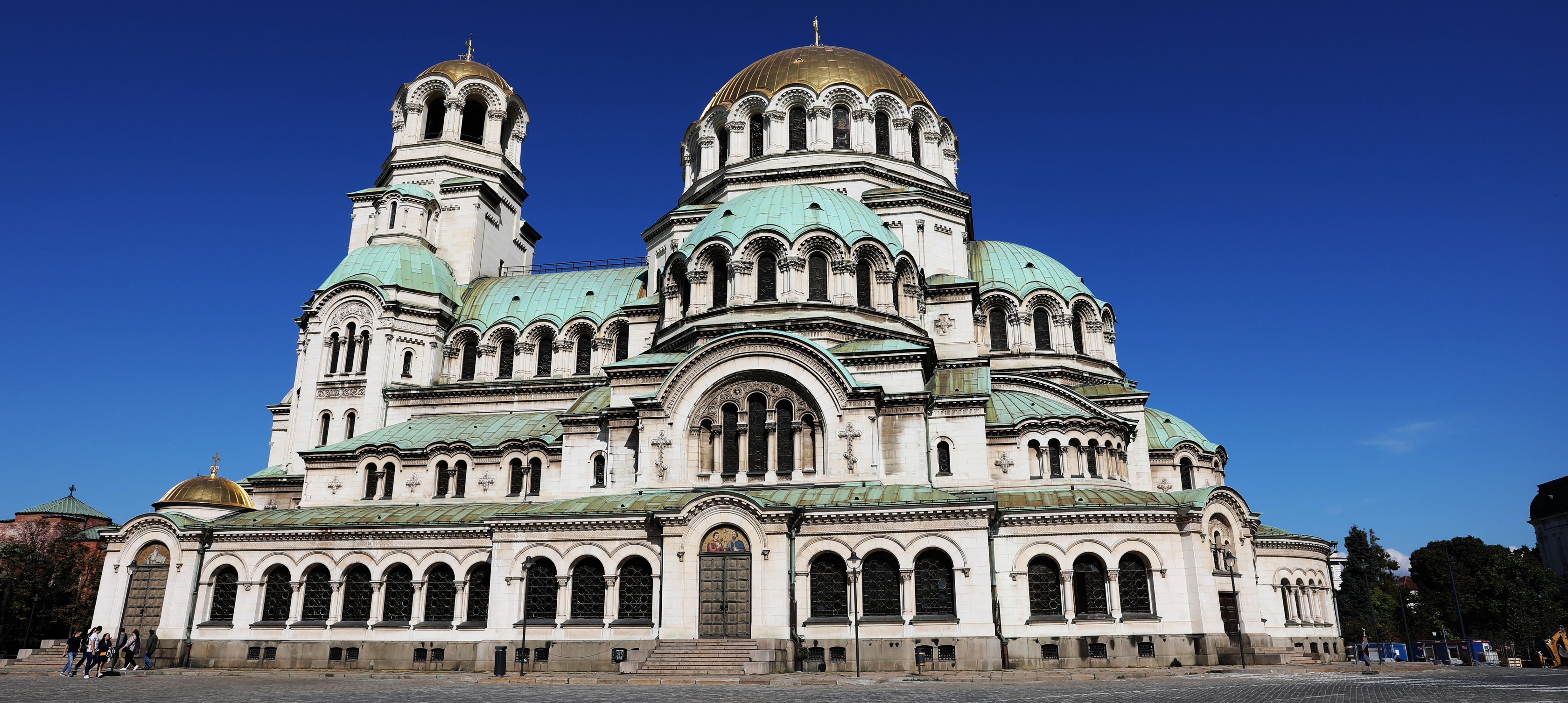
Beside Church of St. Sophia is the multi-domed St. Alexander Nevsky Cathedral. The massive building with green and golden domes commands your attention in the middle of the square. Construction of the church began soon after Bulgaria achieved liberation from the Ottoman and was built to honour Russian soldiers who died in the Russo-Turkish War. The church is named after the Russian Prince St. Alexander Nevsky from medieval times.


From the first moment you enter through the doors, you will realize that this is a magnificent building. The main sanctuary is richly decorated with painted walls and ceilings. The large room is divided into separate areas by large pillars covered in murals. Each of these separate areas is under its own painted, domed ceiling.
At the front is a very elaborate marble altar. Beside it are finely carved marble frames that surround the patriarchal thrones. It is quite dark inside though so it is difficult to see the details in the paintings.


Entrance is free but there is a small fee to take pictures inside; Opening Hours – 7 am to 7 pm
Historic Downtown
In addition to these notable buildings, the rest of Sofia’s historic downtown is filled with buildings that show the different styles of architecture in this capital city. In the years following their independence from Ottoman rule, political and business leaders were anxious to modernize Sofia. With influences from European designs, new buildings were erected to show their new independence and growing wealth. This influence is especially apparent around Alexander Nevsky Square.


A few blocks away from Alexander Nevsky Square is the 4th century Rotunda Church. As its name suggests it is a round building. Inside, the brick walls and ceilings in the four alcoves are dotted with frescoes. Some of these paintings date back to the times of the Byzantine. In the yard behind the church are ruined walls from Roman buildings that once stood here.


The original 10th century Hagia Nedelya Church was a wooden building but was replaced by a new stone church in the late 19th century. In 1925, the church was destroyed by a bomb when Russians attempted to assassinate Bulgarian King Boris III. Hundreds of Bulgarians were killed, but the king was not.
Only two years after the bombing, rebuilding of the church began. Although it is a massive structure, it is rather plain and is said to be an exact replica of the bombed building. Inside, the tall walls and domed ceilings are covered in frescoes, as we had come to expect in Bulgarian Orthodox churches.


Church of St Pietka of the Saddlers is an old stone church with an interesting story. The single nave Orthodox church was built below ground level in downtown Sofia. During Ottoman rule, new churches were only allowed to be built if they were shorter than a soldier on horseback. That explains the subterranean location of the church.

There are a few interesting buildings within a block of each other. One is Banya Bashi Mosque. Its name means ‘Many Baths’ in English. When it was built, the surrounding area had many public baths. Today it is the only functioning mosque of the original 70 in Sofia. In front of the mosque are more reminders of the Romans time in this city.
Behind the mosque is the Regional History Museum. The distinctive building was built on the site of the Roman’s Central Baths. Not far away is Sofia Synagogue, but we were only able to see its rooftops. When we were there, the current conflict between Israel and Hamas had just begun so the building was closed to visitors. It is said to be the largest synagogue in southeastern Europe.


The final building in this area is the spectacular early 20th century Ivan Vazov National Theatre.

Boyana Church
On the edge of the city is a small 10th century Byzantine Church. Even though it is small, there were many additions to Boyana Church over the centuries. Inside refurbished 11th to 12th and 17th to 18th century frescoes adorn the walls and ceiling. Only a limited number of people are allowed inside at one time so you may have to wait to enter.


Entrance Fee – 10 BGN ($5.50 USD); Opening Hours – 9:30 am to 6 pm
Where to stay in Sofia
The city’s downtown is quite spread out, but it’s a very walkable city. It would be best to stay close to Vitosha Boulevard or Church of St. Sofia.
Where to eat in Sofia
The pedestrian mall, Vitosha Boulevard, has many cafes and restaurants with indoor and outdoor seating. It is a very popular place. Our favourite restaurant was the traditional Bulgarian Restaurant Shtastliveca. We also ate at their location in Veliko Tarnovo.

Ruse
On the banks of the Danube near the border with Romania, the city of Ruse is a little rough around the edges. At the end of the Ottoman rule, Ruse experienced a boost in its economy. As a result many elegant late 19th and early 20th century buildings were erected. As with Sofia, they were influenced by modern European designs. As we explored the Old Town we found a few of these elegant buildings near a pedestrian street for shopping and dining. Most of the city’s buildings however, are in much need of repair.


It’s not a bad city if you need to stop before entering into Romania as we did, but there’s not enough to see to be a destination on its own.

Tip – There is not a lot of English spoken in Bulgaria and they use the Cyrillic Alphabet. It would be wise to have your destinations written in Cyrillic before leaving your hotel. Google Lens is very helpful to translate written material such as menus.


This article is now featured on GPSmyCity. To download this article for offline reading or create a self-guided walking tour to visit the attractions highlighted in this article, go to Walking Tours and Articles in Sofia.
Click on the link for Travel Tips For Bulgaria.
To read more of our adventures in Bulgaria click here.
Coming Next – Visit Bulgaria’s Plovdiv
For pictures from other blogs go to Gallery at monkeystale.ca
To read about more of our adventures go to Destinations.
If you like what you read, please comment or share (with credit) using the links below.




We'd love to hear from you, please leave a comment.