
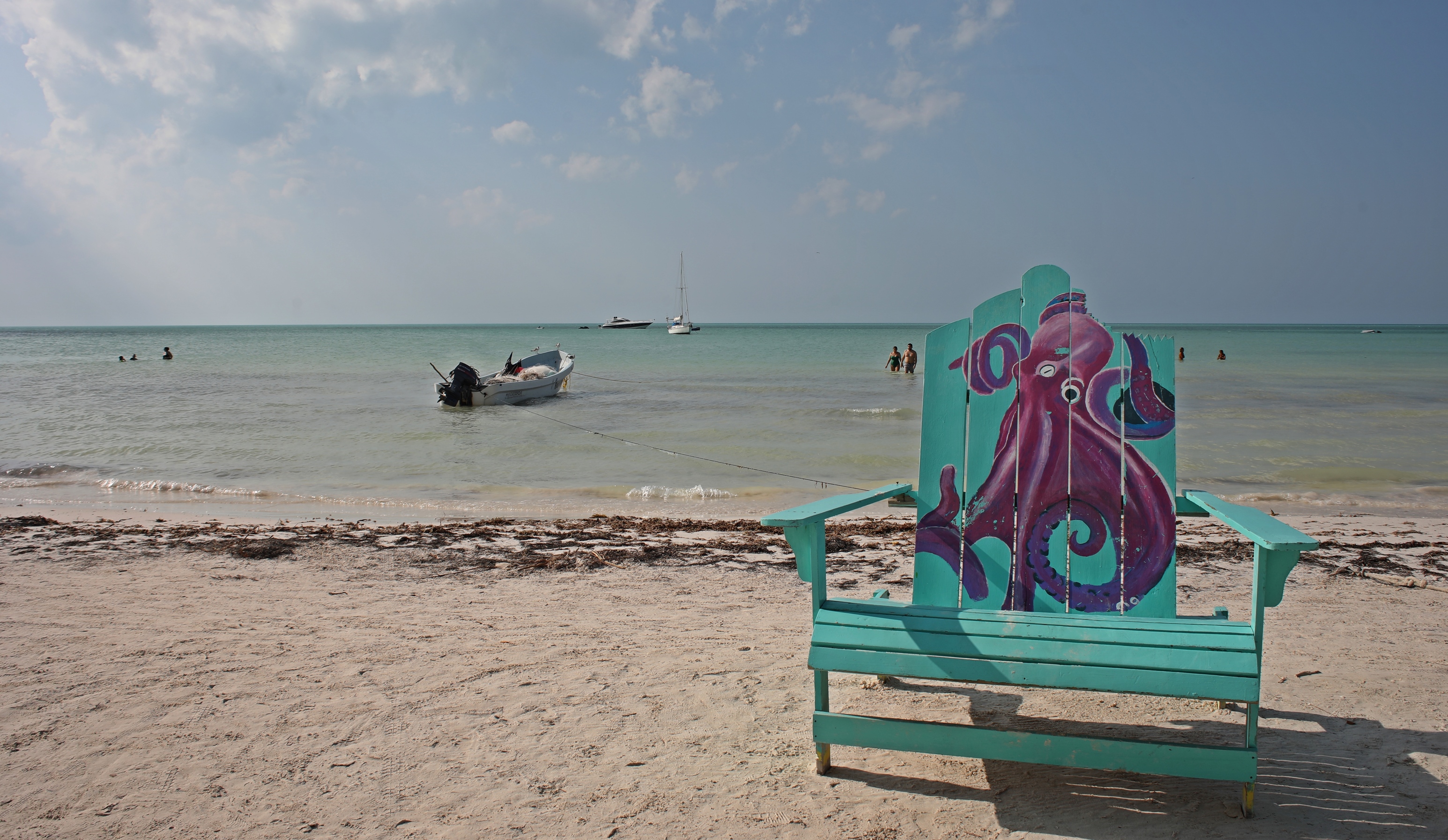
Just off the northern tip of the Yucatan Peninsula are two popular tourist islands whose distinctly contrasting atmospheres appeal to different beach tourists. If you’re travelling to Cancún and are looking for a change of scenery, you have your choice between the easy going vibes in Isla Holbox and the fast-paced, party beaches of Isla Mujeres. Here’s a short tour of both to help you decide.
Isla Holbox
The main town on the island is laid-back and a little bit quirky. The roads are made of sand and are lined by colorful buildings decorated with murals and other artistic creations. The town reminded us a little of Jericoacoara in Brazil. It is a great spot to spend a few relaxing days.


Holbox, pronounced Hole-bosh, translates in English to Black Hole. It is located at the meeting of the Caribbean Sea and Gulf of Mexico. The initial settlers were indigenous and arrived on the island in the 1800s. The came from the mainland’s Punta Coco to escape vicious attacks from Mayans. These settlers decided to stay and the people who live on the island today are ancestors of those first residents. They are good caretakers of this beautiful spot of land. They have implemented strict rules to prevent over-development and environmental damage which has allowed it to remain mostly untouched, and adds to its laid-back feel.
The main past-time for visitors to Holbox is to hang out at the beach. Located on the Gulf side of the island, the beaches are long and white. The sand is not soft though. It is composed of roughly crushed coral so going barefoot is difficult. There is also a lot of sargassum, a type of algae that is often mistakenly called seagrass. They don’t seem to rake the sargassum in Holbox, so the beaches are not as picture-perfect as others. This didn’t turn us off from swimming in the warm water though.
Holbox beaches are much more low key than either of its neighbours: Cancún or Isla Mujeras. There are plenty of sun beds for rent, but there is also a lot of free space to find a spot for yourself on the sand. There are also many stalls renting kayaks and SUPs if you want a little exercise.


Punta Coco is on the western tip of the island. When conditions are right, you can see bioluminescent algae or plankton in Punta Coco lagoon at night. We visited during the day to check it out first. Unfortunately, conditions weren’t good for us to see them at night.

Not far away from the lagoon is Playa Coco Point. It is supposedly a great spot to see flamingos, but our timing was off for them too. They would arrive a couple of weeks later in late spring and stay until fall.
We walked to the Punto Coco from town through the centre of the island and thought we’d take a short cut. The marshy land and warning signs for crocodiles made us stick to the main road. On the return trip, we opted for the coastal walk and even though we didn’t see flamingoes, we did see a lot of water birds.
You can walk along the shore all the way from Playa Holbox to Cocos Point. It’s a nice walk, but since its 3 km, most people take a taxi or rent a souped-up golf cart.


At certain times of the year you can snorkel with whale sharks. We were again visiting at the wrong time of year, but we dove with them in Koh Tao and Maldives so weren’t too upset.
We really enjoyed the slow pace and relaxed atmosphere of Isla Hobox and would recommend it to others with the same beach preferences.
Getting to Isla Holbox
To reach the island of Holbox from Cancún, you must first get to the town of Chiquilá. ADO buses leave from ADO Centro Station in Cancún. There is also a colectivo (shared minibus) but we don’t know the price or where it leaves from. The highway goes through the middle of the jungle-filled peninsula meaning that there are not really any views on the 2 hour drive.
From Chiquilá, take 9 Hermanos Ferry to the island. There are a few ticket stalls between the bus stop and the harbour. You can not take your car on the island, but there are paid parking lots in Chiquilá. The ferry ride is short (25 minutes) and takes you across Laguna de Yalahau (also called Conil) to reach Isla Holbox. The first sight you’ll get of Holbox are the mangrove forests that cover this side of the island. From the ferry we saw pelicans, cormorants and gulls sitting on the branches of water logged trees or fishing in the lagoon’s water. The ferry ride was like a small cruise. Because of the distance, you should spend a few days in Holbox.
Getting around Holbox
The best way to get around the small town is slowly and on foot. Many take taxis that are actually souped-up golf carts. You can even rent their own golf cart.

Where to stay and eat in Holbox
There are several hotels and restaurants near Parque Central, but it will be quite noisy at night. Everything is within walking distance, so there really is no bad location. There are quite a few small hotels and apartments between the town centre and Punta Coco. They will be very quiet but are 2 or 3 km from town and the roads are not lit up at night. If you stay here, renting a golf cart may be a good option.

Isla Mujeres
While Isla Holbox has an unhurried vibe, Isla Mujeras is the complete opposite. Located just a 20 minute ferry ride from Cancún, Isla Mujeres is a vey popular spot. It seems as if the sole purpose of the island is for tourists to indulge in sun, sand, food and of course drinks. It could be very pretty, except that it has been overtaken by the tourist industry.
Soft sandy beaches are found along much of its perimeter. Closest to town centre is Playa Centro. Its white sand and gentle waves make it popular with families. There are a few sunbeds and kiosks, but it’s generally quiet.


A little further north is Playa Norte. It is much busier and seems to be the most popular beach. With multiple rows of sunbeds, beach bars and beach restaurants it felt hectic to us.
The water in front of this beach is also busy. Party tour boats blaring music are constantly coming and going, or are anchored close by. Obviously a lot of people like this atmosphere, but we kept on walking.


Playa Centro and Norte have both received Blue Flag designation. This distinction means that the water quality is frequently monitored for contamination levels to ensure safety for both visitors and the environment.
As we walked around the north point of the island, the water became rougher and the shoreline more scenic. By the time we reached Hermosa Caleta we were all the way around the point, where the shore is very exposed. Here there is no shelter from the wild waves that seem to come barreling in, straight from the ocean. Although the rocky shoreline has much more character, swimming is not allowed so the beaches are almost empty.


In the middle of the island, Avenida Miguel Hidalgo leads to Playa Norte. This pedestrian mall is stuffed with shops selling tourist knick-knacks like t-shirts, sombreros, bottle openers and fridge magnets. One shop offered a free shot of tequila to shoppers. It was only 10 am though, so we declined.

Most who come to the island rent golf carts for the day to get around even though it is quite small. Unless you’re staying in a remote resort, walking is the best way to get around.
You can either stay on Isla Mujeres for a couple of days or just visit as a day trip from Cancún. It’s so close to Cancún, that most people visit on a day trip. You can easily see the city’s high-rises from the island’s beaches.

Getting to Isla Mujeres
There are two ferries that leave from Puerto Juárez in Cancún to the island: Ultramar and Jetway. Ferries leave frequently and take 20 minutes. If you’re brining your car, use Punta Sam port, further down the coast.
Cancún
We have both visited Cancún before, but it was years ago and either it has changed a lot or our memories have faded dramatically. Maybe it’s a combination of both. The largest change was the size and prison like feel of the Zona Hotelera (Hotel Zone).
Set along a man-made peninsula in the Caribbean Sea, Zona Hotelera is where most tourists end up in Cancún. In a way, who can blame them. The long sandy beach catches gentle waves and the water is the most beautiful shade of turquoise. The soft sand, and colour of the water are what caught our attention and is what brings the crowds. Sargassum is often bad here but they consistently rake it off the sand.


On the side of the beach though, are tall hotels that are attached to each other by walls that don’t allow passage between giving it the prison-like atmosphere. It seems as though, once you’re on the beach they don’t want you to leave. The main access point is near Playa Forum where many of the nightclubs and beach bars are located. A huge crowd laid in sunchairs in this area, but actually, outside of these bars, the beach was fairly quiet. Cancún likes to party, but it was nice to know you don’t have to.
Boulevard Kukulkan is the long street that runs the length of the peninsula and separates the hotels from Nichupté Lagoon. Other than visiting the shopping malls and restaurants you’ll only be on this street in a taxi. A week or two after we left, parts of the walkway were closed because crocodiles were coming out of the lagoon and walking along the sidewalks.

Getting around in Cancún
Taxis are quite expensive in the city in comparison to other cities. Uber is also available, but they aren’t allowed to enter all areas such as Zona Hotelera (pick up). A cheaper way to get to town from the airport is ADO bus to either Centro or Zona Hotelera.
Where to stay and eat in Cancún
There are oodles of hotels to choose from in Zona Hotelera, each with their own restaurant. If you want to stay outside of the zone, the next best place would be Centro. It you do, try to stay within walking distance of El Parque de las Palapas where there are a few very good traditional restaurants.
How to get to Cancún
As one of the premier destinations in Mexico you can easily find flights to Cancún. Its busy international airport receives flights from all over the world. If you’re already in Mexico, ADO bus is another way to get in or out of the city. There is a stop at the airport, a terminal in city centre and a stop in Zona Hotelera.

To read more of our adventures in Mexico, click here.
Coming Next – 15 Best Places To Visit In Mexico
For pictures from other blogs go to Gallery at monkeystale.ca
To read about more of our adventures go to Destinations.
If you like what you read, please comment or share (with credit) using the links below.




We’d love to hear from you, please leave a comment.