Located on Chile’s western edge, near the divide between the Lake District and Patagonia, you’ll find the fascinating Chiloe Archipelago. Its largest island is home to the region’s capital city, Castro, and this remote location has given it a unique personality. With rustic stilt houses along its waterfront and colourful homes spread up and down its many hills, Castro is a city worth visiting.

The main island in the Chiloe Archipelago, Isla Grande de Chiloe, is usually referred to as Chiloe Island. It is the largest island entirely in Chile. Only Chile’s portion of Tierra del Fuego is larger, but that island is shared with Argentina. For perspective, Chiloe Island is almost as large as Puerto Rico, but much more sparsely populated. Two sites bring most visitors to the Chiloe Archipelago: its UNESCO-designated wooden churches and its stilt houses (palafitos), and we planned to see both.

You can read about the churches in our post UNESCO Wooden Churches in Chiloe Archipelago.

Set on the edge of the Castro Estuary (Estero de Castro), Castro is the largest city and capital of the archipelago. Not only is it the best city to use as a base to see the rest of the island, but it also has a few points of interest itself.

Castro is the most western point in the lower half of the map below. It is an interactive map, so you can zoom-in, or click on a marker for a link to our post from that region.

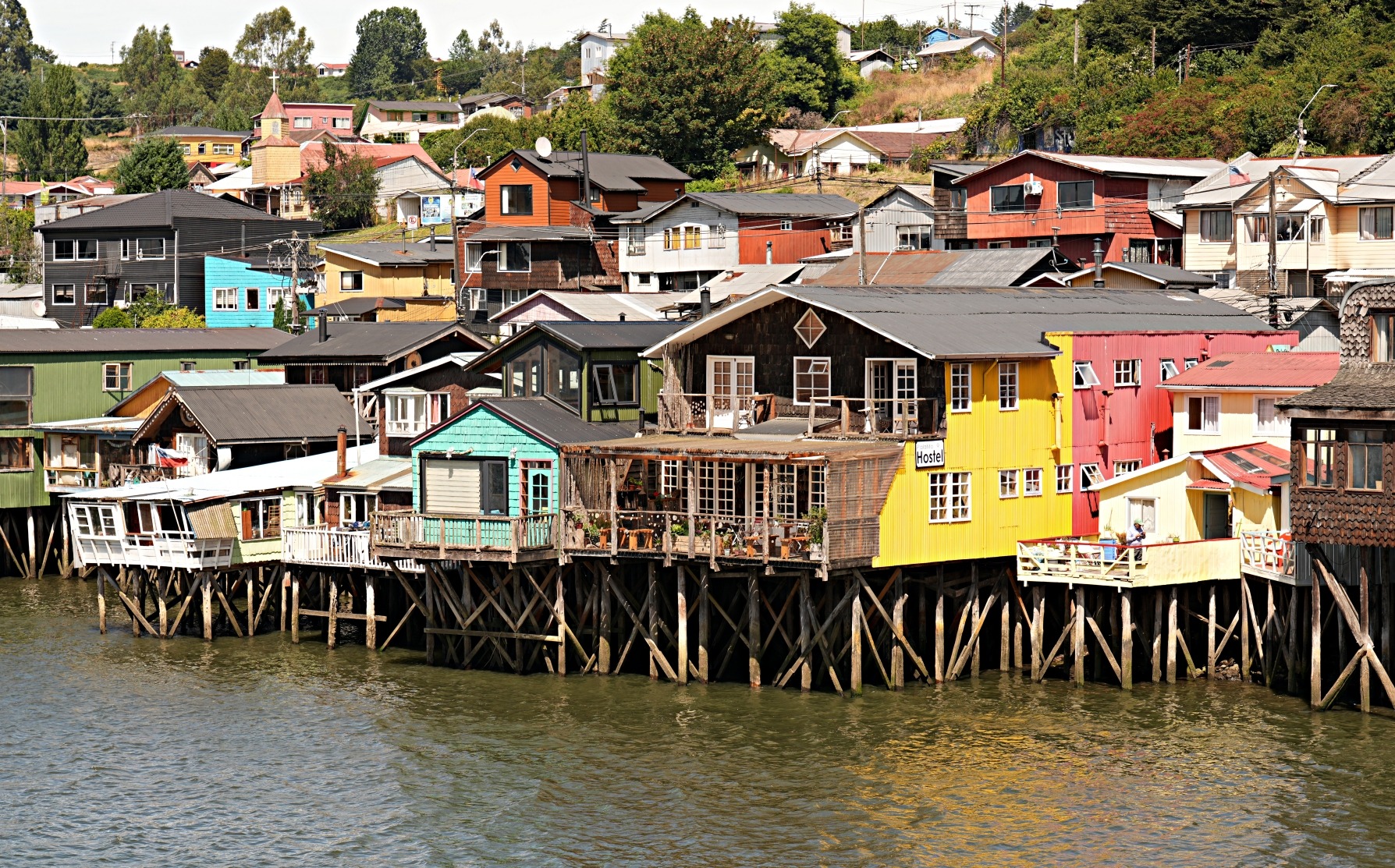
Sitting on the edge of the water, 19th century, colourful stilt houses (palafitos) add an interesting character to the city. Once home to the city’s fishermen, today, the palafitos are one of the city’s main attractions. Recently, boutique hotels, hostels and trendy restaurants have joined the fishermen by moving into the palafitos.

There are two different stilt house communities in Castro. Gamboa is the most often photographed because you can see it from across the Gamboa River. From there, you have the perfect view of the colourful houses above their wooden piles. Some have boats tied up to the piles, which adds even more charm to the scene.

We first visited when the tide was low so there was mud beneath the houses and fishing boats were resting on the sea floor. During high tide, the scene is quite different because water has replaced the muddy shore. At hightide, seawater flows under the houses, and the boats float on its surface. The pictures below are arranged in pairs so you can see the same area, including boats and houses, first at low tide and then at high tide.

Check tide tables before going, because it is interesting to see both at high and low tides.


Above the stilt houses, is one of the 60 or 70 wooden churches in the archipelago. This one is not a UNESCO-designated church, but we still liked to see the old building.

Another community of stilt houses is at the other end of the city along Pedro Montt Street. As we walked along the sidewalk in front of them, we didn’t realize they were all stilt houses. They are colourful and wooden, but otherwise you wouldn’t know they were on stilts. One of them is a chapel, Capilla Palafito Santa Maria de los Angeles. It may be the first stilt church we’ve ever seen.

From their side, though, you can see they are on stilts. At low tide, the muddy land extends far away from the houses, but they looked quite different when the tide comes in. These are also displayed below in before and after pairs.


Part of this community is on the other side of the road around a lagoon. Even at high tide, the lagoon in front didn’t fill with water.

The rest of the city has a different look from the stilt houses, mostly because its streets climb the steep hills from the estuary. They are lined by typical Chiloen architecture, which includes boldly coloured wooden houses. Their outer walls are often decorated with larch shingles, called tejuelas, unique to the area. Tejuelas are made in a variety of shapes and add a touch of cuteness to the vernacular architecture.

The people from the archipelago were well regarded for their shipbuilding skills. Their most famous ship was the Ancud. We saw a re-creation of it in Punta Arenas. Those shipbuilding skills were also used to build the wooden homes and churches.

At the base of those hills is a small port and a waterfront promenade. Along the walkway are a number of unexpected finds including wooden art installations and old trains. A railway once travelled the 88 km between Ancud and Castro, but these trains are all that remains.

In the centre of the city is the large Plaza de Armas. It is filled with tall trees, rose gardens and is a popular place for Castro residents to gather. It is also home to a small tourist market with souvenir stalls and tour agency touts.

In addition to seeing the stilt houses, we also wanted to see the UNESCO World Heritage wooden churches in Chiloe. The first one we saw was San Francisco Church, located on the side of Plaza de Armas. Although a Jesuit church was built on this spot in the 1500s, the one we see today was built under the Franciscans in the early 1900s.

We’ll talk about the building in more detail when we visit all of the UNESCO wooden churches next. You can read about it in our post UNESCO Wooden Churches in Chiloe Archipelago.

Beside it is an old wooden building that used to be a part of the church’s monastery, but is now an artisan market.

Castro and Ancud are the largest cities and have the most infrastructure in the archipelago. Castro is more central, making it easier to visit other parts of the island. It also has a wide range of accommodations including stilt houses set up as hostels and boutique hotels. Many of these stilt houses are also restaurants and coffee shops. Remember, though, at low tide, the smell coming off the estuary is not the most pleasant. In addition to the stilt houses, many traditional wooden buildings now operate as locally run hotels and apartments. If you have a car, you could stay in one of the smaller villages for a more peaceful stay.

Most will access Chiloe from the city of Puerto Montt. Queilen Buses frequently travel between Puerto Montt’s bus station and the archipelago, stopping in both Ancud and Castro. The bus even travels across the Canal de Chacao on a ferry, so you don’t have to change buses (3 1/2 hours to Castro). You can buy tickets at the bus stations in Puerto Montt, Castro and Ancud.

There are several public buses running between the towns on Chiloe Island including Nercon, Vilupulli, Chonchi, Rilan and Dalcahue. You can find their schedules in Castro’s bus station. To visit towns other than these, it is probably best to have a car.

Click on the link to read our Travel Tips For Chile. (Coming Soon)

Read from another device.

To read more of our adventures in Chile, click here.

Fediverse reactions

50 responses to “Stilt Houses in Castro on the Chiloe Archipelago”

  1. I am not sure I could live in such a house. I guess there would seldom be a humidity problem, unless that problem was too much humidity. There are some large houses built on those stilts and I wonder about their durability and longevity. Thanks for sharing Maggie. Happy Friday. Allan

    1. I imagine they need regular maintenance, but many have been there for generations. Thanks Allan

  2. Quite the place. The stilt houses reminded me of the ones in Bear River in Nova Scotia, but they are much prettier with their bright colours. As you know, Canadians tend to be more conservative when it comes to house colours.

    1. Well NS houses have a lot more colour than those on the prairies! But they did take it up a notch in Castro. I haven’t been to Bear River, is it worth a visit?

      1. Bear River is small. It has a lot of artisan shops and the buildings on stilts. We stopped in while on a road trip several years ago that looped the south end of the province included Digby, Briar Island, Yarmouth and Shelbourne. You can see the entire village all in an hour. I wouldn’t call it a destination but it was a nice little stop.

        1. I’ve been to Digby, Shelbourne and Yarmouth, but missed Bear River. Next time 😊

  3. The quaint vibe of Castro is appealing. I’d like to stay in one of those houses but would not want to live in one as a tenant or an owner.

    1. I wouldn’t want to live in them either, I had wished we stayed in one until we visited at low tide. The smell was not pleasant. 😊

  4. We have roughly the same photos.🙂 I got lost there, almost lost my guide.😀
    Of course, the history there is short, less than 300 years. But you have to admit that those wooden churches are just a kind of naive art compared to those in Maramures.
    You keep writing about Puerto Madrin. Is it the one in southern Argentina or is there another one in Chile?

    1. I admit, I had certain expectations based on the wooden churches in Maramures. These ones are much simpler, aren’t they?
      I wonder if it is a translate issue because it is Puerto MONTT, not MADRIN (capitals are to prevent translation) in Chile.

      1. I’m sorry, although I read it several times, each time I read it wrong.😀

  5. Those brightly colored houses built on wooden stilts over the water are quite amazing- the town certainly has plenty of unique character and distinctive architecture.  I love Chiloé’s UNESCO-protected wooden church and its wonderful canary colour too. Thanks for sharing, and have a good day 🙂 Aiva xx

    1. It is a very charming area, full of colour and character. It is one tonkeep in mind if you visit Chile, although it is quite out of the way. Thanks Aiva

  6. Very nice tour of Chiloe Archipelago. We visited but on a day tour and it was raining the day we went. If we had known it was so pretty we probably would have gone for a few days. But sometimes you make decision on the spot that aren’t the right one…(Suzanne)

    1. We really enjoyed Chiloe, but luckily had very good weather. I guess your day trip was from Puerto Varas? That is a long way, which probably also made it less enjoyable.

  7. Stilt houses are fascinating to me. Above the water is not the place that would come to mind when building a house. It would be interesting to watch them construct some.

    1. I imagine the builders have to spend a lot of time at the start in the water which wouldn’t be fun. But it is an interesting way to live. Thanks Lyssy

  8. Castro’s UNESCO-protected wooden church with its beautiful canary colour looks amazing, dear Maggie, and so do those colourful stilt houses along the waterfront. It certainly looks like a unique destination. Thanks for sharing, and have a good day 🙂 Aiva xx

    1. Thanks again Aiva

  9. We only spent a day on Chiloe and the weather wasn’t great but of course we saw some of the churches and also had time in Castro to see the church there and these colourful stilt buildings. Apart from that though we saw relatively little so I enjoyed seeing a bit more of the town through your photos 🙂

    1. We didn’t expect much from Castro other than the stilt houses, but the whole town is quite cute with colour climbing up and down the hills. I’m glad we spent a few days. Thanks Sarah

  10. Wow what incredible houses. I love all the colour; it reminds me of Cambodia and the colourful stilt houses over Tonle Sap.

    1. Tonle Sap was not colourful when we visited. Interesting that they have painted the stilt houses, they were just wooden when we saw them.

  11. The stilt houses are very colorful and unique. You always find the most interesting places.

    1. This is definitely a unique part of Chile. Thanks Tricia

  12. A beautiful set of photos of the stilt houses, Maggie. They’re also somewhat common in Yellowknife and Inuvik in order to protect the permafrost. Cheers.

    1. Interesting, haven’t been to either yet. Thanks Lynette

  13. Those old trains made me smile, Maggie. It’s a colourful, interesting place xx

    1. Happy to put a smile on your face Jo 😊

  14. Ahh….. the palofitos,,,,,,,, memories of past wanderings

    1. Happy to take you back 😊

  15. How interesting to see the front of those houses on the street and then on the opposite side their backs with stilts over the water – the inhabitants have the best of both worlds.

    1. I know, we didn’t realize that the entire street was stilt houses until we reached an opening and could go down to the water. You’re right, they can walk out one door, and boat out the other. 😊

  16. The colourful stilt houses look so picturesque along the waterfront. It’s neat to see the difference between low and high tide.

  17. What about waste management? Is there any sewage system?

    1. Well, we didn’t see any pipes, so they likely wait for the tide to come in. Some of them now, such as the hotels, have apparently added in septic tanks that are emptied regularly, but many of the older, local homes still do it the old way.

  18. Love the stilted houses.

    1. Thanks Pat, they’re awesome!

  19. Stilt houses are a sight I usually associate with Asia, not South America. It’s interesting to learn that Castro has a lot of them. Now I’m even more intrigued by the UNESCO-listed wooden churches!

    1. It is a very unique part of Chile, with their wooden home and church construction techniques. We liked Castro more than expected. Thanks Bama

  20. Never heard of the stilt houses in Chile before. They look intriguing! Lucky you that you got to visit them.

    1. They were so many of them too, and all brightly coloured. It was a great day. Thanks Annie

  21. Wow, this is really unique. I suppose if it’s all you’ve ever known, it would just be normal to sometimes have water under your house and out your windows. For me, that would definitely take some getting used to. I wonder how well the stilts hold up in bad weather. I’d be afraid of them collapsing.

    1. I imagine they need replacing more than regular house foundations, but some have been up since the 19th century, so they must have figured it out. It is a strange way to live isn’t it. Thanks Diana

  22. As others have noted, it is a strange way to live (but if that’s all you know, I suppose it’s quite normal 😉). Thank you for the low and high tide photos – it was good to see how it differs. And there is definitely no shortage of colour – whether it’s the stilted houses or boats.

    1. The difference between tides makes a huge differnce in how they look, and smell 😊

  23. Those stilt houses are so colorful and picturesque. I’d love to boat around that area. It would be a tough place to live, though. I saw your comment about the smell at low tide… eww.

  24. What a interesting and beautiful collection of houses. I love how different each one is

    1. It is a unique way of living and very photogenic. Thanks Meg

  25. The stilt housing is intriguing. It is interesting how people live around the world, Maggie.

We'd love to hear from you, please leave a comment.

Destinations

Discover more from Monkey's Tale

Subscribe now to keep reading and get access to the full archive.

Continue reading