
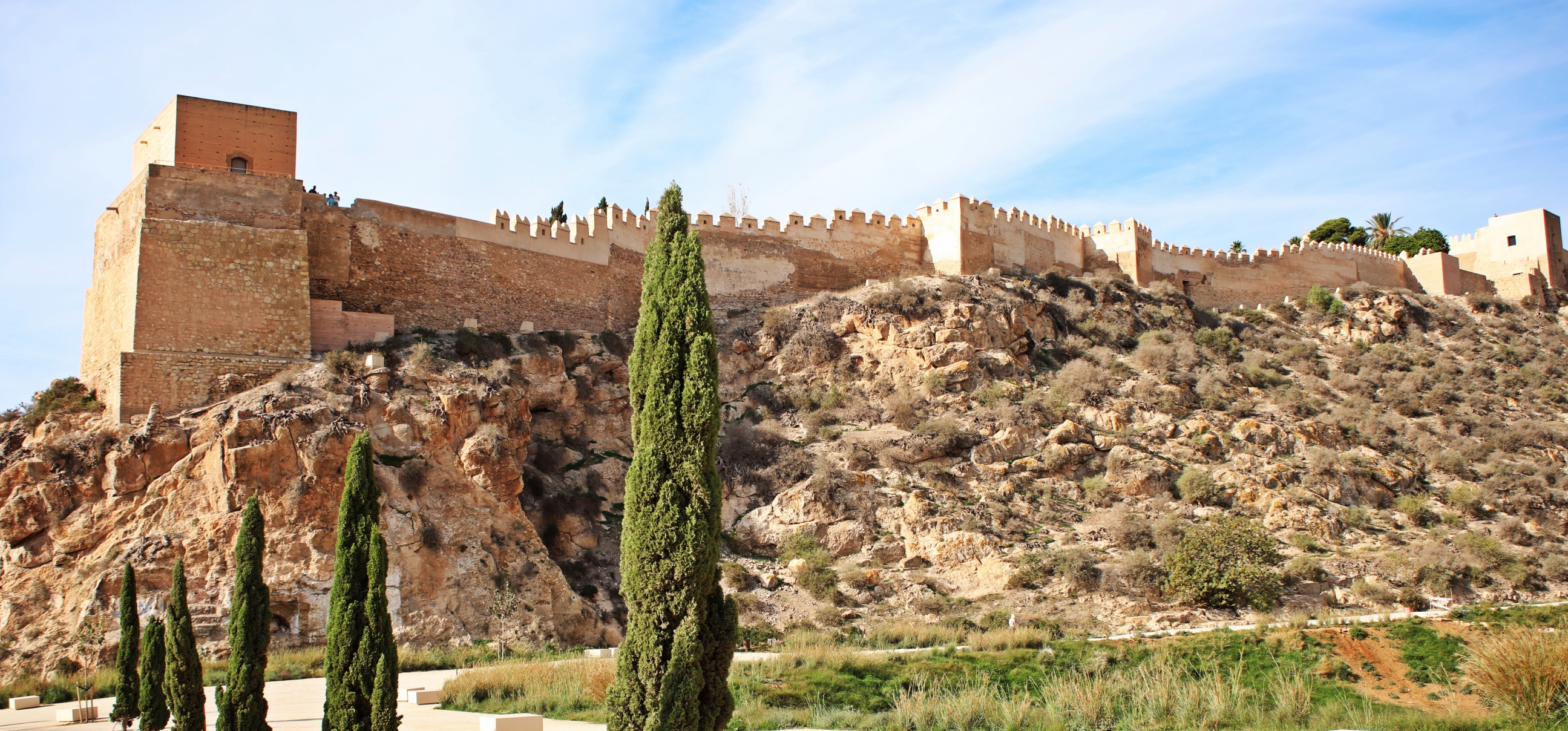
As the most eastern capital of Spain’s Andalucía Region, Almeria isn’t visited as often as other, more famous centres. Today, it is predominately a modern city, but its Moorish alcazar, Spanish cathedral and sandy beaches are beginning to attract attention. Come with us as we explore the sites in Almeria.
Almeria’s location between the eastern slopes of the Sierra Nevada Mountains and the Mediterranean Sea made it a desirable location for over millennia. Before the Spanish, it was called home by the Phoenicians, Romans, Visigoths and Moors. For many, it was a fishing town, but for the Moors, it grew in prominence during the days of the silk trade. Their influence can still be found in a few parts of the city.
Alcazaba of Almeria
This 10th century citadel still has a prominent place atop a hill overlooking both the city and the Mediterranean Sea. There is evidence that the hill was used during the Bronze Age, and then by the Romans. It was the Moors though, who built an alcazaba. Most of the fortress’ crenellated exterior walls are still standing. The best way to see these walls and its hilltop location is from Mediterráneos de La Hoya Garden below.
The alcazaba is second in size to the Alhambra in Granada, which speaks to the importance this city once had in the silk trade industry. It was named Al-Mariyyat (Watchtower) by the Moors. Alcazaba comes from the Arabic word, Al-qasbah which describes a fortified citadel within a city. In Morocco, they use the word Kasbah.

The Moors divided the complex into two parts. One section contained the fortified city, the other held the palace. The entrance to the complex leads you into the previous Moorish city. Instead of ruins or buildings, a large, tiered garden spreads across the space where the village once stood.
Separating this garden and the former Moorish palace is Muro de la Vela ( Wall of the Sail). In the middle of the wall is an 18th century bell tower.


On the other side of Vela Wall are ruins of the Moors’ palace. Today there are only partial walls of buildings, but the external wall is still in good condition.


Almeria came under Spanish control in the late 1400s, only a few years before Granada. When the Spanish moved in, King Ferdinand and Queen Isabella added a third section to the alcazaba. At the very top of the hill, they built their residence. The new wall had watch towers that helped keep an eye out for attacking Moors.
This Spanish section is mostly an empty shell, but the three towers, The Keep, Torres Noria del Viento (Windmill) and Pólvora (Powder) Towers still stand. From the top of the towers, you can appreciate why this location was so coveted. Not only could we see the modern city, we had a panorama that extended far down the Mediterranean coast.


Some Hollywood shows were filmed here including Game of Thrones, Indiana Jones and the Last Crusade and Conan the Barbarian.
On the neighbouring hill are the remains of the 10th century San Cristóbal Castle (Castillo de San Cristóbal). The castle is closed to visitors but a park was built on the hill, allowing visitors be treated to similar views of the Mediterranean.

The streets below the alcazaba are home to a few medieval era homes. Most of the historic buildings in the city’s downtown though, are pinched between modern buildings.


Almeria Cathedral
The large Almeria Cathedral is the only fortress-church in Andalucía. Its austere look doesn’t give much indication that it is a church. You may only figure that our when you spot some of its ornate doors and very large belltower. Its stoic outer walls have six towers, chunky turrets and buttresses. The only decorations are a few peculiar faces on the walls.


Beaches
Factors such as frequent droughts and earthquakes as well as its distance from trade routes to the Americas, led to the city being partially abandoned. Today though, it has found a new resource. Its beaches are becoming a draw for tourists. Although it’s not busy yet, it may be soon.
We walked along the paved malecón that travels beside the connected beaches of San Miguel, del Zapillo & Ciudad Luminosa. It was quiet in October, but its a lovely area and the sunbeds are likely full in the summer months.


Aguadulce
Not far away from Almeria is the charming beach community of Aguadulce. Its placement under the cliffs of the Sierra Nevada Mountains gives it a unique and scenic setting. The age of the buildings makes it feel a little like a 1970s beach resort, but it has a nice marina and a tree-lined boardwalk. The weather was perfect in October and there were still a few sun worshippers on the sand.


Where to stay and eat in Almeria
There are not a lot of hotels with parking in or near the city centre, but there are a few more along the beaches. You could also stay further out in a beach community such as Cabo de Gata-Níjar. We stayed in the nearby beach town of Aguadulce and found it very relaxing with easy access to the sites in Almeria. There is a frequent bus that travels between the two cites.
Restaurants in Almeria and Aguadulce are closed between midafternoon and early evening. There didn’t seem to be a tourist area that would have restaurants open in the off-hours. One great custom that all of the restaurants follow is that if you order a drink, it will come with a complimentary tapa. In Aguadulce, there are a lot of chiringuitos (Beach Bars) that serve delicious meals.
How to get to Almeria
As capital of the province of Almeria, the city has an international airport with flights from major centres in Spain and a few from Europe. It also has a bus depot and train station that connects it to nearby Spanish cities. If you have a car it is easy to reach on good freeways.
Almeria is in the lower right section of the map below.


To read more of our adventures in Spain, click here.
Coming Next – Discover Hidden Gems in Cartagena & Murcia
For pictures from other blogs go to Gallery at monkeystale.ca
To read about more of our adventures go to Destinations.
If you like what you read, please comment or share (with credit) using the links below.





We'd love to hear from you, please leave a comment.