
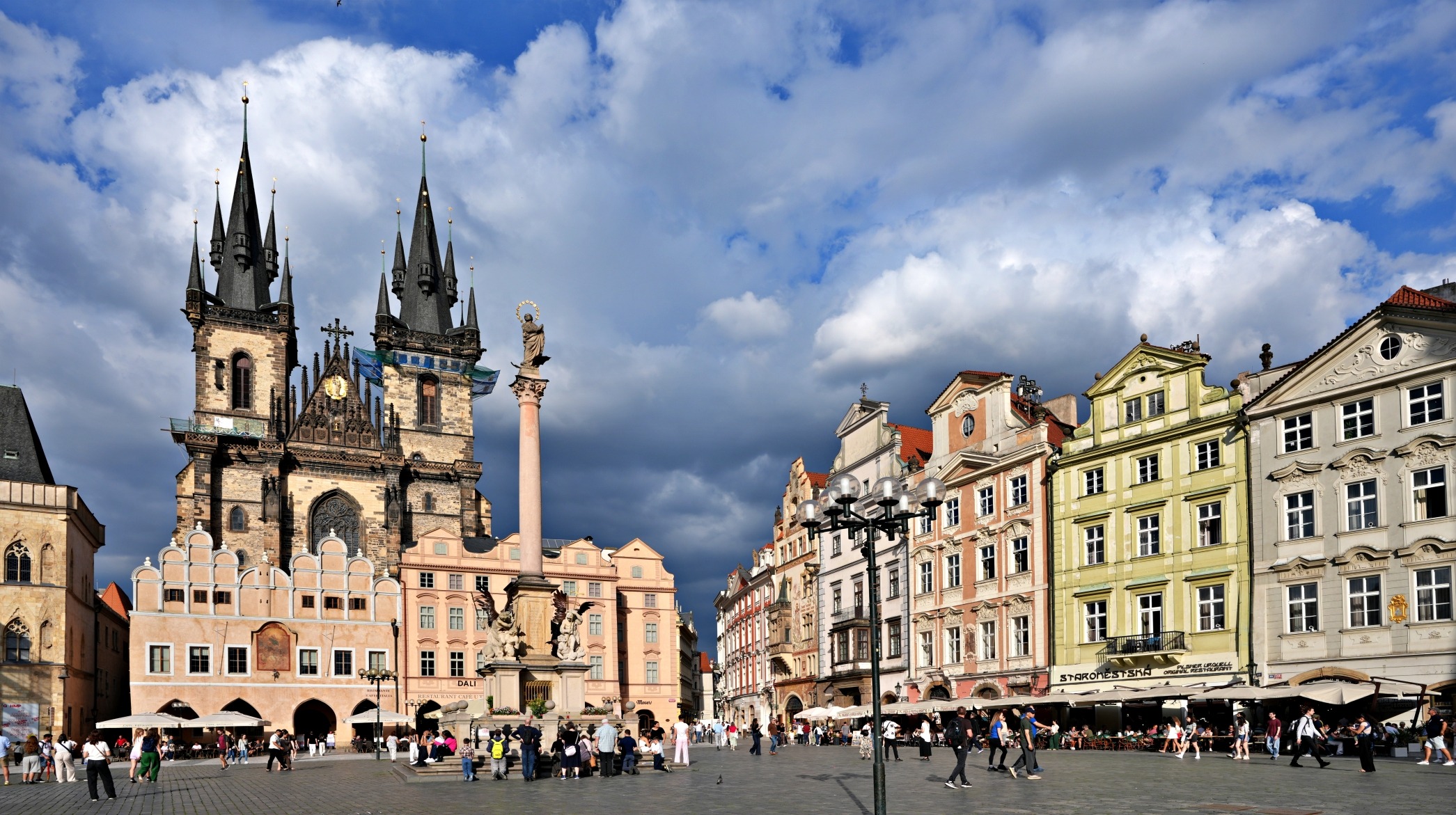
Prague’s historic centre stretches out in every direction, and its old streets let you walk from its Romanesque core through its Gothic, Renaissance and Baroque eras. What makes Prague truly amazing is that, unlike many other European Old Towns, its beautiful old buildings are not limited to a couple of blocks around the main square. In Prague, they continue on the footprint of the old city, on both sides of the river. Exploring its streets is like walking through a continual time machine as one era blends into the next.
To find where Prague is located please visit our interactive map of Czechia.
Old Town
What began as a 9th century small market on the edge of the Vltava River became a city in the 1200s when it was founded by Wenceslas I, King of Bohemia. He surrounded Old Town (Staré Město) with a protective city wall and a moat that incorporated the river. Today, only a few scraps of that wall remain, but most of Old Town is still intact. A couple decades later, King Ottokar II founded Lesser Town (Malá Strana), on the other side of the river. We’ll explore it when we visit Prague Castle.
Over the next hundred years, the town grew in importance, which meant more and more tradespeople moved to Prague. In 1335, Bohemian King Charles IV became Holy Roman Emperor, firmly establishing Prague’s place in history. It was under his reign that the most famous and elaborate structures were built, including Prague Castle, St. Vitus Cathedral and Charles Bridge.
By the mid 1300s, Old Town was bursting at the seams, so a new community was established outside the city walls. This new district was called New Town (Nové Město). While it is still old to us, you can see a definite difference in styles as you walk from one to the other. Together, three connected districts, Old, Lesser and New Towns, make Prague’s historic centre very large.
Part of what makes Prague so special is that these areas were not damaged in WWII, so this large historic area is filled with authentic structures. Because this is such a historically important area, Prague’s Old, Lesser and New Towns are collectively a UNESCO World Heritage Site.

Old Town Square
Begin your visit to Prague in its Old Town Square (Staroměstské Náměstí). You’ll be enchanted as soon as you see the pretty burgher buildings framing the old market. These merchant homes have been here since the early days of the city, but over time many were rebuilt and redesigned. The result is a look that combines several architectural styles. Today, most have patios at their base and are the perfect spot to rest over lunch, dinner or Czech beer.


Church of Our Lady before Týn
Above those pastel buildings, the fantastic and unique Gothic twin towers hovering above will steal your attention. Built between the 14th and 16th centuries, the Church of Our Lady before Týn is considered a masterpiece of Gothic architecture.
It seems to have an unusual placement because it’s not really on the square; a row of houses stands between the church and the square. The reason is that the church we see replaced a smaller one, and the houses that were already established on the square were left in place.


The church’s interior is a stunning mix of Gothic, Baroque and Renaissance decor. Photography is not allowed inside, so you’ll have to visit yourself to see it.
Entry is free; donations are appreciated; Opening Hours – 10 am to 1 pm, and 3 pm to 5 pm; Sundays from 10 am to noon. Closed Mondays.
Old Town Hall
The square’s other main feature is the Old Town Hall (Staroměstská radnice) and its iconic Astronomical Clock. The Town Hall was first established in the 1300s when city councillors purchased a merchant house. As the city grew, Town Hall also expanded by purchasing adjoining properties. This amalgamation of homes makes it one of the most unique Town Halls we’ve ever seen. It must have been even more impressive in earlier times, though. During the Prague Uprising after WWII, part of the Town Hall was destroyed and never rebuilt.

Astronomical Clock
Thankfully, its 14th century attached tower still stands. Built in the 14th century, its appearance transformed over the centuries. Those changes included adding the iconic clock in the following century, and its zodiac symbols in the 1800s.
Not only is the clock beautiful on its own, but every hour a puppet show draws a crowd. In it, a procession of Jesus and the 12 disciples parade in front of the two windows. The puppet show takes place every hour, on the hour, between 9 am and 11 pm.


For an amazing view of Old Town Square, climb up to the top of the tower. From this elevated position, you get a better view of the large cathedral, crammed into the space between the older houses.
Tickets are purchased in the Town Hall.


Jan Hus Memorial
In the centre of the square is the monument to Jan Hus. The former catholic priest became a religious reformer when he condemned the corruption he saw in the catholic church. Hus was burned at the stake for his heresy, and four years later his followers led the resistance army in the Hussite War. This statue, erected on the 509th anniversary of his death, depicts Hus standing above a burning stake. The monument also pays tribute to those who died or were banished during the Protestant-Catholic battles.

In addition to the Old Town Hall and the cathedral, there are many more buildings to take notice of in the square, including the Gothic Baroque Church of St Nicholas, the Rococo Kinský Palace, and the Gothic House at the Stone Bell beside the cathedral.

Powder Gate Tower
Only a couple blocks away from Old Town Square is the 65 m (213 ft) tall Powder Gate Tower (Prašná Brána). Built in 1475, it was one of 13 original city gates. You’ll see similar high-pitched tent roofs on many Czech’s towers, and adding to this dramatic feature, statues of the country’s kings and saints adorn its outer walls. Its glamorous look matches its function as the starting point of royal Coronation processions. The name, however, comes from its second function, but it looks far too pretty to store ammunition.
Beside it is the ornate Art Nouveau Obecní dům (Municipal House (1912).

You can go inside and climb to the top of the tower. The ticket office is on its main level. Open – 9 am to 8:30 pm in the summer.
Old Town Streets
After admiring the buildings in Old Town Square, spend time just wandering the surrounding streets and admiring the gorgeous heritage buildings. You don’t need a plan since these street go on for many blocks.


When you’re ready to head to the river, the are several paths to choose from. One of the cutest is Karlova (Charles Street), but there are others near Bethlehem Square (Betlémské náměstí) too. On your way between these two, look out for the quirky Man Hanging Out by Czech artist David Černý.


Vltava River
Defining the border between Prague’s Old and Lesser Towns is the Vltava River. With so much history on either side, you know there will be much to see along its banks. We’ll come back to the river when we take you to Prague Castle and Lesser Town, but let’s take a quick trip there now.
On the Old Town side is the picturesque Old Town Water Tower and the attached waterworks building. Together, they pumped water from the river to the Old Town. Today, the waterworks building houses the Bedřich Smetana Museum.
Further down the river is the ornate National Theatre. We actually walked toward the theatre to see it up close, but with so many buildings surrounding it, the best view is from further away.
Remember to return at night to see these historic buildings beautifully illuminated.


We’ll also give you a sneak peek at the famous Charles Bridge and Prague Castle on top of the hill.


Clementinum Library and Astronomical Tower
A 13th-century Dominican Monastery once occupied this space on the edge of the Vltava River, but it was looted and destroyed by Hussites in the 1400s. When the Jesuits arrived in the 1550s, they used what was left to establish a religious complex. Their goal was to re-Catholicize Czechia through education, so they opened the university. They named it Clementinum after St. Clement Church, one of the only remaining buildings from the Dominican Monastery.
As a centre for learning in science and religious studies since the Middle Ages, Clementinum is the second-largest complex in Prague. The large religious campus includes dorms, lecture halls, an apothecary, a printing room, an astronomical observatory, a chapel, and churches.
Baroque Library
Visiting the Jesuit college today means taking a tour of its Baroque Library and Astronomical Tower. From the outside, it doesn’t stand out, especially compared to other buildings in Prague, but don’t let its outer appearance fool you; its interior is magical.
Today, the Baroque Library is open as a museum and what a museum it is. Completed in 1727, the elaborate room has spiral columns that give the space a dynamic look. In addition, using trompe-l’oeil techniques, the frescoes on the ceiling give the illusion of high domes in the barrel ceiling.
In 1773, the Jesuits were disbanded, and the monastery, including the library, became a public school and library. Today, it belongs to the National Library of Czechia and is an archive of 27,000 books. The tour only lets you look from the library entrance. Learning this, we debated if it was worth visiting. As you can see in the pictures below, it is definitely worth a visit.


Astronomical Tower
At 68 m tall, you can see the Astronomical Tower from many parts of the city, but in a city of over 100 towers, you need to know which one to look for. A visit includes climbing 172 steps to the viewing balcony at the top, but there are also a few things to see on the way up.
Of those we saw, Meridian Hall is the most interesting. In this room, you can see their old methods that kept the entire town operating on the same time. It included a meridian line on the floor and a tiny hole in the ceiling positioned so that the sun would shine on an exact point at noon. When this happened, a flag waved from the tower, signalling the churches to ring their bells. Since clocks and watches were not very accurate, everyone in town waited for the noon signal. It didn’t work on a cloudy day, so they had a backup clock. Even if it was wrong, at least everyone was on the same wrong time.
The tower also has displays of other medieval equipment, including sundials and a large sextant to measure the angular arrangement of stars.

Below the observation deck, a study records astronomical and meteorological observations. Every day for the last 240 years, they have measured the temperature in this room, making it the longest-running temperature measurement in Europe.
The view from the top, though, is the main reason to visit this tower. With a 360° panorama, we picked out many highlights in the fantastic city, from Old Town Square in one direction to Prague Castle in the other.


The complex also includes St. Clementine Cathedral, St. Salvator Church and the Mirror Chapel. The churches are only open for special tours, and the Mirror Chapel is only open for concerts.
Entry- Tickets can be purchased in advance online, but if these are sold out, don’t worry; they hold back 150 to sell at the tower every day. We were told to arrive around 8:30 am to guarantee a ticket. We did this, but there were still tickets available by 10:30. Opening Hours – 9 am to 8 pm, daily. The tour takes 45 minutes.
New Town
In the mid 1300s, a large population growth meant Old Town was bursting at its seams, so King Charles IV established New Town. It began as a planned community around three markets: Horse Market (currently Wenceslas Square), Cattle Market (currently Charles Square) and Hay Market. This meant that New Town wrapped around Old Town in a horseshoe shape, making Prague the third-largest European city in the 14th century. On its edge, St. Henry’s Tower seems to lead the transition from one area to the next.

Wenceslas Square
One of the main features of New Town is Wenceslas Square (Václavské Náměstí). The large square is actually a rectangle extending from the edge of Old Town to the National Museum at the end. It was under construction and torn apart when we visited, but we could still appreciate the centuries-old buildings on its sides. As you walk in this square, don’t miss the wonderful ornamentation on the eaves and rooflines.
It is a popular place for both tourists and locals, with many eateries, pubs and outdoor patios, and is always bustling with people.


The square is named for Czechia’s patron saint, Wenceslas, also known as Václav the Good. A statue of the saint stands at the end of the square in front of the National Museum. Strangely, he was the inspiration for the British Christmas Carol. Every time we walked through the long square, I couldn’t help myself from humming ‘Good King Wenceslas”.

Historic Train Station
Not far from Wenceslas Square and the old Hay Market, you’ll find Prague Main Train Station (Praha Hlavní Nádraží). It wasn’t easy to find its historic section, but if you follow the signs for the Historic Train Station, you’ll reach its decorated rotunda and hallway. Then, from the parking lot on Wilson’s St., you can see it from the outside.


Jewish Quarter
While it doesn’t look like it today, the Jewish Quarter (Josefov) was the site of a medieval Jewish Ghetto. In the 13th century, Jews were forced to leave their homes in Lesser Town and settle in this walled quarter. New migrants from Moravia, Austria and Spain were also forced to crowd into the ghetto. The district was almost completely demolished at the start of the 19th century during the city’s urban sanitization project; only 6 Synagogues remain. The revitalization included erecting Art Nouveau buildings which is what we see today.

The synagogues were spared from destruction by the Nazis because Hitler wanted to keep them open as the ‘Museum of an Extinct Race’. Today, you can visit the Jewish Museum, the cemetery and the Synagogues, including Maisel, Spanish, Jerusalem and Old-New. Each has a very distinct design.


Vyšehrad Fortress and Cemetery
If you have extra time, stop by the site of the old Vyšehrad Fortress. Not much remains of it today except a few walls. The best reason for visiting is the views of the fortress walls and the river.


Beside it is St Peter and St. Paul Church and the Vyšehrad Cemetery. The church was founded in 1070, but the current one dates to the late 1800s. Beside it, the 13th-century cemetery was the burial place for several famous Prague residents, including actors, authors, and painters.
There is a fee to enter the church, but the park is free. The church is open from 10 am to 5 pm; the park is open 24/7.


Not far from it, along the river, you’ll find the Instagram-trendy Dancing House and an old water tower.


How to visit the attractions in Prague
There is so much to see in Prague that you will need a few days. One option to see many of the sites is the Prague Visitor Pass. Find out more information on their website here; otherwise, you can purchase individual tickets for the attractions.
Getting to Prague
Fly – Most will arrive by air at Václav Havel Airport in Prague. There are a few ways to get from the airport to the city centre. You can use Uber or an official taxi; they have a desk at the airport. You can also take Trolley 59 or a taxi to Nádraží Veleslavín metro station, and take the Metro Line A to the centre.
Train – Prague city centre is very easy to reach by train from Gdansk, Krakow, Vienna, Berlin and many more. Prague Main Station (Hlavní Nádraží) is located near Wenceslas Square, making it very convenient.
Getting around Prague
It is best to explore Prague’s Old Town on foot. To reach other neighbourhoods, the trams and metro are very convenient. Pay with a credit card on the tram, or some stops have machines. Their public transportation system is integrated with Google Maps, so it is very easy to figure out where to go, which train to take, and the schedule.
Where to stay in Prague
There are so many options, from luxury hotels to hostels, in every part of the city. When you’re deciding where to stay, you should base it on the area you prefer. The city is very walkable, but the neighbourhoods we recommend are anywhere in Old Town, near Wenceslas Square in New Town, or in Lesser Town. Remember, though, that New Town is very hilly and the closer you are to the river, the less climbing it will be to reach your hotel. We stayed near Wenceslas Square because it offers easy access to the Old Square as well as the train station for day trips.
Tips – The currency is the Czech koruna (CZK), not Euro.

Here’s a link to read more of our adventures in Czechia, and a link to our interactive map of Czechia.
Coming Next – A Guide To Prague Castle
For pictures from other blogs, go to Gallery at monkeystale.ca.
To read about more of our adventures go to Destinations.
If you like what you read, please comment or share (with credit) using the links below.




We’d love to hear from you, please leave a comment.