
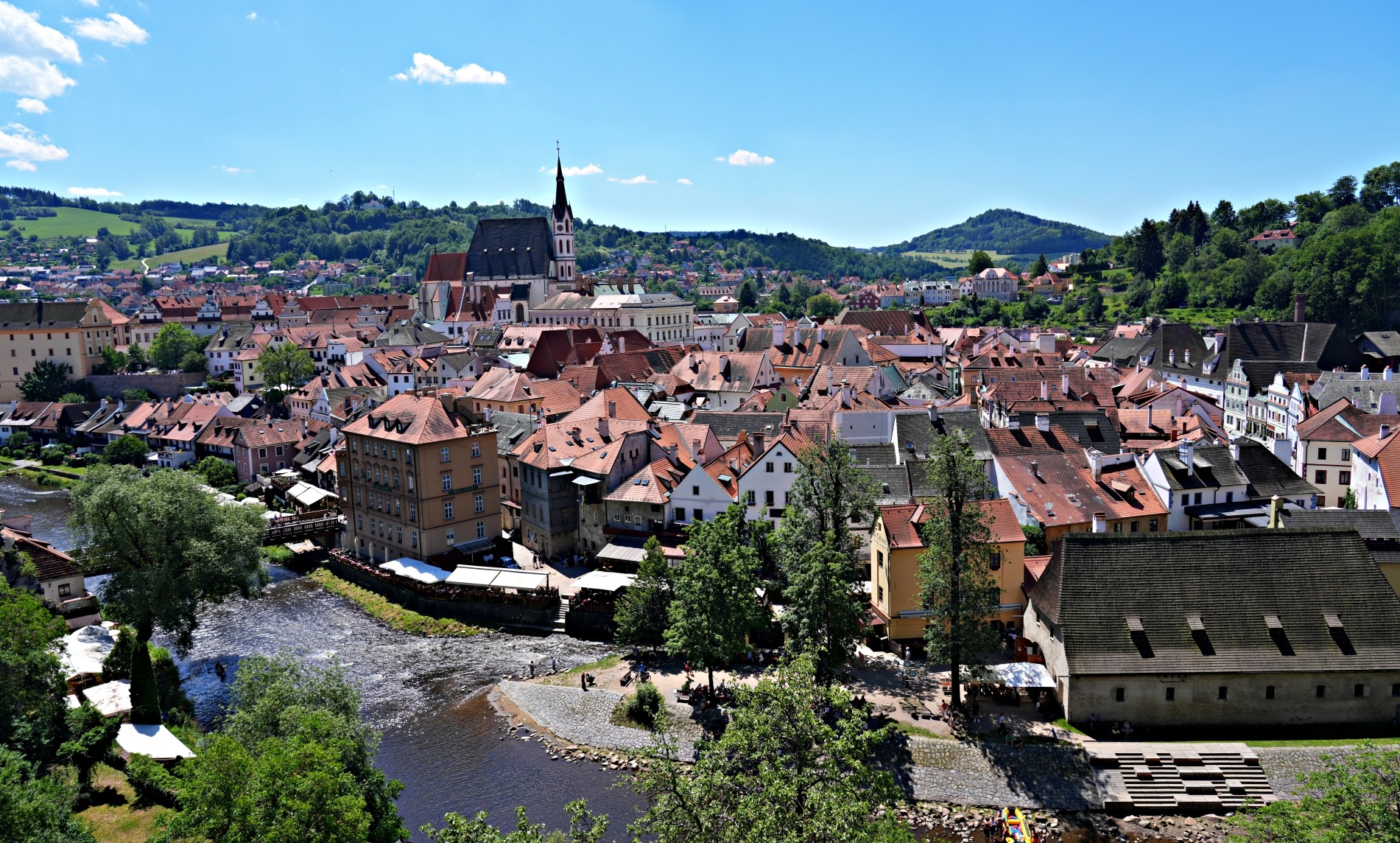
Cesky Krumlov looks as if it were torn from the pages of a fairytale. Its medieval castle overlooks a perfectly restored Old Town, leaving no wonder why Cesky Krumlov is loved by all who visit. Let us show you the magic of this charming Czech town.
To find where Cesky Krumlov are located, please visit our interactive map of Czechia.
Originally founded around 1250 by the Lords of Krumlov, ownership of Cesky Krumlov Castle (Český Krumlov) passed to successive noble families from Bohemia and Austria. Over the centuries, the castle changed its appearance and layout several times, until finally resting in its current footprint.
The town below followed the same pattern, so today, both the castle and Old Town blend several architectural styles. Because Cesky Krumlov was not located on a major transport hub, nor did it support large industry, it was spared during wars and invasions. As a result, it looks much the same today as it did in medieval times. For that reason, the fairytale castle and town of Cesky Krumlov rightly deserve the UNESCO World Heritage Site designation, and should be put on your must-see list.

When you visit, one of the best entrances to the castle is through Budweiser Gate, or Budějovická Brána. Although the short tower above the yellow gate was built to protect the city, we liked it because it is also very attractive. Not only should you enter this way to see the tower, but walking through it instantly immerses you in the magic of this town.


After walking along the car-free streets, passing a number of charming homes, you’ll find yourself at the first entrance to the castle grounds: the Red Gate. On the other side is the castle’s First Courtyard. At its side, the large Csesky Krumlov Monastery is almost too big to appreciate when you’re this close. Today, it is no longer a monastery, but rather operates as a museum and cultural centre.
Between the First and Second Courtyards, the castle is surrounded by a deep moat, which today is home to unusual animals for a Czech castle: three bears. They look well fed, but signs still warn visitors not to lean over the edges.

Why are there bears in a Czech castle? They are related to a 16th century tradition. Since there are bears on the Rosenberg Dynasty’s Coat of Arms, the family kept bears at the castle, and they have been here ever since. Animal activists, though, have become more vocal lately, and the bears will no longer be kept at the palace after 2030, which is still quite a long time away.

Visiting the castle means walking through a series of courtyards and open terraces offering views of the city. After crossing the moat, you’ll enter the castle’s Second Courtyard. This is where you’ll find the ticket office and have your first good view of the painted Castle Tower. We thought it looked far too pretty to be a part of a medieval castle. You can climb to the top of the tower, but the views are not much different from what you can get in other parts of the castle.
The only way to see the castle interiors is on a guided tour. The ticket office sells a variety of tour options, but be aware that photography is not allowed inside. There is still a lot that you can see without going on a tour. Remarkably, everything we’re about to show you can be visited for free.


At various points when you walk through the castle, don’t forget to take in the views of the Old Town and the river below. You’ll reach the first viewpoint not long after entering. From here, we can see the river’s curvy course and understand the origin of the town’s name. Krumlov is believed to come from the German words Krumme Aue, meaning Crooked Meadow. Since the Old Town was built on a kink in the Vltava River, the name makes sense. The twisted river almost puts the town on an island and therefore it only has a few entry points, which adds to its cuteness.

Cross under the next gate to reach the Third Courtyard, and then the Fourth. They are almost identical twins, so don’t get confused as you pass through them, both on the way in and out. In between the courtyards are narrow, tunnel-like passages that keep the next sight a surprise.
We saw several people dressed in medieval costumes and thought they must be castle staff. It turned out that we had arrived on the day a Medieval Fair was taking place in town, and a few arrived early to visit the castle.


The Fourth Courtyard leads to the picturesque Cloak Bridge. This covered bridge has tall statues on its edge, making you feel like royalty as you cross. It was first built as a drawbridge, but by the 1600s, it was converted to a permanent stone bridge. The bridge is another spot offering wonderful views.
At the end of the bridge is the Fifth Courtyard and the entrance to the theatre and the royal stables. Both operate as museums and require a ticket.


Before leaving this area, stop at the open terrace on the side of the Fifth Courtyard for a lovely view of the Castle Tower and the town below. From here you can also get a good view of the elaborate Cloak Bridge.


From the bridge, walk up the hill to the castle gardens. Established in the 17th century, the large garden has an 18th century fountain, rose bushes and manicured hedges. At the end is a revolving auditorium which has summer theatre performances.


Tickets and Hours – There are several options for tickets depending on which you want to see; many are only accessible with a tour. For complete information, visit their website. Remember, though, everything we showed you can be visited for free.
Cseky Krumlov Town
Once you’ve explored the castle, take the Castle Stairs down to the oldest part of town. As you walk down you will be treated to peek-a-boo views of the town and its two church steeples. The homes on the castle side of the river were built by staff and patrons of the nobles. They moved to the area early, which is why they are a little older than those on the other side. Most of the perfectly restored medieval homes that line the cobbled streets now serve the many tourists who come to the city each day.


Cross the river where you can admire the mix of Baroque, Renaissance, and Gothic buildings in the other half of Old Town. Each house seems to come in a different design or colour. Today, most operate as tourist shops, hotels and restaurants serving the many day trippers. Even the high number of tourists, though, can’t take away its charm.


Main Square
In the centre of town is the main square, Náměstí Svornosti. At its head is the Old Town Hall, but when we visited, they were setting up for the Medieval Fair, so a large stage blocked our view and the entire square was very busy.

St. Vitus Cathedral
Rather than enjoying a prominent spot in the town square, as is typical, St. Vitus Cathedral stands on a small hill, above the old town. It is easiest to see from a distance because the surrounding buildings are so close together on these old streets. From the cathedral’s elevated spot, you can see the castle through the narrow streets.


Seminární Zahrada
There are many places in town for nice views of the town and castle. One of our favourites is near St. Vitus Cathedral. Seminární Zahrada is a small park that offers a great panorama, including the castle and the Czesky Krulmov Monasteries. We walked past this collection of three monasteries in the castle’s First Courtyard, but from above we had a better view.


Chapel on the Hill
Another viewpoint is outside of town, on top of a hill, 110 m (360 ft) above Old Town. It’s the location of a small chapel and the Stations of the Cross. Unlike the castle, we had this view to ourselves.


When to visit Cesky Krumlov
Spring and fall are the best times, with smaller crowds and comfortable weather. It is very busy during the summer months because it is a popular day trip from Prague. Another popular time is December, when the Christmas Market fills the streets. It will be quiet in January and February, but also very cold.
How long do you need in Cesky Krumlov?
You can see all the attractions in Cesky Krumlov in a half day, going at a leisurely pace. There are more things to see in this area, though, so we recommend staying for a night or two in either Cesky Krumlov or Cesky Budajovice. You can read about Cesky Budajovice and the nearby Holašovice in our post, Czechia’s Hidden Gems.
Other activities
In addition to visiting Cesky Budajovice and Holasovice, there are a few other things to do.
Kayak – Rafting, canoeing or kayaking on the Vltava River is very popular. There are several companies renting boats and kayaks along the river. Road biking is also very popular in this region.
Bike – The rolling hills and lack of traffic make it perfect for getting out on your bike. The local train that travels between Cesky Budajovice and Cesky Krulov has a car dedicated to bike storage, so you can get off at any of the small towns it passes through and go for a bike ride.
Getting to Cesky Krumlov
Bus – To get to Cesky Krumlov from Prague, you can take the 3-hour Regiojet bus from the Špičák Bus Station in Prague. It lets you off just outside the walls of Cesky Krumlov.
Train – Another option is to take a train from Prague to Cesky Krumlov (45 min). You can easily reach Cesky Krumlov from Ceske Budejovice by bus or train.
The Cesky Krumlov Train station is 1 km from the Old Town, and the bus stop is 350 m. Both are on Google Maps; schedules can be found on Mapy.cz.
If you’re in Linz, you can take one of the twice-daily shuttle buses (90 minutes).
Where to stay in Cesky Krumlov
This town may be small, but it is very prepared for visitors. You can find many hotels and guesthouses for all types of travellers in the town, but prices are typically higher. An alternative is to stay in Ceske Budejovice and take the train or bus between the two sites.
Here’s a link to read more of our adventures in Czechia, and a link to our interactive map of Czechia.
Coming Next – Touring Kraków With A Local
For pictures from other blogs go to Gallery at monkeystale.ca.
To read about more of our adventures go to Destinations.
If you like what you read, please comment or share (with credit) using the links below.



We’d love to hear from you, please leave a comment.