
Standing in the middle of a forest of columns in Hypostyle Hall was a little overwhelming. Towering over us were ancient columns, decorated with hieroglyphics and reliefs, messages from Egyptian Pharaohs from centuries ago. This hall is just one of the many spaces in Luxor’s Karnak Temple with wonderful, thousands-of-years-old monuments that offer a glimpse into ancient Egypt’s traditions and beliefs. Join us as we take you through the mystical Karnak Temple and the fascinating Mummy Musuem.
There is a reason Luxor is the most visited city in Egypt; it has some of the most colossal and elaborately decorated buildings and rock-cut tombs anywhere in the world. Visiting Thebes, or Luxor, as it’s called today, means dividing your time between its ancient temples and palaces on the Nile’s east bank and the necropolises and mortuary temples on the west. It is definitely worth spending a few days here to see as much as you can.
To show you all these fabulous UNESCO World Heriage Sites will take some time, so we will present them over several posts. In this post, we’ll take you to Karnak Temple on the Nile’s east bank. In the next few posts, we’ll show you Luxor Temple and then the necropolises and mortuary temples on the west bank, including Valley of the Kings, Valley of the Queens, Noble Tombs, Worker’s Tombs, and the mortuary temples of Hatshepsut as well as Ramses II and Ramses III.
A Bit of History from Ancient Egypt and Luxor
To better understand these tombs, it helps to know some of the history. Around 3100 BCE, Upper and Lower Egypt united to become one territory, marking the beginning of the Dynasty of Pharaohs. In total, there were 30 Pharaoh Dynasties between 3,100 BCE and the 300s BCE. At many times in history, foreign rulers and citizen uprisings disprupted the Egyptian Pharaohs’ rule. With these disruptions as well as a change in the family dynasties, the history is further divided into Early Dynastic, Old Kingdom, Middle Kingdom and New Kingdom. The Pyramids of Giza were built during the Old Kingdom (2500s BCE).
The busy city of Luxor sits on the ancient Egyptian capital of Thebes. Even though inhabited for over a thousand years already, Thebes’ golden age was during the New Kingdom, beginning in 1550 BCE. This is when pharaohs built majestic temples and elaborately decorated their tombs. Some of the most famous pharaohs ruled from Thebes, such as Seti I, Ramses II and Tutankhamun.
It’s difficult to conceptualize such large time spans, but the monuments we’re about to see in Thebes were built approximately 1,000 years after the Great Pyramids of Giza. All have been designated as UNESCO World Heritage Sites. So, let’s visit these awe-inspiring sites now.
Note – Even though these monuments have been studied for decades, their exact dates are estimates. As well, historians don’t always agree on relationships or positions of non-pharaohs. We are including the most common dates and theories, which are usually those presented by the museums.
Temple Complex of Karnak
Originally built during the Middle Kingdom (around 1970 BCE), Karnak Temple experienced a dramatic expansion in the 1500s BCE under Pharaoh Thutmose I. As the first pharaoh of the New Kingdom, his rule began after Egypt endured a century of hardships under foreign rulers. The temple, therefore, was not only dedicated to the sun god Amun-Ra, but was also a display of the power and dominance of the new pharaoh and his rebuilt Egypt.
Karnak is also called the Great Temple of Amun-Ra.

After it was built, Karnak Temple continued to be expanded by numerous pharaohs over many centuries. As a result, it is one of the largest religious complexes ever built, second only to Cambodia’s Angkor Wat. As it grew, Karnak became more than just a temple; it was the epicentre of Egyptian politics, art, and spiritual rituals for the society’s elites.
Since this complex was built over hundreds of years, there is a wide variety of structures inside. In some areas, old structures were torn down to make way for new ones. In others, monuments from different eras stand side by side. All of this adds to the mystique of Karnak and makes a visit even more fascinating.
Avenue of Sphinxes
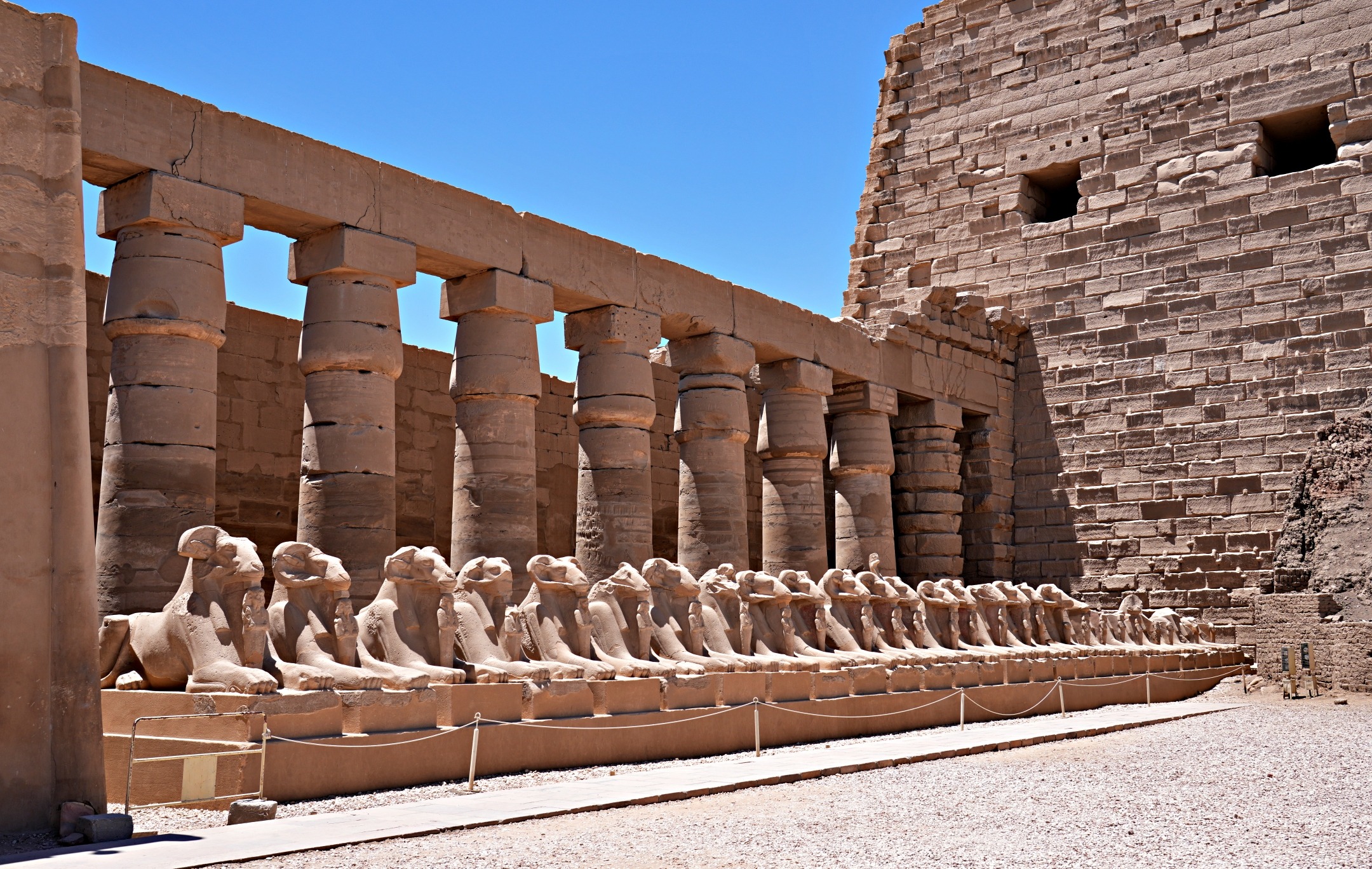
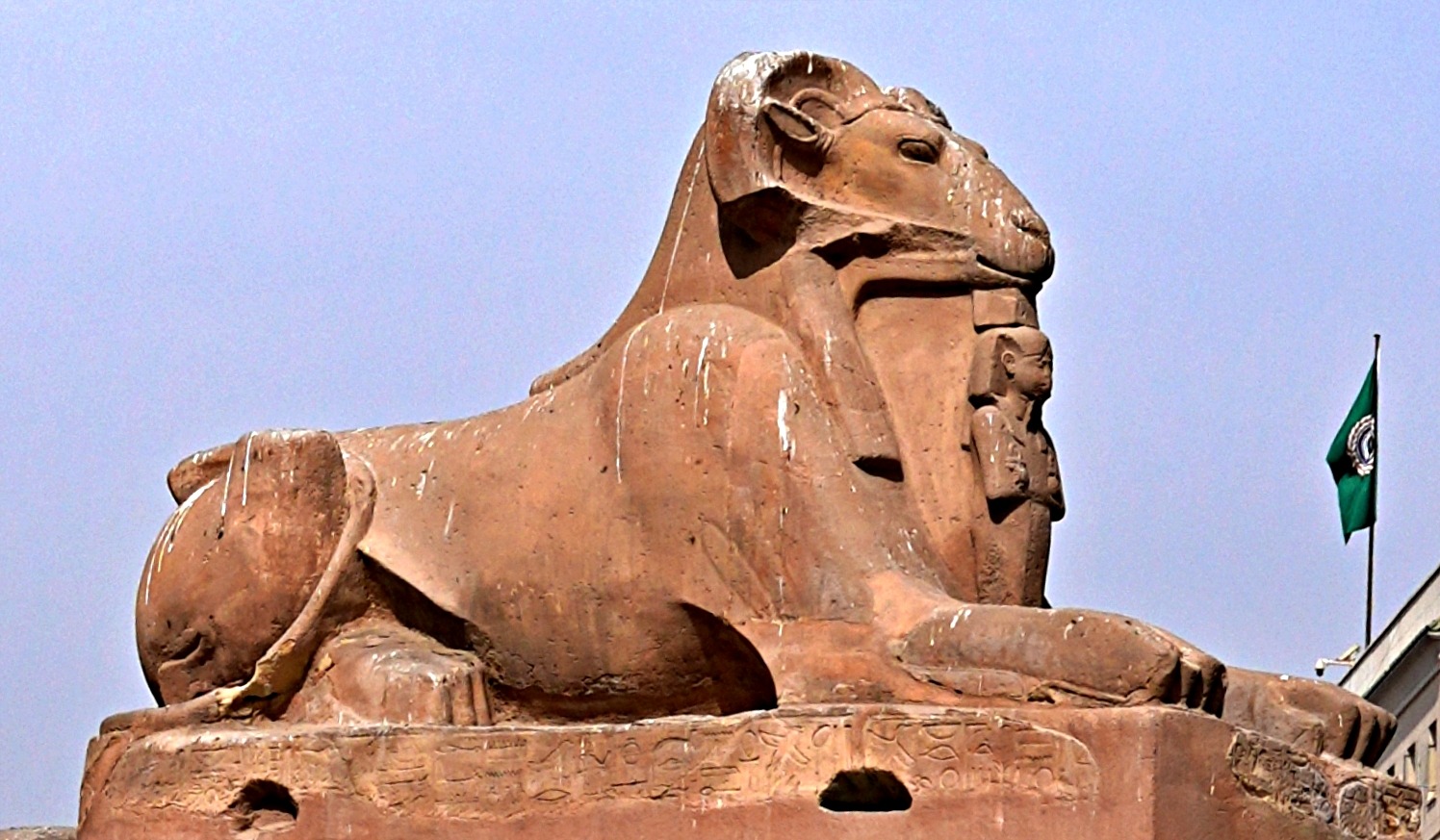
A parade of ram sphinxes welcomes you to Karnak and leads you to the main gate. Originally, the 3 km (1 ½ mi) road extended from Karnak to Luxor Temple and was lined with as many as 1350 sphinxes. It included both ram-headed and traditional pharaoh-headed ones. Work on the avenue began in the 14th century BCE under Pharaoh Amenhotep III and continued for over 1000 years. Remarkably, this avenue wasn’t discovered until 1949.
The ram’s head on a lion’s body represents the god Amun. He was a rather insignificant deity in ancient Egypt, but as pharaohs changed over time, their gods changed too. Amun rose to greatness in Thebes when he was combined with the sun god Ra to be Amun-Ra, the King of Gods.


A new tradition that Ramses II started was to include a statuette of the pharaoh between the sphinx’s forelegs, symbolizing their protection of the pharaoh.

The Avenue of Sphinxes was built for processions during the 27 day Opet Festival. As part of the celebration, pharaohs and priests travelled from Karnak to Luxor on golden barques (boats) carrying an icon of the triad Amun-Ra, Mut and Khonsu. At the end of the festival, the icon was returned to Karnak, symbolizing that the triad had rejuvenated. We’ll show you more from the Avenue of Sphinxes when we visit Luxor Temple.
Great Court
When you enter the complex, you’ll pass under the last structure built at Karnak, the 1st Pylon (gate). It was left unfinished, so the temple isn’t as impressive from the front as Luxor Temple.
On the other side of this gate is the Great Court. With a giant 21 m (70 ft) column, a row of sphinxes, and a statue of Ramses II, there is so much to see, and this is only the first space.

Temple of Ramses III
Off to the side of the Great Court is the Temple of Ramses III, built to house the barques (boats) used during the Opet Festival. It is one of only a few temples in Karnak that has been restored. Weathered statues of Ramses III guard the temple entrance. Inside, the walls are decorated in original raised and etched reliefs and hieroglyphics. The images include gods, pharaohs, and the Opet Festival procession.


We’ll show you many decorations on the walls in Luxor, including hieroglyphics, reliefs and paintings. Hieroglyphics are Egyptian text that tell tales of the pharaohs’ military conquests, religious stories and rituals. In royal tombs, they often instruct the deceased on how to reach the afterlife. In addition to the text, you’ll see many images painted or carved on the walls. They usually represent gods, pharaohs, religious offerings and battle scenes.
2nd Pylon
Walking through the 2nd Pylon was a wonderful introduction to what we’d see in the room beyond. Tall walls, painted white and decorated in colourful scenes, make it a stunning entryway into Hypostyle Hall.
Pylons are large, monumental gates, often with colossal statues in front. They are used at the main entrance to a temple and also to separate many of the new additions from the older areas.

Hypostyle Hall
The highlight of your visit to Karnak is the magical forest of columns, called the Hypostyle Hall. These rooms are found in many New Kingdom buildings and are filled with elaborate columns, built to support a roof. In Karnak, the large hall and its grandiose columns are adornded with thousands-of-years-old hieroglyphs and reliefs.
Pharaoh Seti I began construction on this hall, but it was mostly built by his son, Ramses II, in the 1200s BCE.


The decorations are not limited to the columns either. Stone slabs between the column tops, called architraves, are painted with cartouches. These oval nameplates include a hieroglyphic of the pharaoh’s name. Future pharaohs often created their own version of history by scratching out a previous pharaoh’s name in the cartouche and adding their own.


With a mix of open-flower and closed-bud papyrus columns, the 134 giant columns, combined with the artwork, make this a magical room.


The outer walls are not left bare either and are also decorated with images of deities as well as scenes of Seti I and Ramses II in battle.

Hypostyle Hall sustained significant damage over centuries of weather events and disuse. Most of the columns were toppled and lay in pieces. Thankully, though, it has been rebuilt and restored. Remarkably, the paintings and reliefs we see were cleaned, but not repainted. It only recently opened in January 2024, so we feel very fortunate to have seen it.
Obelisks
Pharaoh Hatshepsut from the 1400s BCE also contributed to Karnak Temple. The tall monument called the Obelisk of Hatshepsut is most of what is left from her dynasty. Originally, there were up to 20 obelisks in the temple, but only a few remain. At 29.5 m (97 ft), the Obelisk of Hatshepsut is not only the tallest in Karnak, but in all of Egypt.
We’ll take you to this female pharaoh’s Mortuary Temple soon, and later to an unfinished obelisk that was being built for Hatshepsut in Aswan.

Temple of Khonsu
Constructed by Ramses III, this temple is dedicated to Khonsu, the god of the moon and the skies. Khonsu was a deity thousands of years earlier, but in Thebes, he became the lunar son of Amun-Ra and his wife, Mut. Together they created the Theban Triad. Inside the temple, the white walls have unrestored paintings and hieroglyphics, but since we saw scaffolding inside, we hope it is being restored.


The Temple of Khonsu is on the edge of the complex, near the Gateway of Ptolemy III, where there is another section of the Avenue of Sphinxes. This part would have connected with the sphinxes coming from the main temple and those from the Temple of Mut before travelling together to Luxor.

The Temple of Mut is located at the far end of the complex. It requires an extra ticket that must be purchased online or at the main ticket office. When we tried to buy it, the ticket machines didn’t have it as an option. We walked to it anyway, but its surroundings are in complete ruin, and we couldn’t even see a temple. Maybe they will have the tickets sorted out by the time you get there.
In addition to these main monuments, there is still so much to see in Karnak. It has a sacred pond, a scarab statue, a sanctuary built by Alexander the Great and several stately pylons with large statues of pharaohs in front.


A lot of the complex is still in ruins, including the Temples of Ramses II, Osiris, and Ptah. Walking between the monuments on the edge of the complex, we passed thousands of broken pieces, scattered all over the ground; most still display their ancient hieroglyphics. It was a cemetery of ancient artifacts, and we found it a bit overwhelming to realize how much of this great temple will never be restored.

Entry – 600 EGP ($11.25 USD) plus 200 EGP ($3.75) to enter Temple of Mut; Opening Hours – 6am to 5pm, daily. Time Needed – Expect to spend 2 or more hours in Karnak Temple.
In addition to Karnak Temple, there are a few more things to see on the east bank.
Mummification Museum
Since Egyptians used mummification methods extensively, we found this small museum very interesting. The museum describes the process of mummification and how their techniques evolved and improved over the centuries. It was a long procedure that involved purifying the body, removing the organs and placing them in canopic jars, drying the body and then covering it in resin-soaked linen bandages.


There were also a few on display that are not your typical mummies. You can see several mummified animals, including a baboon, a ram, a crocodile, a cat and a duck. Some animals represented Egyptian gods and were placed in tombs. Others were pets, and their owners wanted to share their eternal life with them.


We also saw mummies in the Egyptian Museum in Cairo, and apparently several are on display at the National Museum of Egyptian Civilization in Cairo.

Luxor
The Nile River splits Luxor into two, and the main part of the city is on the east bank. It is a far cry from the ancient city of Thebes. Car horns blare in the congested streets and share the space with tuk-tuks, donkey carts loaded with alfalfa or papyrus, as well as horse buggies called kalash. In the midst of the traffic, litter swirls around the edges. Above them, ratty apartment buildings are tightly packed together, and lack the Parisian feel of downtown Cairo.


The west bank of the Nile is much quieter, with less traffic and litter. It has its share of touts, but there are two or three times fewer on the west bank compared to the east. Most are boat captains and private drivers.
The best feature on both sides of the Nile is the lovely corniches where you can enjoy views of the river, both day and night.


Felucca Ride on the Nile
While in Luxor, you may want to take a felucca ride on the Nile. These wooden sailboats have a long history on the Nile, so plan to go on at least one while in Egypt. If you’re going to Aswan, though, we recommend you wait to take a felucca ride there. It is a much more picturesque part of the river for a cruise.


Another popular activity is to take a boat to Banana Island. We didn’t have time for this, but heard that it is just a bunch of cafes and is very overrated.

Tips for visiting Luxor
- Luxor Pass – Once Nefertiti’s tomb is open, you may want to consider purchasing the Luxor Pass for $250 USD. As of May 2026, this tomb is closed, making it a more expensive option. Without seeing Nefertiti’s tomb we paid $200 USD. That included entry to Luxor Temple, Karnak Temple, Valley of Kings, Valley of Queens, Tombs of Nobles, Deir el Medina, Ramesseum, Hatshepsut and Medinet Habu Temples.
- Touts – Since Luxor is very popular with tourists, it is a hot spot for touts and scams. It is very tiring because they are relentless in some areas. You can respond with no thank-you, or in Arabic ‘La Shukran’, but they will still try to convince you to go with them. Even if they are talking about something you have no interest in, and even if you tell them no, they will still follow you. They are much more aggressive than those we experienced in Cairo. We found the best response was to say ‘we went yesterday’. Then they tended to leave us alone.
- Fake guides at temples – You will likely be approached several times by men claiming to be guides. Most are not and will likely not provide the high level of service you expect.
- Paying for a photo in a restricted area – Museum/Tomb staff may offer to take your camera/phone behind a restricted area and take a picture for you. If you let them do this, realize that there is a fee. We saw a few heated discussions when someone refused to pay after the picture was taken. As well, caretakers of tombs often demanded a tip, especially if you let them explain details about the tomb. Remember, nothing is free in Egypt. If they do you a favour, they expect to be paid.
- Taxi Scam – A common taxi scam around the world is prevalent in Luxor. They will tell you that an attraction, restaurant, etc is closed so they can take you to one where they get a kickback. Many will also offer to take you to an alabaster museum, but they are really just shops. Uber/Careem have their own scams. After recieving a quote from these apps, the driver often sent us a message to say he would only come for a higher fee.
Getting Around in Luxor
On the east bank, Luxor and Karnak Temples and the Mummification Museum are close together so you can either walk, or hire a tuktuk, taxi or kalash (horse and buggy).
The tombs on the west bank are spread out, so you need a car to reach them. Taxis are found everywhere, and were generally easy to deal with. There are also many private drivers with personal cars hanging around the ferry docks. We found the real taxis much easier to deal with than these private drivers with personal cars. Taxis will have a sign on the car and usually one on the roof. Once you find a reasonable one, you can hire him for other trips. This has been our approach in many cities while travelling, and we found it works very well.
To get between the east and west banks, you need to take a boat, but don’t worry, getting across the river is simple. There is a ferry that runs from a pier near the Luxor Museum (called Ferry to West Bank on Google Maps) to the pier near Al Qarna Rd. roundabout (called Luxor Nile Ferry West Bank on Google Maps). The cost is only 25 EGP one-way per person. The other option is to take a private boat. You have to haggle, but we usually paid 50 EGP each. Once we got the captain down to 25 EGP each, but that is not common. They are easy to find; just go to the water, and they will find you.

Where to stay in Luxor
Deciding where to stay in Luxor means deciding between east and west banks. East bank is where you’ll find the main city. It is busy, crowded and dirty. Most large chain hotels are on this side of the river. The two sites on this side are Konark and Luxor Temples.
West Bank is quieter and cleaner with smaller, locally run hotels and guesthouses. The necropolises and mortuary temples are on the west side. We preferred the west bank and stayed in a beautiful apartment on a quiet street and had excellent meals.
Where to eat in Luxor West Bank
There are also many excellent restaurants on the west bank. Our favourites were Sunset Cafe and Restaurant. It is a locally run restaurant on a quiet street that served some of the best Egyptian meals of the trip. Another is Thebes Restaurant on the main road along the Nile. It is very popular for a reason; their food is very good and reasonably priced.
Getting to Luxor
Since it is so popular, you have many options to reach Luxor:
Fly – Luxor International Airport is connected to many major destinations around the world.
Cruise – A very popular option is to take a Nile cruise between Luxor and Aswan. It takes 3 days, and the boats are mostly luxury river boats, but there are cheaper versions too.
Train – While it is possible to travel between Luxor and Cairo or Aswan, by train, prices for foreigners are at least four times more expensive than taking a bus.
Bus or drive – The land between Cairo and Luxor is quite desolate. An occasional mountain in the distance adds a bit of interest, but essentially, it is mostly the brown, flat Western Desert. Closer to Luxor, though, the landscape changes with sharp cliffs adding variety to the landscape. Then, just before reaching Luxor, the road turns toward the Nile and small shrubs begin to appear and add a slight bit of colour.


Stay tuned for more posts from Luxor including Luxor Temple, Valley of the Kings and more.

To read more of our adventures in Egypt, click here.
Coming Next – Explore the Wonders of Luxor Temple
For pictures from other blogs go to Gallery at monkeystale.ca.
To read about more of our adventures go to Destinations.
If you like what you read, please comment or share (with credit) using the links below.




We'd love to hear from you, please leave a comment.