
Across the Nile from the Pyramids of Giza is a type of historic neighbourhood that we didn’t expect to find in Egypt. Coptic Cairo tells the story of the city’s early Christian roots dating from long before Cairo was a town. In another area of the city, we discovered a completely different Christian neighbourhood. Garbage City is almost exclusively a Christian community, and its name hints at what else we found there. Once we learned about these two lesser-known communities, we were very intriuged and excited to visit. In this post we’ll share with you what we saw.
Babylon Fortress
We must first explain the location of Coptic Cairo by describing its Roman history. Egypt has had its fair share of rulers, and in the 2nd century, the Romans were in control. While they established their capital in Alexandria, Emperor Trajan erected a small fortification to guard one of their harbours on the Nile near what is today Cairo. By the 300s AD, it expanded into a large, walled complex called Babylon Fortress. There are several stories about its name. Most believe it was named after the Mediterranean capital Babylon, because there may have been a much older Babylonian military outpost at this same location.
Today, not much remains of the Roman Fortress, but one of its towers still stands in front of the Coptic Museum. The limestone and red brick tower was part of a matching pair. The two towers stood on the edge of the harbour with a chain between them. When tightened, the harbour chain would block the river, preventing unwanted boats from entering. The remains of the other tower are under the new St. George Church, and the old Roman port no longer exists.

Coptic Cairo
Christianity was introduced in Egypt in the 1st century when St. Mark went to the city of Alexandria to spread the gospel. Being Christian in this land was not always easy, so in the 3rd and 4th centuries, Christians flocked to the safety found behind the walls of the Babylon Fortress. They built churches and homes, eventually establishing a large community.
When we read this history, we expected Coptic Cairo to have time-worn buildings, narrow streets and an aura of mystery. It wasn’t quite like that. Instead, its main street is lined with vendors selling typical tourist fare like magnets, scarves, and pottery. They do sell something unusual for Egypt: Christian crosses. Making it even less mysterious, the historical churches are hidden behind cement walls, so it is quite difficult to see their exteriors.
But despite the cold appearance, we still wanted to visit these UNESCO World Heritage monuments.
Note – It is called Coptic Cairo because almost all Christians in Egypt belong to the Coptic Orthodox Church. It is a member of the Oriental Orthodox Churches and is most similar to the Armenian Orthodox Church.
Cavern Church of Abu Serga
The most important church in this district is the Cavern Church of Abu Serga. It was built on top of a historically important cave. According to a Bible passage, when Mary, Joseph and baby Jesus were forced to flee Palestine from King Herod, they spent time in Egypt. During these years, they purportedly spent three months in this cavern.
A 4th century chapel surrounds the cavern, but it has been modernized. The chapel floor has open windows, allowing visitors to see the original stones they claim Jesus slept on and where Mary and Joseph may have walked.
It seems highly unlikely to us that anyone at the time knew who they were or what their baby would become. It is even less likely that anyone would remember which cave they stayed in, but it remains a very important pilgrimage site.


Above this cavern chapel is the 17th century Abu Serga Church. Like most Coptic churches, it has a central nave and two side aisles. Most of the brick walls are undecorated and there is a plain wooden iconostasis at the front. The entrance to the cave is at the front of one of the aisles.
The church is also named for St. Serius and St. Bacchus. They were respected officers in the 4th century Roman military until it was discovered that they were Christians. Because they wouldn’t denounce their religion, they were martyred in al-Resafa, Syria. The name Abu Serga translates to Father Serius.


St. Barbara Church
Dating from the 5th to 6th centuries, St. Barbara Church is one of the oldest buildings in Cairo. It is located on the eastern side of Fort Babylon, just around the corner from the Cavern Church of Abu Serga. Original icons of Saint Barbara once hung on its walls but are now in the Coptic Museum.

Nunnery of St George
An old wall encloses the Nunnery of St. George. Once you pass through its gate, though, you enter a fairly modern courtyard surrounded by monastic residence buildings.

A small set of stairs takes you down into the 10th century Shrine of St. George. He was born in Cappadocia in 280 AD and became a soldier in the Roman Army. He refused to relinquish his Christian beliefs, and for this, he was martyred in 303 AD. Since we didn’t know much about this history and there were very few ornaments, the space was a little underwhelming.
What did interest us, though, was the line of people along one wall in the small chapel. At the front of the line, hanging on a wall, was a shackle that was apparently used to keep St George in captivity until he was martyred. It looks to be in excellent condition for a 1700 year old shackle, but many believe it is authentic. A dozen or more pilgrims were waiting in line to touch it and even put the shackle around their neck. Such devotion is mind-boggling to us.

Coptic Cross
Since Coptic Christians were separated from other Christian churches for hundreds of years, they developed many of their own traditions and beliefs. One of those is their cross. A noticeable difference between the Coptic cross and those in the Western world is that each arm of the cross is of equal length. The first Coptic crosses combined the pagan symbol Ankh and had a circle around the top arm. As they evolved, some had three points on the end of the arms, symbolizing the Holy Trinity. The most recent version combines two crosses, making it three-dimensional.


Ben Ezra Synagogue
Located a few steps away from St. Barbara Church is a highly decorated synagogue. It is the fourth Synagogue to be built on the spot, and legend says it was built on the ground where baby Moses was found.
Inside, its elegant front altar and horseshoe arch were built to protect the Ezra Torah Scroll. These sacred 11th century documents are now housed in university libraries in the UK. Today, the synagogue is a museum, not an active place of worship.


Hanging Church at the Old Babylon
Built on top of the Babylon Fortress’ Water Gate, means that the church wasn’t built on a solid foundation. That is the reason for its nickname, Hanging Church. Instead, it lies atop palm trees and stones that cover the base of the Roman gate. Unfortunately, the 7th century church was closed to visitors on Coptic Easter Sunday when we visited. Its proper name is the Church of the Virgin Mary.

St. Mary’s (Kasreyet Elrehan)
There are two churches in St. Mary’s (Kasreyet Elrehan) complex. The antique one dates to the 7th century and has a dark stone ceiling that gives it a lot of character. It is showing signs of its age, though, with braces holding up this old ceiling. Even though this complex was not on the list of recommended churches, we enjoyed this antique church more than most of the others in Coptic Cairo.
The newer church was built in the 1970s after a fire destroyed the previous building.


Church of St. George
Located outside the walls of the Roman fortress is the massive Greek Orthodox Church of St. George (Mar Guirguis Church). Originally built in the 10th century, the round church we see today was rebuilt after a 1904 fire destroyed the original and all of its artifacts. The church is named for St George, the same saint from the chapel we saw earlier.
While the Coptic Churches were subdued, this Greek Orthodox Church is the opposite. With golden frames, a maroon wall and a blue ceiling, it is bursting with colour.


There is a monastery behind that is not open to visitors.
Saint George Cemetery
The centuries-old cemetery beside the churches has elaborate crypts in many shapes and sizes. It was closed during our Coptic Easter visit, but we could see its many domed-roof tombs from the outside.


Note– all of the churches are free to enter, but donations are appreciated. There is no official dress code, but it is recommended to dress modestly.
Coptic Museum
This museum is located immediately beside Saint George Church. It has a large collection of Coptic textiles, manuscripts, icons, sculptures, and woodwork from their early beginnings in Egypt. Because of the dry climate, many artifacts from these early days have survived, including old scrolls. A few are in the museum, but most are kept in the library, which was closed to visitors when we were there.
We did see several paintings. One that looked unlike most religious paintings was of King Herod murdering St. Zacharias, father of John the Baptist.

The main gallery is held in a lovely stone building with lace-like carvings and wooden balconies. It was built in the early 1900s in the style of a 12th century traditional house. The building’s features continue inside, with beautiful ceilings salvaged from Coptic churches and palaces around the country.
They also have wooden balconies, which we associate with Mughal architecture in Spain. In the museum, we were finally able to see what they look like from the inside.


One interesting piece of history we learned in the museum is that Egypt is the birthplace of Christian monasticism. In the 200s, St. Anthony of Egypt established the first monastery, and over the next few centuries, they spread across Egypt.
There is a library and school as well but they were closed for renovation.
Entry – Coptic Museum 280 EGP ($5.30); Opening Hours – 9 am to 5 pm, daily; Time Needed – 2 hours should be enough to see all of the churches and the museum.
How to get to Coptic Cairo
The historic complex is located across from the Mar Girgis station on the Metro line. It is also very inexpensive to take a taxi from Tahrir Square area. (200EGP/$3.80USD)
After visiting Coptic Cairo, you should cross the Nile to Rawda Island to see the Nilometer and Prince Mohammed Ali Palace . You can read about those in our post Cairo’s Top Historic Landmarks.
With so much history concentrated in one area, almost all of Historic Cairo is designated a UNESCO World Heritage, including Islamic Cairo’s Al’Muizz Street, Coptic Cairo, Saladin Citadel, Mosque of Ibn Tulun, and City of the Dead.
St. Simon “The Tanner” Monastery and Garbage City
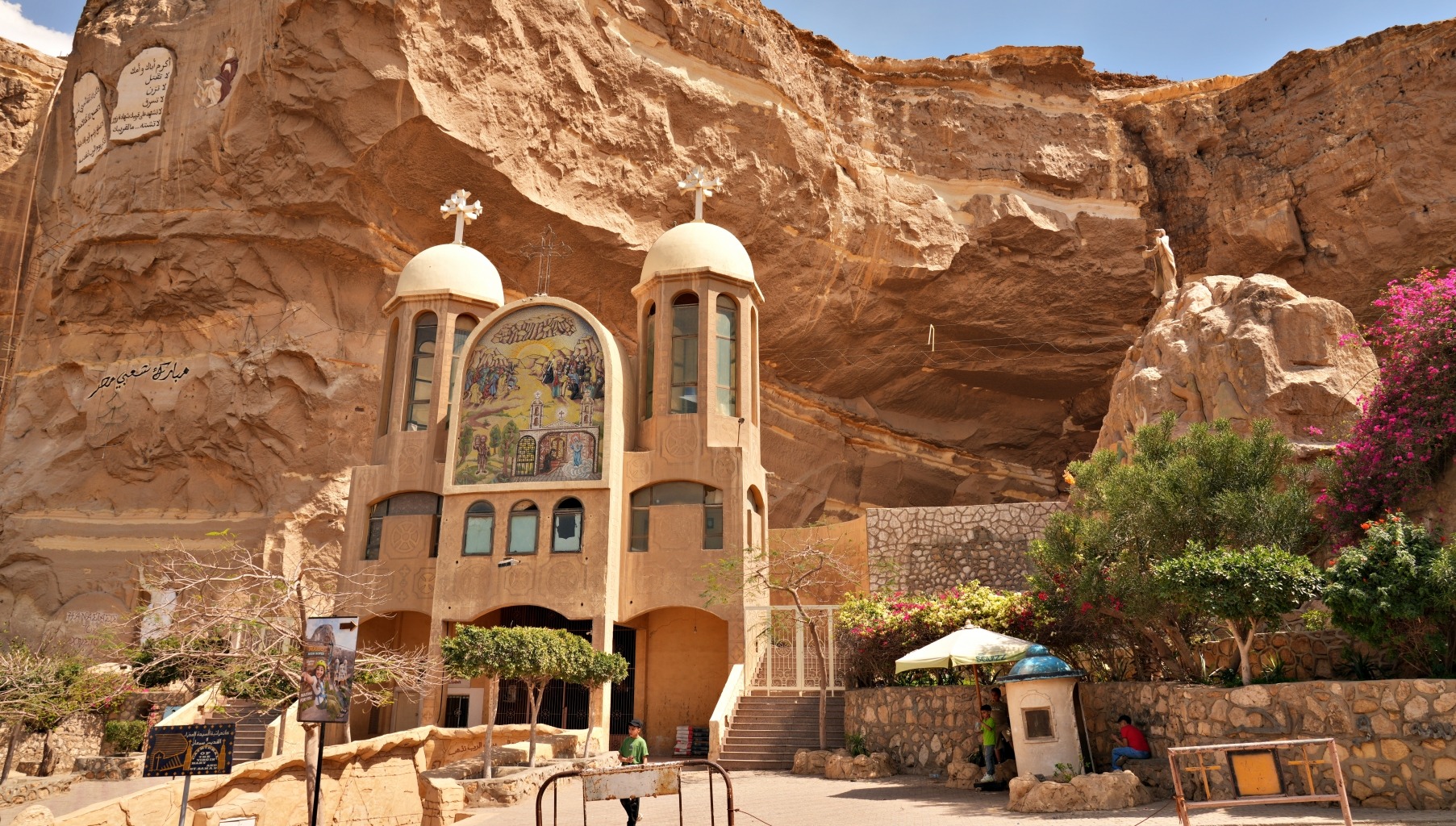
When we read that there was a cave church and monastery in Cairo, we wanted to see it. To reach it, though, we had to travel through Manshiyat Nasser, or Garbage City as it is more commonly called. It turned out that the drive to it was more fascinating than the church itself.
Garbage City
This slum neighbourhood is home to the largest concentration of “Zabbaleen”, or garbage collectors. In their large warehouses, they collect, sort and then reuse, recycle or sell the garbage. It’s not a typical recycling centre, though. They’re not doing it to save the planet; it is their livelihood.

We thought we had hired a tuk-tuk to take us to the cave monastery, but he dumped us on the edge of Garbage City and told us to walk from there. We looked up to see a hodgepodge of apartment buildings lining the sides of the labyrinth of streets. Looking at our map was like studying an unsolvable maze. As well, not only were there no sidewalks, but the streets are barely wide enough for one truck and yet traffic was coming and going in both directions.
Once we looked at the streets and smelled the wafting fumes from the piles of garbage, we knew we didn’t want to walk. Instead, we hired a local tuk-tuk driver, a 10-year old named Anoub. With Arabic hip hop blaring from the stereo, he whisked us along the garbage laden streets, swerving to avoid potholes, pedestrians, donkeys, and garbage trucks. All done with a huge smile on his face.


The entire area is a garbage dump. We passed warehouses full of bags of garbage, but it was also on the roofs, in doorways and on apartment balconies. It felt like we were in a scene from a movie where they exaggerate the chaos and hectic feel of an Egyptian street, and yet this was real.
This wild ride, ended up being one of the most fun things we did in all of Cairo.


Garbage City has a mostly Christian population, something our adolescent tuk-tuk drive was proud to prove with ‘Jesus’ tattooed on his arm. We were surprised to learn that this Cairo community is almost entirely Christian. Later we learned that Christians make up 10-15% of Egyptians, and almost all are Coptic Orthodox.
St. Simon Monastery
At the top of the hill, we found the reason we came to Garbage City. St. Simon Monastery is built into the cliffs of Mokattam Hills. Our ten year old tuk-tuk driver waited for us at the entrance as we walked the last stretch to the church. On the walk, we saw carvings of Jesus and Bible stories in the cliff walls.


The main church is a rock-cut cave church, but unfortunately, we were there on Coptic Good Friday, so only Coptic Christians were allowed inside.


In addition to the cave church, the grounds are filled with small chapels, monastery buildings, and restaurants, all built of stone.
Tip – Coptic Cairo is 5 km from the Citadel, and Garbage City is only 1 km, making it easy to see all on the same day.
For tips when visiting Cairo, including where to stay and avoiding common scams, visit our Tips For Vising Cairo.

To read more of our adventures in Egypt, click here.
Coming Next – Saqqara – Explore The Step Pyramid and Tomb Art
For pictures from other blogs go to Gallery at monkeystale.ca.
To read about more of our adventures go to Destinations.
If you like what you read, please comment or share (with credit) using the links below.




We'd love to hear from you, please leave a comment.