
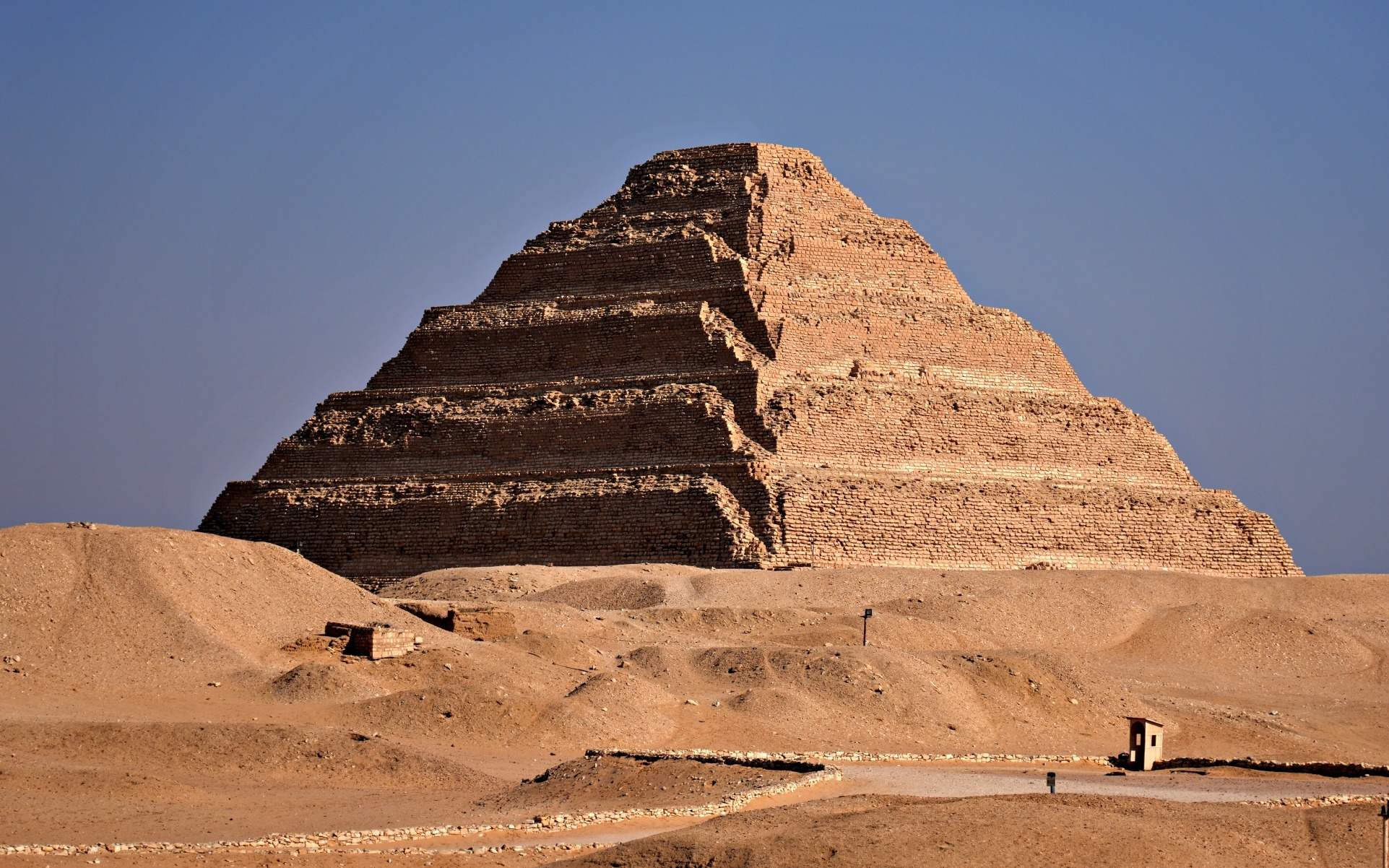
From the world’s first pyramid to the painted reliefs inside ancient tombs, the Saqqara Complex is home to many treasures both above and below ground. Its importance in Egyptian history makes a visit to the Step Pyramid rewarding; however, it is the painted tombs that will leave you in awe. With so much to see, the Saqqara Necropolis should be on your itinerary when you visit Cairo.
A brief history of the pharaohs
To fully understand Saqqara, you need to understand its history, so we’ll give you a quick review of ancient Egypt. Nomads lived in Egypt since at least 6000 BCE. Once these nomads settled into villages, the land was divided into Upper and Lower Egypt and was ruled by different chieftains. Around 3100 BCE, Upper and Lower Egypt united to form one territory, and the Dynasty of Pharaohs began.
In total, there were 30 Pharaoh Dynasties between 3100 BCE and the 300s BCE. At many times in history, the succession of Pharaoh Dynasties was disrupted for several decades by foreign rulers. With these interruptions, as well as changes in the family dynasties, the history is further divided into Early Dynastic, Old Kingdom, Middle Kingdom and New Kingdom.
The first capital of the newly united Egypt was Memphis, not far from Giza and present-day Cairo. One of its most important cemeteries was Saqqara, established during the First Dynasty, over 5,000 years ago. The name likely comes from Sokar, an ancient god of death, rebirth and the underworld.
The first Egyptian Dynasty was buried at Saqqara, and it continued to be used by pharaohs, their families and noblemen for over 3,000 years. As you can imagine, trends changed over time therefore, you’ll see a wide range of tomb designs and the decorations inside. A large part of the reason for Saqqara’s longevity is that it is located on high ground, well above the Nile’s floodplain, making it the perfect eternal resting place.
It is sometimes difficult to put these dates into perspective. We thought this poster from Abu Simbel, would help to understand it better.

With this much importance, there is no doubt as to why this is a UNESCO World Heritage Site. So, let’s look at it now.
Step Pyramid Complex
Although the Saqqara Necropolis was built during the Early Dynastic Period, it is the monument left by the next generation that really changed things. In the early dynasties, before pyramids were used, pharaohs, their families and nobles were buried in mastabas. These included a tomb cut into the bedrock, covered by a rectangular mound composed of mud bricks and stones.
This practice continued for most family members and nobles for many generations, but by the Third Dynasty (Old Kingdom), the design changed dramatically. Around 2650 BCE, an ingenious pharaoh named Djoser and his architect, Imhotep, revolutionized the burial sites of pharaohs. Instead of one mound, they placed a series of 6 successively smaller mastabas on top of one another to create a pyramid. In addition, it was made from large limestone blocks rather than the mud bricks used in the mastabas. This marked the beginning of the Old Kingdom and is often called the Age of the Pyramids.
Step Pyramid of Djoser
A wall once surrounded this important complex, and while there isn’t much left, one lovely section has survived. The Main Entrance takes you into the Great Hypostyle Hall, also called the Courtyard of Columns. This long corridor is filled with 40 polished white limestone columns. It is believed that each column had a statue of the Pharaoh Djoser in front, which would have made a grand entrance to the funerary complex.


The most famous statue of Djoser was found in a nearby cellar called Serdab. The statue is now in the Egyptian Museum in Cairo.

Ancient Egyptians believed in the afterlife. Part of the reason behind this came from observing the sun setting each night and rising each morning. For the first thousand or more years, their main deity was the sun god Ra who was reborn every morning. Therefore, in order to be reborn in the afterlife, the pharaoh’s spirit needed to meet with Ra. The Step Pyramid was considered a giant stairway to the sun to help this happen.

Taking nearly 20 years to build, the pharaoh was likely alive to see his groundbreaking design completed. For us, standing in front of the oldest pyramid in the world is a little overwhelming, so it must have been an extraordinary sight for Djoser. At 62 m (200ft), it is not very tall compared to the ones in Giza, but it was ingenious for its time. It is the same height as a 15-20 story building, but remember this was almost 4,700 years ago.
Scholars are unsure if the idea originated with the pharaoh or the lead architect, Imhotep. We’ll see more of Imhotep at Abu Simbel Temple where he was worshiped as a god by Ramses II, over a millennium later. (Coming Soon)

Underneath the pyramid is a labyrinth of tunnels and chambers that lead to a burial chamber in the centre. The mummified body of the pharaoh and his coffin were placed in a shaft 28 m (92 ft) below the ground. His precious belongings, such as jewels, gold and pottery, were kept in chambers even lower, up to 40 m (130 ft) deep. The pyramid was broken into during antiquity, though, and everything was stolen.
Tip – If you want to go inside the Step Pyramid to reach the burial chamber. It requires an extra ticket, purchased at the main entrance.
Beside the Step Pyramid are the remains of a few ceremonial monuments. Rather than true buildings, though, they are solid structures; symbolic representations of actual buildings. They were built so that the king could still be celebrated after death.


Behind the pyramid are the ruins of the Mortuary Temple. These buildings provided a space where priests could worship the pharaoh long after his death. This practice continued for most of ancient Egypt’s existence and is why they are often described as cult worshippers.
Bent and Red Pyramid
From the Step Pyramid, we could see the Bent and Red Pyramids of Dahshur in the distance. Built by Pharaoh Sneferu, the Bent Pyramid is an early attempt at creating a smoother pyramid than the Step Pyramid. They got the math wrong, however, and had to change the angle of the walls partway up. The lower section was built at an angle of 54°, and the top was built at 43°, giving it a bent appearance.
Beside it is the Red Pyramid, built by the same dynasty. It is the third tallest pyramid in Egypt, but its walls were built at a 43° angle, so it has a squatter appearance. For comparison, the Great Pyramid of Giza was built at 51°. They are ony 10 km away, so you can visit the Pyramids of Dahshur if you have time.

Madabas and Shafts
The cemetery of Saqqara was used for over 3,000 years, so in addition to the Step Pyramid, there are several tombs to see that show the progression from plain, undecorated rooms to elaborately painted chambers. Most were for elites and are in madabas and not pyramids. Some of these are just mounds of dirt, but others are more sophisticated. The one pictured below is likely from the 24th century BCE when they were built with stone.
As well as mastabas, there are several deep open tombs; most are so deep we couldn’t see the bottom. They were vertical tombs, called shafts. The Persian Shaft is dated to the 600s BCE, over 2,000 years after the Step Pyramid and these madabas.


Old Kingdom Tombs in Saqqara
The following tombs were built in the 5th and 6th Dynasties (2400 to 2200BCE). At this time, pharaohs’ tombs began displaying hieroglyphs called Pyramid Text. Surprsingly nobles’ tombs were much more elaborate, with Tomb Art depicting scenes from spiritual rituals and also of daily life.
Pyramid of Unas Complex
This partially collapsed pyramid has some of the first examples of Pyramid Text. These hieroglyphics included spells and information to help the pharaoh safely make the journey to the afterlife. It is usually open to visitors, but for some reason was closed when we were there. Not to worry, if it is still closed when you visit, you will still see plenty of Pyramid Text in other tombs.
Tombs of Idot, Unas-Ank and Inefert
These three closely placed mastabas are tombs for relatives and staff of different pharaohs from the fifth and sixth dynasties. The tombs of Idot, Unas-Ank and Inefert are covered in reliefs depicting fishermen, festival preparations, as well as images of wildlife. The reliefs are outstanding, and while we expected to see one or two walls with a few examples, we were unprepared for the large number of carvings we found. Every room in the large tomb complex displays thousand year old art.


We were intrigued by all of them, but laughed when we saw a hippo giving birth, and a crocodile standing behind, in anticipation of his upcoming lunch.

In one area, we saw a false door. They look like doors, but are actually only carvings in the wall. False doors are common throughout tombs in ancient Egypt and marked the place where the spirit of the deceased could receive blessings and offerings from the priests.

Tombs of the Butcher and Birds
Officially called Tombs of Irukapta and Neferherenptah, these tombs provide another look at the details that went into these burial sites. The two men were high-ranking officials in the Fifth Dynasty (2400-2450 BCE). One is called Tomb of the Butcher because of a scene of cattle being slaughtered, but this fresco is in very poor condition. The cattle slaughter scene in Idot, Unas-Ank and Inefert is in much better condition.
In the other, you can still see the wonderful bird paintings on the tomb walls. There are also statues of the deceased at various stages of his life, along with text on the wall giving his name.


Tomb of Two Brothers
Officially named the Tomb of Niankhkhnum and Khnumhotep, many call it the Tomb of Two Brothers. The exterior walls have hieroglyphics of their names.
Most information says they were priests in the Fifth Dynasty. Strangely, their priestly duties included hairdressing, massage and supervising the manicurists. The number of frescoes of manicures and massages being performed makes you believe it is true. An interesting one that seems unrelated is of a cow giving birth.


Some believe they were not brothers but close friends who wanted to share a tomb. There are depictions of them in a close embrace, so many believe that they are the first openly gay couple, which makes sense once you see the paintings.


Tip – We almost missed these two tombs because they are typically accessed from a different entrance in the parking lot. They can also be reached from Idot, Unas-Ank and Inefert Tombs, but the path to them is not obvious. This may be why we were the only ones visiting these tombs. Since there were no other tourists, the caretaker had to unlock the doors for us.
We saw more examples of tombs for nobles as well as those for the artisans who crafted them. You can see these in our post Ancient Egypt’s Deir el-Medina, Tombs of the Nobles, and Valley of the Queens.
Pyramid of Teti Complex
Located up the hill from the main site is the mostly collapsed Pyramid of Teti and tombs of his noblemen. His tomb also has an early display of Pyramid Text, but it was also closed when we visited.
Tomb of Mereruka
Mereruka was the vizier, or advisor, to Pharaoh Teti in the Sixth Dynasty (2330 BCE). Built for the burial of Mereruka and his family, the tomb consists of 30 decorated rooms, each more astonishing than the last. The walls are adorned with scenes of fishing, hunting, dining and tax collections. Many still have traces of the original paint.


Tomb of Kagemni
The next mastaba was the tomb for Kagemni, another of King Teti’s advisors. It is also decorated in coloured etchings of scenes from daily life, including men crossing a river in papyrus boats over a river filled with fish, crocodiles and hippos.


Tip – These two tombs and Teti’s Pyramid are up the road, about a kilometre from the main parking lot. It would be good to have your driver take you to them instead of walking on the dusty road. The next site is a further 2 kilometres away, so have your driver wait.
Serapeum
This animal necropolis is unlike any other site in Egypt. A long underground catacomb is the setting of a Sacred Animal Necropolis for Apis Bulls. These were living manifestations of the Apis God, which is an incarnation of the Memphis God Ptah. The bull symbolizes strength and fertility.
There was only one living Apis Bull at a time, and it was worshipped. After the bull’s death, it was embalmed in the position of the Sphinx and placed in large granite sarcophagi in these catacombs. The necropolis was first built around 1550 BCE and continued to be used for over 1000 years.
At the entrance were small niches that would have held funerary vessels and figurines.

From the entrance, walk down to a long underground corridor with rooms, called iwans, on either side. In each are granite sarcophagi for the bull mummy. Many have engravings decorating their exterior.


Tip – Its located quite far from the main site, so get your taxi to drive and wait for you at the entrance.
In Saqqara, there are also catacombs for other mummified animals, including ibises, a manifestation of the god Thoth; cats, the incarnations of the God Bastet; jackals for the god Anubis; as well as many other animal necropolises. In total, thousands of mummified animals are entombed in necropolises in the region. We didn’t see them in Saqqara, but here are a few we saw in the Mummification Museum in Luxor.


Entry fee to Saqqara Necropolis – 600 EGP ($11.40); Opening Hours – 8 am to 4 pm. There is a separate entry fee to many of the tombs. A good option if you want to see many of these sites, including Serapeum, is the inclusive ticket for 1400 EGP ($28USD). It includes all but two of the tombs. We did this option and are glad we did because there is much more to see inside these tombs than the ones in Giza. Time Needed – Plan to spend 3+ hours in Saqqara if you visit the tombs.
If you want to go for a camel ride, the camel herders are much less aggressive in Saqqara than Giza, so it may be a nicer experience. You still need to be prepared to haggle, though.

Other Sites
Other sites in the area to see if you have time are Bent and Red Pyramids in Dashur, and the open-air museum of Memphis.
Saqqara City
The city of Saqqara is one of the worst we’ve been to in Egypt. Litter covers the ground, and the city smells of rotten food. The dirt roads are littered with potholes, tuk-tuks race around them, and the poverty is difficult to ignore. We don’t advise staying overnight in Saqqara.
Getting to Saqqara
Located 50 km from Cairo in a remote area, you will need to hire a driver to take you to and from Saqqara. The archaeological site is quite remote on the edge of the shabby town of Saqqara. If you arrive by taxi or Uber/Careem, have them wait for you for two reasons. Firstly, it will be difficult to find a ride back to Cairo, and secondly, the sites are quite spread out, so a car is very helpful to reach them. Saqqara is not far from the Pyrimids of Giza, so you could do them both in one day.
We met a taxi driver in Cairo the day before and hired him to take us to Giza and Saqqara. This took most of the day, and he only charged us 1,500 EGP ($30 USD), but we ended up paying him 1,800EGP to include parking costs and extras. If you find a taxi driver you like, this is a great option, and it worked well for us. Otherwise, you can hire a driver from your hotel but expect to pay a lot more.
Do I need a guide?
You don’t really need a guide since there is a lot of information online and posted at each tomb. The most difficult part is figuring out where things are. There are signs indicating the location of the tombs, but that still doesn’t make them easy to find. If you ask for help, be prepared to pay. We asked one of the museum staff, and he wanted a tip after pointing to the tomb. Hiring a guide will help you find them, but otherwise, a guide isn’t necessary, but a driver is.
What to wear to Saqqara
The site is very rugged, so good footwear is needed. As well, other than the time you are inside the tombs, there is no protection from the sun, so a hat and sunscreen are recommended. Since you are in a Muslim country, you should dress very conservatively by covering your legs and shoulders.
For tips when visiting Cairo, including where to stay and avoiding common scams, visit our Tips For Vising Cairo.

Click on the link to read our Travel Tips For Egypt.
To read more of our adventures in Egypt, click here.
Coming Next – Visiting The Pyramids of Giza and the Great Sphinx
For pictures from other blogs go to Gallery at monkeystale.ca.
To read about more of our adventures go to Destinations.
If you like what you read, please comment or share (with credit) using the links below.



We'd love to hear from you, please leave a comment.