
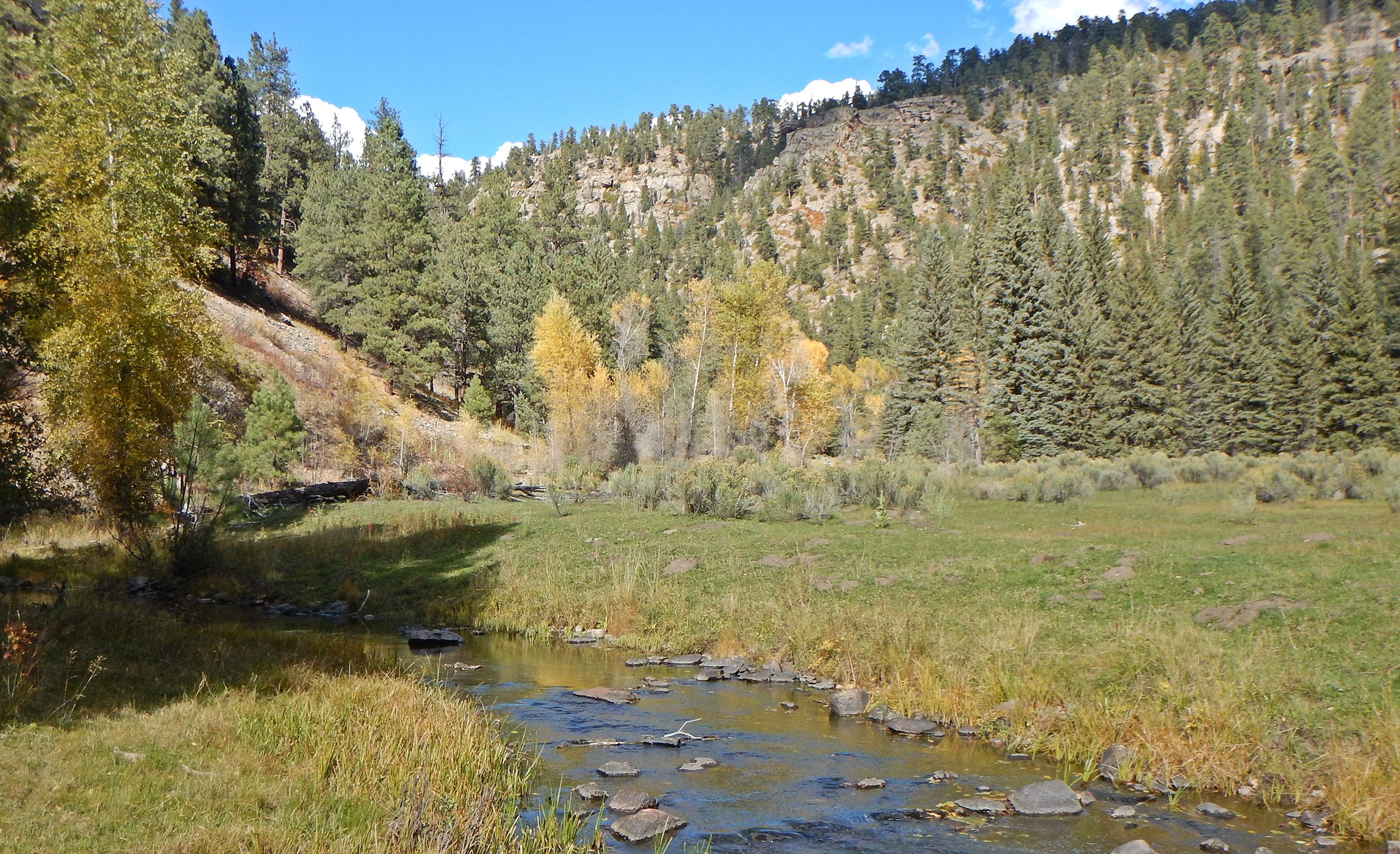
We are deeply saddened by the death of Forrest Fenn. He passed on Sept 7, 2020 at 90 years of age. Our heart felt condolences to his family.
This post will vary from our usual travel blogs. In addition to traveling the world we have been active in the search for Forrest Fenn’s Treasure Chest. The chest has now been found, but unfortunately, it wasn’t found by us. We believe that we had the correct solution, but due to the border closure, we were unable to make our final Boots on the Ground search. This post will tell our story, detailing our solution.
Our hearts sank on the 6th of June, 2020, after a routine check of one of the online blog sites dedicated to Forrest Fenn’s treasure hunt. We read Forrest’s announcement that his treasure chest has been found.
Thank you very much Forrest for the chase. It has been a blast!
To the finder, congratulations.
Forrest created one of the best treasure hunts of our lifetime. We were a part of thousands hunting for his treasure for over 3 years. Here is our story.
We first heard of the treasure four year ago. In August 2016 we watched an episode of Josh Gates’ show, Expedition Unknown. Josh told the story of a bronze chest that was filled with gold and jewels and hidden somewhere in the Rocky Mountains. A poem included in Mr. Fenn’s book, The Thrill of the Chase, carried the clues to find the treasure. It seemed like we were made for such an adventure.
Without having the book, we found the poem on-line and started our four-year quest. After spending about 2 weeks working on Fenn’s poem, Richard came up with a rough solution. We already had plans that summer to go to Yosemite to celebrate Maggie’s birthday with some rock climbing. After a prolonged discussion Maggie caved and agreed to take the 1000 mile detour to check Richard’s solution. Looking back, this first solution was very basic and somewhat simplistic.
The first stanza of Forrest’s poem:
As I have gone alone in there
And with my treasures bold,
I can keep my secret where,
And hint of riches new and old.
To solve the poem, our idea was to use Google Earth to find secluded areas in US National Forests and match their geographic features with the poem’s content. We excluded National Parks and private lands as there are severe restrictions to where you can go and what you can do in a National Park or private/tribal property. In one of his hints Forrest stated that the treasure chest was hidden, ‘in the Rocky Mountains, more than 60,000 links North of Santa Fe’. Links are an old distance measurement and 60,000 links equals to approximately 8.25 miles. So, we began in Santa Fe and decided to move progressively north. The first two National Forests that drew our attention were: Santa Fe National Forest and Carson National Forest. We couldn’t find a large enough secluded area with access to back-country roads in Santa Fe National Forest. Carson National Forest looked more promising though. We were struck by an observation that New Mexico State Road 111 (NM111), cuts straight through Carson National Forest. During our study of the poem, we noticed the first stanza has three ones: I, gone, alone. This matches New Mexico NM111 road. As well, our interpretation of the phrase ‘riches new and old’ to be Old and New Mexico, although we took it as a description helping with clue one.
There’s a good hint pointing to NM111 in Scrapbook SB49. In this Scrapbook Forrest talks about his wife’s spice drawer. There were total of 72 spice bottles in the drawer, most of them were 4 inches long, but the bay leaves bottle was 3 inches long and in the picture you can see one jar in the corner, that is roughly half size of the others, which would make it 2 inches long. The length of all jars adds up to 285 inches. In this SB Forrest is plying a role of a ‘spiceman’, which if taken as a homonym, sounds similar to a ‘spaceman’. New Mexico state road NM285 originates in Roswell, NM (alien spacemen crash site) and cuts through Carson National Forest. NM111 road starts at NM285 just past the settlement of Ojo Caliente.


The second stanza of Forrest’s poem:
Begin it where warm waters halt
And take it in the canyon down,
Not far, but too far to walk.
Put in below the home of Brown.
We were flabbergasted after we noticed that we could match ‘canyon down’ from stanza two with our location. A small settlement at the end of NM111 is called Cañon Plaza. Plaza can also mean downs or greens, therefore ‘canyon down’ fits.
In our solution, the line ‘where warm waters halt’ refers to the town of La Madera (wood in Spanish). We interpreted ‘where warm waters halt’ to read with silent ‘h’ as, ‘where warm waters alt’. Since La Madera is the place where Rio Tusas and Rio Vallecitos merge to create Rio Ojo Caliente (Rio Hot Eye), it is a place where two rivers alternate (alt) creating Rio Hot Eye. We had clue one; begin on NM111 in La Madera where Rio Tusas and Rio Vallecitos ‘alt’ to create Rio Ojo Caliente, or ‘Begin it where warm waters halt‘. Our solution was starting to look good.
After Cañon Plaza, NM111 ends as a paved road and continues as two gravel roads through Carson National Forest. One of the roads is Forestry Road 42 (FR42). If you take the words from stanza two, ‘Not far, but too far to walk.’ as homonyms, you get ‘Not four, but two 42 walk.‘ We believe the first 42 refers to FR42 road and the second 42 refers to a number 42 from the 5th stanza (see further down). It gets even better! Above Cañon Plaza is Cañada del Oso (Canyon of a Brown Bear) or the ‘home of Brown’. In our opinion, Vignette ‘The Knife That Growls’ points to the fact that ‘home of Brown’ is associated with Brown Bear.
FR42 begins right below Cañada del Oso, so this is where you ‘Put in below the home of Brown“.


The third stanza of Forrest’s poem:
From there it’s no place for the meek,
The end is drawing ever nigh;
There’ll be no paddle up your creek,
Just heavy loads and water high.
Once you get on FR42 it starts climbing switchbacks, gaining a lots of elevation (almost 500 feet from Cañon Plaza).
It made sense to us that ‘it’s no place for the meek’ could mean ‘it’s snow place for the meek’. During winter this altitude gets a lot of snow, where Cañon Plaza below has no snow at all. But this is more of a description than a clue.
Our solution past this point on our first trip was too simplistic. We ended up in an area that was too easy to access and realized our solution needed more work. We felt it was a successful first trip though as it gave us a better understanding of the area. Driving through FR42 we noticed that the road crosses Tusas Creek before joining NM64.
After arriving home from Yosemite and browsing through some of the treasure hunt websites, we found out that a few people had already solved the first couple of clues and had driven FR42. We traced the person with the first posted solution to the first two clues, to a blogger with a handle ‘tokyoburns’ on Reddit (it appears that he never went BOTG). After solving the first two clues his solution went astray. He considered Burnt Mountain as the blaze. Later other people followed this solution (including Cynthia Meachum).
We decided that to be successful, we needed Forrest’s book, The Thrill of the Chase. After reading the book, we returned to working on our solution.
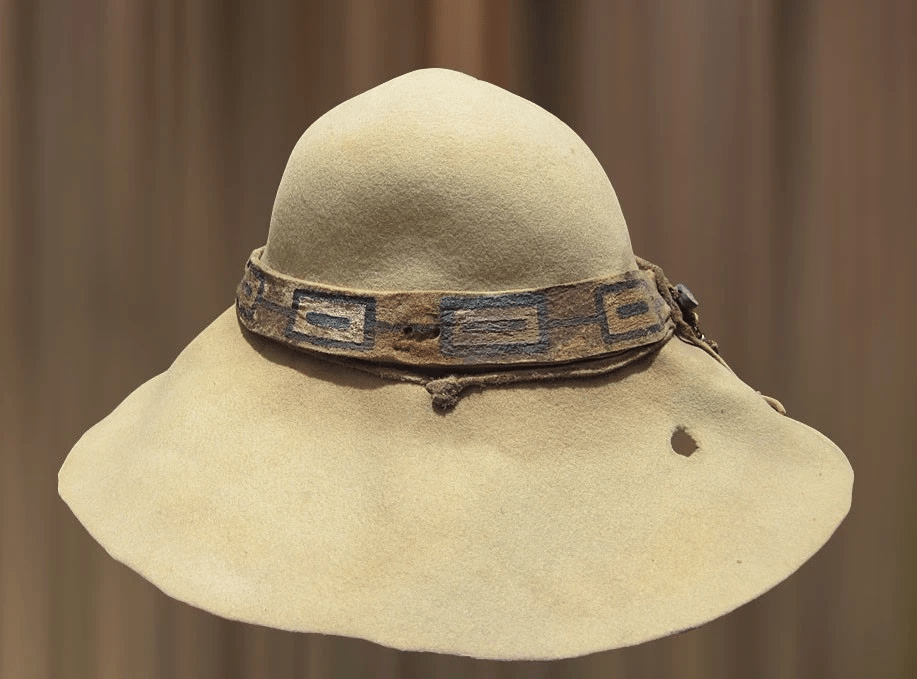
We continued to follow the solution as explained above on FR42 road. Eventually FR42 crosses Rio Tusas after which it terminates at NM64 road. We believe ‘The end is drawing ever nigh’ means that FR42 road terminates after crossing Rio Tusas at NM64 road. Forrest provided great confirmation of FR42 in one of his vignettes. Kiowa Mountain is featured in ‘Anabella’s Hat’ vignette. The mountain is located on the right side of FR42 when driving toward NM64 road. The shape of the mountain resembles Anabella’s Hat, with FR713 road as the hat’s band and a scree spot that looks like the bullet hole.


We reached the end of ‘too far to walk’, so now we got out of the car and started walking along the banks of Rio Tusas. ‘There’ll be no paddle up your creek’ the poem tells us, the creek is too shallow to paddle on and we must walk down stream not up. Also, according to our solution, Forrest was having fun telling us ‘up your creek,’ or ‘up your’s’, or ‘tus ass’ in Spanish, thus naming the creek. We also believe that the Asphalt Art vignette points to Tusas creek. In the ‘Asphalt Art’ vignette, Forrest writes about his soda cans collection as a modern art. He acquired his Coca Cola can while crossing San Mateo Street in Santa Fe. There’s no San Mateo Street in Santa Fe. There are: W San Mateo Rd, S San Mateo Way and San Mateo Ln. San Mateo Ln crosses Tusa Dr which, in our opinion points to Tusas Creek. If you drove FR42, cross Tusas Creek you hit NM64 which is paved with asphalt, so this is where the hypothetical can was located.
There are only 4 wheel drive roads at the end of FR42, so the terrain is only accessible by ‘heavy loads‘ (trucks). In our solution the last line ‘heavy loads and water high’ is a description of the area at the end of FR42 where; only trucks can drive and where water tanks (or water pools to fight forest fires) are located high up on the surrounding plateaus.

The fourth stanza of the poem:
If you’ve been wise and found the blaze,
Look quickly down, your quest to cease,
But tarry scant with marvel gaze,
Just take the chest and go in peace.
In our solution the first line ‘If you’ve been wise and found the blaze’ applies to a nearby section of Rio Tusas. In one section, Rio Tusas flows exactly from North to South. This creates a geographic feature that you can call ‘wise’. Therefore ‘wise’ is the line where ‘west is east’ or ‘w is e’. Basically, one side of the creek is west, the other side is east and the middle is ‘wise’ line. So, if you are ‘wise’ you will follow the creek where ‘west is east’ and eventually you will find the blaze. That is exactly what we did, we followed Rio Tusas along the ‘wise’ line. On Google Earth you can see a perfect demarcation feature on the ridge above this ‘wise-line’ section of Rio Tusas. It is a 90° rock feature that consists of boulders in the shape of trail markers or diamonds. (see. 36°36’15.52″N, 106° 4’27.33″W). We had found the blaze!
Standing on the blaze, we are told to ‘Look quickly down, your quest to cease’. We looked down to see ‘tarry scant with marvel gaze‘. Below and to the right of the blaze are two boulders, that from the blaze look like a small man (scant) with tarry butt and a large smiling man (marvel gaze). As a matter of fact, you can see them clearly on Google Earth (see below). In our opinion Scrapbook 82 (Marvel Comics – Submariner with Captain America) confirms this clue.


Directly to the east of these two ‘stone men’, is a partially buried rock that looks exactly like the treasure chest. This is the chest from ‘Just take the chest and go in peace’. One of Forrest’s many seemingly contradictory statements refers to this ‘rock-chest’. Forrest said,‘To answer some questions and save others from being asked, I did follow the clues in the poem when I hid the treasure chest, although I hid it before the poem was complete.’ You can see how Forrest managed to hide this ‘rock chest’ in the poem before the poem was complete. As you might have noticed, our solution heavily relies on homonyms. Since piece is a homonym of ‘peace’, we think that this clue refers to a piece of music. This phrase therefore tells us, while standing on the blaze, to take direction of the ‘rock chest’ and walk down to Tusas Creek following the rhythm of music. This brings us down to Rio Tusas at 36°36’15.70″N, 106° 4’16.37″W .


There’s a strong conformation of the whole area in Scrapbook SB107. In SB107 Forrest carefully arranged items like: the pen, the 5-dollar bill, the postage stamp, the addressee on the envelope, the road name and the number. Forrest used the first two pictures of SB107 just to muddy up this very important post. The first two pictures are not relevant.
If you compare Forrest’s picture with Google Earth’s map between La Madera and Tres Piedras you will notice a strong correlation between Google Earth geographical names/positions and Forrest’s picture items.
- The way Forrest positioned his pen on the picture, resembles the switchbacks on FR42.
- Forrest made sure that you can read the addressee’s name and the address on the envelope. The envelope reads Mr. U Puceet, 1921 Wilderness (R or Road possibly), Florence (possibly). Because the alternate meaning of Puceet is Brown, you can write it as Mr. Ursus Brown (or Mr. Brown Bear). The switchbacks of FR42 are crossing Cañada del Oso (Canyon of the Bear) in a very similar manner as Forrest’s pen arrangements cross the addressee’s name. See the picture with Cañada del Oso sign.
- If you measure the distance from Ojo Caliente (beginning of NM111) to Cañada del Oso (Canyon of the Bear) it’s exactly 19.21 miles.
- Further in, towards Tres Piedras you can find a feature that was created by Rio Tusas that looks like a perfect digit 5. The feature perfectly matches the digit 5 on the 5-dollar bill. Note how Forrest shows the bottom part of the digit by folding the corner of the bill.
- The USPS stamp location matches the USPS building in Tres Piedras.


The fifth stanza of the poem:
So why is it that I must go
And leave my trove for all to seek?
The answer I already know
I’ve done it tired, and now I’m weak.
Up to now the poem has been descriptive. This stanza is different as it defines and sets up some of the parameters for the rest of the poem. Forrest ends the previous stanza telling us to proceed in the direction of the ‘rock chest’ down to Rio Tusas, in the rhythm of music.
One of the best hints to demonstrate that Forrest used a song to encode part of his poem can be found in SB181. The SB is dedicated to Doug Hyde’s work but, at the end of the post, Forrest gives away an important hint. He includes a picture of Henry Farny’s painting ‘The Song of the Talking Wire and mislabels it as the ‘The Song of the Singing Wire’ to bring it to a reader’s attention. In 1905, when Farny painted the piece, the rural telephone poles shown on the picture, were spaced just over 200 feet apart, which is almost exactly 2 arcseconds. This in turn is the distance between Forrest’s musical staff lines.
In our opinion‘So why is it that I must go’ means that once you arrive back at Rio Tusas, follow the wise line (wise is a homonym of ‘why is‘), this time up the Tusas Creek, until you reach the note ‘so’ (as in: do, re, me, fa, so…). ‘So’ is the most important word in the poem and is also the word that is ‘key’ (or a note)! The note is located at 36°36’23.69″N, 106° 4’16.37″W, which is 8 arcseconds from where we crossed Rio Tusas (note ‘do’).

After you walk from the note ‘do’ to the note ‘so’, the next line tells you to ‘leave my trove for all to seek?’ . Trough (creek) is a homonym of ‘trove’ and ‘for all to seek’ becomes 4, 4, 2 seconds. ‘For all’ equals two 4s; ‘to’ is a homonym for two; and ‘seek’ is a homonym for second, which we determined to be arcsecond. An arcsecond is a unit of angular measurement used in navigation. On Earth an arcsecond translates to about 101 feet (or 31 m). Because it is an angular unit, its length does not depend on the Earth’s geographical features.
Now the poem gets a bit complicated. You have three numbers (4, 4, 2) and don’t know how to apply them. After number of tries we came up with the following assignments. There must be 2 arcseconds between notes on his music staff. This gives a total of 8 arcseconds from the note ‘do’ to ‘so’. The 3 numbers (4, 4, 2) must also be arranged in a certain way. After BOTG experiments we came up with 4 and 42. Therefore, you are to leave the trough (creek) for 4×42=168 arcseconds.
The last line in this stanza is especially important. ‘I’ve done it tired, and now I’m weak’ tells you two things. Firstly, you must tie (‘tired’) everything to the ‘do’ (‘done’) note. Secondly, after you leave the trough (creek) from ‘so’ you must follow the staff lines that go in the direction of 1 am (‘I’m’) from west to east (‘weak’). On the, clock dial that would be 4 o’clock, therefore, the staff angle is 120° true. The 1 am line begins at the ‘so’ note on the staff line. This is very important as it will be used throughout the rest of the poem.
We found a physical mark left by Forrest exactly (to a foot) on the ‘do’ note on the edge of Rio Tusas. It was a wooden cross (36°36’15.70″N, 106° 4’16.37″W). The arms of the cross point in the direction of the ‘wise’ line. This cross is featured in the Reliquary vignette.

The last stanza of the poem:
So hear me all and listen good,
Your effort will be worth the cold.
If you are brave and in the wood
I give you title to the gold.
In our solution ‘So hear me all and listen good’ says that once you’ve traveled 168 arcseconds from the trough, staying on the ‘so’ line, you need to go to the next note. We determined the next note to be the lower octave ‘me’ (‘me all’ is two ‘me’ notes) minus or less 10 (less 10 is a homonym of ‘listen’). This operation brings you back to the note ‘do’.
‘Your effort will be worth the cold’ we interpreted as; your ‘F forte’ note will be orth (orthogonal or perpendicular) to the ‘col’ (pass). There is a col in the depression between two hills at 36°34’52.31″N, 106° 1’20.11″W. The line from the ‘do’ note to the ‘F’ note crosses the ‘F’ staff line at 36°34’23.13″N, 106° 0’31.52″W, where we found another marking that we believe was left by Forrest. A vertical ‘X’ made from two logs inside a rock crevice was placed exactly at that location. The col between two hills is described in the Olmec Jadeite Mask Vignette (jadeite feels colder..). Notice the resemblance of Olmec Jadeite mask to the Google Earth image below (at the ‘So-to-MeMe’ mark). We also found a cairn on the line between ‘do’ and ‘X’ that we believe was a marker left by Forrest. The cairn has a twig of an old, weathered tree attached to the top. The direction of the twig follow exactly the staff line, pointing towards the vertical ‘X’.


The next line is the 9th clue (at least that’s what we thought in 2017) and it is the most difficult clue.
Imagine this, with just 8 words ‘If you are brave and in the wood’, Forrest takes you on crazy journey for more than 10 miles!! This solution required multiple BOTG trips.
We are certain that this line in the poem pertains to sheet music from the original Peter Pan musical. The songs in the musical are sung by 4 characters: the three ‘braves’ (often called Indians) and Tiger Lily (she’s also called ‘brave’). The three male braves are named Pine, Oak and Shrub which are all wood!
We figured out that the notes from the sheet music move you down the staff lines at 210° true. This angle is perpendicular to the staff lines which are aligned at 120° (‘I’m weak’). This is not all though. When you play music you not only move down the staff, but you also move to the right and then to the left when you go to the next staff. On the surface it might seem simple, but if you dig deep down, the method has a significant number of different options. Do you count just the 5 staff lines? Do you count the ledge lines? Do you count only the singing notes or do you also count the ghost notes? How do you count double notes? How do you account for the tempo? On top of it, the distance involved is enormous. From the ‘X’ these songs take you to a spot over 10 miles away.
In total we had 4 different solutions for this clue using a different combination of notes and bars. Each solution took us further and further away from Forrest’s ‘X’ (the end of the clue 8). But, on each trip we learned something new about how Forrest encoded the last clue using Peter Pan musical.
In the end, we had two solutions. In the first solution we assumed that for downward movement he only counted notes that change in range. Lateral movement was determined by the number of musical bars in the songs and this changes with the tempo. In the second solution we used the number of staff and ledger lines used in Peter Pan musical.
In our two BOTGs for this clue, we found many marks such as cairns and erected poles that we believe were left by Forrest. Some of the cairns had a wooden post in the centre, similar the bell pole from SB172. There are two wooden posts; about 5 feet tall and 6 inches in diameter, placed in cairns on the presumed 9th clue (see pictures titled Wooden Post 1 and 2 above). The posts are placed at GPS coordinates: 36°30’20.70″N, 106° 3’0.70″W and 36°27’29.60″N, 106° 3’16.00″W. The positions appear to confirm the vertical and lateral movements of the ‘Braves’ and Tiger Lilly songs.
At clue 9 we also found a row of quartzite cairns spaced exactly 2 arcseconds apart. These cairns form a line that intersects direction of the staff lines, just above where we think the treasure was hidden.
Near the second cairn with the pole, where the row of quartzite cairns is located, we found a rock feature that we call ‘Horns of Chaos’. There are 2 rocks which resemble the horns of Chaos and one that resembles the hat of Embroidery. The SB209 was released right after our trip to this particular area, so the only picture we took is the one below.


We weren’t able to search for our last two solutions. We are quite sure that we just needed one more BOTG to get the chest but unfortunately Covid-19 didn’t allow us to cross the Canada/US border to make this trip. The final solutions took us back to La Madera across from Rio Vallecitos at: (36°26’14.95″N, 106° 4’56.19″W) or 36°26’12.65″N, 106° 4’51.20″W). This is 528 arcseconds across the staff and between 59.5 and 66.25 arcseconds along the staff from the X. We think SB166, Grave Yard Logic, matches the area where the treasure chest was hidden. Note the arrow feature on Google Earth and compare it with SB166. The light leakage area of the Divorce Logic SB166 could be the Vallecitos Canyon.
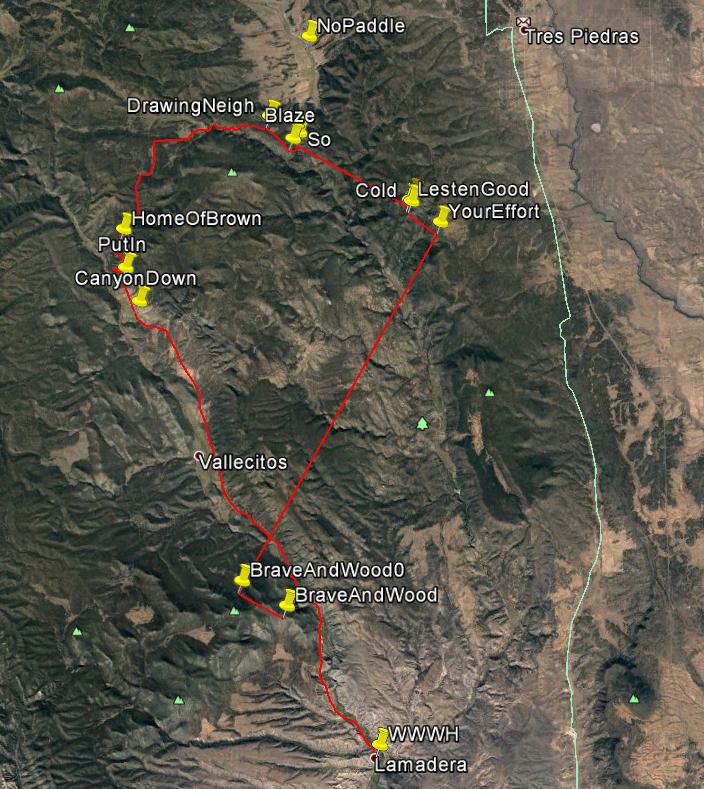

You see now why Forrest told everyone that you won’t know if you have correct solution until you find the treasure. The last clue also explains why the poem hasn’t been solved for such a long time!
We also want to add a bit of the history of our search. As we mentioned, we started our search in 2016. We had 8 BOTG throughout 2016 and 2017. In October 2017 we left for 2 year long, pre-planned trip to SE Asia. At the time we had already found Forrest’s ‘X’ (end of clue 8). We were hoping it would take one more trip to finish it off, not realizing the difficulty of the last clue.
We returned from our SE Asia trip at the end of May 2019 and few weeks later armed with a new solution, went to Carson National Forrest. Obviously, we were still far away from the treasure location and were just starting to realize how difficult this last clue was. After this failure we thought we would need at least 2 more trips to New Mexico. Renovation of our new home slowed us down and we managed to take only one trip in October 2019. The trip, although successful in finding additional markings left by Forrest, did not secure the chest. In November 2019 we left for South America where we stayed until mid February 2020. The plan was to finalize the chase in April, but due to Covid-19 restrictions we couldn’t even cross the border into the US.
Final observations and comments.
The vignettes on Home of Dal website illustrate scenes from the whole route beginning and ending in La Madera. This matches the ancient Egyptian Vignettes describing passage to the underground. Almost all of Forrest’s SBs have hints. We managed to match most of them to the features described by the poem. In time, we’ll be adding our interpretation of Vignettes at the end of this post.
We do not believe that Forrest walked this entire route, to hide the chest. The hiding spot was within walking distance of NM111.
Forrest elegantly quoted T.S. Elliot’s poem:
“We shall not cease from exploration, and the end of all our exploring will be to arrive where we started and know the place for the first time.” T.S. Elliot
The treasure hunt begins in La Madera and the hunter returns to La Madera, seeing it in a completely different light.
We don’t have plans to make the final trip to complete the last section of the 9th clue. It is mostly due to one of Forrest’s statements. According to Forrest; ‘a searcher won’t know with 100% certainty if he/she is on the right path until he/she finds the chest’. Now, because the chest was found and is gone, Forrest is dead and the finder is not talking, you’d never be sure you were at the right spot. Also, in our case the 25 hours of driving to NM doesn’t entice us to commit to the final search.
If you decide to explore the area, check the spot that looks like an arrow on Google Earth (see below). Is this the same area that SB166 arrow points to? One of the old meanings of Ferd (from SB166) is ‘end of journey’. If you zoom-in the terrain on Google Earth, you’ll notice a giant ‘ X’ made out of logs at the tip of the ‘arrow’. Compare this with Forrest’s drawing of the two Xs he did for Cynthia. If this is the case, the other X is probably located close to the NM111 road. All terrain features of this area and those of the drawing from ‘The Thrill of the Chase’ are dauntingly similar.


There’s one more coincidence of the terrain’s feature with Forrest’s writings. Note the Google Earth feature that looks very similar to the Indian garb picture from couple of his Scrapbooks.

Wyoming ConnectionS
On July 22, 2020 Forrest announced that the treasure chest, hidden for 10 years was found in Wyoming. Obviously our 9th clue does not lead to the state of Wyoming, but we are still confident that our solution, as described above, is correct and all marks left on the trail are from Forrest. But, we do not have a full understanding of how the 9th clue would lead all the way to the state of Wyoming. There are a few possibilities that we would like to consider.
Before we talk about it though, let us touch up on the way we counted poem’s clues. To give you an example; if you have three geographical locations called A, B and C, there are two ways to give a direction for a trip from A to C via B. One way is to describe each of the geographical locations and let the traveler follow the locations. The other option is to describe each leg of the trip. In this case describe A to B leg and then the B to C leg. As you can see in the first case you need 3 clues to describe the journey and in the second case you need only 2 clues for the whole journey.
In our case when solving the Fenn’s poem we used the first method, so our 9th clue ends with ‘If you are brave and in the wood’ line. If Forrest was using the second method of counting poem’s clues then the 9th clue would have to be ‘I give you title to the gold’. This final 9th clue could be in the form of a proxy item, e.g. an engraved rock at the final destination. The searcher would still need to solve the whole poem and receive title to the gold, but the gold would be located in Wyoming. In the hindsight, Wyoming makes sense because of the tax and asset protection laws difference between New Mexico and Wyoming, i.e. there are no state taxes and 1,000 year asset protection laws in Wyoming.
Possible solutions pointing to Wyoming
The most basic possibility of the treasure chest being found in Wyoming is based on the etymology of the word ‘wyoming’. The word is used from Wyoming Valley in Pennsylvania, which derives its name from Munsee xwé:wamənk (literally “at the big river flat”). Forrest being cheeky stated that he and the finder ‘agreed’ that the chest was found in Wyoming. Note that he never said; the chest was found in the State of Wyoming. This interpretation would fit our solution as it leads to the area right above Rio Vallecitos.
Another possible solution leading to Wyoming would be that at the final New Mexico destination, Forrest left hidden instructions. e.g. GPS coordinates of where in Wyoming the chest is hidden. The last line of the poem, ‘I give you title to the gold’ would give the finder GPS coordinates anywhere in Wyoming to claim the treasure chest. This approach though, does not seem like Forrest’s way of ending the poem and the treasure journey.
Our preferred Wyoming solution
There is yet another possible solution that we favour. Remember the fifth stanza’s first line, ‘So why is it that I must go’? Our sole interpretation of this stanza is that you must go to the note ‘so’ on the ‘wise’ line, which is 8 arc seconds from ‘do’ note. What if this line had a double meaning? The first meaning was, as we interpreted it above. But, what if the second meaning is pointing to Wyoming? ‘Why’ is a homonym of ‘WY’, which is the state name abbreviation for Wyoming. If this is the case then the second meaning would required the searcher to apply an offset along the ‘wise’ line at the note ‘so’ right across Montana/Wyoming border? The ‘wise’ line runs straight from the South to the North, along 106° 4’16.37″W meridian and crosses Montana/Wyoming boarder on the 45th parallel .
If this solution is correct, then you finish your search in New Mexico and then by taking a mirror image (using Montana/Wyoming) border, with the offset at Wyoming ‘so’ note, you would have the place where the chest was hidden. We favour this solutions based on Forrest’s fascination with mirrors; just to mention SB99.5, the reverse bicycle story or the gold mirrors included in the treasure chest. For us, it was difficult to accept this solution as it takes you all the way up to the Montana/Wyoming boarder, hundreds of miles away from the start of the solution.
According to this solution the treasure resting place would be in Bighorn Nation Forrest.
A wooden log with a sharp end, see picture titled ‘Wooden log with a sharp end’ was found behind a rocky outcrops that we called ‘Horns of Chaos’ and ‘Hat of Embroidery’. The wooden log (GPS: 36°27’30.40″N, 106° 3’15.20″W) rests against a leaning stone and its bottom sits in a rock cairn. The sharp end of the log points a few degrees toward the west, as compared with the line between Post 1 and Post 2. Does it point toward Wyoming’s Bighorn National Forest location where the chest was hidden? Unfortunately we didn’t take the bearings of its direction.
There are a number of SBs which also appear to point to Bighorn National Forrest. Just to mention: his fascination with Buffalos (Bighorn National Forrest is just miles west of Buffalo, Wyoming), Willow Park Reservoir shape is pictured in SB 243. Not to mention how many times Forrest posted a picture of western wagons. Wagon Box Battle Monument is just east of Bighorn National Forrest.
We think that all of the; cairns, wooden cross, ‘X’ arranged logs, post mounted logs and twigs on cairns tops were part of the blaze Forrest left behind. The final twig was found inside the chest, by the Forrest’s treasure finder.
In coming days we’ll provide detailed calculations where in Bighorn National Forest the treasure was located.

Forrest Fenn’s Vignettes
Forrest’s battle with cancer and his near-death experience was the trigger for hiding his treasure chest. At the time like his father, he decided to end his life on his own terms, but unlike his father his plan was to disappear. He knew of a perfect secluded spot, which he knew won’t be easy to find, a spot where his bones will rest for hundreds of years.
Not to become an asterisk in the history books, he decided to cache a treasure chest filled with gold and jewelry in his secluded spot. A second part of his plan was to end his life, on his own terms, in the very spot where he hid the chest. A poem that he wrote would lead to his bones and to the treasure chest.
His plan was sabotaged by the cancer’s remission, but he decided to proceed with the plan anyway.
After he wrote the poem and hid the treasure, he couldn’t help himself to stay away from the treasure search community. He wrote books, Vignettes, Scrapbooks and various other publications.
It is our opinion that up to 90% of Forrest’s writings are directly connected with the treasure chest hunt. This connection is especially evident with his Vignettes.
Although vignette word is of French origin, it is heavily used in the Egyptian Book of the Dead. Egyptian Book of the Dead was written in hieroglyphic script on a papyrus scroll, and often illustrated with vignettes depicting the deceased and their journey into the afterlife.
In our opinion every Forrest’s vignette was meant to depict a particular scene from his intended allegorical passage into the afterlife. The vignettes depict scenes along the treasure hunt route from ‘where warm waters start’ all the way to ‘I give you title to the gold’.
As with Forrest’s poem and all his writings, the vignettes are very vague and they are very prone to personal interpretations. Not counting Forrest, only the person that found the chest can claim with high probability he knows how to interpret Forrest’s writings.
Here’s our interpretation of some of the Vignettes:
1. Butterfly Maiden
The Vignette was posted on Dal’s website April 17th, 201
This vignette depicts Las Tablas area in Carson National Forrest. Note how Forrest describes one of the Katchina’s dolls: ‘Sao Hemis always wears a kilt, a TABLITA, and their bodies are painted with black corn smut’. Note that this is the only vignette posted in 2017, more than 2 years after all other’s were posted. Posting of this vignette coincides with searcher SeattleSulivan correctly answering Forrest question ‘Where he caught this fish’. It was well known that SeattleSulivan was searching in Carson National Forrest and spent most of the 2016 winter searching in Las Tablas area.
Compare the geographical shapes of Las Tablas with Sao Hemis.


2. Palettes
The Vignette was posted on Dal’s website December 7th, 2014
In our opinion the vignette depicts the area in Carson National Forrest just north of Lamadera. There’s a private property area North of Lamadera in a shape of the Forrest’s palette. Note how the NM111 road encroaches in the rectangular area. We still believe that the private property has something to do with the poem’s solution.


3. Well, Here’s Moses
The Vignette was posted on Dal’s website December 14th, 2014
Note Forrest’s description of Moses: ‘And I believed it because why else would someone throw his arms out like that except to summon the Israelites and lead them out of Egypt and across the Red Sea to Mount Sinai?”.
In our solution, the second stage of the poem changes from a descriptive to parametric solution. Once you at the blaze, you must go in the direction of the chest, perpendicular to Tusas creek, follow the creek north and then go South-East at 120 deg angle. This is exactly where you must cross Rio Tusas and what Moses’ arms are pointing to.
Note Forrest’s statement: ‘Moses now stands in my home on the second step that leads into my den, and his expression continues to telegraph a timeless message.’ This is the clue where you start counting arcseconds.


4. Osiris…King of Gods
The Vignette was posted on Dal’s website November 23rd, 2014
This is a difficult one. Our latest interpretation of it pertains to Seth and Osiris son, Horus. This is what Forrest writes about Horus in this vignette. ‘Isis once again found every piece of his (Osiris) body, save his phallus (it had been eaten by the now-cursed Nile fish). She magically re-assembled Osiris and resurrected him long enough to be impregnated by him so that she could give birth to the new king Horus.’
‘Horus’ sounds somewhat like ‘Chorus’. As a noun ‘Chorus’ has two meanings: a repeating section of a song and of course a group of people that sing the chorus. This leads us to the poem’s final clue which uses ‘Peter Pan’ musical. Three Braves and Tiger Lilly (Chorus) sing a repeating section of a song that lead you to the final spot.
5. John Bullis
The Vignette was posted on Dal’s website November 16th, 2014
A geographical feature of 2 dry lakes near the path of the search resembles the perforator kit.


9. The Knife That Growls
The Vignette was posted on Dal’s website November 3rd, 2014
This vignette is about a knife that he purchased from a Sioux Indian. The knife has bear-jaw haft. In our opinion the ‘home of Brown’ from the poem is Cañada de Oso above Cañon Plaza, NM. Cañada de Oso in Spanish means Canyon of the Brown Bear.
In this vignette Forrest writes: Upon hearing the knife roar “approach at your own peril,” the warriors turned and fled, not being willing to test the supremacy of the bear. NM111 switchbacks start at Cañon Plaza and then gaining the high plateau where the FR42 starts. Almost 180 deg switchbacks are fairly intimidating for drivers with no off-road experience


10. Reliquary
The Vignette was posted on Dal’s website November 1st, 2014
The main subject of this vignette is a Spanish Reliquary Cross. Forrest placed his handmade cross at Rio Tusas, right below ‘the blaze’ (see below). The cross, exactly to a foot, is located at the place where you must follow the ‘wise’ line at the ‘do’ note.
The arms of Forrest’s cross align with Rio Tusas and the horizontal sliding banner show the directions in which you must follow the ‘wise’ line.
In this vignette Forrest writes: On the reverse is the crucifixion of Christ, except Christ has gone. He just isn’t there anymore. This is not true, the crucified figure of Jesus Christ is always on the front, never on the reverse side. What it means though is that although the sliding banner point the direction to the right, you have to follow the ‘wise’ line to the left.


11. Falcon Mummy
The Vignette was posted on Dal’s website October 15th, 2014
This vignette depicts a mummified falcon from Forrest’s Egyptian art collection.
The mummified falcon resembles geographical feature at the end of clue eight (see below).
In the vignette, Forrest writes: ‘When the falcon was being x-rayed at the hospital a crowd of nurses and doctors came in to watch’. The geographical feature of the falcon is in direct line of clue number eight, which ends with Forrest’s mark of vertical ‘X’ (logs hidden in a crevice). In one of his scrapbooks Forrest repeats the hospital X-raying scene and adds, ‘no cartouche was found inside the falcon’. Our interpretation of this statement was that the chest was not hidden in the falcon geographical feature.


12. Annabella’a Hat
The Vignette was posted on Dal’s website July 12th, 2014
Forrest provided great confirmation of FR42 road in Annabella’s Hat vignettes. The hat with a bullet hole that Forrest bought from a sheepherder, looks exactly like Kiowa Mountain. When driving towards NM64 road, the mountain is located on the right side of FR42 road. The mountain resembles Anabella’s Hat with FR713 road as the hat band and the scree spot looks like the bullet hole.
13. Kyetena’s Tobacco Canteen
The Vignette was posted on Dal’s website July 9th, 2014
One of the dry lakes near clue 7 resembles the Tobacco Canteen.


14. Olmec Jadeite Mask
The Vignette was posted on Dal’s website August 5th, 2014
The col from ‘Your effort will be worth the COLd.’ is described in the Olmec Jadeite Mask Vignette (jadeite feels COLder..). Note the resemblance of Olmec Jadeite mask to the Google Earth image below (at the So-to-MeMe mark).


15. Asphalt Art
The Vignette was posted on Dal’s website September 16th, 2014
Asphalt Art vignette points to Tusas creek. In the ‘Asphalt Art’ vignette, Forrest writes about his soda cans collection as a modern art. He acquired his Coca Cola can while crossing San Mateo Street in Santa Fe. There’s no San Mateo Street in Santa Fe. There are: W San Mateo Rd, S San Mateo Way and San Mateo Ln. San Mateo Ln crosses Tusa Dr which points us to Tusas Creek. If you drove FR42, cross Tusas Creek you hit NM64 which is paved with asphalt, so this is where the hypothetical can was located.
16. The Dragon Bracelet
The Vignette was posted on Dal’s website July 16th, 2014
In The Dragon Bracelet vignette Forrest describes how he came into possession of the Dragon Bracelet that supposedly was included in the treasure chest content.
He wrote; ‘Coincidentally, we had a very nice canary diamond in our jewelry display. It was 43 carets. I remember the size because it was two carets smaller than the Hope Diamond that’s on display in the Smithsonian. Eric acquired our lovely canary for a Campbell Soup box full of money, and his wife’s very handsome gold dragon coat bracelet that was littered with rubies, diamonds, sapphires and emeralds.’
In the text above you can notice how he misspells ‘carats’, writes carets instead of carats thus pointing the reader to the canary diamond. Coincidentally, one of the water tanks on Carson Forest plateau (Hondito Tank) beares very close resemblance to a diamond field.




We’d love to hear from you, please leave a comment.