
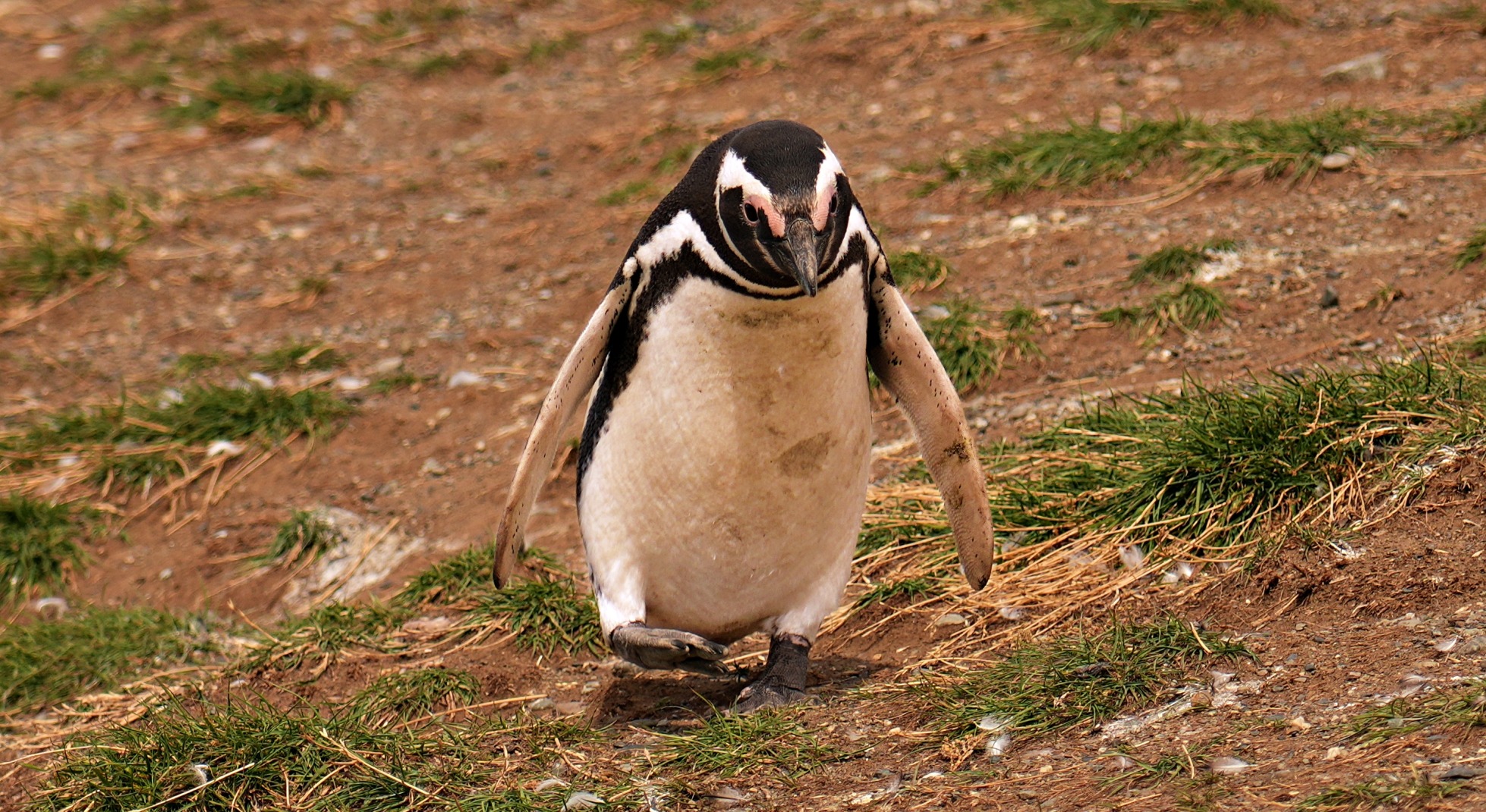
As we approached Magdalena Island by ferry, I almost couldn’t contain my excitement. We were about to visit the second-largest colony of Magellanic Penguins (Pingüino de Magallanas) in South America. Located in the middle of the Magellan Strait, over 120,000 of these adorable birds come to this island every year to raise their young. Not only are there a large number of penguins, but the walkways that travel between their nests make Magdalena Island one of the best places to see these penguins up close.
When Magellan and his crew first sailed through this strait, they saw the penguins but reported them as odd-looking ducks. Today, the birds are loved around the world, and we couldn’t wait to see them in their natural environment. Our journey began at Terminal Tres Pointes, not far from Punta Arenas, where we boarded a ferry for the 1½ hour ride to the island. On the way, we hoped to see dolphins, but we weren’t so lucky; only Kelp Gulls followed our wake.


Magellanic Penguins spend their winters in the warmer waters near Brazil, Peru and northern Chile, and then swim to Magdalena Island in September to breed. Interestingly, they are monogamous, but don’t travel as a family. Males arrive first to locate the same burrow they used the previous season.
As we approached the island, we could see how small and isolated it is, making us wonder how the penguins were able to find it every year.


They may be little, but they are well adapted to this life. These penguins can travel 45 km/hr in the water where they feed on small fish, crustaceans, krill and squid. They tolerate drinking salt water by filtering it through their kidneys and glands in their eyes.


They are burrowing penguins, meaning that their nests are built in holes up to 3 metres deep. Each couple has 1 to 2 eggs, with a 40-45 day incubation. During this time, parents work as a team; one guards the eggs while the other goes to the ocean for food.


Since Isla Magdalena is an important breeding ground for penguins and other seabirds, it is included in Los Pingüinos Natural Monument, along with nearby Santa Marta Island. This designation has resulted in a high survival rate for the birds.
Being a protected area, there are quite a few rules to follow, but we were surprised by how close we were able to get to them and their nests. Walking trails allow visitors to walk between the thousands of penguin nests, while the tuxedo-clad birds waddle around, seemingly without a care that we are there.


When we visited in January, the chicks were about 1½ months old, and most still had their fluffy feathers. Adults are black and white with pink around their eyes and a chin strap. At 70cm (2 ¼ ft) tall, they fall in the middle of the penguin height chart.

Since the chicks were still young, the parents were tending to most of their needs. At several nests, the chicks were screaming and hollering, as if they were starving. Some were chasing their parents, insisting on being fed. We were lucky to see a few of those get their lunch directly from the parent’s beak.

By February, the chicks lose their fluffy feathers, which means they have become juveniles and will soon be able to swim. By mid-April, they will leave the island and spend the first few years of their lives in the ocean. During this time, they learn survival skills such as hunting before returning to the island to look for a mate.


Once the chicks leave, the parents remain on the island to prepare for the long journey. One thing they do is overeat until they gain twice their weight. They also waterproof their feathers by coating them in an oil excreted by a gland near their tail. Once they’re ready, the birds leave the island alone and either swim in the Atlantic Ocean to reach the south of Brazil or the Pacific Ocean, all the way to Peru. Although monogamous, the two mates don’t see each other again until they return to Magdalena Island in September.
As we walked around the island, we saw other behaviours such as braying. They stand with their neck arched high and make a loud call, similar to a honking goose. They bray for a variety of reasons, including attracting a mate, when males are fighting, or when they switch guarding duties.


These cute birds can live 20 to 25 years. Their main predators are sea lions who live on Marta Island, next door. The eggs and chicks aren’t safe on land either. The Chilean Skua is their main predator, which is why an adult always stands on guard. Thankfully, we only saw one skua on the island, and it wasn’t after a chick.

In addition to the penguins and Chilean skua, Isla Magdalena is also home to thousands of Kelp seagulls, Upland geese and Magellanic cormorants. We saw a huge gathering of tuxedo-clad cormorants in the distance, and at first, we first thought they were penguins.


The island’s landscape is quite bare, but for visitors it is perfect because you can see penguins in every direction. At the top of the island is a lighthouse from 1902, and on the shore, we could see our ferry. We barely paid attention to either, though, since the penguins were our main focus.


How to visit Isla Magdalena
There are several tour operators in Punta Arenas. We booked our trip with Nomades. Their ferry leaves from Terminal Tres Puentes, 7 km north of the city. We were able to book a day in advance, but our boat was full, so it may be better to book a few days early if you’re short on time. Be aware, though, that tours will be cancelled in bad weather. In fact, tours didn’t operate the day after our visit because of an incoming storm.
You can read about Punta Arenas in our post Visit Punta Arenas and the Magellan Strait.
Best time to visit Isla Magdalena
The penguins arrive in September and leave in March. To see the chicks, January and February are the best months to visit.
Nao Vicotria Museum
After visiting the penguins, you should visit the Nao Victoria Museum. It is near Terminal Tres Puentes and showcases a replica ship from Magellan’s voyage as well as the Beagle and others. We described it in more detail in our post Visit Punta Arenas and the Magellan Strait.

Seno Otway
It seems that things do change with time. On our visit 20 years ago, we went to see the Magellanic Penguins on Seno Otway (Otway Sound). We assumed we would do the same this time, but unfortunately, in 2015, they stopped coming to the sound. The reasons they abandoned their nesting ground are attributed to a few factors. One may be from recent mining that started in the area. Another is because of an increase in salmon farming. Both of these would add pollutants to the water and decrease available food. Since 2015, the penguins have moved on and no longer use Seno Otway. Here are our pictures from that long-ago trip.


Tierra del Fuego – Another place near Punta Arenas to see penguins is Tierra del Fuego. A new flock of king penguins have started nesting there, so maybe we’ll visit one day.
Here’s a link to see more birds on Birds of the Week..
Click on the link to read our Travel Tips For Chile.

To read more of our adventures in Chile, click here.
Coming Next – Puerto Varas in Chile’s Lake District
For pictures from other blogs go to Gallery at monkeystale.ca.
To read about more of our adventures go to Destinations.
If you like what you read, please comment or share (with credit) using the links below.






We’d love to hear from you, please leave a comment.