
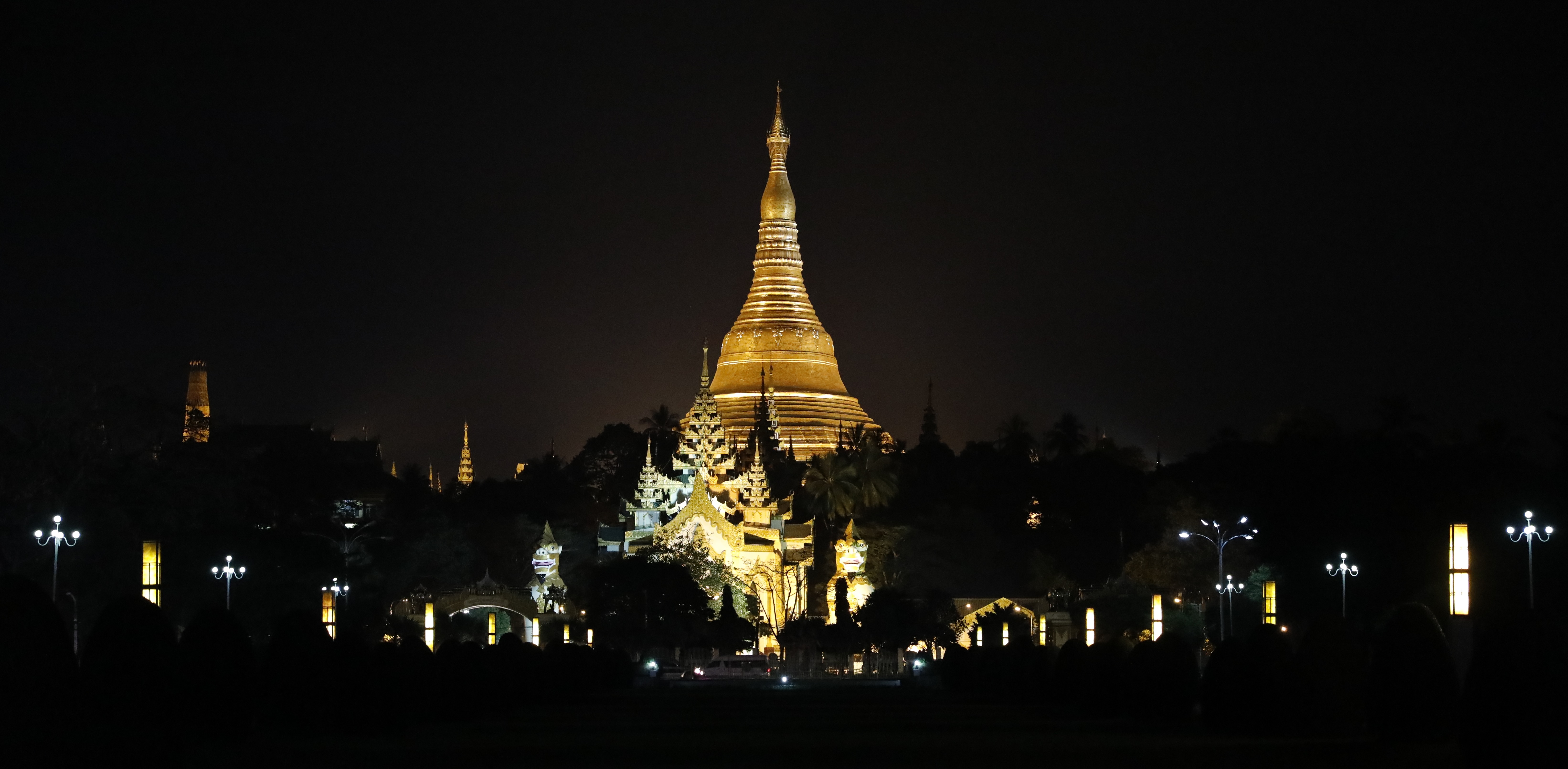
High up on top of a hill, the glittering Shwedagon Pagoda seemed to be beckoning us to take a closer look. From below we couldn’t have imagined the spectacular golden plaza we would see on top of the hill.
Two lion-like creatures, called leogryphs, guard each of the four entrance gates located at the base of the hill. We knew we were going to see something special when we entered though the Western Gate. In front of us was a long walkway bordered by golden pillars and a marble floor. The walkway leads to a golden staircase that takes you up to the main plaza on the top of the hill.
We were lucky to see a Burmese couple getting their wedding pictures taken on the staircase. They were dressed in colourful traditional attire and let us take their picture.


As we entered the plaza at the top of the stairs we were speachless. In front of us was a glittering collection of pagodas and shrines. The large main golden Shwedagon Pagoda was surrounded by dozens of smaller golden zetis. These in turn were encircled by dozens of shrines and golden Buddha statues. Everything glittered in the morning sun.
The Shwedagon Pagoda Complex is very important to Buddhists. The main pagoda is believed to hold 8 hairs from Buddha and one of the shrines has an imprint of Buddha’s footprint. The second picture below allows you to see the size of the pagoda.


The pagoda is in the middle of a large plaza that is filled with many more temples, zedis and shrines all glittering with gold, mirrors and coloured glass. It’s a little overwhelming to see so much opulence in one space.
We had to remove our shoes at the entrance gate. By mid morning the tile floors in the plaza were very hot to walk on with bare feet. We found our selves hurrying from one shady spot to the next as we explored the plaza.


Shwedagon Pagoda is impressive during the day but is even more stunning at night. The entire complex is illuminated and can be seen from many parts of the city, shining on the top of the hill. Inside, worshipers lit candles and butter lamps in front of many of the shrines and temples adding to the glow.


Another favourite spot to take pictures of the pagoda is from Kandawagi Lake at sunset. There are a few small coffee shops and restaurants around the lake allowing you to sit and enjoy the view while waiting for the perfect sunset shot.

We saw many monks and nuns in Myanmar, more than in neighbouring Buddhist countries. We learned that every boy between the ages of 10 and 20 is expected to spend one year in monk training . Girls are not expected to serve, but many do. These novice monks and nuns collect alms on the sidewalks in the morning and worshsip at the temples during the day.


Downtown Yangon still has many colonial building from the time the British ruled. Unfortunately, they are in very poor condition. It’s quite a stark contrast to the spectacular golden pagoda.

Fifty kilometers north of Yangon is the former capital city of Bago. It was the capital during the 13th century and you can find many old pagodas and shrines from that time. The difference with the sites in Bago compared to other sites such as Ayuttaya in Thailand, is that the pagodas in Bago have been restored many times over the centuries. Today they don’t look much different from the modern technicolour ones.


Kanbawzathadi Palace was the king’s palace in the 16th century. When we visited, the palace was being restored so we were only allowed to visit a few rooms. The main rooms that have been completed are the Great Audience Hall and the Throne Hall. These elaborately decorated rooms were embellished with gold.


Not far from the palace we spotted a group of men in traditional longys. As we got closer we saw they were preparing food in a large wok over an open flame. A longy is a sheet of cloth wrapped around the waist, similar to a skirt. We had heard of these but thought it would only be worn in traditional settings. Instead, we saw almost all men in Myanmar wearing longys.
The men saw us watching and called us over. They offered us a sample of the food, served on a banana leaf. We’re not sure what the dish would be called but it wasn’t very flavourful. It was nice to be able to interact with these men.


Traveling in Myanmar
Traffic is difficult in Myanmar. Cars drive on the right side of the road, but the problem is that most of the cars have their steering wheels on the right! Apparently, in the 1970s the government changed from left to right side driving overnight. Supposedly it was mayhem! Cars today are either still from the 70s or are cheaper right-side drive imports. It was scary to be in one of these cars on the single lane highways. When the driver wants to pass they have to move all the way over to check for oncoming traffic.
Visiting Shwedagon Pagoda Complex
The complex is open to visitors 7 days a week from 4 am until 10 pm. It gets very hot in the mid day sun so try to plan an early or late visit. Conservative dress is required. This means that knees and shoulders must be covered for both men and women. Shoes must be removed at the entrance gate and are stored at the gate for a fee. Note that socks are not allowed, you must go in bare feet.
The entry fee $8 USD and is good for one full day. We visited early in the morning and returned the same evening on the same tickets.
Coming next – Thailand’s Floating Markets and a Hill Top Palace
For extra pics from this trip go to Gallery/Myanmar. For extra pictures from other blogs go to Gallery at monkeystale.ca Click on a picture to view it as a slide show.
To read our stories from around the world go to Destinations.
If you like what you read, please share it using the links below.




We’d love to hear from you, please leave a comment.