
Once you first set foot on the Atacama Desert, you’ll think you’ve stepped into another world. Its many volcanoes, mineral lakes, colourful canyons and salt flats create some of the most surreal landscapes you’ll find in northern Chile. Adding to the scenery is an array of wildlife, including flamingos, vicuñas and guanacos. With so much to see, planning a trip to this vast land can be daunting. In this guide, we’ll show you its many famous sites and explain how you can easily see them without a car, and without breaking the bank.
First, a Little History of the Atacama and its People
The indigenous people of the Atacama are typically called Lickan-Antay, which translates to People of the Land. Some, though, prefer to use the older names, Atacameños or Atacamache. Their language is called Kunsa, and even though many of the sites in Atacama have Kunsa names, the language was getting lost over successive generations. Recently, however, there has been a revival within the community, so maybe the language will be saved.
The Lickan-Antay have been living on the Altiplano, or high plateau, for over 6,000 years, but in the 15th century, they were conquered by the Incas. About one hundred years later, the Spanish moved in and took control of most of the Inca Empire, including Atacama. When Chile, Bolivia and Peru achieved independence, the Atacama Desert came under Bolivian rule. Half a century later, however, land disputes resulted in a war between these countries. Ultimately, the borders changed, and it became a part of Chile, where it remains today.
How The Land Was Formed
Located on the Chilean Altiplano, Atacama was once part of a prehistoric ocean floor. Millions of years ago tectonic activity raised it to a staggering 2,400 to 4,000 m (7,900 to 13,000 ft) above sea level. As a result, the ocean dried up and that dryness continues today. When it does rain, many areas in the Atacama Desert only receive a few millimetres of rain a year. The reason is due to a few factors. One is that their location between the Andes and the Coastal Range has put Atacama in a rain shadow. Adding to this, dry, cold winds from the South Pole, as well as the Humboldt Current, impede the formation of moisture. All of this together means that the area receives no rain and has a high evaporation rate. Apart from the poles, the Atacama Desert is the driest place on Earth.

This may make you wonder how the indigenous were able to survive for thousands of years. The answer lies below ground, where there are numerous natural underground water reserves. Some of those provided drinking water, but others created otherworldly scenes that we’re about to explore.
San Pedro de Atacama
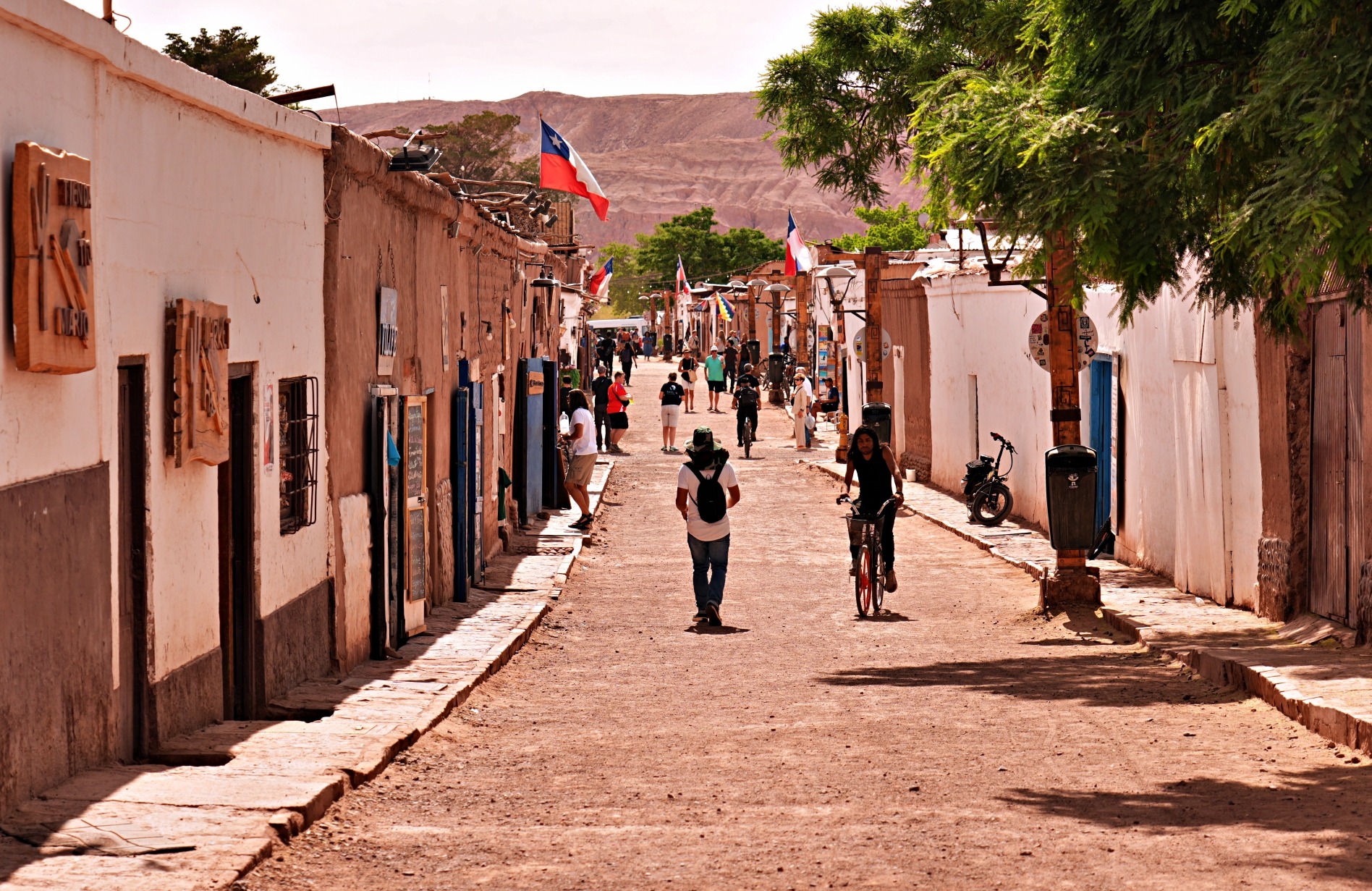
Although the Atacama Desert is massive, extending from the Pacific Ocean to the Bolivian border, most of the fascinating landscapes are close to the main town, San Pedro de Atacama. It lies at 2,450 metres (8,040 ft) and feels more like a border town than a tourist hub because its dirt roads are fringed by single-story adobe buildings. Many of the patrimonial houses lie behind mud fences with basic, but classic patterns that add to the local flavour of the town.


Caracoles is the main tourist street, and most of its adobe buildings are home to tour agencies and restaurants. Even though it is typically a busy place, it still carries a humble, remote feel.


Above town, the perfectly shaped Volcan Licancabur caught our attention. Only a couple of years ago, we were in Bolivia and saw it from the other side, hovering above Laguna Verde. The first two pictures below are from San Pedro, the third is from the Bolivian side with Laguna Verde. You can read more in our post, Stunning Lakes of Uyuni.


San Pedro de Atacama Square
The main square matches the laid-back atmosphere of the town, where whitewashed buildings stand beneath tall shade trees.


Not much happens in the square, but it is home to San Pedro Church. Similar to the town, the church looks like many from the early Spanish colonial days. First built in 1557, it was damaged many times by a few different fires and then by an earthquake. The church was reconstructed in 1884 and restored in 2015.
Inside, the nave matches the exterior with white walls and an open wooden ceiling made with cactus and carob wood.


What to see in Atacama
In a land with such a unique geological setting, there is a wide variety of natural scenes. Visiting them, with or without a car, involves a bit of planning and research, especially if you have a limited amount of time. While we didn’t see everything, we did spend several days in Atacama and were able to visit quite a few sites. We’ll describe those to you below to help make your trip to the Atacama perfect for you.
In addition to selecting the sites you want to see, visitors often have to decide if they want to rent a car or take tours. We decided to take locally run tours instead of renting a car. Whether you drive or take tours, the Atacama is huge, so we are presenting the sites based on their proximity to one another so you can be efficient with your time. We’ve included the local tour names because most tour agencies promote them by these local names. We’ve provided links to our posts with more information on each.
Here is an idea of the tours and what you’ll see. Some are half-day tours, others take a full day.
1. Piedras Rojas Tour
One of the most popular tours in the Atacama is called Piedras Rojas, but it includes a lot more than just Red Rocks. The full-day tour takes you to see: flamingos in Laguna Chaxa; Piedras Rojas that surround Salar de Talar (salt flats); and the Altiplanic Lagoons that are perfectly placed under tall volcanoes.
Find out the details of these amazing sites in our post, Atacama’s Piedras Rojas, Chaxa and Altiplanic Lagoons.


2. El Tatio Geysers Tour
Set in a basin that is jam-packed with more than 80 geysers and fumaroles in 10 km² (3.8 mi²), El Tatio Geysers puts on quite the display. When we first saw it from above, the entire valley looked to be steaming. Pathways run between the many geysers, fumaroles, cones and pools, allowing you to get quite close.
The full-day tour also takes you to Machuca village, the highest village in Chile, and to a few small lagoons along the way.
Learn more about these sites in our post Atacama’s El Tatio Geysers, Rainbow Valley and Baltinache Lagoons.


3. Rainbow Valley Tour
Located in the Rio Grande Basin, Rainbow Valley (Valle de Arcoiris) in the Domeyko Range lives up to its name. Filled with canyons, cliffs and boulders in a multitude of colours, Rainbow Valley was one of our favourite places in the Atacama.
Some tours will also take you to Rio Grande, an authentic indigenous village in the same valley. It is a half-day tour.
We’ll describe this area in more detail in our post, Atacama’s El Tatio Geysers, Rainbow Valley and Baltinache Lagoons.


4. El Baltinache Lagoons Tour
Located in the driest part of the Atacama Desert is a string of seven small, turquoise lagoons rimmed in salt. The main reason most visit Baltinache Lagoon is to float in Lagoon 7. It can be very busy, though, and it was one of our least favourite places in Atacama. It is a half-day tour.
You can see pictures of all seven lagoons in our post Atacama’s El Tatio Geysers, Rainbow Valley and Baltinache Lagoons.


5. Mountain Biking in Garganta del Diable or Valle de la Luna
Exploring the surreal Atacama landscapes on a bicycle is one of the best ways to experience what Atacama has to offer. We mountain biked in two different areas, Garganta del Diablo and Valley de la Luna and loved seeing these wilder parts of the desert. You can visit them self-guided or with a private biking guide.
We explore the routes and scenery in our post, Biking in the Atacama: Garganta del Diablo and Valle de la Luna.


Getting to San Pedro de Atacama
Most arrive in Atacama by air, landing in El Loa Airport in Calama, 95 km (60 mi) away. To get to San Pedro, you can take one of several private transfer companies located on the airport arrivals level. They all seem to charge the same rate and leave as soon as they are full. Taxi rates are about four times the price of a shuttle, but you may be able to share with others to make it about the same price per person as a shuttle. You can reserve shuttles in advance, but there really is no need. There are also many car rental agencies on the arrivals level, but during the busy season, you do need to book these in advance. A bus travels the route for half the price, but it leaves from the bus station in Calama, not the airport.
If you prefer to arrive by bus instead of plane, be prepared for a long ride. As well, the mountain roads depend on good weather, so they may not always be open. Here are the quoted travel times from Santiago (24hrs), Arica (11hrs), and Salta, Argentina (8 hrs). If you plan to visit Uyuni in Bolivia (13 hours), you may prefer to take a tour that stops at the sites in Bolivia on the way to Uyuni.
San Pedro de Atacama can be found near the top of the map below. It is an interactive map, so you can zoom-in, or click on a link for a link to our post from that region.
When to visit Atacama
You can visit Atacama at any time of year, but summer (December to February) is the warmest. It is also the busiest season, so expect higher prices. Shoulder seasons (September to November and March to May) are typically less busy and therefore may be a little cheaper, but temperatures will be cooler. Winter (July to September) should have the clearest skies, but it will be cold.
How to Visit Atacama
Renting a car – Some people decide to rent a car, but unless you have more than two people, this is a more expensive option. If you do drive yourself, be sure to download maps ahead of time because there is often no internet coverage on the backroads. We decided to take locally run tours instead of renting a car and are very happy with that choice.
Booking a tour – We didn’t book our tour in advance, and you really don’t need to. There are dozens of tour agencies offering very similar tours in the town’s downtown. It can be a little overwhelming, so try to determine what you want to see before speaking to them. They all offer half-day and full-day options, and most of the tours include breakfast and/or lunch, which makes them a little more economical. The meals we had were very good, with plenty of choices. Most are picnic style, but may include warm dishes. We had the most delicious scrambled eggs for breakfast on one of our tours. Other choices are sandwiches, fruit, yogurt, cookies, coffee and tea. In the afternoon, you may have a pisco sour.
Atacama vs. Uyuni – Visiting Atacama is much different than Uyuni, Bolivia. In Atacama, there are half-day and full-day options, but you return to San Pedro at the end of the tour. In Uyuni, there are one-day tours, but most are 2 nights/3 days or even longer. Even though the landscapes are very similar, we prefer Uyuni a little more than Atacama, because in Uyuni, we felt as though we were immersed in the wonderful landscapes. In Atacama, a lot of time is spent driving, and the scenery between the sites isn’t as spectacular.
Elevation – Most of the Atacama is located at a high elevation, so you should bring warm layers for mornings and nights. It also means that the sun is intense, so bring sunscreen, sunglasses and a hat. These high elevations mean you need to acclimatize. Either do this by visiting other high elevation places first, or plan to spend your first few days in San Pedro. To help prevent altitude sickness, stay hydrated by drinking a lot of water; many recommend 3 litres a day.
Food and Water – There aren’t many places to buy water or snacks at the sites during the day, so bring with you what you need.
Costs – Our total cost per person was 170,000 CLP ($180 USD) for the four tours and two bike trips mentioned above, plus park entry fees, so it is not as expensive as many think. We visited in November, 2025.
Where to Eat and Stay in San Pedro de Atacama
There are many choices for accomodation in San Pedro ranging from semi-luxury resorts to modest guesthouses. The town is quite small and since tours pick you up at your hotel and drop you off at Caracoles Street, the location of where you stay is not as important. Most restaurants are located on or near Caracoles Street, so you may want to consider how long the walk is between it and your hotel. There are a few other restaurants scattered throughout the town, but almost all eateries in San Pedro are for toursits.

Click on the link to read our Travel Tips For Chile.
To read more of our adventures in Chile, click here.
Coming Next – Atacama’s Piedras Rojas, Chaxa and Altiplanic Lagoons
For pictures from other blogs go to Gallery at monkeystale.ca.
To read about more of our adventures go to Destinations.
If you like what you read, please comment or share (with credit) using the links below.




We'd love to hear from you, please leave a comment.