
Travertine pools, filled with mineral rich water cascade down the mountain side. This brilliant natural marvel has been a draw for visitors since ancient times. Used as a health resort by the likes of Cleopatra, today it is an Instagram favourite. Come with us as we visit Pamukkale’s Thermal Pools and the ancient cities of Hierapolis and Laodicea.
Pamukkale Thermal Pools
Nicknamed ‘Cotton Castle’, Pamukkale’s white, travertine thermal pools cover the mountain in a blanket of white. These pools, filled with beautiful blue water, gave the mountain an even more magical appearance. At least, that’s how they used to be seen. Today, the thermal pools of Pamukkale are dry, but this unique display of nature’s artwork is still an awe-inspiring vision.

The pools were formed centuries ago by underground thermal springs that escaped through fissures in this earthquake-prone area. This process is still occurring, although on a much smaller level. The water is high in calcium, bicarbonate and other minerals. Once the water reaches the ground, it cools and carbon dioxide is released. The result is a calcium carbonate precipitate, and once that dries, it becomes travertine. In addition to fissures, earthquakes have caused the hill to be uneven, allowing the travertine to form pools in the flatter areas. The water slowly trickles down the hill, making travertine pools at different levels, covering the slope in white. As long as the mineral-rich water flows, the travertine pools will grow.
Unfortunately for us, the travertine pools of Pamukkale were quite disappointing. Almost all of the pools are dry, leaving only stark white pools filled with clay. They are not as you see on social media or marketing brochures that show a mountain covered in turquoise pools rimmed by white edges. They were once like this, but not any longer. We were told two stories about this lack of water. One is that the pools were purposely drained to allow the travertine to whiten. The second explanation is that because of the increasing water needs in the growing cities below, there is not enough water to fill the pools. Perhaps it’s a combination if the two.
Luckily, we found one area where several thermal pools are filled with water and allow you to see how this site must have once appeared. You’ll have to keep reading to find out where it is.
We have visited other travertine sites around the world. You can click on the links to read about out adventures in Agua Azul, Hierve el Agua, Semuc Champey and Kuang Si.
We began our exploration of Pamukkale from the lower gate at the bottom of the hill. After removing our shoes we walked up to the top passing a row of eight man-made pools. These pools are apparently the only pools that are always filled with water. They are also the only ones that you are allowed to enter. The man-made pools are unique and beautiful, but not as picturesque as we had hoped.


We read that Pamukkale is the most visited tourist site in all of Turkey. You can imagine then how many people are trying to get that perfect shot of the pools. The crazy thing, though, is that since tour buses arrive at the upper gates, only the top few pools are busy. Only a few of the throngs of people made it down to the bottom 3 or 4 pools, so these are often empty. This Instagram hotspot had people dressed in all sorts of crazy outfits, making annoying poses and hogging the top pools. We couldn’t wait to get away from this busy part of the park.

Tip – These 8 pools are in the shade until noon so even though it is quieter first thing in the morning, the pictures won’t turn out because there’s not enough light.
As we walked up the hill beside the man-made pools, we looked to the other side of the walkway, where there are hundreds of white, travertine pools. Since they are all white, they’re not nearly as picturesque as we had hoped.
Sidewalks along the top of the hill allow you to look down on the mountain. From there, we continued to see hundreds of these dry, white pools. Some were stark white, others had a layer of mud on the bottom. This scene does bring about a sense of awe, though, at how spectacular nature’s designs can be.


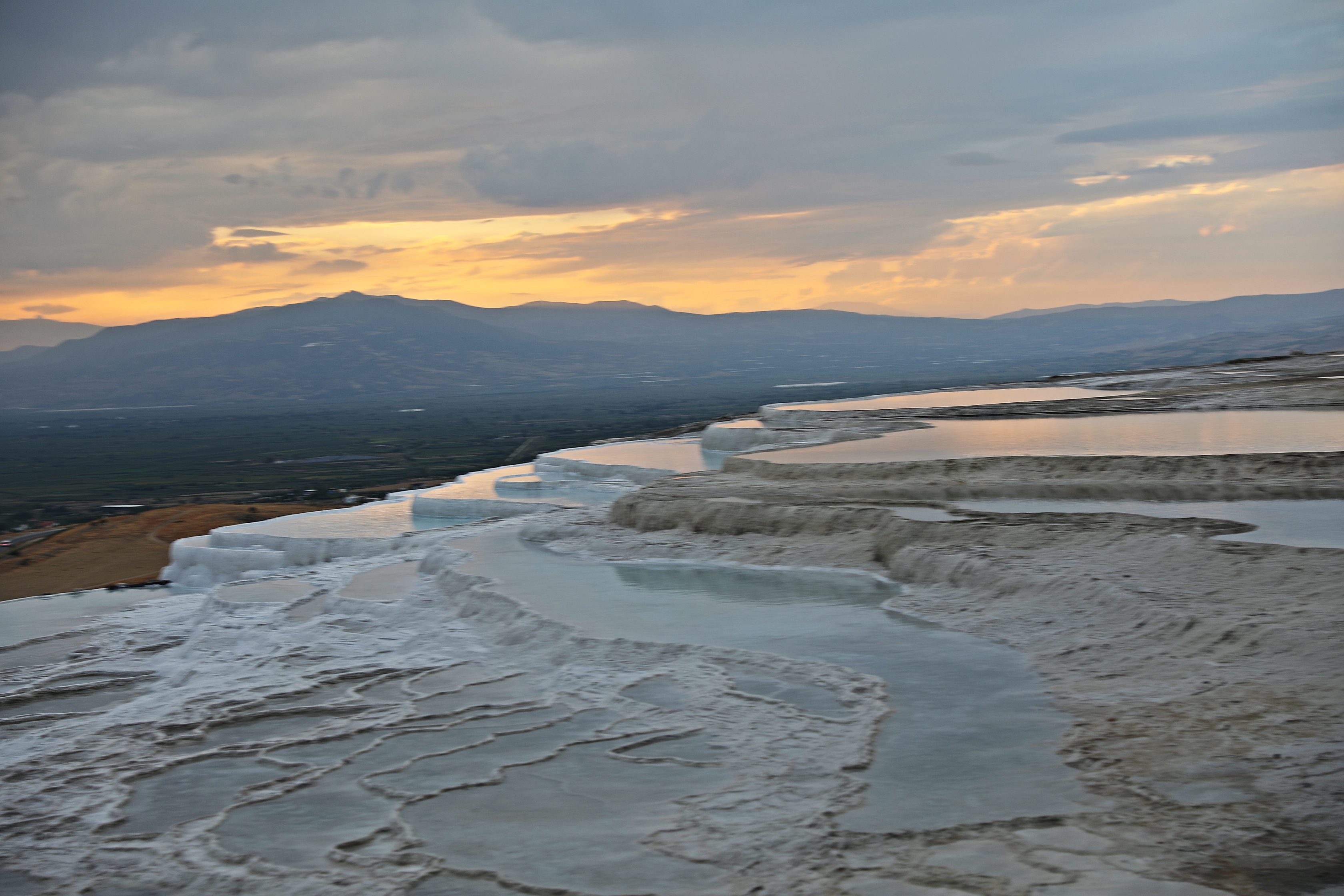
After walking along the top for a while, we were lucky enough to stumble upon a small group of natural pools that were filled with water. No one else seemed to know about these pools, and we had them almost all to ourselves. This small collection of pools finally gave us an idea of how spectacular this area must have been in the days of Cleopatra.
They are located beside the walkway at the top of the pools. They are only a five minute walk from the main pathway that takes you from top to bottom.

We returned to this spot at sunset, where we were able to see what all of the hype was about. The white-rimmed pools, reflecting the orange setting sun, created a phenomenal view. If only the entire mountain were still this beautiful.


We can’t deny that Pamukkale is an unmatched natural beauty, but it is not as advertised.
To read about other travertine pools we’ve visited, visit Laos – Luang Prabang; Guatemala – Semuc Champey; Mexico – Agua Azul , Hierve el Agua.
Hierapolis
The Greeks soaked in the travertine pools as early as the 2nd century BCE. As the pools became more popular, the spa-resort city of Hierapolis was built on the flats above.
Today, most of the city is in ruins, but there are a few sites that make it worth exploring, beginning with the main entrance to the city. The 1st century triple-arched, travertine Domitian Gate would have given a stunning first impression. Named after the Emperor Domitian, the gate leads you to Frontinus Street, which would have been one of the city’s main markets.
During his reign Emperor Domitian declared himself to be god so those that enter the gate had to pledge devotion to him.

In the middle of the city, the 3rd century Apollo Temple was under renovation when we visited. It will likely be a gorgeous building when it’s completed. What is hiding beside the temple is more interesting anyway. The Plutonium, likely from the 2nd century BCE, is dedicated to the God Pluto, who presides over the afterlife.
The Plutonium was built atop a cave that emits a suffocating CO2 gas, which they believed was sent by Pluto. It is thought that ancient rites, such as sacrificing bulls, were performed here. The animals were sent into the cave and suffocated to death from C02 poisoning. Strangely, eunuch priests were the only ones who weren’t affected by the noxious gas. Likely, they learned that they could hold their breath while venturing inside and make it out alive. Because of their tricks, the eunuchs were held in high esteem and were considered to be Oracles.

Above the temple is the theatre. Having seen so many Greek and Roman theatres, such as Ephesus, we weren’t really sure we needed to see another, but we’re so glad we did. At the front of the 3rd century AD building are gorgeous marble columns and elegantly sculpted friezes. It has been restored, allowing us to get a better sense of its original beauty. This piece of art provides an incredible backdrop to the large theatre.


In the 5th century, the orchestra pit was lined with a waterproof mortar. Pipes were added so the pit could be filled with water. This allowed for water-themed performances and made us wonder if this was the inspiration for Cirque du Soleil’s show O.
In the 1st century citizens worshipped their Emperor as a god. At this time, St. Philip, one of the disciples, preached Christianity to the people. Because of this, Emperor Domitian had him crucified. There is a martyrium and tomb that may have been Philip’s, but much of it is in ruin. Over three hundred years later, the city became Christian under the Byzantines.
At the far end of the city is a massive necropolis. The sheer number of sarcophagi, tombs and tumuli (funery chambers) led researchers to believe that Pamukkale’s mineral pools were used for their healing properties. They believe that many people came to cure their various illnesses. Likely, though, most were not cured by the pools and instead died here. The necropolis covered a large area that extended all the way to the pools. We found one tomb inside a travertine pool.
There are so many sarcophagi here that some researches talk about the 4th and 5th centuries’ sarcophagi industry. Funny how we don’t tend to think about organized industries in these times.


Inside the museum there are a few examples of how elaborate these sarcophagi were.


Next to the museum is the information centre and the Antique Pool apparently used by Cleopatra. Columns from the original bathhouse are still at the bottom of the pool, and for a fee, you can swim over them. The pool was quite busy, and since we had already swam over ruins in Kekova, we didn’t feel the need to do it here.
Pamukkale Town
At the base of the travertine pools is the small town of Pamukkale. Even though the pools were very busy, the town was quiet. It seems that most people take day tours and don’t stay locally.
From the edge of town, you can see the tall white mountain hovering above a small duck pond. Running from it are travertine lined canals. Further down, a man-made set of pools is on display. They are actually nicer than the man-made ones on the hill.


Laodicea
On top of a hill, on the other side of the valley from Pamukkale is another site with Greek and Roman ruins. From the tall columns of Laodicea, we could see the white travertine-covered hill of Pamukkale in the distance.


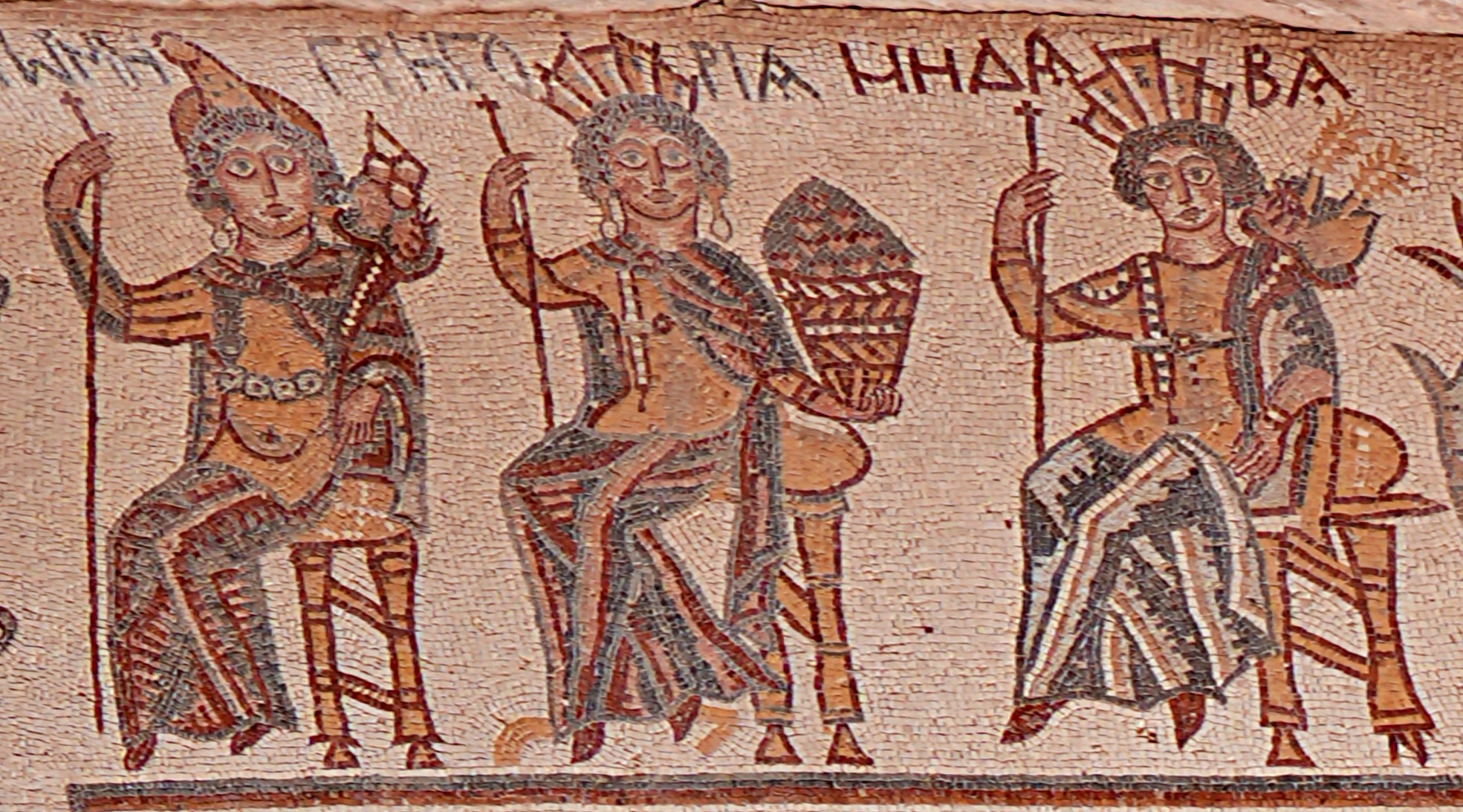
The most interesting building in the ancient city is the Church of Laodicea. The floors of this large 4th century building are covered in gorgeous tile mosaics with images of old clerics and geometric designs.

Next door to the church are the remains of a temple. Above the columns, beautifully carved friezes provide great examples of the skill of the carvers.
At the back of the temple, a glass floor allows you to walk over one of the rooms. Although today the room is deep underground, it would not have been when it was built. Walking above it brings perspective to how much earth has covered these buildings over the centuries. It was an interesting way to view the ruins, but not easy to photograph.


Tips for Visiting Pamukkale
Loaded tour buses start arriving around 9 am and continue to arrive until 5 pm. They seem to stay at the top 2 or 3 pools and only visit a couple of archaeological sites so it wasn’t as bad as we expected.
Instead of taking a tour, consider staying in the small town of Pamukkale. There are several local hotels and restaurants within walking distance of the site.
Entrance Fee – Pamukkale/Hierapolis 700 TRY ($22.80 USD); Ladoacia 280 TRY ($9.20 USD), Combined ticket for all three was 850 TRY ($27.70 USD); Opening Hours – 6:30 am to 9pm
Tip – There are many different museum passes in Turkey that provide discounted fees for multiple sites in a short period of time. For us, they often included sites we were not interested in seeing, so it was usually cheaper to buy individual tickets. You can find pricing on the government website here.

Click on the link to read our Travel Tips For Turkey.
To read more of our adventures from Turkey click here.
Coming Next – Izmir & Pergamon
For pictures from other blogs go to Gallery at monkeystale.ca
To read about more of our adventures go to Destinations.
If you like what you read, please comment or share (with credit) using the links below.




We’d love to hear from you, please leave a comment.