
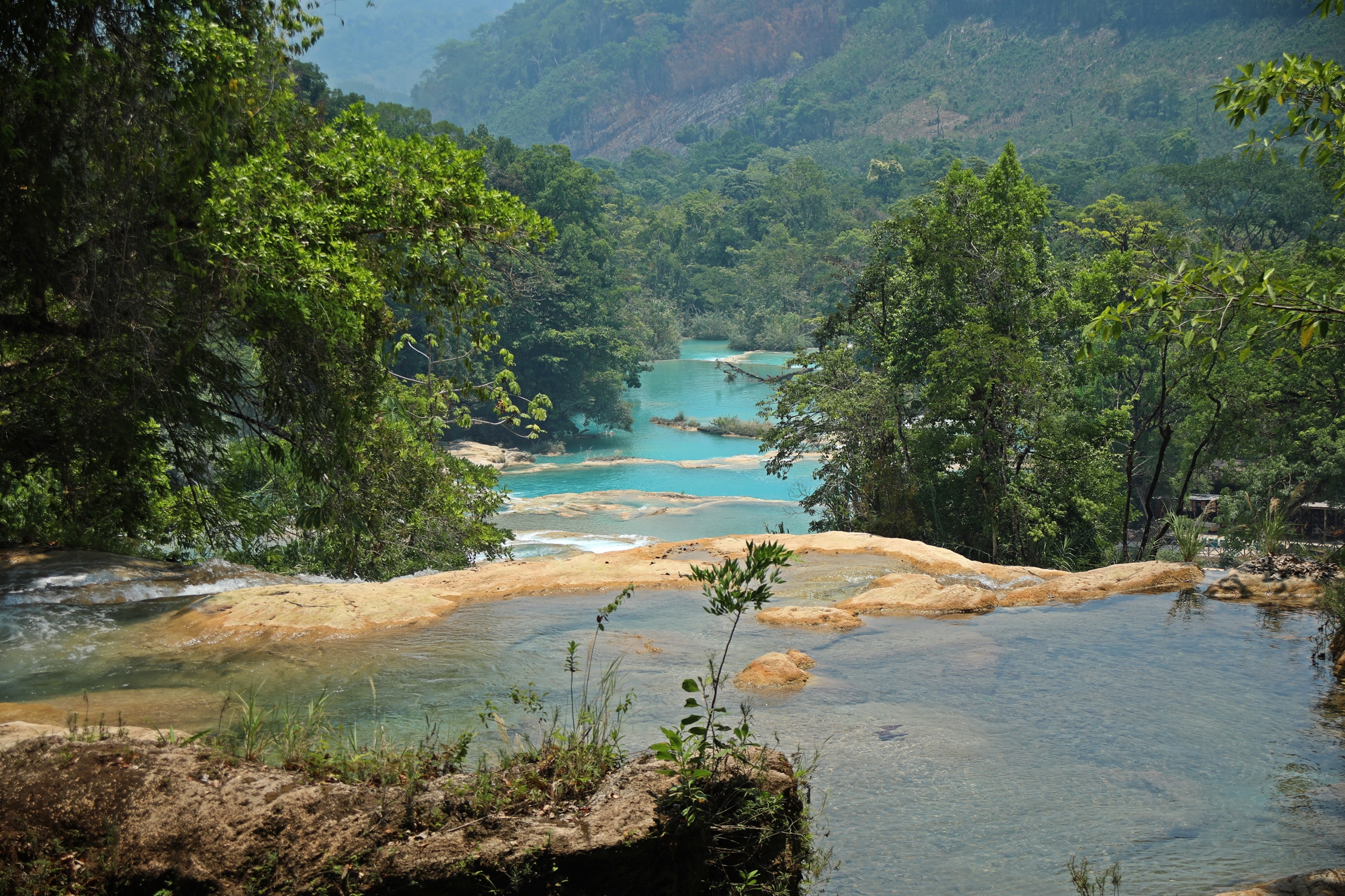
With a gorgeous turquoise waterfall in one direction and an important Maya city in the other, it is very surprising that there aren’t more visitors to Palenque, Mexico. We spent two full days exploring these fabulous sites and highly recommend that Palenque be included on your next trip to Mexico.
After visiting the highlands of Oaxaca and San Cristobal de las Casa, we were now travelling to the middle of Mexico’s jungle. Palenque is located far from both the breezes on the coast and the cool air in the mountains. Its elevation is only 60 m (200 ft) above sea level. If we thought it was hot in other parts of the country, it was at least 10 degrees warmer in the jungle.
The two most popular sites to visit on day trips from Palenque are the waterfalls of Agua Azul and the Maya city of Palenque. They’re easy to reach, but are on opposite sides of the city so you likely will need a day for each.
Agua Azul Waterfalls
A great day trip from the steamy city of Palenque is a visit to one of the most beautiful waterfalls in Mexico. Imagine tiers of white rimmed, travertine pools gently spilling their turquoise water into the pool below. This long string of mini waterfalls together form Cascadas de Agua Azul.
We explored this stunning waterfall by starting near its lowest level. Here, the travertine pools spread out, covering the land in turquoise. Some are little, white-rimmed pools to dip your feet in, while others are large, spa-like soaking pools.


As we walked up the hill, we passed many waterfalls. Like the pools, the falls come in different sizes too. They range from a small trickle over the edge of a pool, to a more dramatic drop off a higher ledge. Spray from the falls helped to keep us cool in the heat of the jungle.


The beautiful turquoise colour is due to calcium carbonate and magnesium sulfate in the river water. These minerals then get deposited to form travertine ridges that form the rims of the pools. The scene they create is almost too perfect to be real.
The penultimate view at Agua Azul is near the top of the site. Here a large waterfall powerfully surges over the cliffs, beginning the cascade of waterfalls down the hill.

You can take a refreshing dip in most of the pools, but not all of them. There are a few barriers preventing you from going into spots deemed unsafe. Eagle-eyed guards blow their whistles if you get too close to the edge.


We have visited other travertine sites around the world. You can click on the links to read about out adventures in Hierve el Agua, Semuc Champey, Pamukkale and Kuang Si.
Getting to Agua Azul
Being located about 30 km from Palenque makes this a great day trip from the city. There are many tours in Palenque that include Agua Azul in their trips along with other spots. You can also take a tour from San Cristobal de las Casas, but it would make a very long day. If you don’t want to take a tour you can easily visit Agua Azul and Misol-Ha independently. The air-conditioned colectivo stop in Palenque is marked on Google Maps as ‘colectivo Ocosingo/Agua Azul’. The bus lets you off 4 ½ km from the falls. There are taxis or share-taxis waiting at this stop to take you the falls.
Misol-Ha Waterfall
If you’re going to Aqua Azul you can stop at another waterfall near by. Although not as large or pretty as Aqua Azul, Misol-Ha is still a nice spot. The water here drops straight down for about 30 m into a small pool. You can follow a small trail behind the falls to reach a small grotto. If you want to swim in its pool, you will likely have it all to yourself since there aren’t as many visitors to this waterfall.


Getting to Misol Ha Waterfall
The colectivo that goes to Aqua Azul passes by the Misol-Ha turn-off. From the highway there is an easy 1.6 km walk along a quiet road.
A Bit About The Maya
Located near the Mexico – Guatemala border, Palenque is located in traditional Maya lands. As one of the first indigenous groups to settle in Mesoamerica, Mayans spread across Mexico’s Yucatan peninsula and north into the Mexican states of Tabasco and Chiapas. They also went south into Guatemala, Belize as well as parts of El Salvador and Honduras.
The Maya people were very advanced, excelling in math and astronomy. Using this knowledge, they developed one of the most accurate calendars with 365 days separated into eighteen 20-day months and one 5-day month. They used hieroglyphics with 800 characters to tell their stories, legends and history.
The Maya were not empire builders, but instead built independent cities and states. They shared common religious beliefs, customs and language with each other but remained independent. Communities developed cooperative relationships with some of their neighbours while being at war with others.
Exploring these cities is a great way to further understand this fascinating culture.
Palenque Archeological Site
Palenque was once an important Mayan city, located not far from the present-day city of the same name. It was first settled early as the 3rd century BCE and lived in until 799 AD. Researches suspect there were originally Olmec tribes living on this spot even earlier.
Palenque was originally built as an agricultural village but soon became the capital of a region that included the present-day states of Chiapas and Tabasco. Ruling Mayan kings in Palenque were frequently allied with another Mayan powerhouse, Tikal, over 300 km (180 miles) away. Together they fought against Calakmul (Maya city in Campeche State). After the 8th century, the city was abandoned and eventually was taken over by the jungle. It wasn’t rediscovered until the18th century.

When you reach the archeological site you can either drive directly to the main entrance or walk through the jungle to see a few smaller ruins. Walking through the jungle sounded more adventurous, so of course that’s the option we chose. As expected, the ruins here were in rough shape but the sounds from the jungle let us know it was very alive. Animals scurried about as they heard us approach. We didn’t seem to bother the group of howler monkeys sleeping in the trees overhead though.


After walking on this rough path, we were quite surprised when we emerged from the dense jungle to see a gorgeous stone palace in front of us. The Palace was built in the 6th century by one of the city’s most prominent rulers, Pakal. He reigned for almost 70 years, which at that time is quite remarkable. The Palace is a very impressive structure with a wide stone staircase leading up to its single story main building. In its day it would have been decorated in carvings and sculptures. Today there are only a few left but they help you imagine how spectacular it must have been.


The palace has a 15 m tall tower which is unusual in Maya buildings. It was a much later addition to the palace, but researchers still aren’t sure if it was used as a watch tower or observatory.

The buildings in Palenque have a different style than other Mayan cities we’ve seen. Temples were built on pyramid bases, but the stone buildings on top have their own style and look more like regular stone buildings.
Beside the palace is a row of three pyramids. The first is Temple of Inscriptions that houses the Tomb of Pakal. It is a very eye-catching building and you know immediately that it was built for someone important. The surrounding green of the healthy jungle adds to the beauty. You’ll notice that the windows have been sealed up to protect the interior.

Visitors can no longer enter, but inside researchers found a funerary and sarcophagus for Pakal. Archeologists found a tombstone and other stone tablets that had hieroglyphics revealing Pakal’s name, ancestry and a scene recreating his death. These inscriptions are what gave the temple its name.
Immediately beside this building is Temple of the Red Queen. When the tomb was opened, researchers found a female skeleton coated in red cinnamon. It is believed she was the spouse of Pakal. We entered the tomb and could still see red inside the sarcophagus.

The final pyramid in this row is Temple of the Skull. It’s not as gruesome as it names leads you to believe. At the base of the door is a carving of a rabbit skull. It would have originally been painted red or blue. A tomb with rich offerings were found inside the building.


Across from the palace is the North Group of temples. One is called Temple of the Count because eccentric French explorer and artist Count Waldeck lived in it for a couple of years in the 1800s.


A small aqueduct splits the site in two. We crossed over it to find a collection of buildings called Temples of the Cross Group. The name comes from cross-like windows on the buildings’ walls. It’s not a cross at all, but rather a Ceiba Tree, which is sacred in Maya culture. The temples in this group were built by Pakal’s son Chan Bahlum II when he came to power. The three buildings are called Temple of the Cross, Temple of the Sun and Temple of the Foliated Cross.
They are quite unique in design with fantastic mansard roofs and a lattice style top often referred to as a comb. We have never seen roofs like this before. They are fabulous.


We climbed up the steps of both Temples of the Cross and Sun to have a look inside. At the entrance of both are weathered engravings and hieroglyphics that show Chan Bahlum II’s ascension to the throne as well as his ancestry. According to records from the 16th century, the stone temples were originally painted blue and red.

From the top of the pyramids we had great views toward the Palace and surrounding jungle.

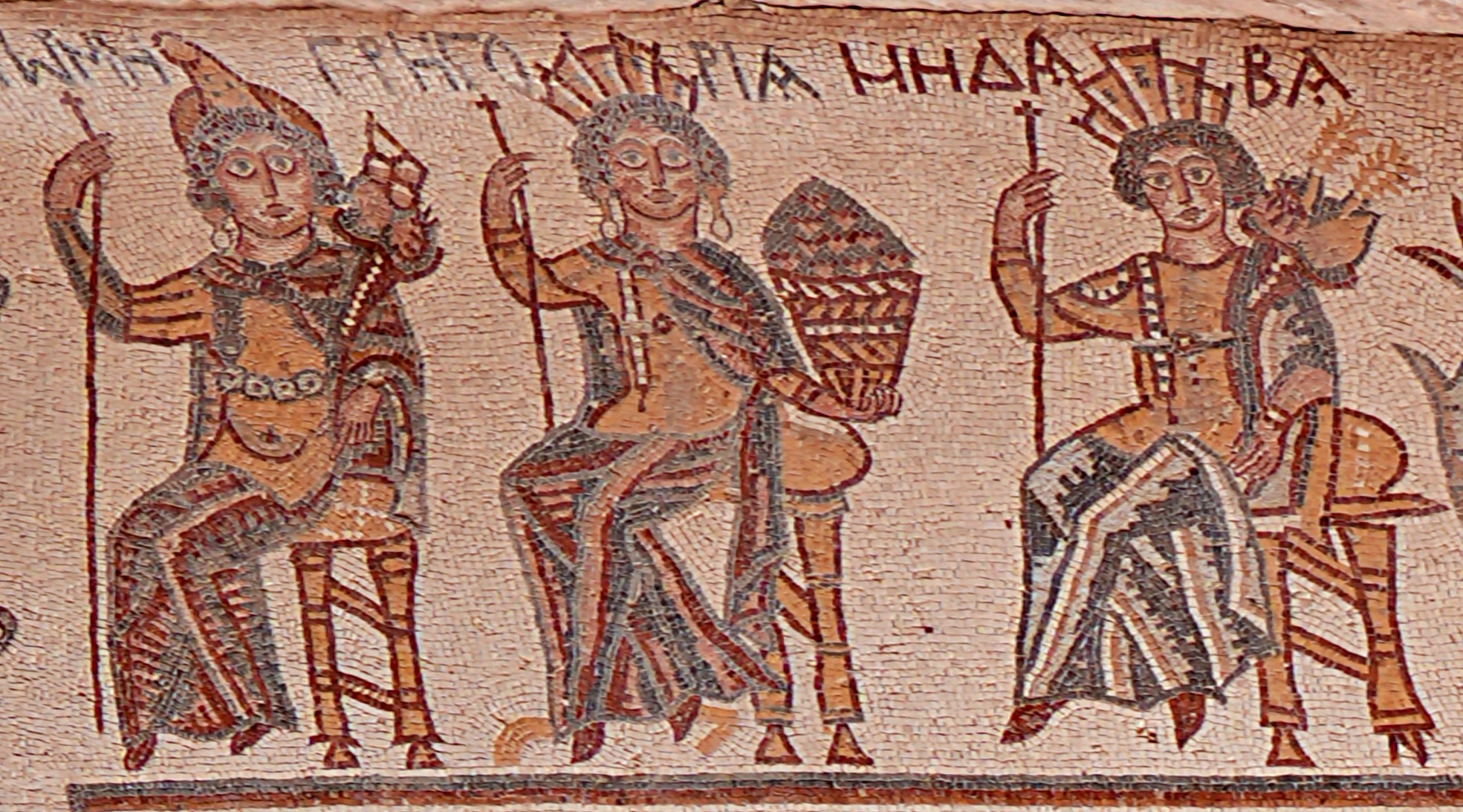
There are a few more sites to see on top of the hill behind this group. These temples were less maintained and not very interesting, but they house something else that is special to see. On one of the pyramid platforms are several stone tablets with bas relief carvings of Maya kings and gods. The people’s attire in the carvings made the Spanish believe they were Egyptians. When you look at the first picture below you can probably see why they may have thought that. The carvings are in remarkable condition considering they are from earlier than 800 AD.


As we were leaving the site we saw workers picking mangoes from the trees. They saw us watching and were kind enough to give us a couple. The mangoes were so sweet and juicy, we wished we taken more!

The archeological zone is inside Palenque National Park. The park and the archeological site have separate fees. To enter the archeological site you must also buy a park pass. The museum is included in your entry fee, but was closed for renovations when we were there in the spring of 2024.
When to visit Palenque Archeological Site
Dry season is between November and April and would be the best time to visit. Rainy season runs from May to October. We visited in late May and were lucky to have great weather, but it was very hot. It was one of the hottest places we visited in Mexico with temperatures well into the 40°s C (105° F) and very high humidity.
How to get to Palenque Archeological Site
If you’re staying in the city of Palenque you can easily visit on your own. Colectivos with a ‘Ruinas’ sign on their windshield leave from downtown. The stop is listed on Google Maps. It also will stop near the ADO bus station. It leaves every 15 minutes and will take you to the park gates. From there it is 1.5 km to the archeological site. Some people take a tour from San Cristobal de las Casas, but that makes for a very long day.
You can read about other Maya sites we’ve visited in Mexico and Central America in our posts: Chichen Itza, Tulum, Uxmal (Coming Soon), Joya de Cerén (El Salvador), Tikal & Yaxha (Guatemala), Xunantunich & ATM Caves (Belize).
How to get to Palenque
There is a small domestic airport in the city, however flights are not frequent and they only fly out of Mexico City. The other airport is Villahermosa Airport (VSA), 133 km away. ADO buses travel between Palenque and San Cristobal de la Casas, Bacalar, Chetumal and Mérida. We found ADO to be safe, efficient and a cost-effective way to travel.
A new option is to take the Maya Train. It connects Palenque with other popular tourist spot in Yucatan.
Where to stay and eat in Palenque
We had heard rumours that Palenque is quite rough so were very surprised to find a lovely area with tree-lined streets, nice hotels and excellent restaurants right across from the ADO bus station on Primera Avenida Norte. We think it is worth it to stay in Palenque when you visit the archeological site and Agua Azul rather than take a day trip from another city.


Click on the link to see our Travel Tips For Mexico.
To read more of our adventures in Mexico, click here.
Coming Next – Seven Shades Of Blue In Bacalar Lagoon
For pictures from other blogs go to Gallery at monkeystale.ca
To read about more of our adventures go to Destinations.
If you like what you read, please comment or share (with credit) using the links below.




We’d love to hear from you, please leave a comment.