
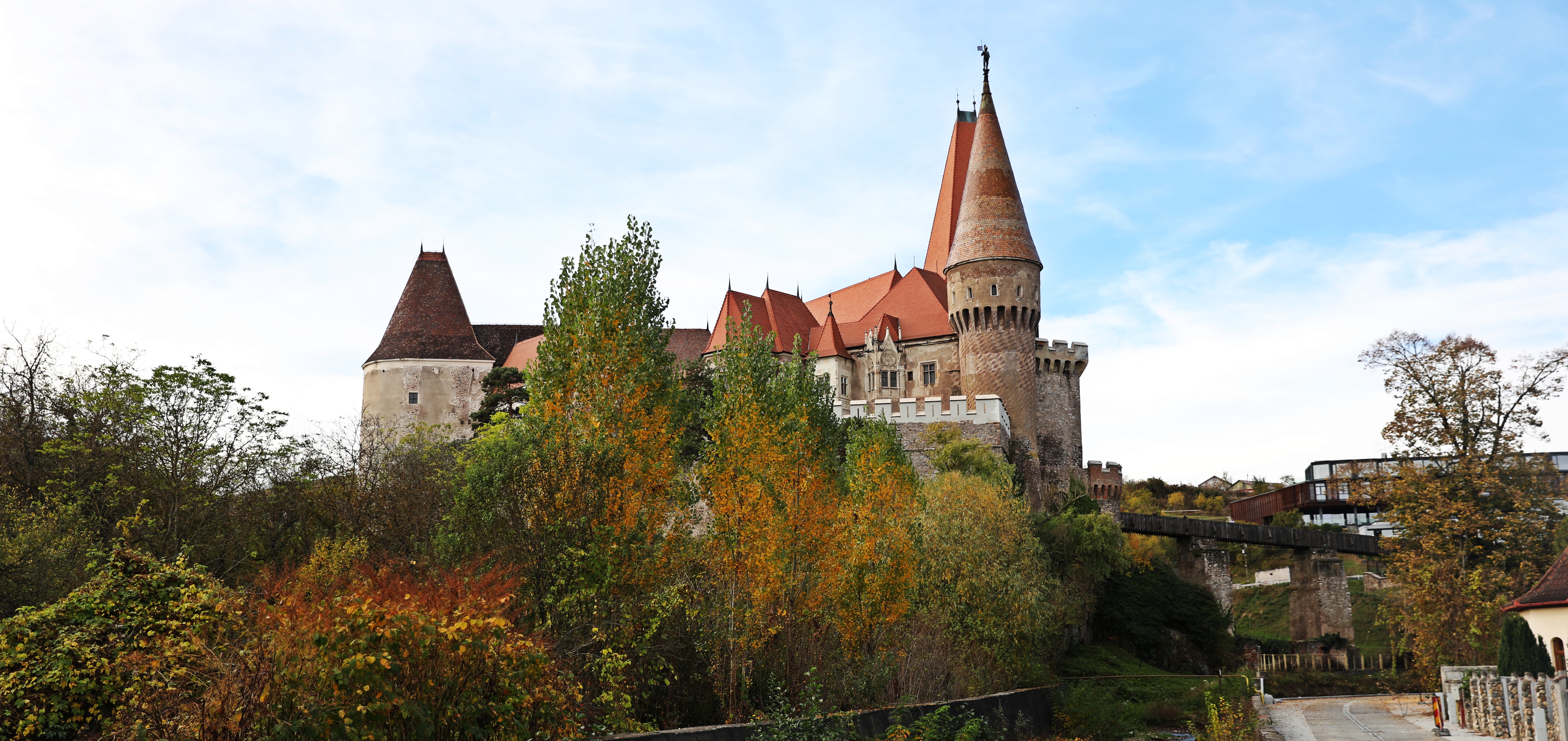
From the creek below we looked up at a long drawbridge that led our eyes to the enchanting Corvin Castle. The Renaissance-Gothic structure has more turrets, towers and bay windows than most other castles we’ve seen. It looked almost too good to be true. After this view from below, we were excited to get a closer look at the perfect storybook castle.

Corvin Castle
In a land filled with castles, it’s difficult for one to stand out, but Corvin Castle does exactly that. Not only because it is the largest castle in Romania, but also because it looks like our idea of the perfect medieval castle. Construction of it began in 1440 by Transylvanian Prince Ioan de Hunedoara. He is known for many successful battles against the Ottoman. The castle is therefore also known as Hunedoara Fortress.
The fairytale building has so many details from the outside, you don’t know where to look. The combination of squared corners against rounded towers, battlements below pointy roofs and a large number of overhanging windows, makes it a feast for the eyes. It is so perfect that we could picture an armoured prince riding up to it on his horse.


We walked across a long wooden draw bridge that extends over the dry moat to reach the arched entryway. Inside, we found a large courtyard that is almost as impressive as the castle’s exterior. High stone walls surround it, allowing only slight glimpses of the towers hovering above.


It was erected on top of an older fortification and was originally used as a defensive fortress and prison. The likes of Vlad the Impaler is said to be one of the captives held here for a while. In the 14th century it was transformed into a residence for Hungarian King Corvin. At this time there were many modifications to turn it from a castle to a palace, but it still has a lot of typical castle elements.
The first room you enter from the courtyard is the not-so-welcoming dungeon and torture chamber. Inside there are a few medieval torture devices on display. Included with them were detailed instructions or human mannequin examples to make sure you understand how they would have been used. Some of the how-to instructions seemed a little too explicit as if they wanted us to try them out.


The living spaces are sparsely decorated but many are well lit, receiving light through the large bay windows we had seen from outside. The most impressive space is the large open room called the Knights Hall. Marble pillars and tiled floors make it more elaborate than most of the other rooms in the castle. We could picture the room filled gallant knights planning their next battle.


Most of the towers have stairwells that allow you to climb to their tops. Some are narrow and steep leaving only enough room for a sentry to pass through. Others are much larger with rooms and balconies around their circumference. A few led to exterior balconies that offered us a different perspective of the castle walls.


Between the towers are loggias (covered balconies) that allow you to look down upon the courtyard below as well as to the town beyond the castle walls.


There are so many nooks and crannies in Corvin Castle that it seemed like you could spend days inside it and still not see it all.
Hunedoara
Corvin Castle is located on the edge of Hunedoara. After visiting the castle we drove through the the city and saw a peculiar sight. Large homes plastered with tacky silver decorations line one part of the main street.

The homes were built by Romas (They also called Gypsies, but it is considered a derogatory term). Originally they were nomads who migrated from northern India in the late Middle Ages. They were discriminated against for generations, especially during Nicolae Ceaușescu’s reign when they were marginalized. After the Romanian Revolution, they took this new freedom to express themselves in the most ostentatious ways possible. The Romas in Hunedoara decorated their houses in outlandish, gaudy decorations that reminded us of the Adams Family. One article we read said the homes were built with financial support from their criminal family members in the UK. Locals have been pushing to have the homes demolished for a while.
All we could think was that we were glad they aren’t our neighbours.


Densuș Church
If you visit Corvin Castle, you should also stop by the oldest church in Romania. As we approached Densuș Church there was no mistaking that this building was unique to the area. Although its exact beginnings are unknown, it is believed that Romans originally built a pagan temple on top of Dacian ruins at this site. Remains of this temple were then used by the Byzantines in the 12th and 13th centuries to built a church. The building continued to be modified over the centuries.

From the exterior we can see its tall stone steeple and typical rounded Byzantine apse. Attached to it are the remains of collapsed walls. Beside them are a couple of columns, although the roof they once supported is gone. It is a hodgepodge building but this clumsiness makes it all the more charming.


An old weathered painting still decorates the wall above the door. Inside, large columns with old frescoes on them take up most of the space. It hardly seems like there’s room for a congregation, but church service still take place in the 700-year-old church.


The centuries old frescoes on the walls and pillars haven’t been restored and add to the ambience in the old building. Many of the eyes have been scratched out. Apparently this was done by Ottoman during their reign in Romania.


How to get to Corvin Castle
Located 140 km from Sibiu, you can easily visit Corvin Castle on a day trip from Sibiu. If you have your own car it is an easy drive on two-lane good highways. Densuș Church isn’t far away and is worth a side trip. Tours to the castle are offered in Sibiu and it is also often included on multi-day tours of the country. It is possible to take public transportation, but it is very arduous as it involves a train, a minibus and a taxi.
Where to stay near Corvin Castle
Although there are hotels in Hunedoara, it’s likely more comfortable to stay in Sibiu where there are more choices for both hotels and restaurants. You can read more about Sibiu here.
Click on the link to read our Travel Tips For Romania.
To read more of our adventures in Romania, click here.
Coming Next – Driving The Transfăgărășan
For pictures from other blogs go to Gallery at monkeystale.ca
To read about more of our adventures go to Destinations.
If you like what you read, please comment or share (with credit) using the links below.




We’d love to hear from you, please leave a comment.