
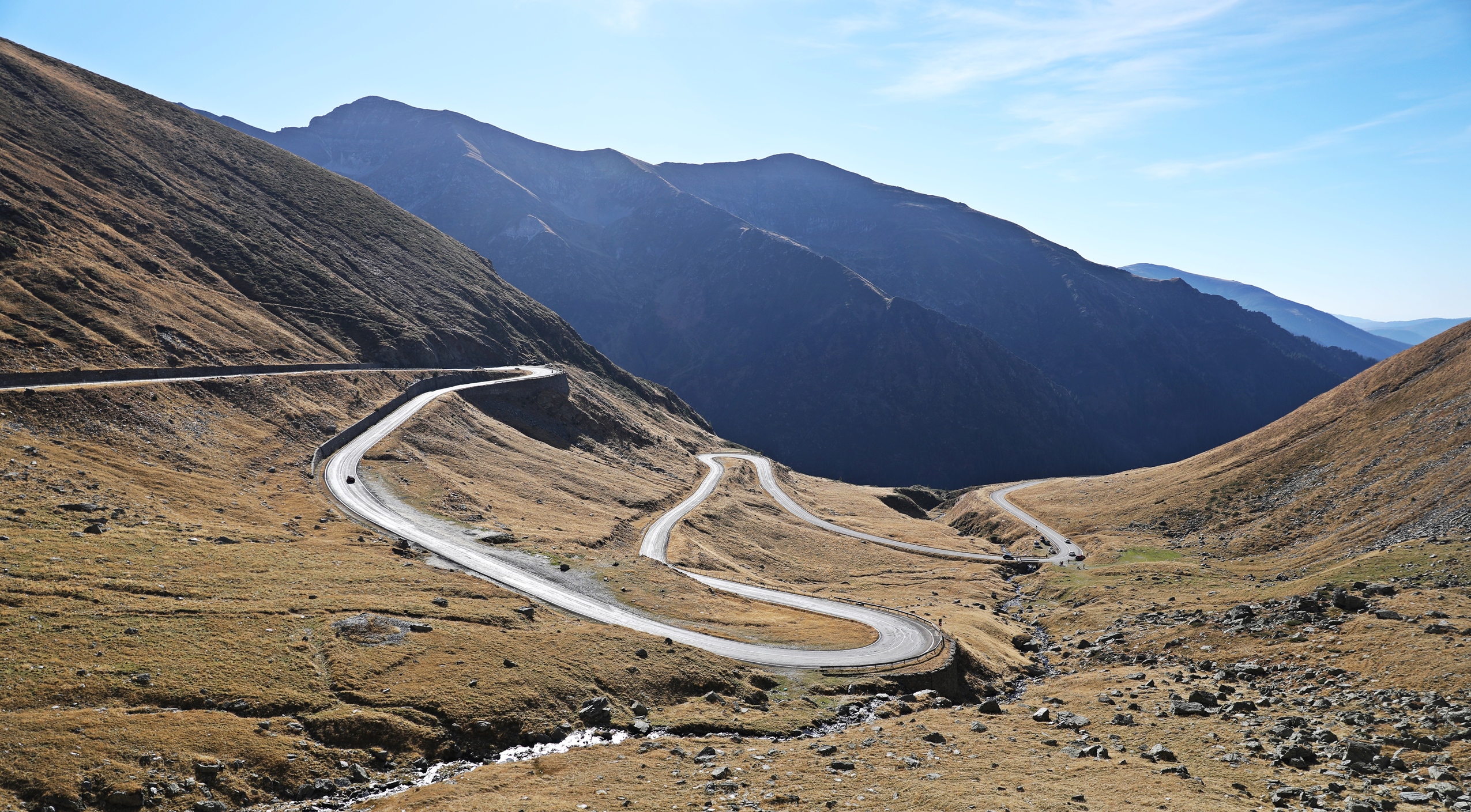
Our car careened around one turn and then another and another. We were finally driving the famous Transfăgărășan Highway. The road takes you over the Făgăraș Mountains for a spectacular 90 km (56 miles) drive that includes countless switchbacks, avalanche sheds, bridges and a long tunnel. Driving the twists and turns of this mountain road is an experience everyone should have at least once.
The Transfăgărășan Highway (DN7C) was called ‘The World’s Best Road’ by BBC’s show Top Gear. The highway connects the historic regions of Transylvania and Walachia by crossing between Moldoveanu and Negoiu, the highest peaks in the country.

We drove the route from north to south, beginning in the village of Cartisoara, Tranyslvania. It starts by winding its way though the dense forest which gave us only occasional views of the mountains ahead.

One of the common stops in this section is at Bâlea Waterfall, located just before the start of the big climb. It was nice to have a break, but the waterfall isn’t particularly noteworthy. If you don’t want to drive all the way to the top of the road, you can take a gondola from the waterfall up to Bâlea Lake. This is especially popular when the road is closed or in poor driving conditions.
Once we left the waterfall lookout, we drove under several avalanche sheds, thankfully there was no snow when we were there.

Finally, we reached the open slopes. Ahead of us we could see the famous road zigzagging its way up the rugged mountain. Unfortunately, we were there early in the morning and the north side of the mountain was still in shade.


The higher you climb, the switchbacks become tighter and more frequent; one 360° switchback leads to the next. Most cars don’t go faster than 40 km/hour, mostly because many of these tight corners don’t have barriers. The other reason they drive slow is because everyone wants to look around and enjoy the setting of this fantastic drive.


If you are driving don’t worry, there are many pullout spots where you can stop to enjoy the views. Some are formal parking spots; others are just roughly cleared areas. We stopped in many of them so we could take it all in.


The highest point that the road climbs is Bâlea Lake ( 2,042m/ 6,700 ft). During the summer this is likely a busy place, but on a cold autumn day there were only a few other cars. We were there on one of the last days that the highway was open, October 31, and only one or two kiosks were open. It was very cold and windy so we didn’t hang out at the lake for long. At times the wind was so strong that we thought it may blow off the car doors when we were getting in and out.


After the lake the road passes through an 884 m (2,900 ft) long tunnel. It is the longest road tunnel in Romania. The road was built between 1970 and 1974. The story we heard is that former dictator Ceaușescu built it as an escape route in case of a Soviet invasion. The avalanche sheds and tunnel look as if they haven’t been touched by work crews since that time.

We emerged from the tunnel to find ourselves in the sun on the south side of the mountain. The views were spectacular. We had a full panorama of the treed mountains and valleys in the distance. It was a lot less windy on this side of the mountain and about 5 degrees warmer. We had read that there are often two completely different types of weather on either side of the tunnel. There can be a blizzard, pouring rain or fog on the north side and the south has beautiful blue skies. For us, we were very lucky having blue skies on both sides.


There is another series of multiple switchbacks on this side of the mountain too. Turn after turn, we slowly made our way down. We stopped at many of the small pullouts on this side too so we could gaze at the beautiful surroundings.


Once we reached the bottom of the mountain, we were back in the forest and were traveling beside the Argeș River. A great place to stop is the pretty Lake Vidrarau where a hotel and restaurant on the edge of the lake offer a relaxing view. The autumn colours were really spectacular here.


Not long after the lake we looked up to the cliffs, high above the road. Not only are they ruggedly beautiful, but on top of those cliffs is Poienari Castle. Apparently, this is where Vlad Draculea III (Vlad Ţepeş) actually lived for a while. The castle is located in one of the most precarious spots, likely because he was said to be very paranoid about being invaded. He had acquired a large number of enemies in his tenure as a heinous impaler. You used to be able to visit Poenari Castle, but it is currently closed to visitors.
You can read about our visit to Dracula’s Bran Castle here.


Once we were on flatter ground, we spotted a mother brown bear and her cubs along the side of the road. At first we were surprised that they would be so close to the highway. In Canada we don’t see bears along the highway very often. They are usually deep in the forests where they should be. The brown bears look quite similar to the Grizzlies we have in Canada, except they are much smaller.


Further on we saw another bear and then more and more. In total we saw seven bears in four separate areas in a very short period of time. We soon realized that the bears were being fed by people who were driving on the road. One group of bears was eating crackers that had been thrown to them.
It was very sad and maddening. Feeding bears is an easy way to ensure they become habituated to people and view us as a source of food. The end result is that these bears become a danger to people and therefore have to be killed. Never feed wildlife.


Note– Due to avalanche hazards and winter driving conditions, the Transfăgărășan Highway is only open from late June until the end of October or early November between Balea Waterfall on the north side and Piscu Negru on the south side. As well, it is only open during the day from 6 am until 10 pm.
After completing the iconic drive, we needed to refill our gas tank. Richard filled up the tank while Maggie went to the washroom. We both met inside and decided to buy some snacks. When we went to pay, the cashier was excited at this opportunity to practice his English on us. That made it a bit more confusing though, so we didn’t mention that we got gas, and he didn’t ask. He was still trying to speak English with us when we were paying with a credit card so we didn’t really look at the amount. Then we walked back to our car, which was still sitting beside the gas pump, and drove off. It wasn’t until that evening that we realized that we didn’t pay for the gas!
We weren’t sure what to do, but our guesthouse owner was able to call the gas station the next morning who gave us instructions on how to pay. Well, as luck would have it, those instructions didn’t work. It took a few days of messaging back and forth with Google Translated messages until we finally were able to e-transfer the payment. But, it was sent to a personal account so we don’t really know if it went to the business or just to the manager’s pocket, but at least our hands are clean. The moral of the story is always look carefully at your invoice before paying.
Tips for driving the Transfăgărășan Highway
• Check the weather forecast and only drive in good conditions. You can chck the road conditions and status here.
• Make sure your brakes are in good condition. You will be braking a lot and many of the hairpin turns do not have barriers.
• Fill up your tank in Sibiu or Curtea de Argeș. There are not many service stations on the route.
• There are many places along the route where there is no mobile coverage.
We began our day in Transylvania and now were in the region of Walachia. Before returning to Bucharest, we stopped to visit a few points of interest on the south side of the Transfăgărășan.
Stone Ravens Monastery
At the base of a small cliff, is a 14th century rock-cut monastery. Stone Ravens Monastery is very small with only two rooms. One of them has an arched altar with Byzantine-style paintings. It’s not a large site and wouldn’t be worth the trip just to see it, but we’re happy we stopped.


Curtea de Argeș
The city of Curtea de Argeș was the first capital of Walachia. Today, the main site to visit in the city is Curtea de Argeș Monastery and its unusual design. On top of the roof of the monastery’s church are the most unique cupolas we’ve seen. Instead of typical straight walls, the cupolas are spiraled. These interesting design features makes it a worthwhile stop.


The pretty church has a gruesome legend attached to it, however. The monastery was built in 1512 by the Walachian ruler Neagoe Basarab. He built the monastery to both prove his faith and to display his wealth. The legend claims that the architect Manole, had a dream where the walls of the monastery would collapse unless he built his pregnant wife into its walls. It appears that his love for his personal legacy was greater than it was for his wife. And so, the story says that he had her entombed in the south wall. A red stamp on the wall is said to be her burial site.

The macabre legends of this monastery don’t end with the architect’s wife, either. When the building was completed, the prince asked the builders if they could build one that is even more beautiful. They said ‘of course’. To ensure they never would build a more beautiful monastery than this one, he trapped them on the roof and let them jump to their deaths. Hopefully neither of these are true, but since truth is often stranger than fiction, it is possible.
The church’s interior keeps up with the spiral theme. There are several pretty, spiraled pillars throughout the church. The general design however, is rather ornate with its walls, pillars and ceilings embossed in gold and painted dark green and maroon. Most of what we see today are the result of restorations. Only a small portion of the original frescoes have survived, but it is still a remarkable building.


Horezu Monastery
Another site that is worth visiting if you’re in the area is Horezu Monastery. Behind a rather plain white wall is a large courtyard with monastery residences wrapped around the perimeter. Its manicured garden and potted plants give this UNESCO World Heritage Site a very serene setting.


This monastery also has an accompanying legend. To display his strong faith, Prince Constantin Brâncoveanu of Walachia had the church built in 1697. That faith however, is what led to his demise. Ottoman attackers said they would spare him and his family if he renounced Christianity and converted to Islam. He refused and as a result, his family was executed in front of him before his own head was cut off. Because of his display of strong devotion, the monastery is now a pilgrimage site for Romanian Orthodox Christians.
This design of this church was the first in a new Romanian architectural style. It is called Brâncovenesc style as a tribute to the prince. It is considered a traditional Romanian architectural style that is said to be a fusion of Ottoman, Byzantine and local Romanian designs. It is characterized by delicate stone carvings, ornate embellishments and narrow, elongated windows. We saw another Brâncovenesc church in Sinaia Monastery.


Inside, the church is divided into two rooms. Like all of the Orthodox Romanian churches we saw, every inch of the walls, ceiling and window sills are painted with depictions of Bible stories and saints.


Where to stay when driving the Transfăgărășan Highway
The north side of the road begins just over fifty kilometers from Sibiu, so this city would be a great place to stay. We chose to stay in the small community of Cârțișoara, which is even closer. We had a nice B&B, but it is a small village with no real services. Curtea de Argeș is located on the south end of the road and is a nice city with many hotels, guest houses and restaurants. Bucharest is another 150 km away, so it is possible to get all the way there in a day.
Our drive on the iconic Transfăgărășan Highway put a great end to our trip through Romania.

Click on the link to read our Travel Tips For Romania.
To read more of our adventures in Romania, click here.
Coming Next – Best Places To Visit In Romania
For pictures from other blogs go to Gallery at monkeystale.ca
To read about more of our adventures go to Destinations.
If you like what you read, please comment or share (with credit) using the links below.



We'd love to hear from you, please leave a comment.