
Romania is growing in popularity among international travellers, and for good reason. The country has a multitude of fascinating sites to keep visitors busy for days. From the many castles and fortified cities to wonderfully restored heritage centres and unique churches, to hiking trails and drives through the Carpathian Mountains, there really is something for everyone.
We have created a list of the best places to visit on your next trip to Romania, but it was a difficult task to rank them. In fact, our top few are all tied for number 1. So, depending on how much time you have and where your interests lie, you will have a fantastic time visiting any of these suggestions when you visit this fascinating country.
To go directly to Travel Tips for Romania click here.

1. Sighișoara
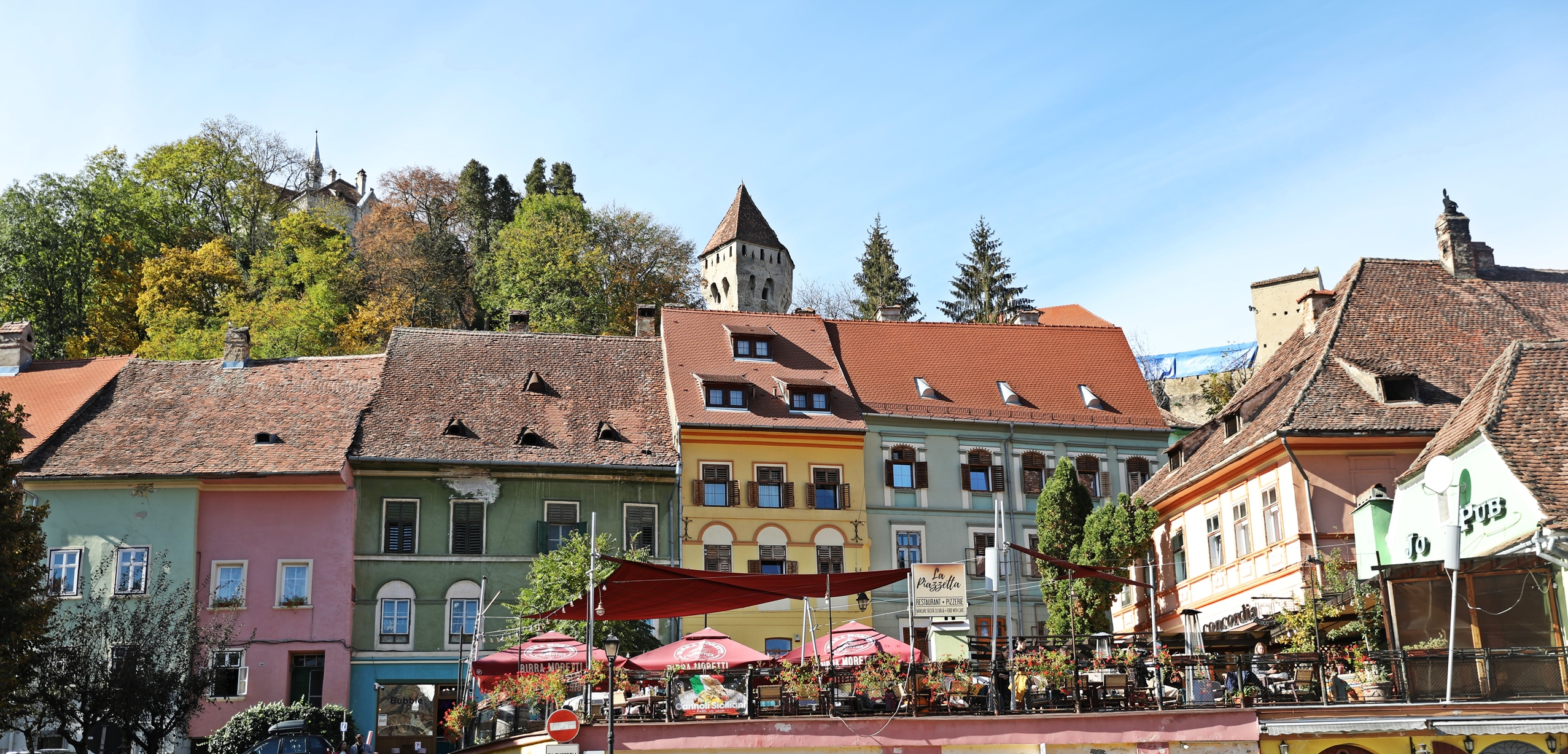
From the moment we put our eyes on Sighișoara’s Old Town, we were enchanted. Residents in this flourishing medieval city gained so much wealth that they became targets for invasions and so they built a fortified wall around the Upper Old Town. Today this UNESCO World Heritage Site has wonderfully restored heritage homes surrounded by a wall with nine adorable watchtowers. Its unique, hilltop location adds to its appeal.
To read more about Sighișoara, visit our post Fortified City of Sighișoara.

2. Sibiu
The city’s large, main square is so perfect it looks like a museum’s showcase of the quintessential heritage centre. During the Middle Ages, Sibiu was one of the wealthiest cities in the region and today what was left behind are beautiful heritage buildings that show the grandeur that this city once had. It’s easy to see how prosperous this city once was with the elegant buildings in Upper Old Town.
To read more about Sibiu, visit our post Discover Medieval Sibiu.

3. Bran Castle
A chill went up our spines as we approached Bran Castle. There was an ominous aura emanating from its towers and turrets; perfect for a terrifying legend. The eerie rock that shapes part of its outer wall added even more mystery to this medieval castle. Although Vlad Draculea III (also known as Vlad Ţepeş and Vlad the Impaler) didn’t live here, it’s easy to imagine that Count Dracula may have.
To read more about Bran Castle as well as Rasnov Castle, visit our post Dracula’s Bran Castle.

4. Brașov
Wandering along the narrow cobblestone streets in Brașov’s historic centre made us think we’d stepped into medieval Romania. The best part of Brașov’s perfect Old Town is that it hasn’t been intruded upon by modern construction. With well maintained heritage buildings, a stunning centre square and towers from the old city wall, you will love exploring Brașov’s Old Town.
To read more about this wonderful historic city, visit our post Explore Brașov’s Old Town.

5. Maramureș and the Wooden Churches of Romania
A tall, spindly spire reaches high above the small, wooden church to look like something out of a Brothers Grimm fable. Local villagers were skilled woodworkers and built churches that would show off their carpentry skills. The old wooden churches in Maramureș were unlike anything we’d ever seen before. Once we saw one of the awkward looking wooden churches, we were excited to continue our travels through northern Romania to see more.
To read more about this fascinating part of Romania visit our post Wooden Churches of Romania.

6. Bucovina and the Painted Monasteries of Romania
The Painted Monasteries are unique, colourful churches in northern Romania’s Bucovina region. What makes them special are the exquisite paintings that decorate their exterior walls. Most of the monasteries were built in the 15th and 16th centuries and are decorated in paintings that helped priests teach the villagers Bible stories and about Orthodox saints. Eight of them are UNESCO World Heritage Sites and are a fascinating part of the heritage in this part of the country.
To read more about these colourful monasteries in Romania visit our post Painted Monasteries of Romania.

7. Transylvania’s Fortified Churches
In the 12th century, Transylvania was under the rule of a Hungarian king. Needing his land to be inhabited, he offered large incentives to any Saxon who would colonize Transylvania. Because they had moved so far from their homeland, they were given a number of liberties including drastically reduced taxes in exchange for their allegiance to the king. They were merchants, farmers and artisans and with their liberties, became quite wealthy. In the end this wealth made them targets so they built fortification walls to protect themselves from raiders and invaders. Today a few of these towns still have intact fortress walls around their churches making them fun to explore.
To find out more about these fascinating towns, visit our post Transylvania’s Fortified Churches.

8. Peleș Castle
We were speechless when we first set our eyes on the perfect Cinderella castle. With its pointed roofs, rounded turrets and wooden accents, Peleș Castle was exactly the castle we were hoping to see in Romania. Situated in Valea Prahovei means that after visiting the castle, you can go and explore the stunning mountainous countryside.
To read more about Peleș and the nearby Pelișor Castles, visit our post Peleș and Pelișor Castles.

9. Corvin Castle
In a country filled with castles it’s difficult for one to stand out, but Corvin Castle does exactly that. Not only because it is the largest castle in Romania, but also because it looks like our idea of the perfect medieval castle. The Renaissance-Gothic structure has more turrets, towers and bay windows than most other castles we’ve seen. It is so picturesque, it looks almost too good to be true. You will love exploring all of the towers, halls and stairwells in Corvin Castle.
To find out more about Corvin Castle as well as the oldest church in Romania, visit our post Romania’s Corvin Castle.

10. Transfăgărășan Highway
The famous Transfăgărășan Highway crosses between Mts. Moldoveanu and Negoiu, the highest peaks in the country. It is a spectacular 90 km (56 miles) drive that includes countless switchbacks, avalanche sheds, bridges and a long tunnel. The Transfăgărășan Highway (DN7C) connects the historic regions of Transylvania and Walachia as it cross over over the Făgăraș Mountains. Driving the twists and turns of this mountain road is an experience everyone should have at least once.
To read more about this fantastic highway as well as some of the sites around it, visit our post Driving The Transfăgărășan Highway.

11. Bucharest
The capital city of Romania may not have the draw of other European capitals, but with its revitalized Old Town, maybe that will change. Filled with grand 19th century buildings, Old Bucharest has its own charm and we were easily able to fill our day exploring this vibrant neighbourhood.
To find out more about Romania’s capital city, visit our post A Day In Bucharest.

Other Sites to visit in Romania
Our friend Florin from Născut Pe Lista Neagră (Born on the Blacklist) has generously provided suggestions of other things to do and places to visit in Romania. As an avid traveller and outdoors enthusiast, Florin has travelled extensively throughout his home country, Romania. Here are his suggestions.
Hiking in Romanian Carpathians
1. Southern (Meridionali) Carpathians
Retezat Massif in Retezat National Park
Access – The cities of Petroșani from the south or Hațeg from the north.
Retezat is a massif formed by glacial erosion resulting in valleys that are covered with glacial moraines and lakes. The central point is Cabana Pietrele from where you there are four circuit trails that cover most of the massif.
Other trails lead to the peaks of Peleaga (2,509 m), Păpușa (2,508 m) and Bucura, Retezat (2,040m) and offer spectacular views from their summits.
Făgăraş Massif
Access – Brașov, Sibiu or directly from Transfăgărășan Highway
You will be delighted by the majesty of the glacial cirques around Făgăraş Massif. Huts allow you to complete the multi-day hike without having to carry a tent.
The main trail (Red Band), follows the main ridge which is mostly above 2,000 m and travels between the ridge huts of: Suru (west), Negoiu (down from the ridge), Bâlea (Transfăgărășan), Podragu, and Urlea (east).
A nice side trip is to the highest peak, Moldoveanu (2,545 m). It is accessible as a day trip from the Podragu hut.
In addition to the views, there is also history in these mountains. Romania was the only anti-communist and anti-Soviet armed resistance. The last groups were liquidated only in 1956, although a nuclei continued to exist until the 1970s. The Făgăraș Mountains were the center of this resistance.
Bucegi, Postăvar, Piatra Craiului, Piatra Mare Massifs
Access – Prahova Valley (Sinaia, Predeal) or Brașov
Piatra Craiului has a long, spectacular ridge that can be completed in two or more days. The area is also relatively easily accessible from Bucharest. In winter, skiing is a popular activity around Sinaia, Predea or Brașov.
2. Eastern (Orientali) Carpathians
Rodna massif
Access – The town of Borșa.
These are also glaciated mountains with lakes and U-shaped valleys. Besides walking the main ridge that does not have a clear direction toward the peak of Pietrosul Rodnei (2,303 m), consider hiking the upper area of the Lala Valley.
Another option is to hike Ceahlău Massif and Toaca Peak (1,904 m). It is said that if the atmosphere is clear, you can see the Danube, far away.
Apuseni Mountains
Access – Cities of Arieseni, Cluj, Turda, Ștei
This is a large calcareous area in a National Reserve with gorges, caves and sinkholes. You can stay for a few nights in the centrally located Padiș hut.
From Stei, you can visit: Bear Cave ( Peștera Urșilor): Cetătile Ponorului Cave: Galbenei Keys, that start from the most spectacular outburst called Izbucul Galbenei: as well as Valea Gârdei with Izbucul Tăuz and Vârtop Cave and Glacier.
Scenic mountain drives
Mestecăniș and Prislop Passes
From north to south and west there are two roads that connect Moldova, Bucovina to Maramureș through Mestecăniș Pass and Prislop Pass. They are open year-round, but in winter you need winter tires, possibly chains. It is important to have good weather in the highlands to be able to enjoy the scenery.
Piatra Neamț to Sfânta Ana
A beautiful road that connects Moldova with Transylvania over the mountains starts from Piatra Neamț and reaches the volcanic Lake Sfânta Ana. It goes through the spectacular gorges of Bicaz. There are many legends related to the mysterious lake of Saint Ana.
Transalpina
Returning to the southern Carpathians, another spectacular road is the Transalpina. It is not open year round. In the northern part, it is recommended to go out towards Sibiu through the town of Jina.
Oltenia to Banat
The last picturesque road is the one that connects Oltenia to Banat, through the Danube gorge. It starts at Drobeta Turnu-Severin (the Portile de Fier hydroelectric dam) and ends at Moldova Nouă city. You will also be able to see the foot of the historic bridge over the Danube. It was built by Apollodorus for the Roman Emperor Trajan (103-105 AD).
Sightseeing
1. Dobrogea
Between the Danube and the Black Sea is an area that is rich in Greek and Roman remains over 2,000 years old along both coasts. In addition, the Dobrogen roads between Măcin-Tulcea and Călărași-Negru Vodă are very scenic drives. In the north is the Danube Delta Biosphere Reserve which offers a unique landscape in Europe, with a great diversity of wild fauna and flora.
2. Monasteries
North of Oltenia
Access – The Râmnicu Vâlcea – Târgu Jiu Road
Bistrita Monastery (1490) and Arnota Monastery (1633) are worth a visit. The latter is on a rock corner, above Bistrita Monastery. West of Târgu Jiu is Tismana Monastery (1380). Vlad Țepeș hid in the monastery in 1458. They are fortified buildings.
North of Dobrogea
The final two recommendations are Tulcea – Cocoș (consecrated 1833) and Celic-Dere (1840). Besides the beauty of the churches, they are surrounded by wonderful nature.
Monkey’s Tale’s Travel Tips for Romania
• Schengen Area – Romania is now a member of the Schengen Area. This only applies to arrival by air. Currently land border crossing checkpoints are still in effect.
SIM Cards – In the parts of Romania where we visited the cellular coverage was very good. The exception was parts of the Transfăgărășan Highway. We purchased a Vivacom SIM card in Bulgaria and it worked in Romania as well as Germany.
• Language – Romanian is the main language spoken. Outside of Bucharest, we didn’t meet many people who spoke English.
- Transportation – There are public buses and trains, but it is not easy to reach many of the sites in smaller towns and villages. Car rentals are inexpensive, and the roads are generally good. There are a few double-lane highways but once you get away from the larger cities the highways are single-lane, with no shoulders. For a North American, there are a lot of Round-Abouts, but it is likely a typical amount for Europe. Also note the following:
- Pay attention to pedestrian crossings when driving. Pedestrians have right of way when crossing in the absence of traffic lights.
- Car rental agencies in Romania require a physical copy of your international driver’s permit. Only a few, smaller companies will rent to you without one.
- There were quite a few police check-points but we were never stopped.

To read more of our adventures in Romania, click here.
Coming Next – El Tunco, El Salvador’s Surf City
For pictures from other blogs go to Gallery at monkeystale.ca
To read about more of our adventures go to Destinations.
If you like what you read, please comment or share (with credit) using the links below.




We’d love to hear from you, please leave a comment.