
As one of the largest cities in the world, Mexico City is surprisingly easy to navigate and a pleasure to visit. It’s often feared as being a dangerous city, and parts of it probably are, but its historical centre is safe, and perfect for history loving tourists. Mexico City’s historic downtown lets you see both sides of its past with colonial churches standing beside Mexica ruins.
Mexico City (Cuidad de México) is often abbreviated to CDMX. The city with a population of over 22 million is located in Valley of Mexico; a highlands plateau at 2,200 m/7,200 ft elevation. The valley originally had 5 large, interconnected lakes that attracted its first indigenous settlers as early as 12,000 BCE. By the 1300s AD, the Mexica people arrived. They and other indigenous people in Mexico and parts of Central America share the Nahautl language and are often incorrectly called Aztecs.
The Mexicas were nomadic people believed to be roaming the lands for generations looking for a place to settle. In 1325, legend says that they spotted a serpent and eagle fighting on a cactus in the middle of Lake Texcoco, one of the 5 lakes. They took this as a sign to establish their community on that island and called it Tenochtitlan. They built floating gardens, called chinampas, as wells as dams and canals to control the lakes’ water levels. We visited one of these lakes for a tour on a traditional boat. (See our post A Boat Tour In Xochimilco).
The city of Tenochtitlan became a large, organized city and the Mexicas became a very powerful, conquering other indigenous communities and expanding their territory. By the early 1500s, they amassed a civilization that extended from the Atlantic to the Pacific and as far as Guatemala and Nicaragua. The population of the Valley of Mexico alone was believed to be over a million people.

Hernán Cortés and his Spanish armies arrived in the 1500s and eventually conquered the Mexica. The Spanish built their capital on the site of Tenochtitlan, and called it Ciudad de México. Many buildings that those first Spanish conquerors built can be seen in the historical centre today.
Constitution Square
Commonly referred to as Zócalo, Constitution Square is a large open square in the city’s historic district. The name Zócalo means base in English and comes from a small platform in the square. It was originally built to be the base for a monument that would celebrate the country’s independence. The monument was never built, but the base of it remains. As a result the term zócalo is used in CDMX as well as throughout much of Mexico to refer to the main square.
Zócalo is a popular place for visitors and locals alike. Dozens of small vendors display their wares on tarps lain out on the ground. Mixed in with the nicknacks are shamans dressed in traditional attire. Long line-ups of tourists wait to receive a spiritual cleansing, called a ‘limpia’, by the shamans.


Metropolitan Cathedral
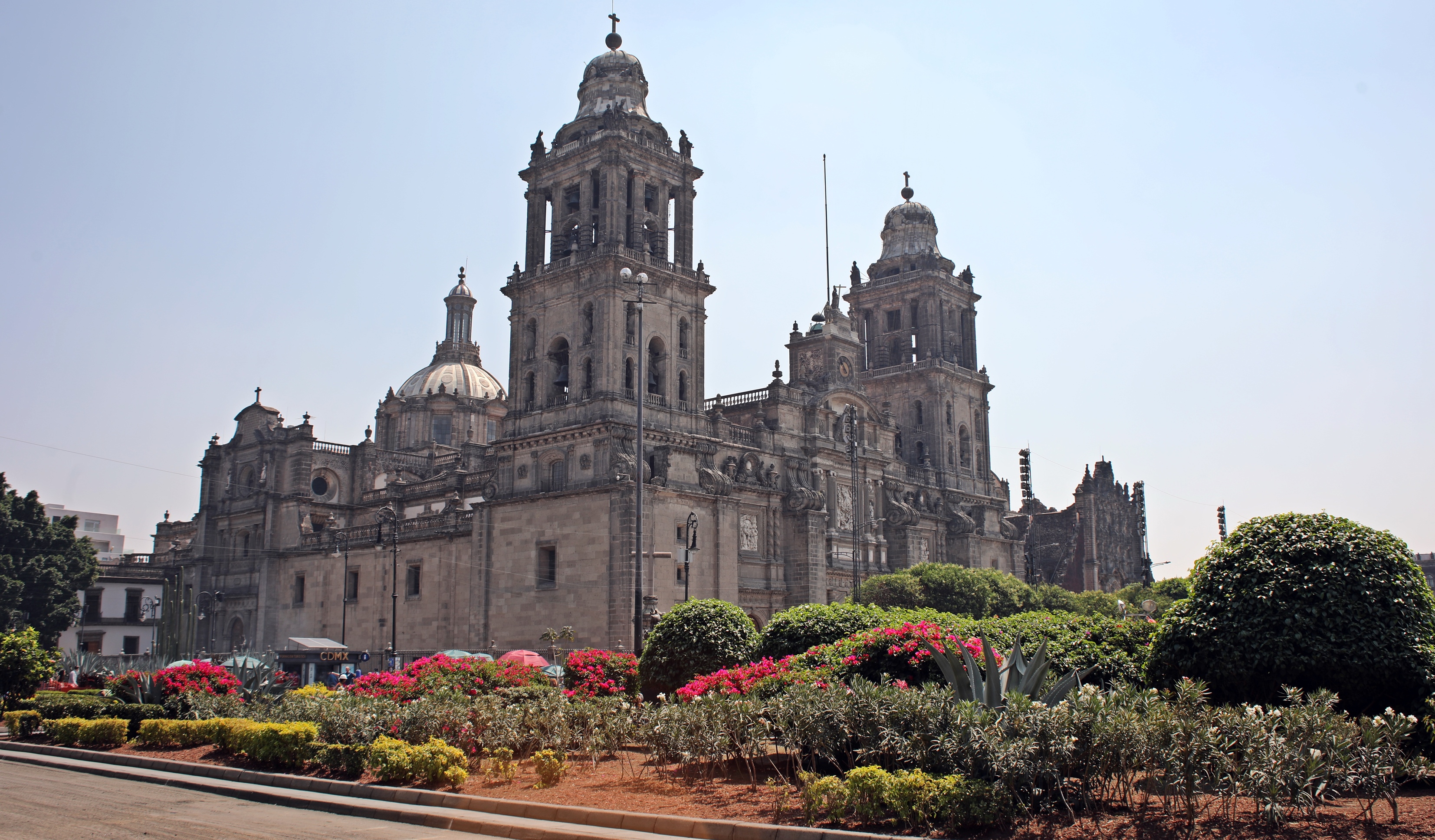
The largest building on the square is the Metropolitan Cathedral of the Assumption of the Most Blessed Virgin Mary Into Heaven. Built in stages from 1573 to 1813 you can’t help but be impressed with its Baroque, Neo-Classic and Neo-Renaissance designs. It is a massive building that takes more than an entire city block.


As we stepped inside the first thing we saw was a large, golden altar. It was quite impressive, but walking in a little further, we realized that this was just a side chapel. An even more elaborate altar stands at the front of the main sanctuary.


Between these altars are two of the largest 18th century organs in North America. From floor to vaulted ceiling, ornate pipes from the organs are so tall that you have to stand back to see them all at once. In fact the organ takes up much of the centre of this large sanctuary. It would have been amazing to hear music played from these impressive instruments, but unfortunately for us they remained silent.
The rest of the church is equally stunning with marble columns and pulpits as well as detailed woodwork throughout.


Metropolitan Tabernacle
Beside the cathedral is the smaller Metropolitan Tabernacle (1768). It’s not as imposing as the Cathedral, but its façade is more elegant with sophisticated sculptures of the 12 Apostles.
Another nice aspect of these two churches is that we could walk all the way around them and they are gorgeous from every angle.


Tenochtitlan
The remains of the Templo Mayor (Main Temple) and other buildings from the Mexica city of Tenochtitlan have been uncovered and are on display immediately beside the cathedral. Most of the stones from Tenochtitlan’s buildings were used to build the Spanish city including the cathedral. Remarkably though, there are still some fabulous designs on some of the ones that were left.


National Palace
Taking up another long side of Zócalo is the National Palace (1522). The building we see today was built right on top of a palace for Mexica Emperor Moctezuma. National Palace was originally used as a residence for Spanish conquistador Hernán Cortés. He led the Spanish as they conquered and colonized much of Mexico. For his efforts, he was appointed Governor of New Spain. Today it is used by the Executive Branch of the federal government and is the residence of the president.


The final two sides of the large square have more grand, colonial buildings. They seem to be fighting each other for attention with pretty tiling and sculptures for decoration. Adding a softness to this large plaza are gardens of cacti, flowers and flowering bushes.


When the Spanish established the city, they damaged the dams and canals that the Mexicas built. As a result, flooding became a major problem. Instead of moving the city though, the Spanish built tunnels and channels to drain the lakes. They clearly didn’t think of the long-term implications of this. The clay-rich soil that was left has been compacted by the heavy, stone buildings. The effect of that can be seen today as Mexico City is literally sinking. In the last century the city has sunk 10 m (33 ft) and it continues to sink 50 cm (20 in.) a year. We could see evidence of this throughout the city, an example is in the picture below.

In addition, water for the city today comes from underground aquifers, but they are running dry. The government says they are working on water conservation strategies, but it seem like there is a lot of work to do as many parts of the city are on water restrictions.
CDMX’s historic centre doesn’t end with Zócalo. The streets branching out from the square are also filled with heritage buildings. Some are a little worse for wear but many are in good condition. Although it’s in the middle of a big city, you can easily wander these streets and take in its history. When you need to take a break there are a few quirky park benches and chairs scattered around.


Avenida Madero
The long pedestrian-only Madero Street (Avenida Fransico Madero), travels between Zócalo and Parque Alameda Central. It’s a popular shopping street and has a few historic buildings too. Unfortunately, Casa de los Azulejos (House of Tiles), the one we really wanted to see, was covered in scaffolding. We could only see a small section of it on the side.


Alameda Central Park
Created in 1592, Almada Central Park is the oldest park in the Americas. Its name comes from the Spanish word álamo which translates in English to poplar tree. As you would expect, the park is filled with trees. There aren’t just poplar though, there are many varieties of trees providing a lot of much needed shade in the city centre. In addition to trees, there are fountains and sculptures, making the park a popular place for people to spend time.

Inside the park is Palacio Bella Artes (Palace of Fine Arts); said to be the prettiest building in CDMX. After seeing Palacio de Bellas Artes in person, we agree. Opened in 1934, the architectural style exterior of the building is primarily Art Nouveau and Neoclassical. With a colourful, domed roof, rounded lintel and multiple pillars, it is quite stunning. It is used today for opera, dance, theatre and art exhibits.

Across from it is Latin American Tower (Torre Latinoamericana) where you can go up to the top for a view of the city. On the other side of Palacio de Bellas Artes is rather worn out, but impressive looking Santa Veracruz Church


Angel of Independence
Since Angel of Independence is the iconic image of Mexico City, we were pretty surprised to find it in the middle of a busy intersection. Somehow we imagined that it would be in a more illustrious spot.


On our walk between Parque Alameda Central and Angel of Independence we passed a few run down historic buildings and then all of a sudden we were in the midst of tall, modern sky scrapers. The business centre of CDMX is much more modern than we had anticipated.


Chapultepec Park
The largest park in the city, Chapultepec Park, is said to be larger than Central Park in New York City. The massive park has an amusement park, fountains, walking trails, gardens. and more.
In the middle of the park is Chapultepec Castle on top of Chapultepec Hill. The castle was used in 1785 as the summer home of the Viceroy of New Spain, Mexican Emperor Maximiliano I.


Also in the park is one of the best museums we’ve visited in a long time. Museum of Anthropology has a vast collection of indigenous artifacts from the region as well as from across Mexico. We’ll show you many of these artifacts when we visit Teotihuacan. (You can read our post here.)
Basilica Guadalupe
On the outskirts of the city is an important pilgrimage site. Sandwiched between a 19th century convent and the modern basilica is the historic Basilica of Guadalupe. Today its called Expiatory Temple of Christ the King (Templo Expiatorio de Cristo Rey) or more commonly, Old Basilica of Guadalupe.

The legend associated with the basilica says that in December 1531 an indigenous catholic man named Juan Diego was approached by the Virgin Mary. She told Juan, in his native Nahuatl language, to tell the archbishop of Mexico City to build a church. He did what she asked, but the archbishop didn’t pay much attention to Juan. To help convince him, the Virgin Mary approached Juan again and said he should collect roses on Tepeyac Hill and take them to the archbishop. It was December so roses shouldn’t have been growing, but he found them and wrapped them in his tilma (poncho). When he opened his tilma to show the roses to the bishop an image of the Virgin of Guadalupe /Mary could be seen on his poncho. Because of this, a chapel was built on Tepeyac hill. In 1709 a large basilica was built on the site to display the tilca.
That original basilica has suffered quite a lot of damage over the years. Like much of Mexico City, the old heavy building is sinking. As well, damage occurred when the convent beside it was built. You can see in the picture below how much it is sinking.

Inside, the historic church is not as elaborate as we expected. It has an understated elegance with tall columns, a small painted domed ceiling and a marble altar.


Eventually it needed to be replaced, so in the 1970s a new basilica was built to house the tilma. The new church is a monstrosity. It has a modern round design with a lot of wooden elements.
Inside, the famous tilma is displayed on the front wall behind bullet proof glass. We happened to arrive when mass was starting and witnessed a procession of priests and nuns solemnly walk to the front.


Getting to Basilica Guadalupe
You can reach the church from downtown Mexico City by taxi/Uber or by public bus. The MoovIt app makes it quite simple. Another option to take a tour. Many tour operators in town offer trips to both Basilica of Our Lady of Guadalupe and Teotihuacán ruins on the same day.
Getting to Mexico City
The capital city is easily reached from many international locations via Benito Juárez International Airport. Since it is a very large city, the airport is not close to downtown, but is easily reached by public transit. To reach the city from the airport take Line 4 bus. It has a stop outside door 7 in Terminal 1, or door 2 in Terminal 2. The buses have luggage racks making it easier to travel. Line 4 bus takes you to San Lazaro Station where you can transfer to a bus to your destination. It’s easy to navigate using the MoovIt app.
You can also travel to or from Mexico City by bus, but it can be tricky. There are four bus stations; North, South, East and West so pay attention to which station when you are booking a bus.
Getting around Mexico City
The large city is very spread out, but there are well integrated priority lanes for buses, metro and trolly buses throughout the city. The MoovIt app makes it very easy to navigate. If you plan to use public transit it’s best to purchase a rechargeable MetroBus Card.
Where to stay in Mexico City
If it’s your first time visiting Mexico City you will want to stay in the historical district, within walking distance of Zócalo. This is where the main sites are located as well as a large selection of restaurants. The area is safe to walk around during the day, but caution should be taken when walking late at night. Other good parts of the city for tourists are: Zona Rosa Norte, Condesa or Coyoacán.
Where to eat
There are many restaurants on the streets around Zócalo as well as near Parque Alameda Central and many international cuisines along Avaneda Lerma.


This article is now featured on GPSmyCity. To download this article for offline reading or create a self-guided walking tour to visit the attractions highlighted in this article, go to Walking Tours and Articles in Mexico City.
Click on the link to see our Travel Tips For Mexico.
To read more of our adventures in Mexico, click here.
Coming Next – A Boat Ride in Xochimilco
For pictures from other blogs go to Gallery at monkeystale.ca
To read about more of our adventures go to Destinations.
If you like what you read, please comment or share (with credit) using the links below.




We’d love to hear from you, please leave a comment.