
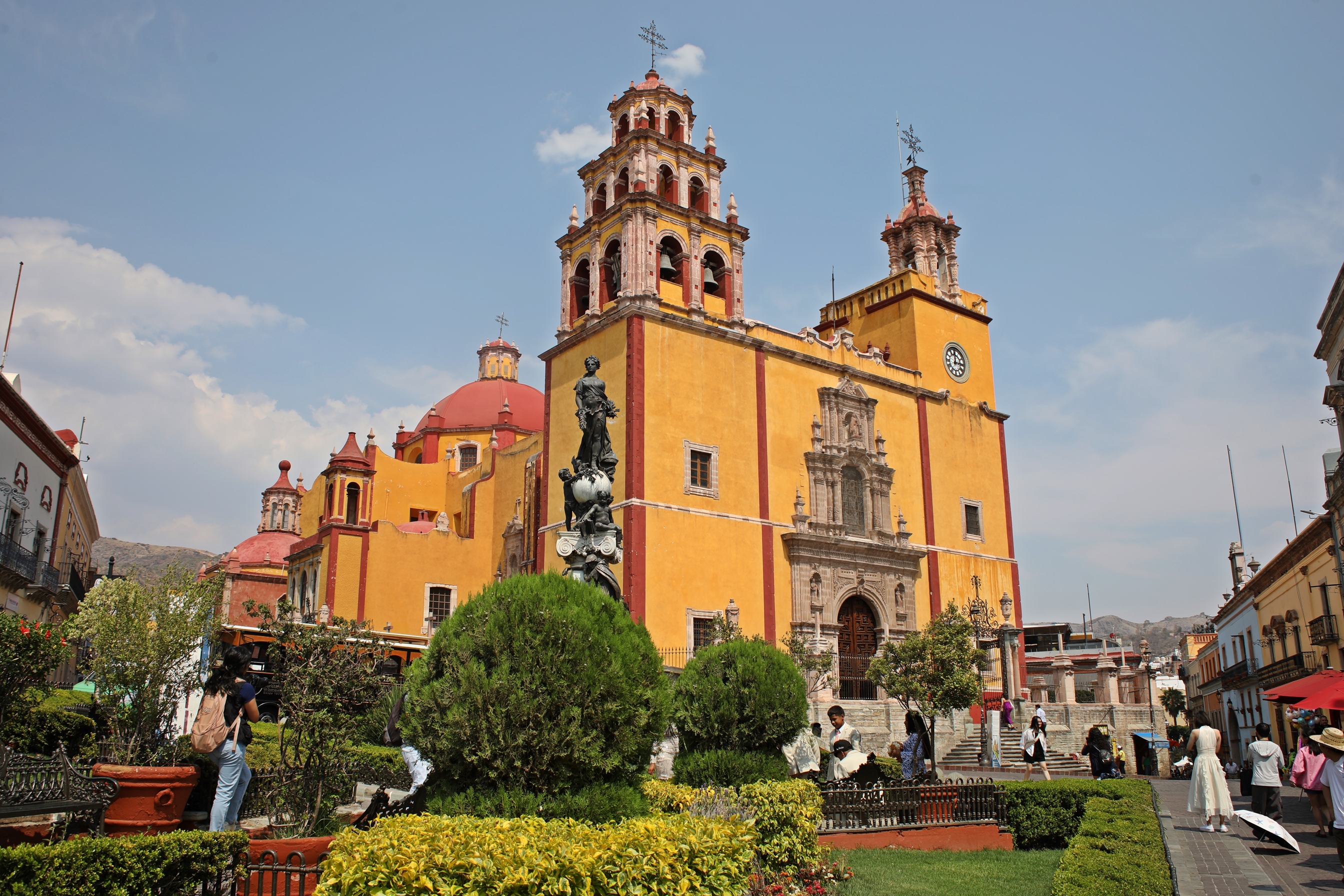
Bursting with energy, the historic centre of Guanajuato is one of our favourite colonial towns in Mexico. Without the typical organized street grid of most Spanish colonial towns, Guanajuato has its own distinctive personality. Streets climb up and down the many hills, covering them in a myriad of colours. Come with us as we explore the sites of this Mexican gem, Guanajuato.
The city was established in the 16th century as a mining town and became one of the great silver mining settlements of this era; much like Potosi in Bolivia (read our post here). The wealth gained from silver can still be seen in many of the buildings around its vibrant historic centre. The Old Town is so impressive in fact, that it has been declared a UNESCO World Heritage Site. Many of the streets have little or no traffic making it a great city to explore by foot.
Peace Square
In the heart of the city is the small triangular shaped Peace Square (Plaza de la Paz). It is the oldest plaza in the city and is fringed by elegant 18th century mansions. They were once the homes of aristocrats and have a much more European look than most Mexican colonial towns. The pastel colored buildings have large windows and doors with Juliet balconies that look out onto the square. You can just imagine how each household was trying to out-do their neighbours by showing off their wealth. Today some of these former mansions are shops or hotels. Others are cafés with patios that spread out onto the road in the evening.
The city is a popular tourist site for Mexicans and we saw a few young ladies celebrating their quinceañera (15th birthday). Many were posing for pictures in their princess dresses around this park and at popular spots throughout the city.


Basilica of Guanajuato
Along one side of Peace Park is the large Basilica Colegiata de Nuestra Señora de Guanajuato. Its bright yellow façade gives it a cheery look that matches the vibrancy of the city. The church’s regal interior is breathtaking with detailed stone and tile designs as well as elegant archways and painted domed ceilings.


Old Town
The wealth of the city can be seen in many points in the historic centre. A few blocks away from Peace Square is the very elegant 19th century Juárez Theatre. The statues of Hellenic muses on the roof add a unique flare to the neo-classical building.


From the flats around Peace Square, the streets climb up and down the city’s many hills. They are lined by homes in a wide variety of colours making it look like a Legoland town. We loved walking these streets and finding many hidden gems along the way. One of the best parts of Guanajuato is that there are no large modern skyscrapers, making it feel quainter.


There are a few quirky homes and apartments in Old Town. One is on Callejon del Beso (Alley of the Kiss). The balconies of two apartments are so close, the occupants could lean across from one to another for a kiss. Legend says that it is where two young people in a forbidden relationship would meet and likely kiss. Like many of these stories it has an unhappy ending. The father is said to have killed his daughter to prevent her from running away with the young man.
As horrible as it ends, we still wanted to see how close these balconies are. Although we didn’t try, we think it is definitely possible to kiss across them. This was just one of the eccentric sites we saw in town.


As we wandered around this popular area we were treated to a parade for volunteer fire fighters. Some participants were dressed in costumes others in were marching bands or dance groups. It was fun to see the local pageantry.


As you would expect there are many colonial churches in the historic centre. Many are in excellent condition and are still in use today. As if in competition with these historic buildings, Hidalgo Market is housed in its own elaborate building; the old train station.


Alhóndiga de Granaditas Regional Museum
Guanajuato was an important city during the independence movement. On the edge of Old Town is a rather stoic looking building with a horrible history related to this struggle. In 1810 Miguel Hidalgo and Ignacio Allende led freedom fighters in an attempt to take over the city of Guanajuato.
During the uprising, Spanish forces used Alhóndiga de Granaditas, a grain storage building, as a fortress. Freedom fighter Juan José de los Reyes Martínez, nicknamed El Pípila, burned down the door of Alhóndiga de Granaditas and became a local hero. The battle was apparently very bloody and continued for three days. This bloodshed horrified freedom leader, Hidalgo who was originally a priest. Upon seeing the battle scene he was unsure if fighting was the correct method to achieve freedom. In the end, the freedom fighters were not successful in this battle and many say that it was due to Hidalgo’s hesitation.

At the end of this battle the Spanish executed many of the freedom fighters including Hidalgo and Allende. Their decapitated heads were hung in the corners of the grain building and were only taken down when Mexico finally achieved independence, a staggering 10 years later. Its difficult to imagine the type of barbarians that would allow such a disgusting scene.
Guanajuato (2,050m/6,725 ft) is located in Mexico’s Colonial Highlands, an area that was prominent in the 19th century fight for independence. We visited other cities along the Freedom Trail too. You can read about our time in San Miguel de Allende and Morelia. In our post about San Miguel de Allende, we mentioned that it was renamed in honour of Ignacio Allende who was executed in Guanajuato.

El Pípila Monument and Viewpoint
There is a monument for freedom fighter El Pípila on a hill above town. In addition to the oversized monument, its attached park gives you a bird’s eye view of the city. Laid out in front of us were the city’s fantastic hills carpeted in colourful homes. Below us was the basilica, theatre and other buildings in Old Town.


On the walk to the viewpoint we climbed narrow streets that were lined with colourful homes and bright street art. If you don’t want to walk up there is a funicular. But if you did that you would miss these great streets and views are along the way.


As the city grew, a network of tunnels were built underground to help divert the nearby Rio Guanajuato. Today these tunnels are used for vehicles which was great for us because it means that less traffic drives through the centre.

Getting to Guanajuato
The main airport to reach Guanajuato is in the city of León, only 30 km away. Another option is to drive on the well maintained toll highway between Mexico City and Guadalajara. It travels not far from Guanajuato. There are quite a few buses that travel between CDMX’s Terminal del Norte and Guanajuato as well as buses to/from San Miguel de Allende, Morelia and Guadalajara. The bus station in Guanajuato is 6 km outside of town. If you drive it is probably best to park your car for the duration of your stay because there is not lot of street parking and much of the historic area is reachable on foot.
Where to eat in Guanajuato
There are many option to eat in the city. You’ll find patios in Jardin de Union and in front of Peace Square as well as unique cafes set up in unexpected spots. We loved the more casual options in San Fernando Park.


Where to stay in Guanajuato
There is no shortage of great hotels and apartments for rent in Guanajuato. Try to stay within walking distance of the historical center. We stayed on one of the nearby hills and had great views that showed us the geography of this interesting city. If you have a car make sure your hotel has parking since many do not have parking.


This article is now featured on GPSmyCity. To download this article for offline reading or create a self-guided walking tour to visit the attractions highlighted in this article, go to Walking Tours and Articles in Guanajuato.
Click on the link to see our Travel Tips For Mexico.
To read more of our adventures in Mexico, click here.
Coming Next – Tequila Tasting In Tequila
For pictures from other blogs go to Gallery at monkeystale.ca
To read about more of our adventures go to Destinations.
If you like what you read, please comment or share (with credit) using the links below.




We’d love to hear from you, please leave a comment.