
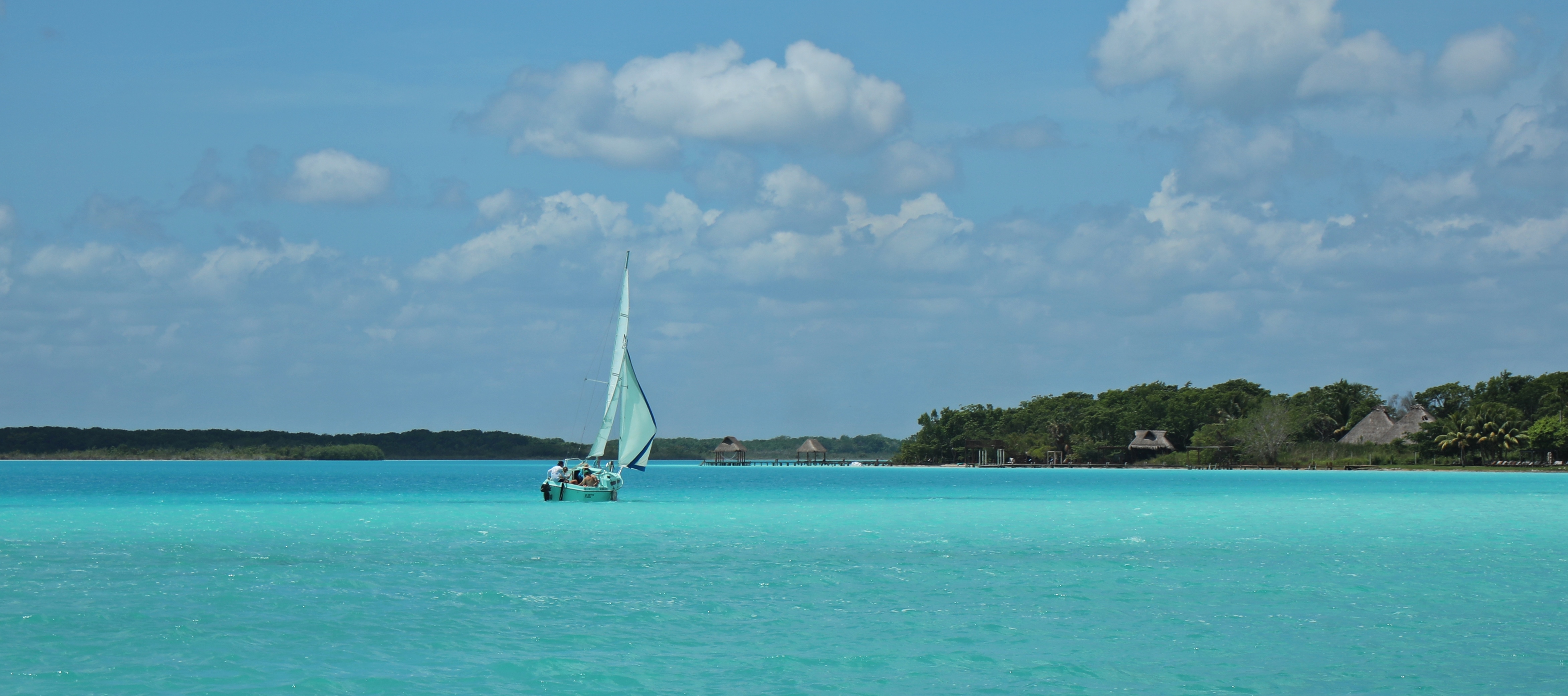
What if we told there’s a little-known, magical place in Mexico where the water glistens in seven gorgeous shades of blue. It’s not a Caribbean beach resort, but the water is just as pretty. This place is called Bacalar Lagoon and it is so beautiful that it won’t be long before the secret gets out.
Located in the far south of Yucatan Peninsula, not far from Mexico’s border with Belize, is the multi-coloured Bacalar Lagoon. As we stared in awe at the pretty site from shore, we could pick out seven distinct shades of blue in the water. From this initial view, we knew we wanted to explore more of this incredible place.


The different shades of blue come from the multiple depths of its sandy bottom. The 42 km long lagoon has a deep centre resulting in a dark blue colour. Its sides are ankle deep and are therefore light blue. Between the two, the bottom undulates creating visible lines of varying shades.
Some people have dubbed it the Maldives of Mexico. Having been to the Maldives though, we can not understand why this comparison is made. Let Bacalar stand on its own as a natural wonder that is incomparable to anything else.
What to do in Bacalar
1.Take a Boat Tour
There are a few different ways to spend your time in Bacalar. The most popular one is to take a boat tour. We hesitated at doing this because we are not fans of tours, and especially boat tours because they often turn into party boats. We realized though, that this would be the best way to see more of the lagoon. So, with our tour booked, we piled onto a pontoon with 13 other tourists. All were Mexican except for us. Some of them brought their own coolers, well stocked with beer. This had us a little worried, but in the end, it was a low-key party and the cruise was well worth it.
As our boat slowly motored across the water we could see the colour of the water continually change from deep-sea blue to pale turquoise and back. It is breathtakingly beautiful. Our boat stopped several times in the shallow areas so we could swim in the crystal-clear fresh water.


We could tell when we were near a cenote because we could see a circle of dark water surrounded by a light turquoise colour. Cenotes are natural wells filled by the underground rivers that run throughout much of Yucatan Peninsula. They are very deep, making the water dark blue. The surrounding floor of the lagoon is much more shallow by comparison, so the water is light blue. Most of the cenotes we think of are on land, but there are a few in Bacalar Lagoon. In fact, Cenote Negra is the deepest point in the lagoon at 165 m deep. These underground rivers are also the water source for Bacalar Lagoon, resulting in crystal clear water.
We went scuba diving in a couple of cenotes near Tulum, you can read about that experience here.


In another part of the lagoon you can see billion-year-old thrombolites. Looking like flat, circular rocks, these were the first aerobic microorganisms on earth. The rocks are actually mounds of cyanobacteria colonies.
We also saw thrombolites on the western coat of Newfoundland, Canada. You can read about those here.

Our boat took us by a couple of the islands in the lagoon. Bird Island (Isla de los Pájaros) is a favourite spot for rosette spoonbills and wood storks. There are so many birds at this island because a favourite food, snails, are prevalent in this part of the lagoon.


A very pretty spot in the lagoon is Pirates Canal. This waterway connects Bacalar to a series of lagoons and canals that eventually reach the ocean. It was used by pirates in the 17th century forcing the Spanish to build a fort directly across the lagoon. The narrow canal is incredibly picturesque, appearing as a strip of turquoise in the middle of the green vegetation.
Boats aren’t allowed to venture too close to the canal so we had to wade through the water for a better look. Because of this we only took our waterproof GoPro and unfortunately, the picture doesn’t do this spot justice.

2. Laze on the Docks
The name Bacalar comes from the Mayan word bʼak halal which means “surrounded by reeds” in English. The description is apt because the shore is almost entirely covered in mangroves and reeds. Instead of beaches, hotels and day-clubs have long docks stretching out into the water. People lounge in sun chairs on the docks or use use them to access the water for swimming. If your hotel isn’t on the water there are a few public docks that serve this purpose. You can also find kayaks and SUPs for rent near these docks.


3. Watch the Sunrise
The town of Bacalar faces east so watching sunrise is a very popular activity. You can take an early morning kayak tour to see the sunrise, but you can just as easily see it from any of the docks.


4. San Felipe Fort
In the middle of town is the 17th century San Felipe Fort. The Spanish built the fort to protect their trading post from pirates. It’s not large, but has a good view of Pirate’s Canal across the water.


5. Other activities
Other popular ways to enjoy the lagoon are at the beach clubs Balnearios and Los Rapidos. At theses day clubs you can take swim, kayak, float down a canal or just relax on the dock and admire the stunning blue water while sipping on a margarita. There are no sandy beaches at Bacalar so these clubs are the Bacalar alternative.
You can also go swimming in Cenote Azul. It is 5 km outside of town. You can reach it by taxi or bicycle.
Rules when visiting Bacalar
The ecology of the lagoon is suffering from the effects of tourism and the local community seems concerned. Those involved in tourism know that people won’t come to see a brown lagoon, so there are a few rules to keep it pristine. The rules include: no boats tours on Wednesdays; no sunscreen when entering the water; you cannot use sand as an exfoliant; and sewage systems can not be dumped into the lagoon.
Booking a Boat Tour
Most boat tours visit the same sites around the lagoon and charge the same price, so it really doesn’t seem to matter where you book. Other than during the busiest season, you do not need to book ahead. If you’re able to be flexible you may be able get a last minute seat for less. There are a lot of touts selling tours at the main entry points to the water as well as tour offices in town.
How to get to Bacalar
Located just off the main highway running between Cancún and Chetumal, Bacalar is quite easy to reach by car. As well, ADO buses have several routes that travel between most of the Yucatan cities and Bacalar.
Maya Train (Tren Maya), will eventually connect Bacalar to many other popular tourist sites in Yucatan. As of May 2024, it wasn’t yet operational.

Where to stay in Bacalar
The town itself is in transition. It’s part laid-back hippie and part rugged Mexican. It is not very large, and nothing is very far from the lagoon. As you would expect, hotels and resorts along the water are more expensive than those a few blocks off. The town is quite safe so walking anywhere during the day is fine. We stayed one block off the lagoon, but still had an amazing view of the colours.
Further away from town are resort style hotels, but they are not nearly as large or busy as other parts of the Yucatan. At least not yet.

Where to eat in Bacalar
There are surprisingly many great food options in this small town. Lagoon side restaurants offer spectacular views, but there are also several option around the Zócalo (main square) as well as the streets leading up to it. We loved the food and atmosphere at Enamora.
When to visit Bacalar
Dry season runs from December to April and is the best time to visit. Not only is it more pleasant to enjoy the outdoors, it is also when the lagoon is the most colourful. During the rainy months, June to November the blue won’t be as radiant. As well, hurricane season runs from late May until November. Hurricanes won’t likely reach the lagoon, but will result in poor weather. We visited in May and were treated to perfect blue skies, but with that came very high temperatures and humidity.
Chetumal
Not far from Bacalar is a larger city that you may find yourself travelling through if your travelling between Mexico and Belize. Chetumal is located on the Mexican side of the Mexico-Belize border. We had heard that it was a rough border town, but we didn’t find that at all. Although there’s not much to do, it was more pleasant than our minds had imagined.
It’s nicest attribute is the very long Malecón de la Bahia, (boardwalk) that travels the length of downtown. It follows the ocean but in many places all you see are mangroves and not the water. Rumors are that there are crocodiles in this area but we didn’t see any signs of them.


There are a few statues of Maya gods and warriors along the boardwalk. The ruins of the Maya city Kohunlich are only 65 km from Chetumal and can be visited if you have time.


How to get to Chetumal
As capital of Quintana Roo State, there are a few options to travel to Chetumal. It has an international airport, but if coming from other parts of the Yucatan, most visitors arrive by ADO buses. If you have a rental car, you likely won’t be allowed to take it across the border to Belize.
Crossing the borders between Mexico, Belize and Guatemala.
There is a very convenient shuttle between Belize and Chetumal with connections to Guatemala. Marlin Espadas Tours operates shuttles from Chetumal to Belize City. Connecting shuttles can then take you to Flores, Guatemala. You can do this route in either direction. We were very impressed at how organized they were especially considering we had to cross two international borders!
They leave Chetumal around 8:30 am, but may be delayed if there aren’t enough passengers. Plan to arrive by 8 am to secure a seat. You can also contact them by email or WhatsApp to reserve. See their website for details.
Another option to travel across the border is to take a ferry between Chetumal and San Pedro or Caye Caulker in Belize.

To read more of our adventures in Mexico, click here.
Coming Next – Tulum – Cenote Diving & Maya Ruins
For pictures from other blogs go to Gallery at monkeystale.ca
To read about more of our adventures go to Destinations.
If you like what you read, please comment or share (with credit) using the links below.




We'd love to hear from you, please leave a comment.