
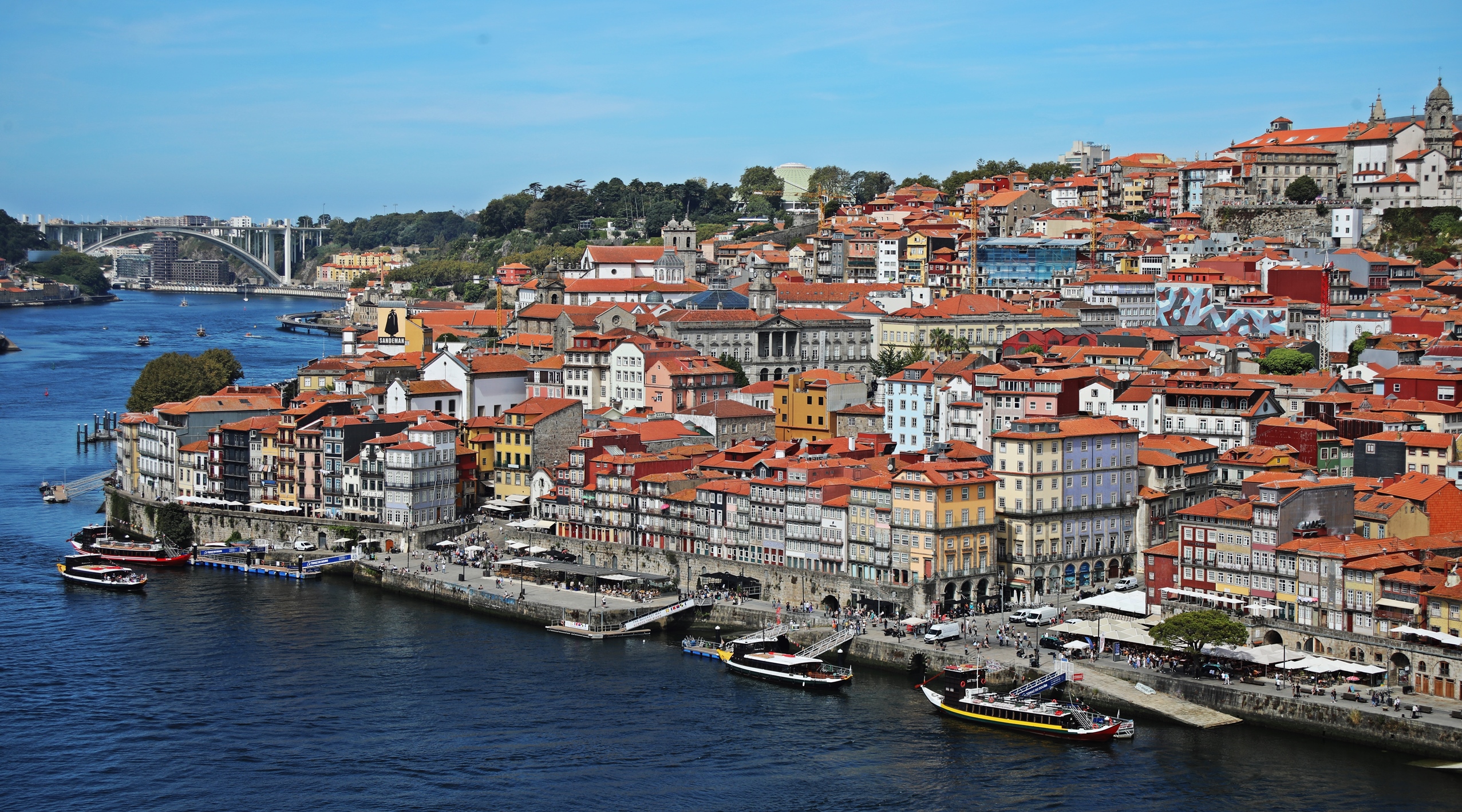
Set on the tall banks of the Douro River, Porto has a fantastic location. Buildings painted in a variety of colours climb the steep slopes above the river, making good use of the landscape. After seeing its setting, we knew we were in for a great few days of exploring the picturesque city of Porto.
There has been an important harbour on this spot since Roman times. They called it Portus Cale which eventually gave the country its name, Portugal. Porto went through many leaders and dynasties over the centuries, but the 18th century is considered its Golden Age. This is when exports of wine and port brought massive wealth to the area. These riches can be seen in the many baroque and neo-classical buildings and monuments found in its UNESCO World Heritage designated downtown. Porto is sometimes called O’Porto, but apparently this is a mispronunciation by the British and in Portuguese it is called Porto.
There is a lot to see in this fabulous city, so here are some of Porto’s top sites that you won’t want to miss.
Cais da Ribeira
One of our favourite things to do in Porto is to stroll along the boardwalk beside the slow moving Douro River. On one side, colourful heritage homes scale the steep riverbanks. On the other side, you can look across the river to the pretty city of Vila Nova de Gaia.
Whether you go for dinner, or just for a walk, Cais da Ribeira is a vibrant part of the city.


Dom Luís I Bridge
At the end of the Cais da Ribeira is the iconic Ponte de Dom Luís I (Bridge). Built in the 1880s, the double decker bridge was designed by Théophile Seyrig, a student of Gustave Eiffel. It has since has become a symbol of Porto.

Not only is the bridge picturesque on its own, it also is the perfect viewing platform to admire both Porto and Vila Nova de Gaia. For the best views walk on the pedestrian walkway on the top of the bridge. From this vantage point you can see why so many fall in love with this city.


After enjoying the views from the bridge, you can start your tour of the city’s sites in Ribeira district which climbs the hill above the river.
Sé Catedral do Porto
High above Douro River, on the top of the hill, is Porto Cathedral (Sé Catedral do Porto). It’s actually rather plain from the outside, but that may be because half of it was draped in tarps and scaffolding when we visited. The original church was built in the 12th century, but what we see today are 17th and 18th century modifications.
Note: Sé comes from Sedes Episcopalis (Bishop’s Seat) and is the name of most of Portugal’s Cathedrals.


What’s more impressive than the church itself are the views from its courtyard and nearby lookouts. From these vantage points it seemed as if the entire city was spread out before us. There was a sea of red tiled rooftops only broken up by domed churches and their tall towers.


São Bento Railway Station
If you love azulejos, then a visit to São Bento Railway Station must be on your list. Built in 1916, the station is located on the site of a former Benedictine Monastery. The interior is beautifully decorated with floor to ceiling azulejos painted with scenes from Porto’s history. Tall windows shine natural light on the 20,000 blue and white tiles. Even though protective netting on the end walls mute the colours, it is still stunning.


We didn’t have a good view of the station’s exterior though because the surrounding streets are being torn up for the city’s new metro line.
After visiting the station walk across the street to the large open square Praça General Humberto Delgado. It is home to a few stunning buildings that give you a hint how wealthy this city once was.


Clérigos Tower and Church
Standing on a small hill in the busy city centre, you can’t help but notice Clérigos Church. Built in 1707, its front façade is highly ornamented, but it is the tall tower beside it that really stands out. In fact, you can see the tower from many points in town.


The small church has a round nave with a vaulted, domed ceiling. Marble columns and sculptures surround the altar while ornate organs hang from the walls on either side.


The main reason to visit Clérigos is not to see the ornate interior, but to climb up to the top of the tower. From here we had a birds-eye view of the city as it scales the banks above the Douro River.


Tip – Only a small amount of people are allowed into the tower at one time, so tickets have timed entries. In autumn it was not busy, and we bought our tickets as we entered. During the busy summer months though, you should probably buy tickets in advance on-line.
Lello Bookshop
One of the most popular places to visit in Porto is the city’s oldest bookstore (Livraria Lello & Irmão). Once you step inside you will know why it’s listed as one of the prettiest bookstores in the world. Built in 1906, entering Lello Bookshop is like walking into a magical land. The first thing you see is a wonderfully carved, forked staircase that looks like it came straight out of a fairytale.


A carved wooden ceiling adds even more detail to the first floor and a stained glass ceiling above the second provides natural light to the space. On both floors, the walls are lined by beautifully carved wooden bookshelves filled with books for sale. Several ceramic busts of writers can be seen in the cabinets between the books.


The store carries mostly the classics, and has editions in Portuguese, English, Spanish, Italian and Russian. Their books are specially printed for the store so the covers are all quite similar in design.
Tips to to visit the Lello Bookshop – You can buy tickets in advance on-line and probably should if you’re visiting in the busy season. Tickets have timed entries and in September, we could buy tickets on the same day, but our entry was for an hour later. The entrance fee goes toward the purchase of a book.
Igreja Paroquial de Santo Ildefonso
There are a lot of churches in this catholic city, but some of them deserve a little more attention. One of those is Church of Saint Ildefonso (Igreja Paroquial de Santo Ildefonso). Blue azulejos adorn the outer walls of the 18th century church. Positioned on top of a small hill, the pretty church instantly grabbed our attention.


Igreja do Carmo
Another church for azulejos lovers is Igreja do Carmo. Built in the 18th century, the church’s south wall is decorated with beautiful blue azulejos. Adding to this lovely exterior are the sculptures and stucco molded designs on its front. The church was built next to Igreja do Carmelitas. You can barely tell, but the two are separated by the narrowest building in Porto.


Victoria Viewpoint
We usually think of viewpoints being on the highest point, but Victoria Viewpoint (Miradouro da Vitória) is part way down the hill. With this position the terrace provides a picture postcard view of the Douro River, Ponte de Dom Luís I (Bridge) and the buildings that climb up and down the riverbanks.

In addition to these specific sites, we found we were stopping all the time taking in the scenes as we walked through Porto’s Ribeira District.


Outside of Ribeira, another nice neighbourhood is Bolhão. There are fewer actual sites in this part of the city, but the historic streets feel more like a livable part of the city rather than a touristy spot.


Bolhão Market is a newly restored building that feels quite open and modern inside. There is a wide variety of vendors selling fish, olives, cheeses and even port tasting.


Where to stay in Porto
Porto is a large city spread across a hilly landscape. The best neighbourhoods to stay are Ribeira, Baixa or Bolhão. Try to find a place walking distance to the sites you want to see most. If you want to stay a little further out, the city also has an efficient metro system making all parts of the city quite accessible. Another great option is to stay in the city of Vila Nova de Gaia across the river.
Where to eat in Porto
The same neighbourhoods that are good to stay also have a large selection of restaurants for every budget. Café Majestic is located in a historic building in Bolhão and is a popular choice. There are also many patios along both sides of the Douro that always seemed to be busy with diners.

Getting around in Porto
Most of the city’s historic sites are within walking distance, but it’s also possible to take a taxi between them if you rather. To reach places further away, the city’s metro is very efficient. If travelling by metro you will need to purchase a metro card from one of the vending machines located at each station. Andante Azul is the most common rechargeable metro card for visitors. When purchasing the card you can load it with the amount of money you will need for your stay. Trip fares are based on the zones that you travel in so consult the map located by the vending machine. The cards are reloadable if you need to purchase more fares. More than one person can use the card on every trip.
If travelling between Porto and Vila Nova de Gaia, you can either walk across Ponte de Dom Luís I (Bridge), or take a ferry. They leave every 15 minutes from either port for the short journey across the river.
The biggest challenge for getting around in Porto are the hills. To get between Cais da Ribeira beside the river and the top of the hills, you can take the stairs, or for a small fee, take one of the lifts: Funicular dos Guindais, Elevador da Ribeira or Elevador da Lada.

Getting to Porto
As one of Portugal’s major centres, Porto is very easy to access. It has an international airport and is connected to other major centres in the country by train and bus. Trains will also stop in Vila Nova de Gaia if you are staying there. If going to or coming from the Douro Valley, you can travel by boat or train. You can read about the Douro wine region in our post A Driving Tour Through Portugal’s Douro Valley.
The map below is of the entire country. You can find Porto near the top of the map. You can click on either for a closer look.


This article is now featured on GPSmyCity. To download this article for offline reading or create a self-guided walking tour to visit the attractions highlighted in this article, go to Walking Tours and Articles in Porto.
To read more of our adventures in Portugal, click here.
Coming Next – Port Tasting In Vila Nova de Gaia
For pictures from other blogs go to Gallery at monkeystale.ca
To read about more of our adventures go to Destinations.
If you like what you read, please comment or share (with credit) using the links below.




We’d love to hear from you, please leave a comment.