
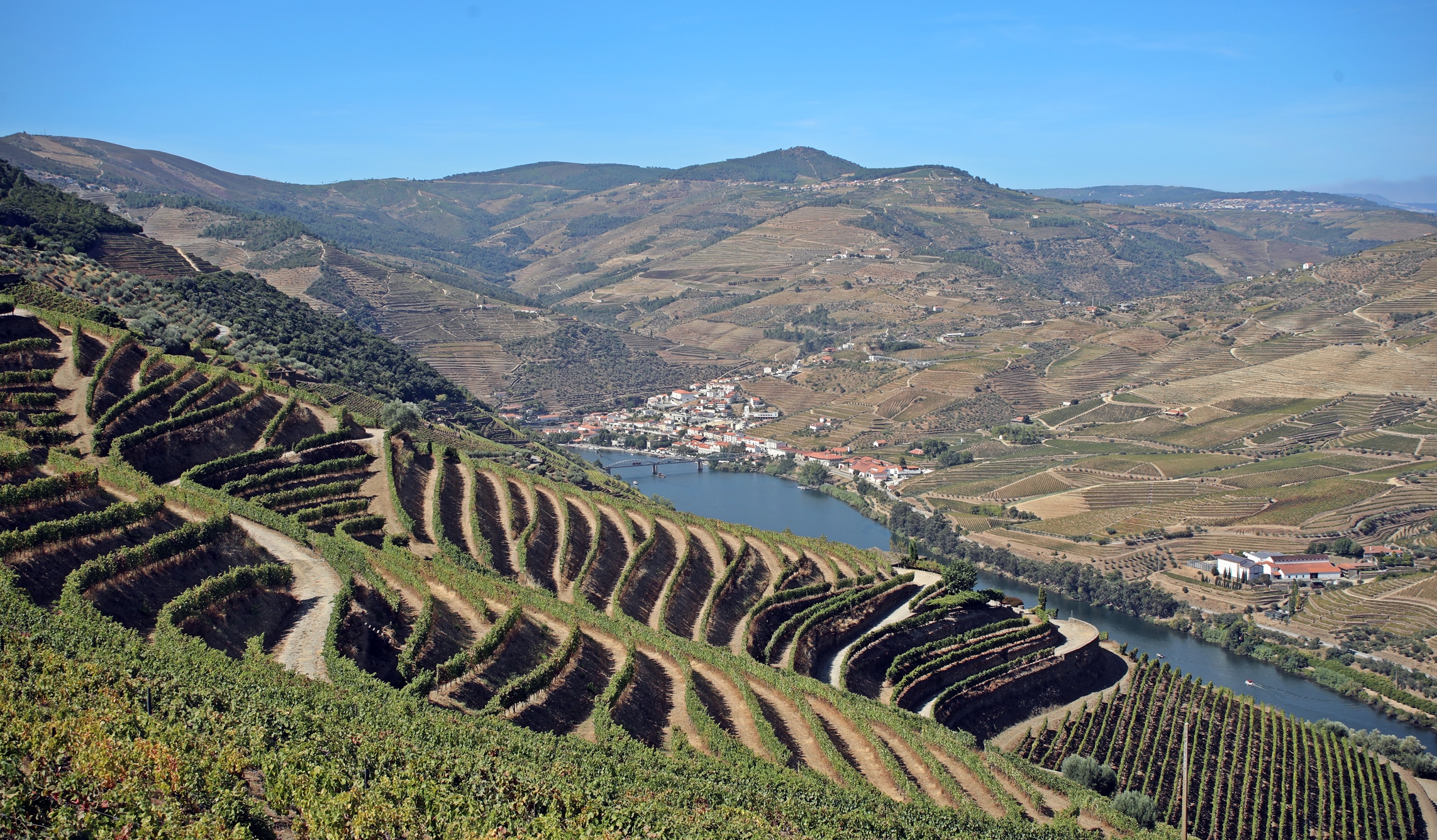
Driving through Portugal’s Douro Valley you are rewarded with spectacular views of rolling hills blanketed in grape vines and olive orchards. Steep terraces planted with vines climb up and down the hills for a very picturesque landscape. Add the slow-moving blue river below, and the setting is like a picture postcard.
Wine grapes have been grown in the Douro Valley since Roman times, but they were more of a hidden gem than important commodity. England began importing wine from Portugal as early as the 1300s in exchange for English cod. This wine though, was from the Minho district and was considered a little too harsh for the British palate, so only a small amount was imported.
In the 1600s the industry dramatically changed when the English king prohibited imports of French wine. This resulted in a search for other sources. The English found the solution in the Douro Valley. Grapes from this region create a heartier wine that the English preferred. The problem was that wine had to travel a long distance by sea from Portugal to England. Sweetening elements such as fruits, herbs, flowers, and brandy were added to the wine before aging it in wooden casks. This ensured that the wine remain in good condition for the long journey. This new drink was called port, because of its proximity to the city of Porto.
This new industry led to the Douro region growing in prominence and wealth. Lodges were set up downstream in Vila Nova de Gaia to support the vineyards up river. English and Scottish merchants set up shops in Porto, Gaia and in the towns in Douro Valley. The entire region became very wealthy.
Today, Douro Valley continues to be a leading grower of grapes for wine and port in addition to the expanding olive oil market. Although most famous for its port, the red wine from this region is excellent.

If you’re looking at visiting the Douro region, we have a few suggestions to help you plan your trip. Many visit on a day trip, but we think there’s so much to see, you should stay longer.
Click on either map for an expanded view.


Scenic drives in Douro Valley
You won’t go wrong with most of the drives you take, but we found the road between Peso da Régua and Pinhão to be one of the prettiest. The narrow highway closely follows the contours of the pristine river. Driving beside the Douro River, we could see that almost all the available land was being used to grow grapes.
There are a few formal pullouts to stop and enjoy the views, but there are also a few less formal, flat spots beside the road where you can pullover. Be aware though, the locals drive very fast around the blind, hairpin turns so do be cautious when entering or exiting these spots.


We were also impressed with the views at the western end, between Mesão Frio and Peso da Régua. This was the beginning of our drive and was a great introduction to the scenes available in Douro.
We visited during harvest season and often saw workers on the terraces picking the grapes.


While you’re driving though the valley, there are quite a few towns and villages that are worth visiting. Although most don’t have a famous attractions, they are quaint and are worth stopping in for a look around. Here are a few of our favourites.
Lamego
With a long history dating back to the Romans, it was during the 16-18th centuries, that Lamego found prosperity in the wine and port industries. The Old Town is quite small, but does have a few nice buildings that show this wealth.


One of those is Sé Catedral de Lamego (Lamego Cathedral). It was built in the 12th century making it one of oldest in country, but only the tower from this time remains. The front entrance was modified centuries later and made it a much grander building. Each of its three front doors are set in recessed arches decorated with Manueline-style designs. Inside, the golden altar is outshined by the colourfully painted ceiling.
The church was first built by the first king of Portugal, Afonso I who was crowned in Lamego in 1139.


Santuário de Nossa Senhora dos Remédios
At the end of a long walkway in the city’s downtown, you can see the stairs leading up to Santuário de Nossa Senhora dos Remédios (Sanctuary of Our Lady of Remedies). Surrounded by the trees of Santo Estêvão Park, its setting is picture perfect and we knew we wanted to get a closer look.

We had heard of this sanctuary before arriving, but didn’t know much about it. Imagine our surprise to look up and see blue and white azulejos panels climbing the hill below the church. Similar to the more well known Bom Jesus in Braga, (link Coming Soon) a series of terraces and 686 steps climb to the sanctuary on the top of the hill. Instead of fountains as in Braga’s church, these terraces are decorated in azulejos (tiles), making them even more beautiful. We took our time as we walked up to the top, admiring each tiled terrace on our way.
There is no funicular option, you have to climb all of the steps on your own. That is unless you want to drive to the top, but then you’d miss this wonderful staircase.


As we approached the top of the stairs we were welcomed by a melodic chanting of prayers. The music added to the peaceful atmosphere as we admired the Courtyard of Kings (Pátio dos Reis). An elaborate fountain is surrounded by eight life-sized statues of the kings of Israel. It is yet another gorgeous feature of this site.
The church above it has a lovely Baroque façade. It is adorned with two bell towers, elegant window and door frames all decorated with carved granite.


Inside, the beautiful decor continues with panels of azulejos wrapped around the nave below colourful stained glass windows.

From the top of the hill, don’t forget to enjoy the views of Lamego far below and the vineyards in the distance.

The staircase and sanctuary are so beautiful, it was quite surprising that there weren’t more people. Its serene atmosphere and of course the azulejos, made us enjoy this site more than the more famous one in Braga.
Peso da Régua
Commonly called Régua, there’s not a lot to see in this busy town, but it is located near a couple of popular viewpoints. Miradouro de São Leonardo (Viewpoint) offers one of the best views in the region with sweeping views of the hilly landscape.
The Douro River is very wide at this point and when we visited a speed boat competition was taking place on the river so we didn’t hang around. The city is the starting point of the prettiest drive in the valley that we mentioned above, so you’ll likely pass through the city.


Pinhão
Without question, the cutest town in Douro Valley is Pinhão. Its charm begins at the azulejos-decorated train station. Acting as a canvas, the tiles are painted with common scenes from the region. Some depict workers in the fields picking grapes, others are of rabelo boats travelling on the river, or the hills covered in terraces.


Across the river we found the vineyard belonging to the lodge where we did our port tasting in Gaia. You can read about this in our post Port Tasting in Vila Nova de Gaia.

After seeing how pretty its setting is, we wanted to see the town from another angle. Driving up between vineyards and farmhouses we reached our favourite lookout in the valley. It is not a formal lookout so can’t be found on a map, we just followed our nose in search of views and found it.


Vila Real
Just when we thought our eyes had been completely filled with beautiful scenery, we were treated to more on the drive between Régua and Vila Real.

The most popular site in Vila Real is Mateus Palace (Palácio de Mateus). Your first view of the mansion is stunning as its elaborate steeples, window and door frames perfectly reflect off a small pond. The granite trim makes these features even more spectacular.
The palace was built in the 18th century, but at its side you can see the original 17th century chapel. If the design looks familiar it may be because the chapel’s architect also designed Clérigos Tower in Porto. It may also be because this view is used on labels of the famous Mateus Rosé wines.
You can read about Clérigos Tower and other sites in Porto in our post See The Sites In Picturesque Porto.


Behind the palace is a lovely garden with manicured hedges and flower beds. Beyond the garden is a vineyard that is still used by a small winery today. Strangely though, this winery is not the one that produces Mateus Rosé. They simply sold the rights to pictures of the palace to another, larger distributer.

The town of Vila Real has a small but pretty Old Town that’s worth exploring. Most of the old buildings have modern shops and cafés at street level.

There are two churches in the historic centre that are worth seeing: St. Paul’s and St. Peter’s.
St. Paul’s Church
The historic St. Paul’s Church (Igreja de São Paulo) has lot of stone details on its exterior that we’d seen before, but this one took it up a notch. The view from the front with its curved pediment, tall columns and statues of St. Paul along with two angels really makes this building stand out. It was designed by a student of the architect who designed Clérigos Tower in Porto and the chapel of Mateus Palace. The17th century church is also known as Capela Nova (New Chapel) and Igreja dos Clérigos (Clergy Church).

Inside, the nave is decorated in lovely azulejos panels that are very common in this region. If you haven’t already noticed, we love azulejos so visiting these churches was a must.

St. Peter’s Church
A block away from St. Paul’s is the slightly older, but more plain looking St. Peter’s Church (Igreja de São Pedro). Inside, though it is far from ordinary. A painted, barrel-vaulted ceiling with gilded frescoes takes your attention away from seeing almost anything else in the old church.


As you can see there are many reasons to visit Douro Valley and with so much to see you’ll want to spend a few days in the region.
How to get to Douro Valley
There are many tours offered to visit Douro region from Porto. They range from single to multi-day bus or boat tours. Otherwise, you can take the train from Porto to one of the cities and join a local tour or create your own tour with a private driver. In the major centres such as Lamega, Pinhão and Peso da Régua you can find a large selection of tour operators. The final option is to rent a car and explore the area on your own, which is what we did.
Where to stay in Douro Valley
The largest centres with plenty of hotels and restaurants are in Peso da Régua, Lamego, Pinhão, and Tua. We stayed in a lovely farmhouse above Lamego and loved the quiet spot.
How to get around Douro Valley
Having a car is the easiest way to explore the area. If you don’t have a car it’s not easy, but there are a few options to get between the towns. A few local buses travel between some of the towns and villages. You can also take the train and get off at different cities along the river.

To read more of our adventures in Portugal, click here.
Coming Next – Guimarães – The Birthplace of Portugal
For pictures from other blogs go to Gallery at monkeystale.ca
To read about more of our adventures go to Destinations.
If you like what you read, please comment or share (with credit) using the links below.





We’d love to hear from you, please leave a comment.