
Around every corner in the pretty historic city of Tavira, there is a lovely surprise waiting to be found. It may be a perfect heritage home with a fabulous chimney or a beautifully decorated church. You may find a pretty scene by the river or flamingos in the colourful salt pans. Built on the hilly banks of the Gilão River, discovering Tavira’s scenic beauty should be at the top of your Portuguese to-do list.
We were lucky to have personal tour guides for our visit to Tavira. Jo from Still Restless Jo and her husband helped to make sure we found all of the little treasures in Tavira’s Old Town.

Tavira Castle
Not far from Tavira, salt has been mined from the river estuary for centuries. As a result, the city’s history is extensive and that past can easily be found in the city’s centre. Tavira Castle was built by the Moors in the Middle Ages but was likely built on top of fortresses from previous civilizations. In fact, remains of Roman and Phoenician buildings can be seen in small excavation sites around the old town. When Portuguese King Dinis was in power, he remodeled the castle to help better protect the important salt industry from pirates.
Unfortunately, the castle was quite badly damaged in the big earthquake of 1755. Today only parts of the wall and a few towers are all that remain. Those castle walls that still stand have been put to good use though. They create the border of a gorgeous garden filled with flowers and trees. We were there in the fall, so it must be even more lovely in the spring and summer.
Another benefit of the wall is that from its top, we could see the rooftops of Old Town.


Surprisingly, one of the best places to see the old wall was from inside Convento de Nossa Senhora da Graça. The 16th century convent has been converted to a luxury boutique hotel, but we were able to poke our heads inside for a look at the wall. Wouldn’t that be a nice view to have during your stay?

The many streets in the historic centre crisscross as they climb up and down the hills. At their sides are well-maintained heritage buildings. The earthquake didn’t just damage the castle the buildings in the city were also extensively damaged. That means there are only a few whitewashed Moorish homes left, and the rest are from the 18th century. Don’t worry, that doesn’t take away from its charm.


There were two features of these old homes that caught our eye. Many have pyramid-style roofs known as “telhados de tesoura” or “scissor rooftops”. They can appear as one pointed roof over a small home, or as many scissor roofs on larger homes. In these bigger buildings, each room has its own pyramid roof.
The other wonderful features are the adorable chimneys. They date back to the late 17th and early 18th centuries and were a type of status symbol. The chimneys were handmade by skilled craftsmen. The more intricately designed chimneys were more expensive and were therefore highly sought after by wealthy homeowners. We were to see a few more of these chimneys as we explored the Algarve region.


In addition to heritage homes, there are many wonderful old churches in Tavira.


The showstopper though, is Misericordia Church (Igreja da Misericórdia Tavira). The simple entrance does not hint to its jaw-dropping interior. The walls of its nave are decorated in the most beautiful azulejos panels, each painted with a different scene. Some are of the life of Christ, while others are religious lessons such as feeding the hungry, or visiting the sick. The architect of this church also designed Jeronimos Monastery in Belem.
The pretty azulejos would usually have distracted us from the golden altar, except that we learned that the gold was brought over from Brazil. We visited the mining town of Ouro Preto in Brazil a couple of years ago where we learned that its gold was sent to Portugal. Now in Tavira, we could see where some of it ended up. You can read about this pretty city in our post Discover Ouro Preto’s Golden History.


After visiting Misericordia Church, we wondered why Jo wanted us to go inside the plain São Pedro Gonçalves Telmo Church. From the outside, we actually thought it was a government building. Inside though, the designs are completely different than its functional exterior. Above the nave is a stunning wooden ceiling that was painted to give the illusion of a three-dimensional surface. It is said to be one of the most important examples of the illusionist perspective technique in Algarve.
The church was built by the brotherhood of seafarers and fishermen, so there are also statues of saints who protect seafarers hanging on the walls.

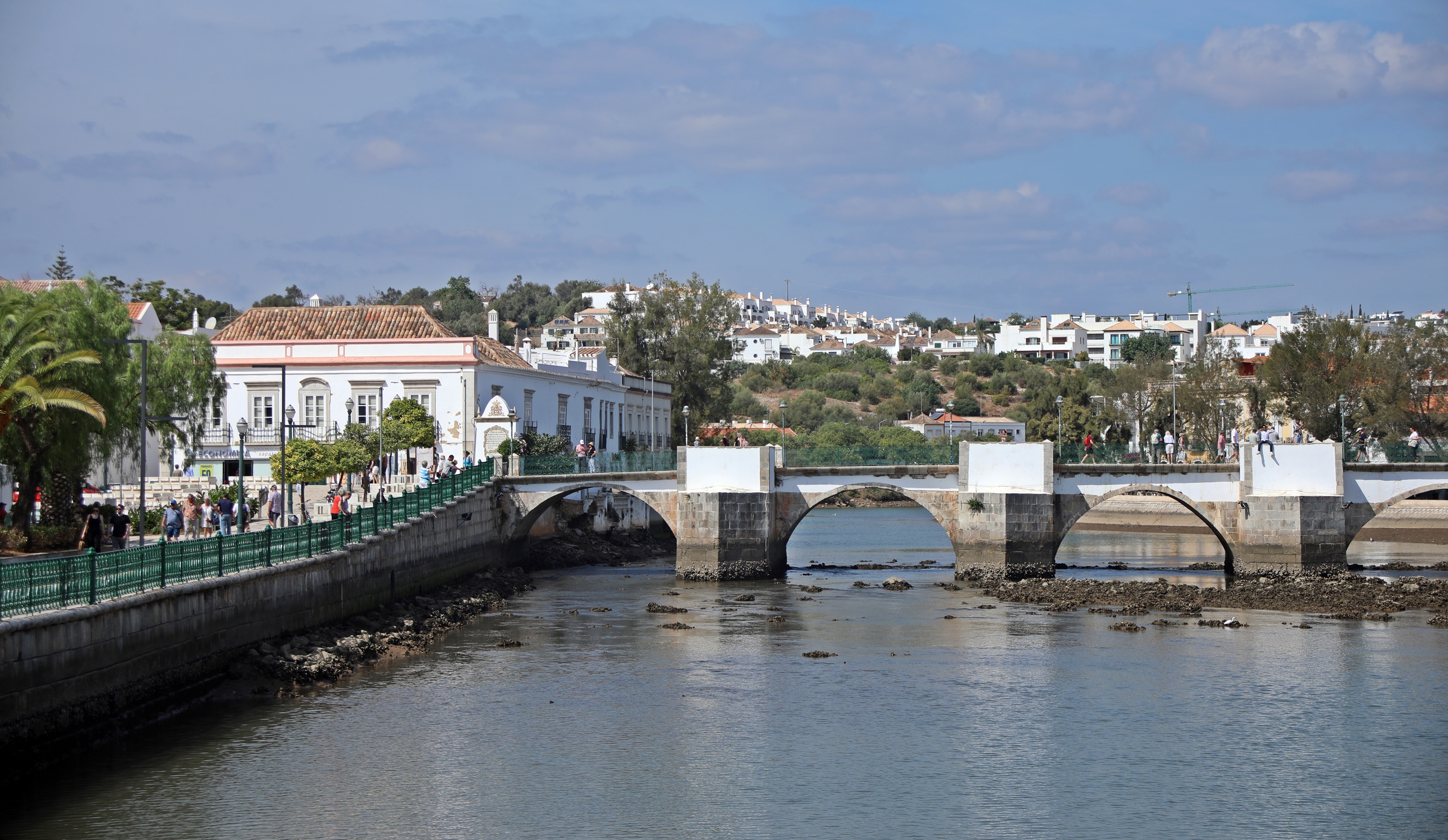
One of the most recognizable sites in the city is the medieval bridge that is strangely called Roman Bridge. This very picturesque seven-arched bridge crosses the Gilão River. When we were there, the tide was low and we could see the full height of those arches. Since it is a tidal river, during the highest high tides, the water rises up to almost cover those arches. Apparently, in 1989 flood waters damaged it and since then it has been a pedestrian-only bridge.


Ria Formosa Natural Park
Further downstream Gilão River meets a large estuary in Ria Formosa Natural Park. The geography of the estuary has made it ideal for extracting salt for centuries. It is known that the Romans mined the salt, but it was likely used by much earlier civilisations as well. The saltpans, called salinas in Portuguese, are fed by the ocean’s seawater through a labyrinth of channels. Sea water fills the salt pans at high tide and drains from them as the water recedes. What water remains then evaporates, leaving a layer of salt behind. Different mineral and algae compositions result in a variety of colours in the salt pans, including blue, pink and white. You can walk between the many pans to get a better look at the many colours.
Some of the pools have shrimp which attracts flamingos and other water birds. The best times to see the flamingos is from November to March so we felt lucky to find some in September.


The estuary is much larger than these salt pans. Covering sixty kilometres of Algarve’s coastline, this landscape is so unique and important, that is protected by Ria Formosa Natural Park (Parque Natural da Ria Formosa). Along the sixty kilometres there are channels, islands, dunes, marshes, mud flats as well as pine forests, scrub lands and pristine beaches.
Barril Beach
There are six islands in Ria Formosa Natural Park. The closest to the city is Ilha de Tavira (Tavira Island). The island is home to the isolated Barril Beach (Praia do Barril). The name Barril translates in English to Barrel and comes from the tuna fishing industry that was once an important part of the economy.
To reach the beach you have to cross a region of marsh and mud flats. To do so you can either walk on the long boardwalk or take a toy train. At the end of this wild land is Barril Beach. It is a long, sandy beach on the edge of the Atlantic Ocean. It was very windy when we were there. A sign says no umbrellas and we noticed that the covers over the sunbeds were well tied down. It made us think it must often be windy on this beach.


On one side of the beach, sand dunes give it a unique look. The beach’s claim to fame is Anchor Cemetery. Here, a collection of large tuna boat anchors are artistically displayed in the sand.


Praia de Cacela Velha
Another beach in the park is a little east of Tavira. Praia Cacela Velha is on a sandbar island in Ria Formosa Natural Park and is one of the most popular beaches in the area. We were there during low tide when pockets of lagoons filled in the low spots between the mainland and the long sandbar. It’s difficult to reach at low tide, but fishing boats will take you across to the beach when the water levels rise.


Above it is the cute fishing village of Cacela Velha. The white homes with colourful window and door frames sit across from Cacela Fortress (Fortaleza de Cacela). Its stone walls were damaged in the Lisbon earthquake so we couldn’t visit, but it adds interest to the view of both the village and the beaches.


Santa Luzia
On the other side of Tavira is Santa Luzia, the octopus capital of Portugal. Set beside the channels of Ria Formosa, the marina has dozens of octopus fishing boats moored along its docks. Octopus traps can be seen hanging from the boats and piled along the docks.


We highly recommend a visit to Tavira.


This article is now featured on GPSmyCity. To download this article for offline reading or create a self-guided walking tour to visit the attractions highlighted in this article, go to Walking Tours and Articles in Tavira.
To read more of our adventures in Portugal, click here.
Coming Next – Silves & Faro – Algarve’s Capital Cities
For pictures from other blogs go to Gallery at monkeystale.ca
To read about more of our adventures go to Destinations.
If you like what you read, please comment or share (with credit) using the links below.



We'd love to hear from you, please leave a comment.