
The district of Belém is home to some of the most elegant historical buildings in Portugal. It may sound dull to visit a watchtower and monastery, but these monuments are far from ordinary. In fact, seeing the dazzling designs on Belém Tower and Jerónimos Monastery may end up being a highlight of your time in the area. Today Belém is a suburb of Lisbon and makes a great day day trip from the capital.
The port city of Belém has been a favourite casting off point for sailors since the 13th century. The furthest they travelled at this time was the Canary Islands. It was during the country’s Age of Discovery though, that Belém and its port really started to gain importance. Most of the large expeditions occurred in the 15th and 16th centuries when Portuguese ships sailed for Morocco, India, Sir Lanka, Indonesia, Brazil and more. These successful exploits brought a lot of money and prestige to the city. As this was happening, noble families began building summer mansions and palaces in Belém and the wealth of the city grew even more.
In the 16th century the two most famous, and most fabulous buildings in Belém were built. Belém Tower and Jerónimos Monastery enhanced the city’s image and are firmly connected to the Age of Discovery. Luckily both buildings survived the Lisbon earthquake.
Belém Tower
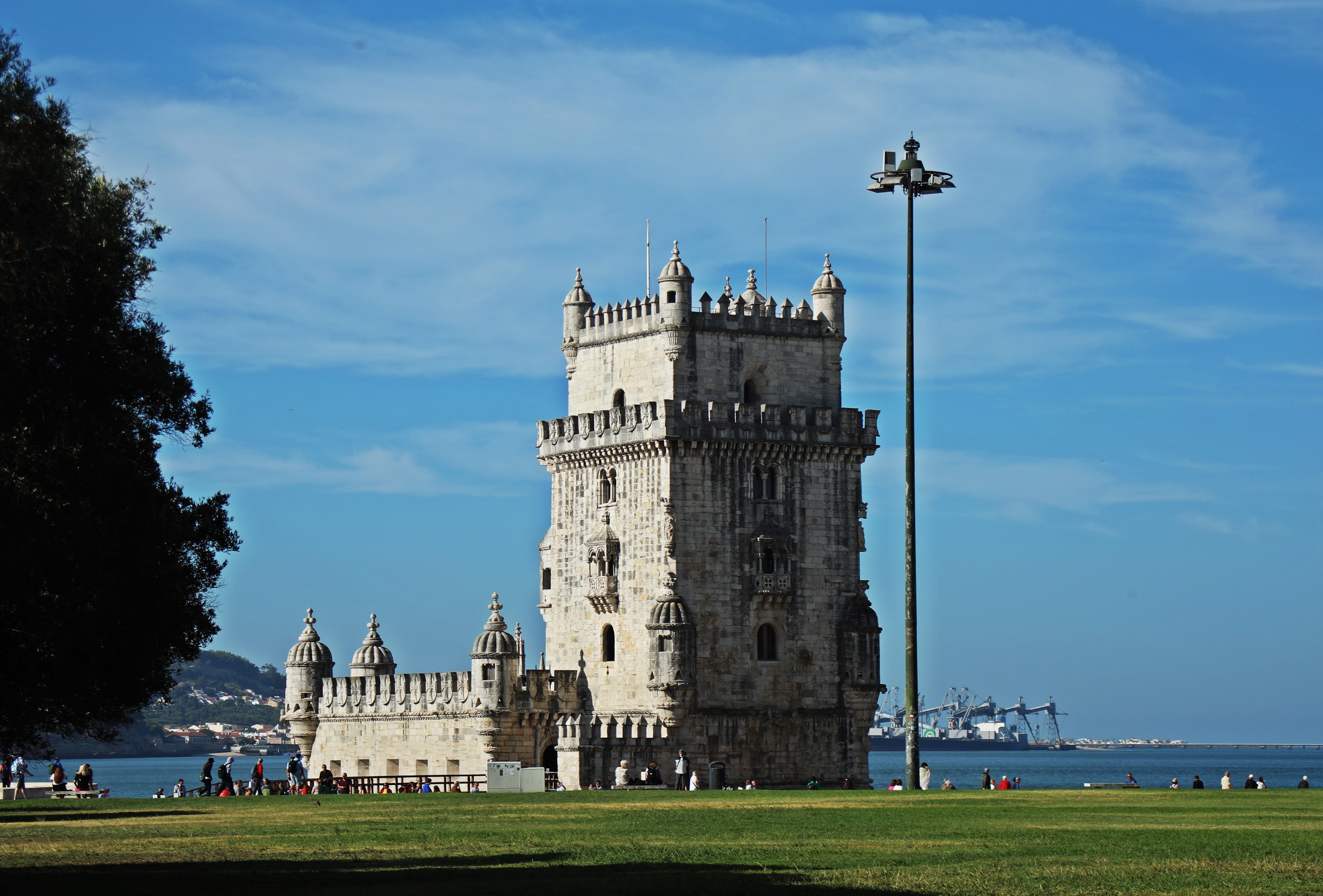
Its official name is Torre de São Vicente de Belém but it is usually called Torre de Belém (Belém Tower). At the height of the Age of Discovery, Belém was a wealthy city with ships heading out and imports coming in. Wanting to protect this valuable port, as well as the monastery and Lisbon, King João II had the idea to construct Belém Tower. He wasn’t able to fulfill this dream, but it was carried out by his successor, King Manuel I, in the early 1500s.
Belém isn’t an ordinary tower though. Not only was it built for protection, it was also used to show off the country’s prestige and wealth. Built in Manueline style, its exuberant design elements make it is a striking building.
Manueline style was popularized under King Manuel I and is known for its lavish ornamentation especially on doorways, windows and columns. You will see a lot more of these designs as we take you on our travels across Portugal.

We first learned of Belém Tower when we were travelling through Brazil. While in Manaus, our next port of call was Belém so we began researching this city. We were both very excited when we saw pictures of an exceedingly elaborate tower on the water. Belém in Brazil is along the Pará River, so the images were very believable. Our hearts were crushed though when we realized that not only was it in the wrong country, it was on the wrong continent. Finally, two years later, we were finally seeing this elaborate Portuguese tower in person. You can read about Belém, Brazil here.
Sitting in the sand of Restelo Beach, on the edge of Tagus River, Belém Tower still keeps a watchful eye over the river today. At the base of the tower is a large terrace, stretching out into the water. It is adorned with stylish sentry boxes and battlements as well as fancy mini-spires on the courtyard walls.


The Keep or Tower is brilliant from the outside, but its interior is not as impressive. There are rooms for tax collection, armories and audience rooms, but most are barren and don’t live up to the glamour of the building’s exterior. The top floor has a the most decorated room. Here we found the chapel with a pretty vaulted, ribbed ceiling emblazoned with crests.


As well as building Belém Tower, King Manuel I built other protective fortresses in the region. The Fortress of San Sebastião da Caparica was built across the river, and Cascais Fortress guards the port a little further away on the Atlantic Ocean. You can read more about Cascais Fortress here. (Coming Soon)
Tips to visit Belém Tower – You will likely need to purchase your tickets ahead of time. In the autumn that wasn’t necessary, but we still had to wait in line for 30 minute. The entrance fee is included on the Lisboa card.
Jerónimos Monastery
Not far from the tower is possibly the most ornate monastery we’ve ever seen. It’s not as extravagant as some churches, but this is a monastery after all. Those are usually more subdued in design. Work began on Jerónimos Monastery in 1501 and took almost 100 years to complete. It was built by King Manuel I for monks from the Order of St. Jerome. This order was dedicated to providing council for sailors as well as praying for their safe and successful voyages. Having a monastery built for them shows how important the sailing expeditions were to the king.

As we approached the building we were struck by the details on its outer walls. After staring at the monastery for a few minutes, we looked at the long line to get inside and realized we needed to join it. We were glad we were visiting in September and not in the middle of summer. As it was, we stood in line for almost an hour before getting inside.
After finally entering, we found ourselves in awe at the incredibly elaborate two story cloister. We began on the second floor where four long hallways wrap around a central courtyard. The ribbed ceiling seemed to go on and on.

The open walls of the cloisters were the most stunning part of the design. Ornamented marble columns and lace-like stone arches frame your view of the courtyard as well as the beautiful tower and dome of the church. It is said to be an excellent example of Manueline architectural style.


There are so many design details that its difficult to focus on one thing. You can’t miss noticing the fabulous gargoyles though. Each one is different, but we quickly found a favourite. It was the cougar-like head set in one of the corners.

After exploring the upper floor of the cloister, we walked around the main floor. It’s a mirror of the second floor with the same elaborate arches and vaulted ceilings, except that there are a few rooms that can be visited. Some of the rooms contain tombs of writers, others were wrapped in azulejos. Apparently the tomb of Portuguese writer and poet Alexander Herculano used to be grander but was modified so it wouldn’t be more elaborate than explorer Vasco de Gama’s tomb which is in the church.


Attached to the monastery is Church of Santa Maria. Statues, gables and spindles decorate its ornate side entrance. Inside a long, vaulted ceiling is similar to the ceiling in the cloisters. Multiple tall pillars have fine decorations on them, but other than the stone altar, most of the walls are bare. It’s a nice building, but not as spectacular as the cloisters.


Around the edges of the nave are many side chapels and altars. The most notable one houses the tomb of Vasco de Gama. He was a famous Portuguese explorer who, among other successful voyages, was first European to reach India by sea. Even though he died in 1524, this tomb was made in 1894.

To visit Jerónimos Monastery – The site has two different entrance tickets and therefore two different lines. The monastery will most likely have the longest line. After visiting it, get into the church line up right away. There is no fee for the church, but you must line up. The monastery is included on Lisboa card. With the card you don’t need ticket, but you do need to stand in line.
Monument of the Discoveries
Not far away from the Tower of Belém is Monument of Discoveries (Padrão dos Descobrimentos). During the “Age of Discovery” Portugal had built a vast empire and gained a lot of wealth allowing it to erect such elaborate buildings. The monument is dedicated to all of the country’s explorers including Vasco de Gama. There is also a statue on it of Italian Magellan because the king of Portugal paid for some of his voyages.

Surrounding the monument is a black and white cobblestone sidewalk called Calçada Portuguesa. These famous walkways were initially installed in Lisbon in the1840s and quickly gained popularity. They even spread to their colonial countries like Brazil, which is where we first saw them. We thought we would see a lot more of them in Lisbon. We did however see a lot of these sidewalks throughout the country.

Farol de Belém (Lighthouse) is not far away, but was covered in scapholding when we were there.
Ajuda National Palace
A little higher up the hill from the monastery is Ajuda Palace. The Great Lisbon earthquake that destroyed Lisbon on November 1, 1755, did very little damage to Ajuda. The earthquake made the king paranoid and he would no longer live in a stone building or in Lisbon. Instead he king built a wooden palace on Ajuda Hill. It burnt down after his death so his daughter, Queen Maria, ordered that a stone palace be built on the site. Due to a number of factors, construction was very slow and a royal family didn’t reside in Ajuda Palace until the late 19th century. It was the royal residence until 1910. Today, the pretty building showcases the extravagant rooms lived in by these royal families. You can walk through it rooms to see lavishly painted ceilings, large wall tapestries, crystal chandeliers, and ornate furniture.


Tickets can be purchased at the main door of the palace. There’s not likely to be a lineup for tickets. It is included in the Lisboa Card.
In front of the palace is an old tower with a rooster on its roof. We saw a lot of statues, paintings and clay roosters throughout Portugal and didn’t know why. After a number of days, we finally learned about the legend related to the rooster. We’ll tell it to you when we travel to Braga. (Coming Soon)

Pastéis de Nata
No trip to Belém is complete without trying Pastéis de Nata. The original recipe comes from the monks of Jerónimos Monastery. While in Belém we purchased a couple from a bakery called Pastéis de Belém. They are said to make the treats with the original monks’ recipe.
We had two and that was enough for Maggie. Richard liked them a bit more. They are very sweet tarts, filled with custard. If you don’t like custard or pudding, you won’t like these. A Portuguese man we met said almost everyone in Portugal eats at least one a day.


How to get to Belém
Located only10 kilometers from downtown Lisbon, it is very easy to visit Belém on a day trip. You can take Uber, but it’s also easy by public bus or tram. The MoovIt App makes it easy to figure out the best way from your location. There isn’t a lot of parking so if you have a car, it’s best to leave it in Lisbon.


This article is now featured on GPSmyCity. To download this article for offline reading or create a self-guided walking tour to visit the attractions highlighted in this article, go to Walking Tours and Articles in Lisbon.
To read more of our adventures in Portugal, click here.
Coming Next – The Palaces of Sintra
For pictures from other blogs go to Gallery at monkeystale.ca
To read about more of our adventures go to Destinations.
If you like what you read, please comment or share (with credit) using the links below.




We’d love to hear from you, please leave a comment.