
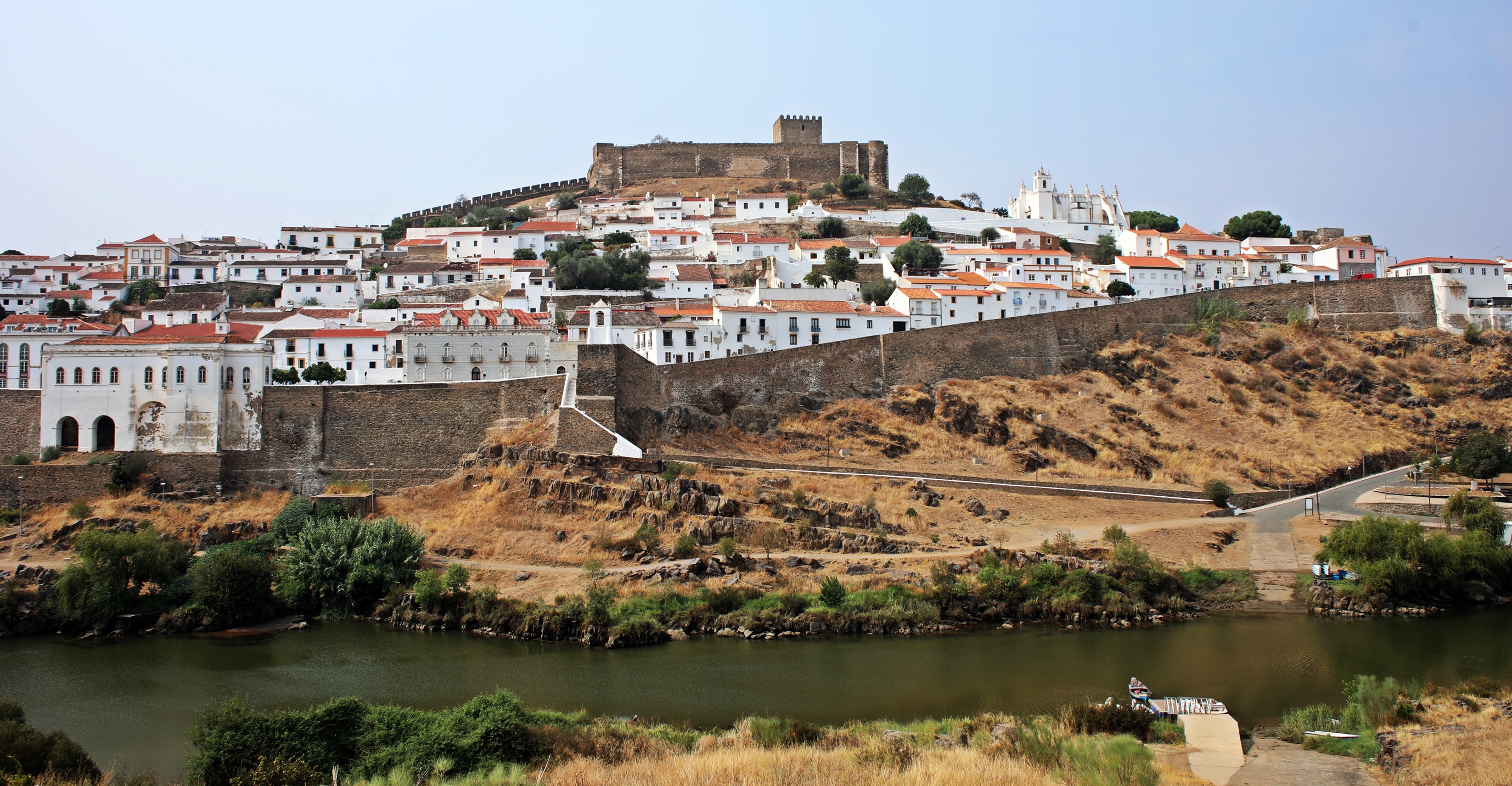
With striking hilltop castles, tall towers, and pretty heritage towns to visit, it is more than worth a trip to the Alentejo Region in south-eastern Portugal. The medieval castles in Beja, Mértola and Alcoutim receive fewer international visitors than the rest of the country which is why you should visit now, before word gets out.
There are so many castles and fortresses along Portugal’s border with Spain, that we’re showing you them over three posts. To read about some of the other magnificent castles in this region, read our posts The Fortified Towns of Monsanto and Marvão, and A Journey Through Elvas & Évora’s Rich Heritage.
Beja
One of these border cities with a rich history, is Beja. Unlike most of the castles we’ve seen along the Portuguese-Spanish border, the castle of Beja is not on a tall mountain or high rocky cliff, but rather on a small hill in the centre of old town. To make up for this lower elevation, they built a tall tower. In fact, it’s the tallest tower in Portugal.
Craning our necks, we looked up, way up to see the top of the 40 m (130 ft) tall Keep. In addition to its height, it is quite pretty, built with white marble from the nearby city of Estremoz. There are quite a few marble structures in the Alentejo region, and all of the marble came from Estremoz.


The castle was originally built in the 13th century and was modified several times over the next 200 years. It’s not large, in fact it’s only a short walk to patrol its perimeter. It is a nice looking castle though, and is in good condition.
Inside, what’s left of the castle is mostly its stately, stone walls except for the bright yellow Governor’s House that is now a museum.


Beside the castle are remains of the original walls of the fortified city. Porta Avis is a small arch that was originally built by the Romans in the 1st century. It was destroyed in the late 1800s, but in 1939 the granite blocks were discovered, and the arch was rebuilt.

Republic Square is a nice spot in the centre of Old Town, where locals meet for coffee or lunch. At its side is an unusual looking church. The low roofed, multi-arched stone Misericordia Church (Igreja Misericórdia) was initially built to be butchers shop. Upon seeing it, the king decided it was too pretty for that purpose and declared that it would instead be a church.


One of the streets leading to Republic Square is topped with an old gate. Arco dos Prazeres (Arch of Pleasures) is on what used to be the main road from Lisbon. It was once a busy spot with horse drawn carriages riding under its gate. If you look closely, you can see that its base has since been altered to allow cars to pass.

The narrow streets around the castle still have a good variety of heritage buildings. Many are in need of a few repairs, but they are charming in their own rugged way. Beja doesn’t see many visitors, but as it becomes more widely known, hopefully some of these buildings will be restored.


Mértola
Standing high above the Guadiana River, only 10 km or so from the Spanish border, is the ancient city of Mértola. The Guadiana River was once an important waterway, so this site was highly sought after for centuries. With a history dating back to Neolithic times, the oldest ruins that can be seen today are Roman. The next major residents were the Moors who built a Mértola Castle on the highest point of an impenetrable rocky point. Although not much is left of the castle, its exterior walls still have a commanding presence.
In the 13th century, when the Portuguese won control of this land, the Portuguese king awarded Mértola Castle to the Order of Santiago. They were a Spanish religious and military order in the Middle Ages that protected Christians on the Iberian Peninsula. This castle was later used by the Portuguese military who occupied it until the late 18th century.


Beside the castle archeologists are slowly uncovering Roman ruins, including mosaic floors. Unfortunately, these ruins are currently blocked off to visitors.

In front of the castle is Main Church of Mértola (Igreja de Martiz). If its appearance looks different from other churches from this time, that’s because this one had its beginnings as a mosque. In the 13th century, it was converted to a church. Even before the Moors built a mosque, there was likely a Roman church on the site.

Spilling down the hillside are the whitewashed homes of the medieval town. Streets run parallel to each other on the slope of the hill. A few staircases allow you to get between the different levels of the tiered town, giving it a unique character. Bougainvillea drapes over many of the white walls, making the old town even prettier. It made us wonder why Mértola is far less visited than other historic towns in Portugal.


As early as Roman times, a wall encircled the town. Today that wall still exists and can be seen from many points in both the old and new parts of the city. The cutest view is of the clock tower which sits on a low point of the hill, not far above the Guadiana River.


A viewpoint across the river was our favourite spot. From this vantage point we could see the perfect setting of Mértola Castle high on a hill above its medieval town. We returned at night to see the town’s lights beautifully reflect off the river.


Alcoutim
Guadiana is one of the longest rivers in the entire Iberian Peninsula. We followed its path from Mértola to Alcoutim where the river marks the border with Spain. From the river’s edge, we looked across to the village Sanlúcar de Guadiana in Spain. It’s a lovely view as the town fills in the river banks below the castle on a hill.
You can take a ferry across the river to visit the Spanish town.


Alcoutim is quite small but has a lot of charm. Only a small part of its castle remains, but its town makes up for it. Stark white buildings decorated with colourful flowers and its views of the calm river make it a nice spot.


Further along the border river we met Jo from Still Restless Jo and her husband for a walk. We climbed up through the hills above the rustic village of Laranjeiras where we had more pretty views of this long river.


How to get to Beja, Mértola and Alcoutim
With direct buses from Lisbon and Faro, reaching Beja is quite easy. Mértola also has a direct bus between it and Lisbon as well as Vila Real de Santo António, in Algarve. You can also travel by bus between Beja and Mértola. It is not as quick to reach Alcoutim by bus though. If you want to visit all three and explore more in the region, it would be much easier by car.

Where to stay in Beja and Mértola
Mértola has a larger offering of hotels and guest houses than Beja. A few can be found right in the medieval village, which would be a great place to spend a night. When visiting Alcoutim it would be better to stay in Mértola or more popular cities on Algarve’s coast such as Tavira.

To read more of our adventures in Portugal, click here.
Coming Next – Discover Tavira’s Scenic Beauty
For pictures from other blogs go to Gallery at monkeystale.ca
To read about more of our adventures go to Destinations.
If you like what you read, please comment or share (with credit) using the links below.




We’d love to hear from you, please leave a comment.