
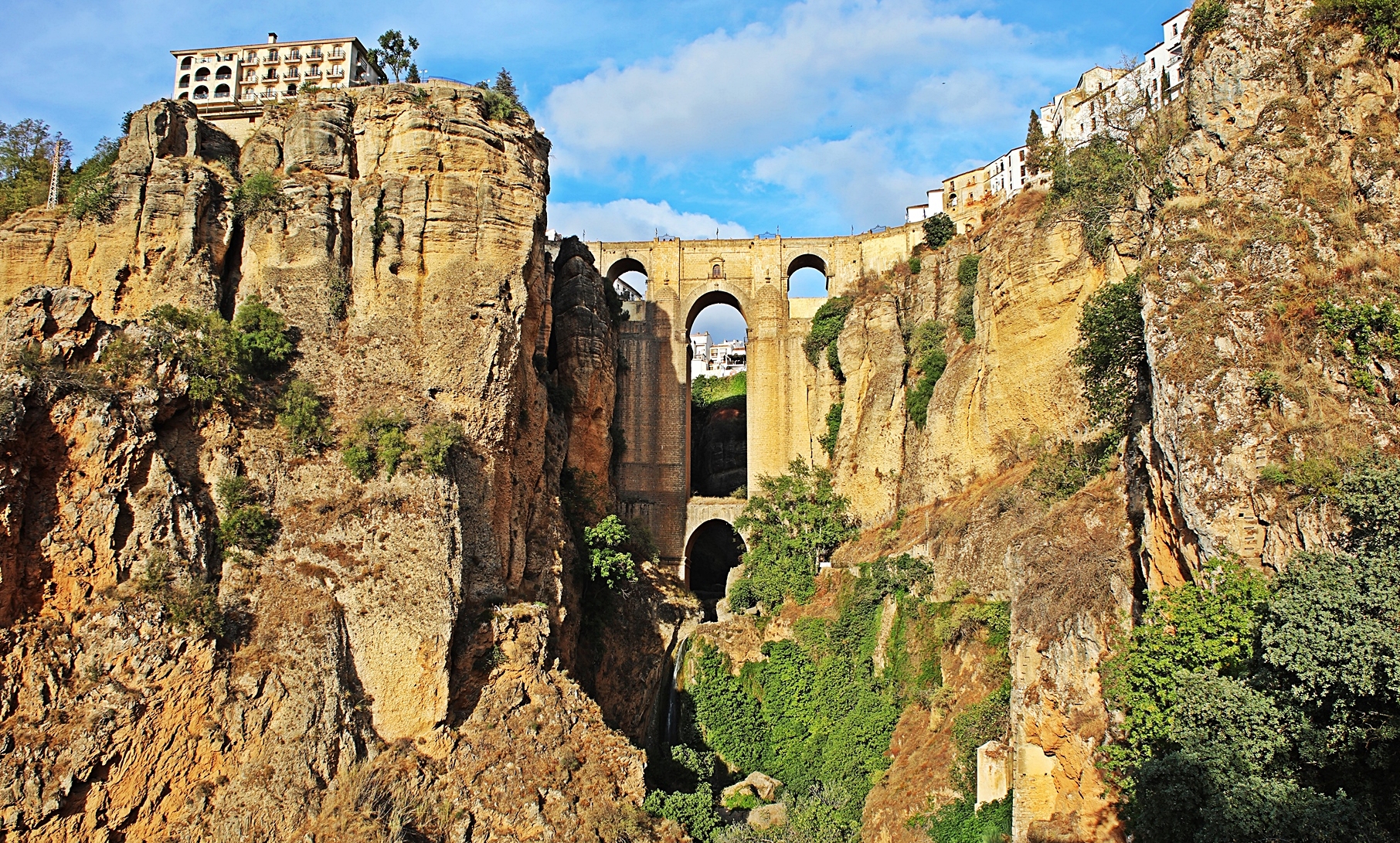
We stood at the base of the deep gorge and stared up in awe. The view of the multi-arched bridge spanning the steep-walled, narrow ravine was a magnificent scene. Never before had we imagined that an old bridge could be so picturesque. Puente Nuevo is so perfect it has become the iconic symbol of Ronda.
People have been living on the edge of the deep El Tajo de Ronda Gorge as early as the Stone Age, finding protection in its sheer walls. When the Romans settled here, they called it Arunda, although the name may have actually come from an even earlier civilization. Next on the scene were the Moors. Over the next 800 years, various Moorish empires battled for ownership. To further prevent invaders, a fortification wall was built around the unprotected side of the city. None of these empires though, attempted to build a bridge across the deepest section of the gorge.
In addition to the gorge, its location in the Serranía de Ronda (Ronda Mountain Range) kept the city isolated. This is partly why it wasn’t captured by the Spanish until the late 1400s, shortly before they took over Granada. This position continued to keep the city isolated from the rest of Spain until the 1800s.


Puente Nuevo
Although the gorge is a striking feature, the star attraction on a visit to Ronda is the photogenic Puente Nuevo (New Bridge). It is part of an awe-inspiring scene that combines natural and human-made elements. Built to connect the new and old parts of the city, El Mercadillo and La Ciudad, it is more than a functional connector, the bridge is quite beautiful.


Despite its name, the bridge is not that new. Completed in 1793, its construction proved to be a difficult task. El Tajo de Ronda Gorge, meaning The Deep Cut of Ronda, is only 68 m (220 ft) at its widest point but it is 120 m (390 ft) deep. The first bridge built across this part of the chasm collapsed after only 6 years in 1741, killing 50 people.
You can appreciate the terrain when you walk along the edge of the gorge. On both sides, buildings seem to cling to the edge of the sheer walls. Some are hotels or restaurants and offer spectacular views.


If your knees are in good shape, it’s worth a walk to the bottom of the gorge. From below, the views of this spectacular 18th century bridge are unmatched. This is where you can fully appreciate the aesthetics of the design including its tall arches and double tiers.
This spot is called Arco del Cristo Viewpoint because of the old Arch of Christ (Arco del Cristo) located there. Even with this stunning view, we were alone. Most seemed to be content to see the bridge from above. We returned to this same spot at night when the bridge was bathed in lights.


From Arco del Cristo you can walk to the Moorish Wind Gate (Puerta del Viento). Both the arch and the gate were part of a wall that protected the flour mill. It was made using tapial construction. This is a typical Moorish technique where clay and lime are compacted inside a temporary frame.

If you don’t want to walk all the way to the bottom of the gorge you can stop partway down at Desfiladero del Tajo, also called Mirador Puente Nuevo de Ronda. From there, a newly opened pathway traverses the side of the gorge and gets you closer to the bridge. There is an entrance fee for this new trail.
Another way to see it from below is to drive to Mirador la Hoya del Tajo. This lookout though, is quite far from the bridge.

Arab and Old Bridges
There’s not just one historic bridge in Ronda, there are actually three. Arab Bridge is sometimes called Roman Bridge, or San Miguel Bridge. It was built during the Moorish rule, making it the oldest bridge in Ronda. It sits only 12 m (40 ft) above Guadalevín River. At this point, the gorge isn’t very wide or deep.


Even though it is newer than the Arab Bridge, the third bridge is called Puente Viejo (Old Bridge). In the 17th century, the Arab Bridge was too narrow for horse-drawn carts to cross. This necessitated the construction of a wider bridge. Old Bridge is not only wider it is almost twice as high as the Arab Bridge. Both bridges are upstream of the famous Puente Nuevo and are now pedestrian-only.

City Wall
The Moors liked Ronda’s location because of the steep cliffs that provided natural protection on one side of their city. For the unprotected sides, they built a stone wall. From the Old Bridge, it’s possible to walk beside a section of this historic wall where many of its old towers and gates are still intact.


The most elaborate gate is Felipe V (Acro de Filipe V).


Below Felipe V Gate are the Arab Baths. Not much of these 13th century baths remain anymore. From here though, you can see the old wall from another angle.


A little further down is Almocábar Gate. It must have been an impressive way to enter the city with castle-like rounded buttresses on either side of the gate. The ruins of the alcazaba are just above.
Beside the gate is Espíritu Santo Church. This stately looking 16th century church was integrated into the city wall and was built on the foundation of a Moorish tower. We saw the large Espíritu Santo Church from many parts of town. You can see it in some of the city wall pictures above.


Historic Quarter
The oldest part of Ronda, called La Ciudad, is located on the south side of Puente Neuvo. It is filled with 9-15th century Moorish homes and palaces, and is a fascinating part of the city to visit. There aren’t a lot of specific sites in this part of the city, so you can just enjoy getting lost in its maze of streets.


As we climbed up and down the old streets, we found the newer part of the heritage centre. Here there is an overlap of Christian and Muslim architecture. A great example is the Minaret of San Sebastian. This minaret was transformed into a bell tower for San Sebastian Church, but it retained its minaret descriptor.


Being a historic catholic town, there are many churches. In Duquesa de Parcent Square you can find a church and a convent next to City Hall.


The streets in the newer section of the historic quarter were laid in a more organized pattern than those in the medieval neighbourhood. Elegant looking heritage homes grace their sides. The streets closest to Puente Nuevo are quite lively in the evening, with many busy patios offering dinner or drinks.

How to get to Ronda
Its location in the mountains kept Ronda secluded until recent times. Today, this tourist hot spot is quite easy to reach. The drive from Seville is roughly 2 hours on good highways. It’s a little closer from Málaga, Cádiz and Jerez de la Frontera (1 ½ hours each). The final section of road from all destinations takes you through fantastic scenery through vineyard covered hills. You could visit on a day trip, but it’s a lovely city with a lot to see so a longer stay is recommended. As well, there are a few smaller towns nearby that are also worth a visit.
If you don’t have a car, you can also travel by train or bus from these centres, but most don’t offer direct lines.

Where to stay in Ronda
There really isn’t a bad part of town to stay, but if you have a car, you will need to enquire about parking. There is a wide variety of hotels, apartments and guesthouses in the city. Since it’s not very large, it won’t be difficult to find one within walking distance of the bridge.
You can find Ronda in the lower left section of the map below. Click on the map for an expanded view.

Don’t forget to check out the great side trips from Ronda in our posts Best Day Trips From Ronda and Hiking El Caminito del Rey.

To read more of our adventures in Spain, click here.
Coming Next – Best Day Trips From Ronda – Setenil de las Bodegas and Olvera
For pictures from other blogs go to Gallery at monkeystale.ca
To read about more of our adventures go to Destinations.
If you like what you read, please comment or share (with credit) using the links below.






We'd love to hear from you, please leave a comment.