
If you are planning a visit to the Jesuit Missions in Paraguay, you have the option to stay in Paraguay or Argentina. Both Encarnacion, in Paraguay, and Posadas, in Argentina, provide easy access to the Jesuit Missions in the region. Straddling the Argentine-Paraguay border, the sister cities each offer a different experience to visitors. We’ll describe what there is to see in both cities and let you decide which you would prefer to use as a base when visiting the UNESCO World Heritage Site Missions.
If you want to go directly to the city we think is best, skip to the bottom by clicking here.
You can read about these mission churches in our post, Jesuit Missions in Paraguay.
Originally, both Encarnacion and Posadas were inhabited by a majority of Guarani people and were in Paraguayan territory. The War of the Triple Alliance, though, resulted in a change of land ownership, and now they are located in two different countries. As a result, both cities have reminders of Guarani traditions, although it is less obvious in Posadas.
Encarnacion
The riverside city of Encarnacion has the closest access to all three Paraguayan Jesuit missions and, therefore, makes a great base for visiting them. Since we are talking about Encarnacion first, you would be correct in assuming that it was our preferred city of the two. In fact, Encarnacion was our favourite city in Paraguay.
Since it is a border city, we were a little worried that it would be rough. Instead, we found it to be a very pleasant, clean city that is more modern than most in Paraguay. Its border location has made Encarnacion popular with Argentine tourists who come for an easy and cheap beach vacation. This influx of tourism resulted in better tourist infrastructure than most other Paraguayan cities, but with a population of 100,000, the city has a small-town feel.
First established in 1615 as a Jesuit mission, there is none of that history left in Encarnacion today. Even without those remains, the city does have a lot to discover. Here are some of the things you can see in Encarnacion:
Costanera de Encarnacion
The city take good advantage of its position on the edge of the wide Parana River. A recently added river promenade called Costanera de Encarnacion provides locals and visitors with a lovely place to go for a walk or a bike ride. Along its side are playgrounds, football (soccer) fields and beach volleyball courts. Just a block away, you can find several hotels and restaurants.
It is 8.7 km (5 ½ mi) long, but most of the sites seem to be located near San Jose Beach.

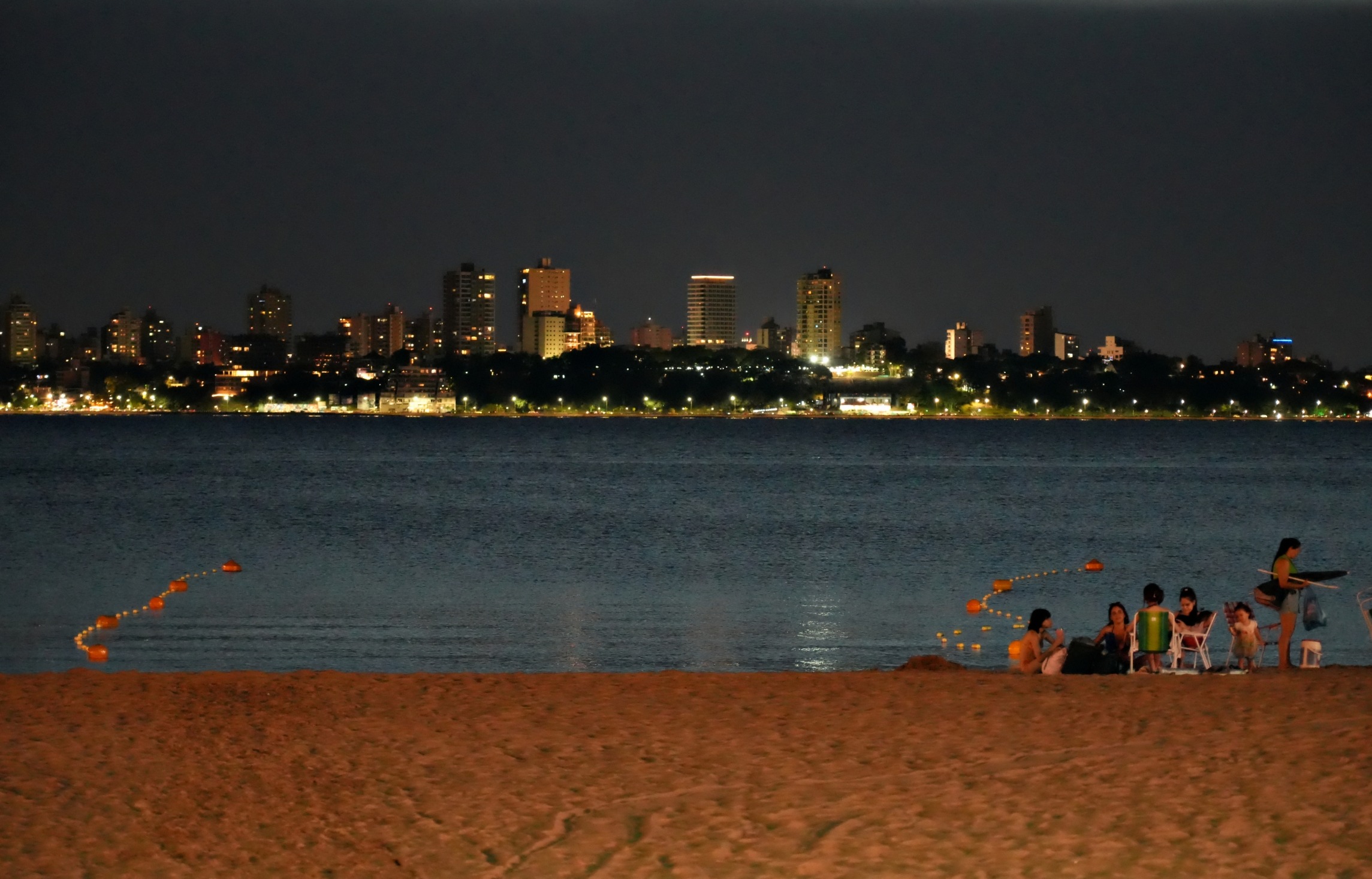
From the Costanera, you can enjoy a wonderful view of the modern city of Posadas in Argentina, on the other side. Also visible is the 2.5 km (1 ½ mi) long San Roque Gonzales de Santa Cruz Bridge that makes travelling between the two border cities very easy.


As we walked through the city, we spotted several birds. Near the Costanera, we came across a family of Southern lapwings. The parents didn’t like it when Richard got too close to their young chicks and started aggressively darting at him. Don’t worry, his photos were taken with a zoom lens.


San Jose Beach
The Costanera leads to San Jose Beach (Playa San José). This artificial beach is home to remarkably soft sand. It was imported in 2011 to make this a viable tourist attraction, and it worked. Today, it is the primary reason for the large number of Argentine visitors and is reportedly very busy during the summer months.
In addition to the sand, new amenities were added, such as beach bars, playgrounds and kiosks that rent jetskis and paddleboards. It is a beach lover’s paradise. If you couldn’t see the city of Posadas on the other side, you may think you are at the lake.
The river, though, is known to be polluted and swimming is often discouraged after it rains.


San Jose Flour Mill and Silos
Beside the beach is the picturesque San Jose Flour Mill and Silos (Malino Harinero y Silos San Jose). The 1940s mill was an important part of Encarnacion’s economy until 1989. Today, it is a historic landmark and in December, was adorned with Christmas decorations.


Plaza de Armas
In the centre of the city is the large Plaza de Armas. It’s filled with tall shade trees, but unlike most South American plazas, this one is not surrounded by colonial buildings, nor does it have a large Spanish-built Cathedral. It is too hot to be enjoyed during the day, but at night, its splash pool and playground make it a popular place for parents to bring their kids.
There are quite a few monuments in Plaza de Armas, many of which are dedicated to the various ethnic groups that now live in the city. We easily spotted the Moorish-looking gate that commemorates the Lebanese-Syrian community. There are also monuments to the German, Ukrainian, Italian and Japanese populations.


Jorge Ukrainian Orthodox Church
Instead of a Spanish Cathedral on Plaza de Armas, it has a Ukrainian Orthodox Church. The onion dome on its top is a rarity in Roman Catholic Paraguay, but it has a prestigious placement on the side of Plaza de Armas.
Ukrainians migrated to Paraguay between the 1920s and 1940s, and many chose to stay in Encarnacion. They started farming in the surrounding fields where they remain today. They cultivate corn, wheat, soy and a new crop for them, yerba mate. This is the plant used to make the popular teas, mate and tereré. Most of the yerba mate in Paraguay is grown in this region.


Cathedral of the Incarnation
The original 18th century Jesuit Church was located on Plaza de Armas. When that building was destroyed, a new one needed to be built. There was a disagreement between citizen groups regarding the location of the new church. To settle the dispute, the new Cathedral of the Incarnation (Catedral de Encarnación) was built between the two proposed locations, resulting in its placement on a busy street, rather than on the main square.
Built in 1939, the cathedral is quite plain inside, but it was decorated for a wedding when we visited, so it was a little nicer than usual. As we started to leave, a car, decorated in flowers, pulled up and sat outside the front door. We assumed it was the bride, so we waited. But, after watching it idle for 10 minutes with no one exiting, we gave up and continued exploring the city.


Saint Nicholas Russian Orthodox Church
Not only is there one onion-domed church in Encarnacion, but there are, in fact, two. The golden onion domes atop the bright green Saint Nicholas Russian Orthodox Church are not easy to ignore. It was built in the 1950s by the local Russian community, who had been in Paraguay for years. After the collapse of the Russian Empire, Paraguay experienced a large influx of Russian immigrants. Many of those landed in Encarnacion and made the city their permanent home.

Where to stay in Encarnacion
There are many choices for hotels in Encarnacion, and the one you choose will depend on the type of stay you want. There are several modern hotels near San Jose Beach, but they may be noisy at night. We stayed in the family-run Terwindt Hotel not far from Plaza de Armas and enjoyed the hotel and supporting a local family.
Prices are much lower in Encarnacion than Posadas for the same quality.
Where to eat in Encarnacion
Most tourist restaurants are located near San Jose Beach or within a few blocks of it. We were not able to find many places closer to the city centre. As with hotels, meals are cheaper in Encarnacion for as good, or even better quality.
How to get to Encarnacion
If you are in Paraguay, many buses travel between it and Asuncion, Villarrica, Ciudad del Este, as well as nearby smaller centres. Click here to find out how to travel between Encarnacion and Posadas.
You can find Encarnacion in the bottom of the map below. It is an interactive map, so you can zoom in, or click on a marker for a link to our blog post from that region.
Posadas
The tall hotels and apartments provide a modern look to Posadas’ skyline. Seeing it first from Encarnacion, Paraguay, we knew, even from a distance, that Posadas is much more prosperous. With a population four times that of Encarnacion, Posadas is also a much busier city. Here are some of the sites we found in Posadas, Argentina:
Costanera de Posadas
The 10 kilometre (6 mi) long Costanera de Posadas provides views across to Encarnacion, and is a popular place for runners, walkers and cyclists. Standing beside the riverwalk are the highrises that we had seen from across the river. They are filled with apartments, hotels and restaurants. Like the pathway in Encarnacion, this one also has a few sites of its own.


Andrés Guacurarí Monument
On the edge of the Costanera, and across from Encarnacion’s old mill, is the 17 m (55 m) tall Andrés Guacurarí Monument. Also known as Andresito, Guacurarí was a key leader under General Artigas in the fight for independence from Spain. He was a strong advocate for the Guarani people, and this continued in his role as the first governor of Misiones Province.
Behind the statue, you can see the two kilometer long San Roque González de Santa Cruz Bridge that travels between Posadas and Encarnacion.

Near the monument, the Costanera is bordered by tall apartments, but within a few blocks, it changes to having lovely gardens at its side. Painted steps are placed periodically in the long gardens, allowing you to climb back up to the city centre.


El Brete Beach
The Costanera leads to the main city beach, El Brete. We visited on a rainy day, so it was empty, but it is busy with locals and tourists on most hot summer days. There are a few restaurants nearby and beach bars on the edge of the Costanera.

La Bajada Vieja
To reach the river from the city centre, we walked through the oldest neighbourhood in Posadas, La Bajada Vieja. Located on the slopes above the old river port, it was established by fishermen and labourers. You can find a little bit of street art in the area, but not as much as we had read.
A statue of El Mensu greeted us as we entered La Bajada Vieja. Mensu is a symbol of the original labourers from the yerba mate plantations in Misiones Province. Their memory is captured in a local folksong, and some of the lyrics are etched into the monument. This is just one of the many examples we’ll provide over the next few months of the importance of mate to Argentina.


July 9th Square
In the middle of the city, July 9th Square (La Plaza 9 de Julio) is the heart of colonial Posadas. On one side, the pretty, pink Government House of Misiones is prominently displayed. Its nickname is La Rosadita, The Little Pink One, because of its colour which was chosen to match Casa Rosada in Buenos Aires.

At the head of July 9th Square is San Jose Cathedral (Catedral de San José). This spot was home to a few different churches. First, a small chapel was erected, then the community raised funds to build a larger church, so the chapel was torn down. This new building had many structural problems and was replaced in the early 1900s. This final building was extensively renovated in the 1930s, and then again in the 1990s when the towers were heightened.
We tried to see the inside, but it was closed each time we passed by. There were quite a few homeless in the square, so this may be one of the reasons it is not left open. Upon seeing the homeless, we realized that there are very few homeless in Encarnacion, or in most places we visited in Paraguay.

In the centre of the square is a monument commemorating the May Revolution (May 25, 1810), the uprising that eventually led to Argentina’s independence from Spain. The Square is named after July 9, 1816, the date when Argentina declared their independence.

The other nice colonial building on the square belongs to the Italian Society of Mutual Aid. It was founded by Italian immigrants in the city to provide support for other new immigrants. On its roof is a statue of the Capitoline Wolf from the Legend of the Founding of Rome.


We visited just a few days before Christmas, so the park was filled with decorations, including Santa’s sled being pulled by what looked more like elk (wapiti) than reindeer.

San Martín Square
Surrounded by 20th century buildings in disrepair, Plaza San Martín isn’t as nice as July 9th. What it did have, though, were blooming Jacaranda trees on all four corners of San Martin’s statue. You’ll find a statue of San Martín in almost every city in Argentina, as well as Chile and many in Peru. The general is called The Liberator for bringing independence to Southern and Central South America.
The playground on the edge of Plaza San Martín is very busy at night with families.


Boulevard Parks
Four boulevards form a border around the city’s historic centre, and their centres have been put to good use. Rather than building uninspired paved medians, the city has filled the space with lush gardens to create a continuous green space. Some have flower beds, others are filled with trees, monuments or even a playground. Along the edge of these parks are running and bike paths to ensure these spaces can be enjoyed by many.


In addition to the parks that surround the historic centre, there are many other parks and gardens throughout the city. In them, we found a variety of plants and birds, many of them we’d never seen before. In one, we saw palm trees covered in moss, a clear indication of the moisture and humidity in Posadas. In another, we saw beautiful flowers on the Royal Poinciana Tree. Almost all were enjoyed by the pretty, but noisy parakeets.


Another small square has a statue honouring mate. In the statue, the character called Matero is preparing his mate, just as almost every Argentine does several times a day. Both Matero and Andrecito were the creation of artist Gerónimo Rodríguez.

Posadas is a pleasant city with a vibrant downtown. At least it has a lively atmosphere in the evenings. During the day, everyone is taking a siesta, so the streets and parks are empty, and most businesses are closed. Siestas occur throughout Argentina, so you often need to plan accordingly.
How to get to Posadas
If you’re in Argentina already, buses run between Posadas and Puerto Iguazu, Buenos Aires, and Salta, as well as smaller centres in Misiones. You can also fly into Libertador General José de San Martín Airport. It receives flights from Buenos Aires, Cordoba and other Argentine cities.
Where to eat in Posadas
There are a few higher-end restaurants and bars along the Costanera with picture windows looking out to the river. In the city centre, however, we were surprised that most of the restaurants serve only fast food. The few restaurants that you can find downtown don’t open until 8 pm. We will never get used to eating that late.
Where to stay in Posadas
Most hotels and short-term apartment rentals are either located near the beach, near the Andrés Guacurarí Monument, or in the historic centre. We chose to stay in the centre, and we’re glad we did, but it was difficult to find a restaurant for dinner.
We were very happy to find excellent coffee in Martinez Cafe. It is an Argentine chain, so we hope to find it in other cities.
As we said in the Encarnacion section, prepare to pay more for less in Posadas.
How to get to between Posadas and Encarnacion
The quickest way to get between the two cities is by taking the train that travels over the San Roque González de Santa Cruz Bridge. It takes only eight minutes and the cost is approximately $2.50 USD.
The other option is to take a bus, but due to heavy traffic on the bridge, buses can take 1 hour or more, and it is only a few cents cheaper.
Travelling in either direction, you must pass through Customs and Immigration for both countries. The train has a very good system for this, we assume the bus does as well.
We knew they were crazy about mate in Argentina, and this COVID sign that we saw at the border further instilled how ingrained mate is in their culture. In the centre of the poster, it translates to ‘Do not share mate or dishes’.

Should you stay in Posadas or Encarnacion?
We stayed in both cities, and each has its pros and cons. Encarnacion is closer to the UNESCO mission churches and is less expensive. We found good restaurants in the historic centre and along the river. But it is very quiet for those wanting a more lively visit. Posadas requires a train, bus, or car ride across the river to get to the missions and doesn’t have as many restaurants in the centre. It is more expensive, but it is a more modern city with more action.
Now you have all the information, what will it be, Encarnacion or Posadas?

This article is also featured on GPSmyCity. To download this article for offline reading or create a self-guided walking tour to visit the attractions highlighted in this article, go to Walking Tours and Articles in Posadas.

Click on the link to read more of our adventures in Paraguay, or Argentina.
Coming Next – Explore The History of Montvideo, Uruguay
For pictures from other blogs go to Gallery at monkeystale.ca.
To read about more of our adventures go to Destinations.
If you like what you read, please comment or share (with credit) using the links below.




We’d love to hear from you, please leave a comment.