

You don’t usually think of going to a beach resort to enjoy its cooler climate, but that’s what they do in Uruguay. A cool breeze keeps the eastern coast from overheating, even in the middle of summer. With a variety of sandy beaches and a wide selection of coastal cities, there are many choices to be made. Two popular, yet very different beach towns are Piriapolis and Punta del Este. We’ll take you to both and let you decide which one appeals to you more.
Uruguay’s beach resorts line its southeastern edge, and are popular with Uruguayans, Argentines and Brazilians. Instead of scorching hot days, though, summer winds coming off the Atlantic Ocean keep temperatures moderate. The average summer high is only 23 °C (74°F), which was a welcome relief from the hot, humid days we recently experienced in Paraguay. These beach towns cool down considerably in the evenings. We visited in early January, the Uruguayan summer, and we had to wear sweaters at night.
Piriapolis
Beginning with the laid-back city of Piriapolis (Piriápolis) tells you which one we prefer. The beach city feels like a step back into the1970s with its bungalow homes on residential streets, kids playing in the streets, and older, simpler hotels along the promenade. But if you like to lie on the beach, its moderate climate and soft sand make it a nice spot.
Piriapolis wasn’t always so unhurried; in fact, for a while, it was the place to be in South America. In the late 1800s, Francisco Piria owned a large section of land in what today is called Piriaopolis. The name cleverly translates to Piria’s Town. He returned to his home after a trip to the south of France and decided this part of the coast would be perfect to develop into Uruguay’s version of the French Riviera. Piria began by building the seaside promenade, Rambla de los Argentinos and the Argentino Hotel. His dream quickly spread, and others joined him, building summer estate homes and luxury hotels nearby. Piria was a visionary. He didn’t stop at the hotel, but also built a port in the city and enticed steamships to bring visitors from Buenos Aires. He also expanded the railway to help visitors reach his resort town. Piriapolis attracted South America’s rich and famous for many years, but it lost its edge in the 1950s when other resort cities became more trendy.
Piriapolis is no longer a French Riviera-style resort. It’s more of a poor man’s family vacation destination. Which is great, it means it is more laid back and simple than many other resort towns.
Here are a few of the highlights in Piriapolis.
Rambla de los Argentinos
Travelling beside the waterfront, this long promenade allows you to enjoy the scenic coastal views of Piriapolis. A cool breeze blows off the water, making it comfortable even during the hottest part of the day. Even though Pirapolis is technically still on the Rio de la Plata and not the Atlantic Ocean, it still benefits from these winds.
Near the start of the Rambla is a statue honouring the town’s founder, Piria.

Argentino Hotel
In the centre of the Rambla is Piria’s famous hotel. It opened its doors just before Christmas,1930. At the time, it was the largest hotel with the highest level of service in all of South America. Today, it still operates as a hotel and casino. The building’s exterior needs a few repairs, but the interior shows off its grand designs.


Playa de Piriapolis
On the other side of the Rambla is the long sandy beach that fills in the curvy shoreline. With temps in the mid 20s °C and a bright blue sky, Playa de Piriaopolis was packed. Umbrellas and sunbeds covered most of the space, and the water was filled with swimmers and seadoos.

Hotel Colón
Another relic from its early days is Hotel Colón. Built in 1910, the neo-renaissance-style building was a private residence for members of the Piria family before transforming into a hotel. Today, it is a sign of the past wealth this resort town once held, but beside it are more modest, rather rundown mid-century ones.

Fountain of Venus
Piria also developed the town, adding touches of European design as he could. The Fountain of Venus (Fuente de Venus) is one of those. It was intended to replicate a fountain in Villa Durazzo Pallavicini Park in Italy. This one in Piriapolis is set in a nice little park, enjoyed by locals and has a thriving bird population.


Cerro del Torro
We always enjoy seeing a city from above, so we were attracted to the hike to the top of Cerro del Torro (Bull Hill). Located on the edge of the city, it has an unusual fountain at its base. Some people come here just to see Bull Fountain (Fuente del Toro), which was another of Piria’s designs. It was built to channel mineral water from a stream through the mouth of the bull.

The trail begins beside the fountain and quickly climbs up the hill through the dense forest. Not far from the summit, you have your choice between Summits 1 and 2 (Cima 1 or 2). We chose Summit 1, where we could look down upon Piriapolis and its long coastline.


The trail is quite rough and rocky, but manageable with good shoes. It takes 20-30 minutes to climb just over 200 m (650ft) to the summit. There is a paid parking lot at the fountain.
Other hikes
Another option is to hike to the top of the much higher Pan de Azúcar. There is no public transit to reach it. You can also walk or take a chairlift to the top of San Antonio, located at the end of Piriapolis Beach.

Getting around Piriapolis
The city is very small, so you can easily walk everywhere. There is Uber, but there seems to be only one driver, and they charge whatever they want. When we arrived by bus with our luggage, we wanted to get a ride to our apartment. On Uber, the 2km trip went from 750 UYU to 2260 UYU. We ended up taking a taxi for 300 UYU ($8USD).
Mate Baskets
We thought they liked mate in Argentina, but in Uruguay, they take it to a whole new level. Almost every person we saw has a carrying basket, specifically designed to hold their thermos, mug or gourd, and often a pocket for extra mate leaves. Some are simple wooden baskets, others are more elaborate, made of leather, and some even come in a travel version with a shoulder strap and cover. They take their mate seriously in Uruguay.


Punta del Este
If Piriapolis looks too sleepy for you, there is another option. Located 40 kilometres (25 mi) away, Punta del Este may interest you more. This beach resort city has a lot more action with high-rise apartments and hotels, and a multitude of restaurants and bars.
Located on a peninsula jutting out to the ocean, Punta del Este marks the end of the Rio de la Plata and the beginning of the Atlantic Ocean. Beaches cover its shore, and in the middle of the peninsula is the busy tourist centre.
Playa Brava
The busiest beach is Playa Brava (Fierce Beach). Located on the east side of the peninsula means the beach faces the wild Atlantic Ocean. Its name is a clue to the rough water you will experience, with a steady stream of large waves hammering the shore. In fact, a little further down, you can find a popular surf beach, La Barra.
Playa Brava is almost 9 km in length and is named at intervals as Parada Playa Brava 1 to 30. These numbers correspond to the bus stops at each beach.


A popular photo op is La Mano (The Hand), also called Los Dedos de Punta del Este (Fingers of Punta del Este). The art installation by Chilean artist Mario Irarrázabal was created during a competition in 1982. Some say it is a warning to swimmers of the dangers of the waves in Playa Brava. Others say it is a tribute to sailors lost at sea. The hand is composed of concrete, atop steel bars and reinforced metal mesh. Irarrázabal later made similar sculptures in Madrid, the Atacama Desert in Chile, and in Venice. We saw a replica, from another artist in Puerto Natales, Chile. (Coming Soon)

Isla del Lobos
From the beach, we can see the rocky Isla del Lobos and its lighthouse. It is a marine reserve where fur seals and sea lions breed, and is home to the second largest sea lion colony in the world. Its name is based on the Spanish word for sea lion, lobo marino (sea wolf). The area was once busy with seal hunters, but today, the seals and sea lions can enjoy its protected waters without concern of being hunted. At certain times of the year, they share this water with whales, dolphins and sea turtles. We had read that the seals often come to the shore of Punta del Este, and we hoped we’d see a few.
You can take a sunset tour to the island from the main port.

Punta del Salina
From Playa Brava, walk towards Punta del Salina (Salt Mine Point). Its name comes from the era when salt mining was the peninsula’s main industry, rather than tourism. The rocky shore on the way to the point is only broken up in a few spots by small beaches. We enjoyed seeing different water birds on the rocks.


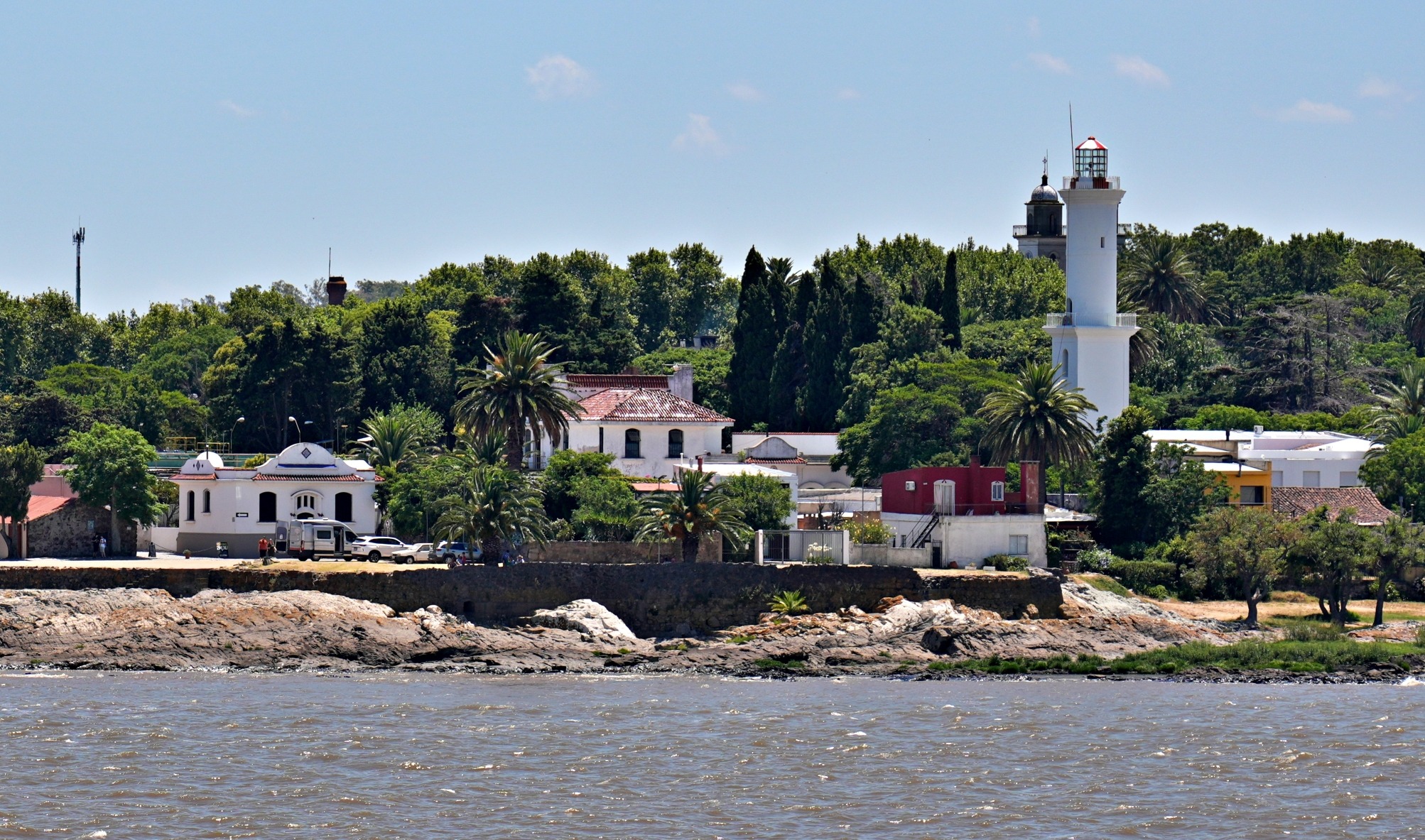
On the walk, you can see the lighthouse. It seems strange that it is not on the point, but instead is in the middle of the peninsula.

At the tip of the peninsula, Punta del Salinas marks the confluence of the Rio de la Plata with the Atlantic Ocean. The high-rises don’t come this far, and most of the buildings near the point are large single family homes with manicured lawns and big terraces.


On the other side of the point, the water is more gentle, and you have a nice view of Gorriti Island. It is a nature reserve, but tour boats take you to visit the beaches and restaurants on the island.

Mansa Beach
The long Playa Mansa (Tame Beach) fills in the coast on the west side of the point. With the gentle water of the Rio de la Plata, its name is quite fitting. The interior of the peninsula is filled with the highrises of Punta del Este, but behind Playa Mansa is the city of Maldonado, with its own tall buildings.
Similar to the other side of the point, this long beach also has several names, Parada Play Mansa 1 to 24, depending on which one you want to use.


All of the city beaches have lifeguards and flags indicating conditions.
Punta del Este Port
Midway on the west side of the peninsula is the busy port (Puerto del Punta Del Este). It has moorage for everything from sailboats to yachts and fishing boats. Although we usually prefer a more natural setting, the high-rises behind the marina make it quite pretty and remind us a little of Vancouver, back home.


Fur Seals
The best part of visiting the marina is to see the fur seals. We read that there is a chance of seeing seals and sea lions, but we didn’t put too much hope in that rumour. We were so happy, then, when we walked to the fish market at the marina and saw fur seals in the water in front. Fur seals are unlike any seal we’ve ever seen before. The males are huge and, as their name suggests, their heads are covered in a furry mane, like lions. They reminded us more of walruses than seals because of their size. Most were in the water, waiting for fish, but we found two others sunning themselves on the other side of the harbour.
The reason there are so many is that people buy pieces of fish from the fishmongers and throw them into the water where the seals are eagerly waiting below.


Other beaches in Uruguay
Between Piriaopolis and the Brazilian border, the long, sandy coast is home to several beaches. La Paloma is a very popular resort city, just east of Punta del Este, but when we tried to book a hotel during the Christmas season, prices had skyrocketed. They were asking hundreds of dollars for a basic room. Even a bed in a dorm room was over $100 USD per night. If you have a car and are looking for something quieter, you can stay in one of the hotels that dot the shore between Punta Ballenas and Punta del Este. Or, if you’re willing to drive further, Punta del Diablo and Cabo Polonio have nice beaches and quieter towns.
Where to stay
Piriapolis – The hotels around the beach are known to be fairly noisy, but apartment rentals are often in quiet neighbourhoods. This is where we chose to stay, and are glad we did. For apartments, hotels and campgrounds, you need to book in advance during the busy season.
Punta del Este – Depending on whether you want to go to Playa Brava or Playa Mansa, you should stay either on the peninsula of Punta del Este or in the city of Maldonado. If you have a car, make sure your hotel has parking, because the streets and parking lots fill up quickly.
Getting to Piriapolis and Punta del Este
Buses frequently run up and down the coast between Montevideo and Punta del Este, stopping in Piriapolis and other beach towns on the way. We were able to visit Punta del Este on a day trip from Piriapolis by using these buses. It is also an excellent highway if you have a car. There is plenty of parking in Piriapolis, but in Punta del Este, there is limited street parking and parking lots, so you may need to search and walk a few blocks.
You can find Piriapolis and Punta del Este in the lower right side of the map below. It is an interactive map, so you can zoom in and click on a marker to find a link to our post from that area.

To read more of our adventures in Uruguay, click here.
Coming Next – Rural Uruguay: Carmelo and Trinidad
For pictures from other blogs go to Gallery at monkeystale.ca.
To read about more of our adventures go to Destinations.
If you like what you read, please comment or share (with credit) using the links below.


![Theresa [Hey, Traveler] Avatar](https://secure.gravatar.com/avatar/6574ed50b29d3b780d644e1ceab3bed8cd8ac90e2b1ca004646ee8cc232ee86e?s=48&d=identicon&r=g)


We'd love to hear from you, please leave a comment.