
Both Carmelo and Trinidad made it to our itinerary based on descriptions of their nearby tourist sites, but on arrival, we didn’t get what we expected. Instead, we were exposed to the small-town charms of these Uruguayan cities. While there aren’t a lot of attractions in either, it was nice to see what Uruguay is like, away from its most touristed parts.
Carmelo
In this slow-paced city, where horse and buggies travel the city streets and its fringes are dotted with wineries and cattle ranches, Carmelo has a unique blend of rural and high-class. Located along the Arroyo de las Vacas (Cattle Stream) just before it empties into the Uruguay River, we came to Carmelo for the wine, but found a little more.
One thing we didn’t expect to find in a wine-growing region was horse-pulled carts. They frequently run up and down the city streets collecting garbage as well as delivering firewood and other small items. They seem to be the most common couriers of Carmelo; we saw at least three different horse delivery carts in the city. For more information, read this humorous article.

Carmelo Swing Bridge
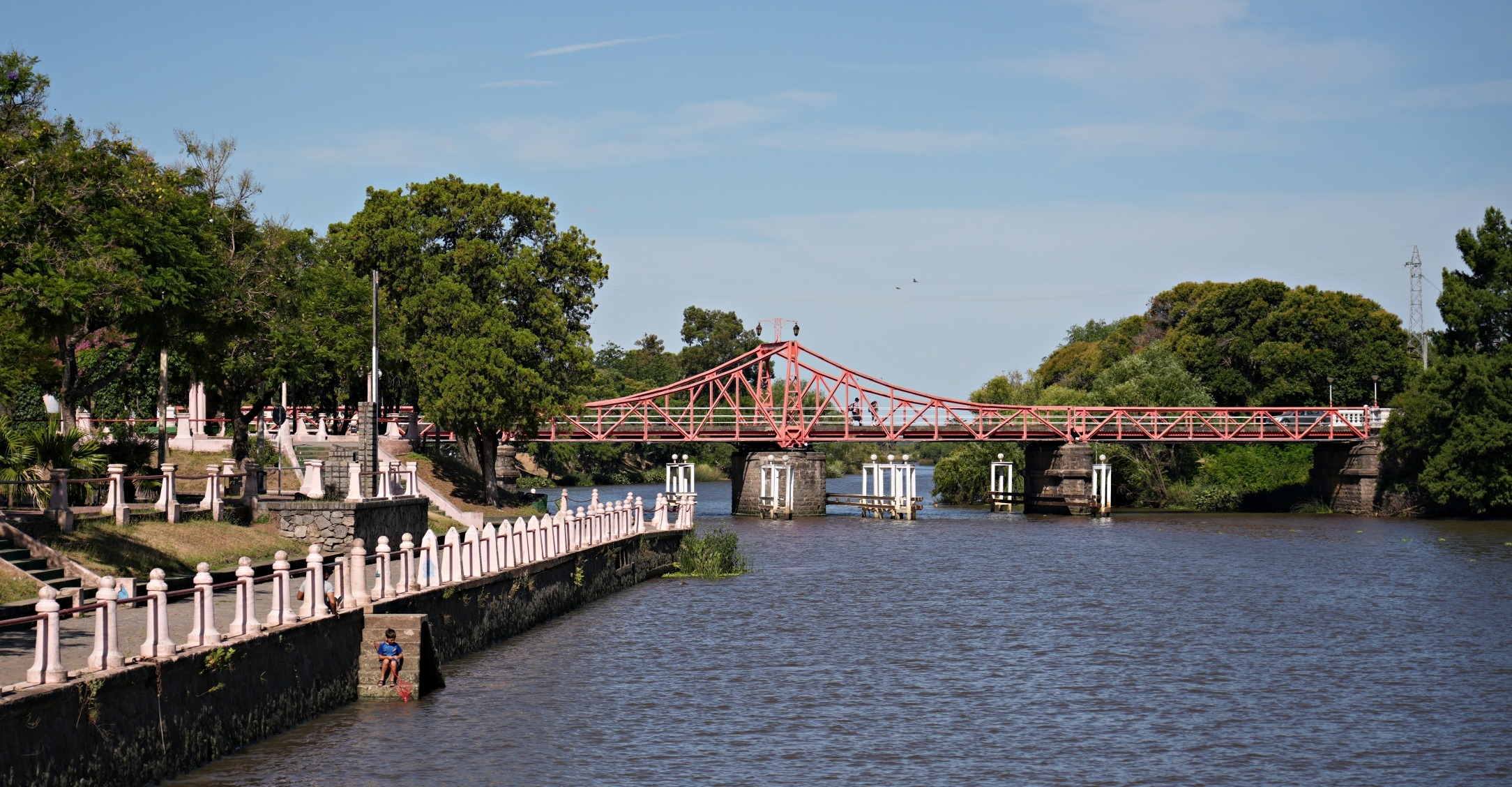
Carmelo’s most famous feature is the red rotating bridge that spans Arroyo de las Vacas. Carmelo Swing Bridge (Puente Giratorio) is still operational, but apparently isn’t used often since traffic on the stream is not as common as it once was.

When the bridge was imported from Germany in 1912, not only was it the first rotating bridge in Uruguay, but it was the first on the entire continent. Its human-powered mechanism isn’t used much today, but when it was first assembled, the Arroyo was an important waterway in Uruguay for shipping cattle and agricultural goods.
The bridge has been damaged a few times in its history, but today it still provides the main vehicle access to the city over the Arroyo de las Vacas.
Rambla de los Constituyentes
Following the Arroyo, the Rambla is a nice place to go for a walk under big shade trees and beside lovely gardens. At one end is the small Bridge Square. It is located just before the red bridge, which explains its name. The square has loads of flowering trees that surround an oddly painted pink historic clock. As well as the clock, a few examples of old steam equipment are on display on the side of the stream.


Seré Beach
Once across the bridge, a narrow peninsula separates the Arroyo de las Vacas from the Ururugay River. On the far side of the peninsula you can find the nice golden sand Seré Beach with trees on its side for shade. It was late in the afternoon on a hot summer day when we visited Seré Beach. A few families were playing in the Uruguay River, while others were drinking mate in the shade.
On clear day you can see Argentina on the other side of the the Uruguay River.


Carmelo Marina
On the protected side of the peninsula is a small marina used by sailboats and yachts. Many come across the Rio de la Plata from Buenos Aires or the Tigre Delta. A little downriver from here, the Uruguay and Parana rivers confluence before going to the Rio de la Plata.


Downtown Carmelo
Back on the other side of the bridge is the historic city. This region has been home to cattle ranchers since the 1600s, but Carmelo wasn’t founded as a city until local hero Artigas established it in 1816. Its economy was based on the limestone quarries and the port on the Arroyo de las Vacas. Today, the small city doesn’t have any main attractions, but you can find a few wonderful buildings from the early 1900s that show what this town may have looked like in its earlier days.


Independence Square
The city has two public squares: Independence and Artigas. The main square in town, Independence, is rather uninspired with a 1960s style fountain and church taking most of the attention. Making it less appealing, its ground is covered in cement tiles rather than gardens and lawns, as we saw in many other South American cities.
Surrounding the square are mostly mid-century buildings that are a little worse for wear.

Plaza Artigas
A few blocks away is Plaza Artigas, which is a lot nicer. Its flowerbeds, lawns and palm trees give the square a sense of calm. In its centre is a statue of Artigas, who is credited with leading Uruguay to independence from Spain. Surrounding the square are nicely restored, stately mansions and government buildings. Joining this elegant crew is the Sanctuary of Carmen (Santuario del Carmen), a very typical-looking, but attractive, colonial church.


Wine tasting
The land around Carmelo has been home to family-run wineries for decades. Most were Italian immigrants who came to the area to continue in the wine business that they knew so well at home. Today, eight of those family-run wineries remain, making Carmelo Uruguay’s third-largest wine-making region outside of Canelones and Montevideo.
We came to Carmelo to sample wines, but found it was more difficult than anticipated. Only a few of the wineries offer tastings or have restaurants where you can purchase a glass, and their hours are quite limited. Luckily, though, two of them are within 4 km of the city centre.
Some of these wineries also operate boutique, luxury hotels.


The primary grape grown in this region is tannat, although they also have cabernet sauvignon, shiraz, sauvignon blanc, chardonnay and others. Tannat is a red grape that can produce a bold red wine. We knew we would enjoy the tannat wines in Carmelo since we had already tasted them in Cafayate, Argentina. (Coming Soon)
If you don’t have a car, there are a few bikes rental shops in the city, including in front of the marina. On the way to the wineries, we passed several ranches, where we watched while flocks of Chimango Caracaras hunted in the fields. We had never seen this kind of caracara before. They are smaller than hawks, and ususally travel in groups. We ended up seeing quite a few of these birds while in South America.
Read about our day biking through Argentina’s wine country in our post Wine Tasting in Mendoza.

Getting to Carmelo
Berrutti Buses travel between Colonia del Sacramento and Carmelo several times a day. If you’re in Buenos Aires, you can take the one-hour ferry to Colonia del Sacramento and then the bus to Carmelo. Another option is to take a ferry from El Tigre, north of Buenos Aires, directly to Carmelo. If you’re coming from Montevideo, you will need to change buses in Colonia.
Where to stay and eat in Carmelo
There is not an overabundance of accommodations in the city, but there are a few in the centre. If you have a car, you could stay at one of the wineries or estancias (ranches). They are high-end resorts, but most are a few kilometers outside the city and it would be best to have a car if you stay in one.
There are a few restuaruants around Plaza de Armas, and some of the wineries have restaurants. They strictly follow siesta times, so most restaurants are closed between 2:00 and 8:00pm.
Carmelo is located on the left side of the map. Trinidad is at the top. It is an interactive map so you can zoom-in or click on a marker to find a link to our post from that region.
Trinidad
Located in the agricultural heartland of Uruguay, the small city of Trinidad is the best location to visit the UNESCO World Heritage Site, Grutas del Palacio (Palace Caves). Unfortunately for us, the caves were closed for an extended Christmas holiday break. So instead of visiting the caves, we had a relaxing couple of days in the sleepy farming town of Trinidad.
If you travel to Trinidad to visit the caves, there are a few things in the city that you may want to see as well.
Constitution Square
The main public space, Constitution Square (Plaza Constitución), is home to the Church of the Holy Trinity (Parroquia de la Santísima Trinidad) and the elegant City Hall. Since we were there just after the New Year, not much was open so we couldn’t see inside.


Other than the main square, the surrounding streets have a mix of heritage buildings, and newer, less attractive ones. Here are the nicest ones we found. Overall Trinidad is likely a nice city to live in, but doesn’t offer much for visitors when the caves are closed.


Trinidad also held a sport in Uruguay’s political history. It is known in Uruguay as the home of the Colorado Party. Uruguay has two main political parties. Colorado Party, was the political party of José Batlle y Ordóñez. When he was president of Uruguay, he transformed the system by establishing labour reforms and nationalizing public works.
How to get to Trinidad
Buses travel between Montevideo and Trinidad several times a day. If you have a car, it is an easy drive on a good highway.
Getting around Trinidad
The city is very small, and therefore it is easy to walk to the main square. To reach the caves, most hotels have phone numbers for local taxis. There is no ride-share app in the city, and we didn’t see taxis driving around town, so your hotel is likely the best resource to find a ride.
Where to stay and eat in Trinidad
There are not a lot of options for either in the city, but you can find a few hotels and restaurants on the streets closest to Constitution Square.

To read more of our adventures in Uruguay, click here.
Coming Next – Colonia del Sacramento – Uruguay’s Prettiest City
For pictures from other blogs go to Gallery at monkeystale.ca.
To read about more of our adventures go to Destinations.
If you like what you read, please comment or share (with credit) using the links below.



We'd love to hear from you, please leave a comment.