
Often overshadowed by Spain’s more famous cities, Cádiz may just be that shining jewel you’ve been seeking. Its connection to Spain’s Age of Discovery brought vast wealth to the port city. Today, that wealth can be seen in the grand heritage buildings that line its narrow streets. Let us show you all there is to see in beautiful Cádiz.
A bit of history
Cádiz had very early beginnings. It was first settled by the Phoenicians in 1104 BCE, making it the oldest city in Spain. The Phoenicians called it Gadir. At that time the island of Cádiz was actually two separate islands: Erytheia and Kotinouessa. They were separated by a canal that eventually silted up and resulted in one island.
Its location on the Bay of Cádiz, in the Atlantic Ocean, put it close to both Africa and the Mediterranean Sea. This prime real estate was home to many other civilizations over the next few centuries. By the 13th century, the city was within Spanish territory. Under King Alfonso X, it became the launching point for many of Spain’s discovery voyages, including one by Christopher Columbus. The result was an increase in trade and therefore a large number of wealthy merchant looking to show off this new found money.

That wealth didn’t go unnoticed. In the late 1500s, the city was sacked by English and Dutch troops. This led to the construction of fortification walls and fortresses to protect the city from further attacks. Most of those city walls have been torn down so today, entering the city is much easier.
We arrived by ferry where cargo and cruise ships vied for space and dwarfed our little boat. Arriving this way gave us a preview of those grand buildings we’d see in the historic city.


Old Town
From the ferry, the fist place you’ll likely see is the busy San Juan de Dios Square. The large public space is very welcoming with decorative statues and fountains displayed under its many palm trees. The perimeter is taken up by patios and tourist shops.
At the head of the plaza is the elegant City Hall (Ayuntamiento de Cádiz). Its tall clock tower catches your attention as it rises high above the square. If you’re like us, you will pass through this plaza several times, and see its look change throughout the day.


Branching out from San Juan de Dios Square are the narrow streets of the historic centre. One of the joys of visiting this city is to roam these streets, without a plan and see what treasures you can find. There are so many elegant heritage buildings, it almost seems as if they are competing for your attention.


In addition to the elaborate homes, you may come across a few stone gates from the old city wall.


Cádiz Cathedral
Standing majestically on the edge of the rough Atlantic Ocean is Cádiz Cathedral, also called New Cathedral (Catedral Nueva). It is an enormous building with a unique façade. What makes it extraordinary is the concave, marble entrance below a large, shell-like feature. As well, two tall bell towers flank its sides providing balance to its appearance.
The building took 130 years to build. During this time, it experienced architect changes and political instability. One of the architects that worked on it also helped design Granada Cathedral. (Coming Soon)


It was called ‘The Cathedral of the Americas’ because its construction was primarily funded by money brought from the new Spanish colonies in the Americas. That money decreased during those 130 years, resulting in shorter towers than were planned.

The interior of this grandiose cathedral is surprisingly monotone. It lacks the usual golden shine typical in Spanish catholic churches. Stone pillars reach up to stone, domed ceilings. At the front, the tabernacle is protected by grey marble and stone columns.
That’s not to say it is not decadent. Fine features can be seen in many places including the choir. Its wooden seating and walls are adorned with expertly carved flowers and saints. Above them are two magnificent organs.


The best part of a visit to the cathedral is to climb Levante Tower. Instead of stairs, there is a continuous ramp that winds its way up the 55 m (180 ft) tall tower.
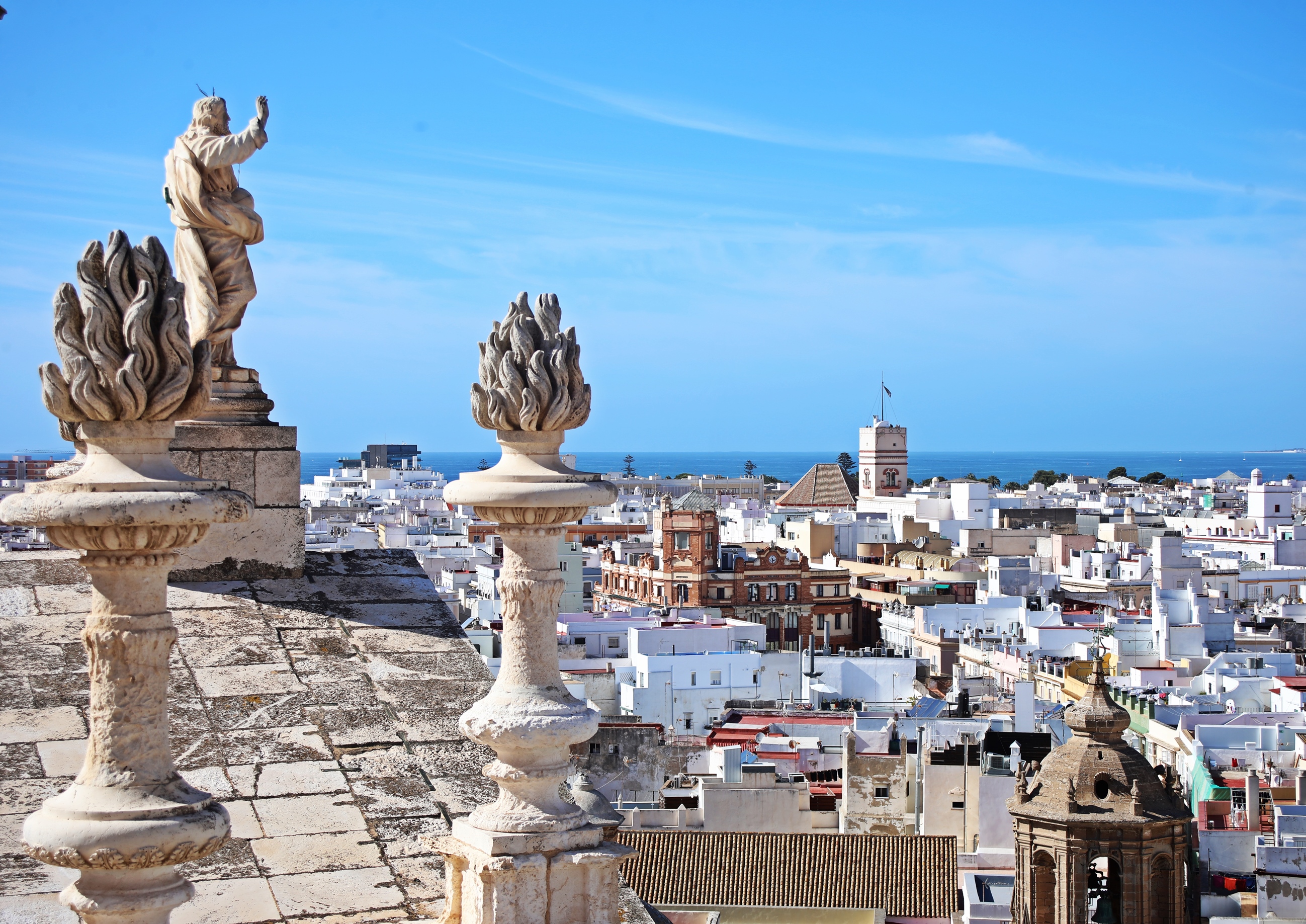
Once you reach the top, you are treated to amazing 360° views. We could see features on the roof that can’t be seen from below, including its colourfully tiled dome. Looking further out, the panorama includes the long coast, and most of the city including Tavira Tower, which we would visit next.
There is a fee to enter the cathedral, but it includes the tower.


In front of the buildings is the appropriately named Cathedral Square (Plaza de la Catedral). It’s a busy place with many patios that seemed to be filled at any time of day.


Old Cathedral
Hidden behind the cathedral is Old Cathedral (Catedral Vieja). It was originally built in the 13th century over a mosque. That building was badly damaged and rebuilt many times. From the front it is a rather plain building that is now called Santa Cruz Parish Church (Paroquia de Santa Cruz). From the back, it looks a little more interesting because you can see its domed roofs that hint to its roots as a mosque.
From this spot you also have nice views up and down Cádiz’s shore.


Tavira Tower
During the city’s heyday, wealthy merchants wanted to keep a lookout for the arrival of their ships. To do this, they built many tall towers, 134 of them to be exact. One of those is the 18th century Tavira Tower. It’s on a very narrow street and therefore is difficult to see. We walked past it a couple of times before we found it.

Since it’s a watchtower, the best activity is to climb to the rooftop. In addition to seeing the ocean on both sides of the island, we had a birds-eye view of the city. Flat-roofed homes and church spires dominate the scene. The most spectacular though, is seeing the cathedral’s towers and dome. With these views, it’s easy to see why it became the official watchtower of Cádiz port.
There’s a Camera Obscura on the tower too if you want to see the streets from a different perspective. There is a fee to climb the tower and an extra fee for the Camera Obscura.


Theatre of Cádiz
While exploring the city, one site you won’t want to miss is Theatre of Cádiz. The Roman theatre was only uncovered in the 1980s and is believed to be the first Roman theatre built on flat ground. It’s a little worse for wear, but its presence makes you wonder what else lies hidden below the streets.
It’s free to enter and is worth a visit.

Santa Catalina Castle
Sitting on the edge of the Atlantic, Santa Catalina Castle was built two years after the Anglo-Dutch invasion. Even though its walls appear to be made with crumbly bricks of sand and sea shells, it was used as a military prison until the 1990s. Inside, there are low-rise, flat-roofed buildings with a small museum. There’s not much to see, but it’s free to enter.


From its outer walls you can look toward Cádiz’s other fortress, San Sebastián Castle and the beach between the two.
Cádiz had already suffered from the Lisbon earthquake of 1755 and countless invasions, but then, on Aug 18, 1947, the navy’s underwater ammunition depot exploded. It was located in the water between these two castles. Shock waves not only destroyed the naval base, there were 159 deaths and 10,000 casualties. Historians are not positive but believe it was a spontaneous explosion of German-made depth chargers.


San Sebastián Castle
Located at the end of a long causeway is San Sebastián Castle. It was built on San Sebastián Island after the British and Dutch attacked the city. The site is actually two forts, connected by a gate. It was used by the Spanish navy until 2000, so most of the construction inside is new, making it lose its appeal to us.


With all of this beauty, it is a wonderful city to explore. Surprisingly, despite its narrow streets there are a few treed parks where you can rest your weary feet. In one, we were very excited to find a blooming orchid tree.

Before getting back on the ferry, there are a few spots near the port to check out. National Tabaco Factory is more elaborate than you would expect for a factory. Standing in front of the 18th century building is a monument to its cigar rollers. You may notice that the figures are female. Historically, cigar rollers in Spain were always female.
Across the street is the former Customs Office (Aduana). The beautiful old building is now used for government offices.


Getting to Cádiz
Although connected to the mainland by a bridge, it isn’t recommended for visitors to drive to Cádiz. There is very little parking in the historic centre. A ferry crosses the Bay of Cádiz from El Puerto de Santa Maria. It is very convenient and inexpensive. There is also a bus that leaves from the ferry office during inclement weather. There is a paid parking beside the ferry terminal and a large free parking lot one block further away.
Where to stay and eat in Cádiz
There are a few hotels in Cádiz, but they are fairly expensive. On the advice of Jo, from Still Restless Jo, we stayed instead in El Puerto de Santa María. The quieter pace made it a nice place to spend the night away from the tourists of Cádiz.
You won’t have to be worried about finding a place to eat in Cádiz. It is more than ready to meet the needs of its tourists. As well as the patios on San Juan de Dios and Cathedral Squares, you can find many more on the sides of the cobbled pedestrian streets.
El Puerto de Santa María
The ‘City with a Thousand Palaces’ sits on the mouth of the Guadalete River. Its history dates back to the Trojan War when Greek warrior Menestheus settled there. It became Spanish territory in the 13th century when, along with Cádiz, it became linked to Spain’s explorations of the New World. In fact, Columbus spent time in the city.
During this time the city’s wealth grew dramatically. Merchants used this new money to fill the city centre with elaborate mansions. We can still see many of them today, which explains the ‘thousand palaces’ moniker. El Puerto, as it is commonly called, is a nice quiet city. It has very few tourists, making it a nice place to slowly explore the streets and seek out these fabulous old homes.


Castle of San Marcos is a 13th century fortress in the middle of the city. It was built to protect the valuable trade routes in the Bay of Cádiz. Its tall crenellated walls are still intact and the red colouring along the tops of its multiple towers gives it a unique look.

The Priory Church (Iglesia Mayor Prioral) on Plaza de España must have been a majestic building when it was at its best. Its roof and façade are adorned with many statues, carvings and flying buttresses. Today though, the building is in need of a few repairs and restorations. Interestingly, the bells are not in a tower but hang above the weathered side entrance.


On the edge of the city is another building that must have been very grand in its day. Victoria Monastery is looking pretty tired, but you can still see many of its old Gothic features.


In the centre of the city is Royal Bullring (Real Plaza de Toros). We weren’t interested in seeing a bull fight, but the large round building let us know we were in Spain.

El Puerto may not be at the top of your list of cities to visit in Spain. But it’s a nice town and a convenient base for exploring the beautiful city of Cádiz.
Getting to El Puerto de Santa María
Located only 100 km from Seville, it is very easy to reach El Puerto. If you have a car there is a good highway that travels between the two. If not, you can take a train between the two cities. Taking the bus is a little more involved as you would have to change buses.
Between Cádiz and El Puerto, the best option is to take the ferry. During inclement weather, buses leave from the ferry terminal and follow the same schedule.
Where to stay in El Puerto de Santa María
In the city’s historic centre there are quite a few small, locally run hotels or apartments. Prices will be much less expensive in El Puerto than Cádiz. The problem with the centre though, is that there is not a lot of parking. If you drive, make sure you enquire about the hotel’s parking before booking.


This article is now featured on GPSmyCity. To download this article for offline reading or create a self-guided walking tour to visit the attractions highlighted in this article, go to Walking Tours and Articles in Cadiz.
To read more of our adventures in Spain, click here.
Coming Next – A Visitor’s Guide to Medina Sidonia
For pictures from other blogs go to Gallery at monkeystale.ca
To read about more of our adventures go to Destinations.
If you like what you read, please comment or share (with credit) using the links below.




We’d love to hear from you, please leave a comment.