Spain’s Costa del Sol is famous for its sandy beaches, vacation resorts and golf courses. If you need a break from these activities, we found something else to do in this popular area. The captivating towns of Frigiliana and Nerja, along the Costa del Sol, are worth getting off your beach towel for a visit.

Costa del Sol’s name translates in English to Sunshine Coast. This name wasn’t reached by accident, since it receives 325 days of sunshine annually. This 150 km long sandy coast extends on both sides of Málaga. Frigiliana and Nerja are east of the city. If you want to travel southwest you can visit Estepona, Marbella & Casarás.

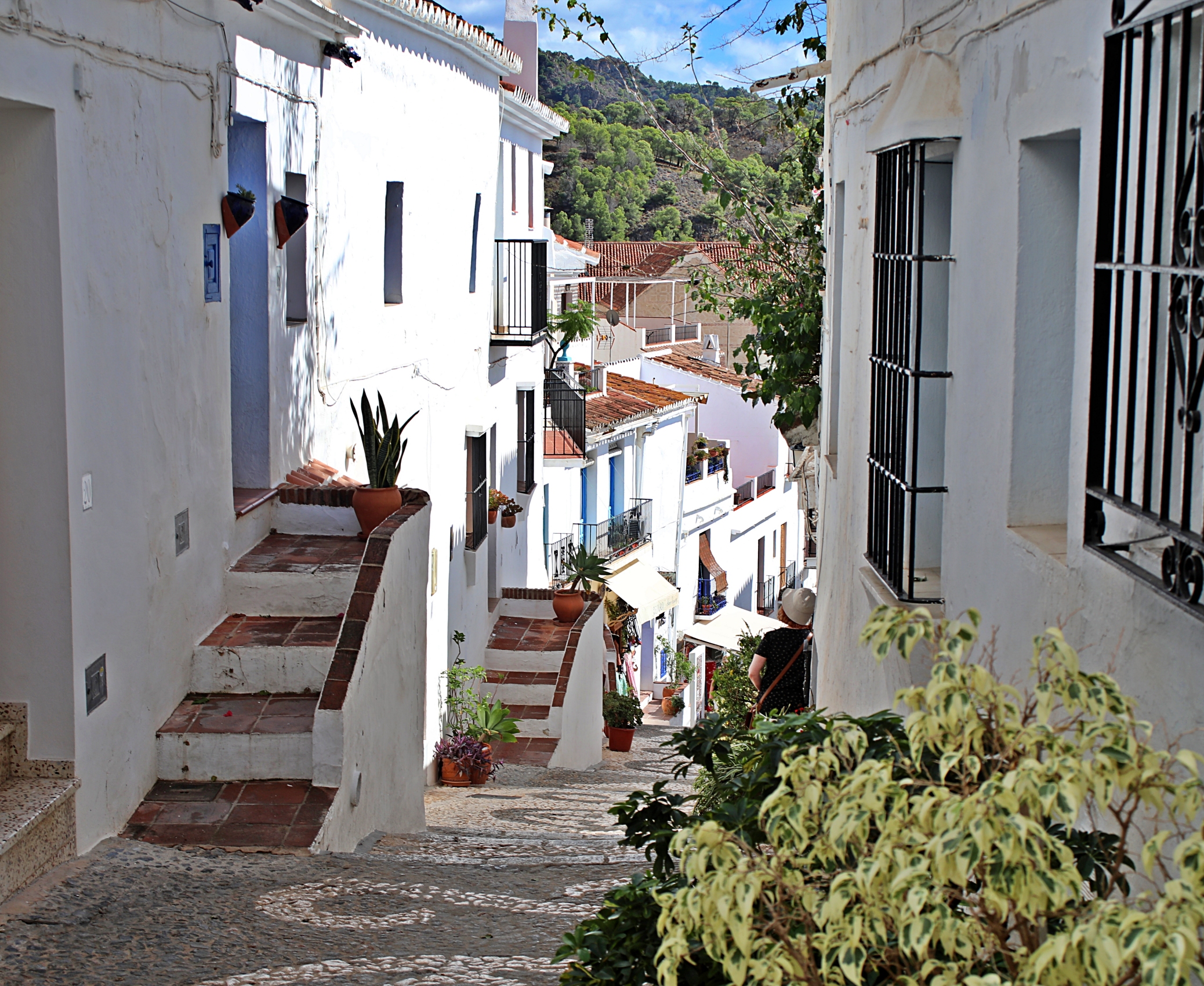
Frigiliana is the quintessential historic town found only 15 km inland. It is adorable and has more than earned its place on Spain’s list of Pueblo Blancos. These are a collection of picture-perfect towns with white-washed heritage homes scattered on the hills and mountains in Andalucía.

Not only does Frigiliana have a spectacular location on the side of a steep mountain slope, the town is also deeply connected to the history of this region. In the 13th and 14th centuries, Spanish Reconquista campaigns were slowly conquering Moorish lands. Frigiliana was one of the last Moorish communities remaining. It fell to the Spanish in the late 1400s, shortly before Granada was conquered. The town was able to withstand Spanish forces for so long because of its hillside position and its protective wall.

During the Moorish reign, a few Christians and Jews lived in separate, but nearby communities. They all lived in peace for a while. Not long after the Spanish took over Frigiliana, the Spanish Inquisition began. Muslims and Jews had to either convert to Christianity or be exiled. Throughout Spain, many of them did convert and were called Moriscos (Muslims) and Conversos (Jews).  The Muslims who didn’t convert were called Mudejares. Their decision to remain Muslim was tolerated for a while.

Over the next century, the Moriscos, Conversos and Mudejares were treated poorly by those in power. In the late 1500s, Moriscos in many communities revolted against the Christian rulers. Frigiliana was one of those communities and its secure location, attracted Moriscos from around Andalucía. The Battle of Frigiliana lasted a few months, but eventually, the Spanish Kings triumphed. The Moriscos living in Frigiliana were either killed, exiled or forced into slavery.

We saw quite a few plaques on the walls describing this history. They are a great way to help everyone remember this horrible time.

The Old Moorish Quarter has three names: Barribarto, Barrio Morisco, and Barrio Alto. The town was built on a steep slope below a Moorish castle. It was destroyed during the Battle of Frigiliana, but thankfully, the village was left intact. As you walk up and down the tiled lanes, it feels as though not much has changed since the early 1400s. The homes have a slightly different look in Frigiliana from others we’ve seen. The white-washed houses are attached as if they are one long rowhouse.

The streets branch off in different directions and each entices you to follow. Some lead to dead ends, while others take you on a meandering trail up the hill. Exploring each one leads to a unique surprise.

At the top of the hill, a small forested park has replaced the castle. Although there’s nothing to see up there, it offers sweeping views of the Almijara Mountains, the homes below and the Mediterranean Sea, only 8 km away.  

Today, the town celebrates the days when the three religions lived in harmony. At the base of the hill is a square named Plaza de las Tres Culturas (Three Cultures Square). One of the unique things you’ll find is a coin-operated mini puppet show that plays scenes from Frigiliana’s past.

Not far away is Casa del Apero. The 17th century building was a granary in the important sugarcane manufacturing industry. Today, it houses the tourist information office and a cultural centre. From the courtyard, you can walk to the top of the city’s rampart to see the town’s white buildings scale the mountainside.

Across from it is an old stone building with an interesting history. It was originally a manor house for the Count of Frigiliana. Then, it was used as a sugarcane factory. Today, it has a similar purpose for a sugarcane molasses business.

Sugarcane was brought to Spain in the 8th century by Arabs. They found the hills around Frigiliana to have perfect growing conditions for the cane.

You can find more Pueblo Blancos in our post A Guide to Spain’s Pueblo Blancos.


With a choice between admiring the Sierra de Almijara Mountains one way, and the Mediterranean Sea the other, means there are no bad views in Nerja. Its picturesque setting is part of its allure. Even the new hillside communities are picturesque.

Before being a beach destination, Nerja was a small fishing village. Its Old Town has remnants of those beginnings and seamlessly transforms from medieval Moorish to 15th-century Spanish. It’s not a large historic centre but is very well maintained. Today, many of these old homes are hotels, beachwear shops and cafes. Even with all of these tourism businesses, it has still retained a quaint quality that is often lacking in these tourist towns.

El Salvador Church is a rather plain, white building, yet charming in its simple design. It is only steps away from Nerja’s most famous landmark. Balcony of Europe was built in 1487. The viewpoint received its name after King Alfonso XII visited in 1885. When standing on the cliff edge, he realized he could see very far both up and down the coast making him call the spot the Balcony of Europe.

From it we could see Salon Beach (Playa el Salon) on one side and Calahonda Beach (Playa Calahonda) the other.

There are many other beaches in Nerja. A little further away, but still within walking distance are two smaller, isolated beaches. Carabeo (Playa Carabeo) and Carabeillo (Playa Carabeillo) Beaches are each contained behind rocky cliffs. They were the prettiest beaches in the area.

If you follow the paved coastal path you will reach Burriana Beach. It is the largest beach we visited in Nerja. Fishing boats are lined up on shore as a reminder of this town’s heritage. The rest of the beach though, is set up for sun worshippers.

The sand on all of these beaches is quite grainy and brown. It wasn’t as nice as we expected.

You can also read our other day trips from Málaga in our posts Best Day Trips From Málaga, Costa del Sol – Estepona, Marbella & Casarás and Hiking El Caminito del Rey.


Located 55 km east of Málaga, Nerja can be easily visited on a day trip by car or even by bus. There is no direct bus between Málaga and Frigiliana, but there is between it and Nerja. The distance is only 8 km. If you don’t want to drive, you can take a tour from Málaga. There is apparently a new train line being planned that would run the length of Costa de Sol, making it easier to visit more of this fantastic coast.

You can find them in the centre of the map, near the coast. Click on the map for an expanded view.

Map of Andalucía, Spain
Read from another device.

This article is now featured on GPSmyCity. To download this article for offline reading or create a self-guided walking tour to visit the attractions highlighted in this article, go to Walking Tours and Articles in Frigiliana.

To read more of our adventures in Spain, click here.

Fediverse reactions

88 responses to “Costa del Sol – Frigiliana & Nerja”

  1. I guess you visited Spain right after Portugal, right?

    1. Yes and then Morcco.. coming soon. 😊

  2. More reasons to return to the Costa del Sol Maggie. We haven’t visited either Nerja or Frigikuana yet but they both look very inviting.

    1. Frigiliana is quite adorable and definitely worth a visit if you’re in the area. Thanks Marion, Maggie

  3. Both of these towns look like lovely places to live in. I wonder what the annual cost of living is in that area.

    1. Cost of living is quite low, and quality of life is high. It’s perfect! 😊 Maggie

  4. Why would you not want to spare the winter there. So many gorgeous streets and views to investigate and for those who want to relax, there is always the beach. Great post Maggie. Allan

  5. Both are lovely town. I like the little touch of colours in the doors or windows. (Suzanne)

    1. Those little features really add to the towns don’t they. Thanks Suzanne

  6. Thank you so much for sharing another wonderful post. I didn’t know this part of Spain

    I really appreciated the description of the places and the  fabulous photos 💝💝💝

    1. Thank you Luisa, I always look forward to your comments. Maggie

      1. … and you are always more than welcome, my dear friend🙏💞🙏

  7. Lovely town, but I agree, I would have been disappointed by the beach too. I know of two other Sunshine Coasts—one around Noosa though not recently sunny with Cyclone Albert invading the Australian coastline; the other right on the BC west coast that I still can’t explain how it got its name when we have more rainy days than sunny!

    1. Haha yes, I’ve been to both of those too. They do get a lot of sun in Spain, except this year. They had torrential rains just as we left the country.

      1. I left before then too, thankfully

  8. Splendid! Visited the lovely Frigiliana once when I was on holiday in Nerja. I remember buying a jar of miel de caña from the sugar mill there 😋

    1. It’s a cute town isn’t it? How was the molasses?

      1. Yes & wonderful. Have you had it drizzled on fried sliced aubergine?

        1. I did have aubergine (eggplant) a few times in Spain, but don’t remember it ever being sweet. So is the taste more like honey than molasses?

          1. no, deffo molasses rather than honey. think you would have recognised the dish if you’d had it:

            https://danzadefogones.com/berenjenas-con-miel-de-cana/

            🫡✌🫶🌟️✨💫

          2. Nope didn’t have it. Maybe next time 😊

  9. These communities are beautiful. So much to explore and then there’s the beach, too. I visited years ago but your post refreshed my memories; definitely took me back. Thanks, Maggie.

    1. Glad to take you back Lynette, the small towns in Spain have so much character don’t they. Maggie

  10. So many beautiful photos, Maggie 🙂 It looks like coming to Málaga and Costa del Sol means finding beautiful landscapes, fabulous beaches, delicious food, and interesting customs and traditions. It means discovering a rich cultural heritage, amazing coastal areas, and charming white hinterland villages. Thanks for sharing, and have a good day 🙂

    1. Thanks Aiva, although Malaga is well known as a beach destination, we were amazed at the many charming small towns we found only a short drive away. Have a great weekend! Maggie

  11. Frigiliana looks beautiful, Maggie, and reminds me very much of the upper part of the village in Setenil, but the views are incomparable. The beaches aren’t great around there but the scenery is lovely. It looks very tempting (except I think they’re being hammered by the rain again, but we’re not exactly rain-free this month) xx

    1. When we did the caminito, those heavy rains were just starting. Our guide said everyone was so happy because there had been a drought for so long. Now it seems it can’t stop raining! Frigiliana is similar to the upper parts of Setenil. They’re all so darn cute aren’t they?! Happy Friday! Maggie

      1. Too many lovely places! I need to be on the road again xx

  12. Both of these villages are lovely and inviting, but I particularly like the looks of Frigiliana, with its narrow streets and beautiful buildings.

    1. Frigiliana is adorable, glad you liked it. Thanks Tricia

  13. Like receiving personalized postcards, with the added bonus of history. Thank you kindly, Maggie.

    1. Aww, thanks Michele 😊 Maggie

  14. Like so many other places, lovely scenery but terrible history. I’m glad it’s not been ignored or forgotten, though.

    1. Each town in this area seems to have a lot of war in their histories don’t they? But it’s what gave them such interesting buildings today. Thanks Diana! Maggie

  15. The clusters of towns like Nerja and Frigiliana are packed tight like sardine cans but clean and amazingly well-kept. Do residents not have cars? If so, where would they park? I think I could get used to 325 days of coastal sunshine! As always-great pics. 🙂

  16. Yes good point. I’m not sure if they were local’s cars, but the streets at the base of the hills were jam packed with cars. We had a rental car and we always parked well away from the old towns. Partly for parking but also because we didn’t want to drive the narrow streets! 😊

  17. We definitely spent time on the Costa del Sol, but not in either of those cute towns. Seems like a raw deal, agreeing to convert and still being treated poorly.

    1. I know, I thought that too. They weren’t very accepting were they?

  18. A great read, again, with fascinating history and delightful views.

    1. Thank you, all of these towns have such unique and fascinating histories.

      1. You used the term ‘rowhouses’ which was unfamiliar to me. Does it mean connected? Sharing walls? They were picturesque, anyway.

        1. Oh yes, several in a row, connected to the next by a shared wall. didn’t realize it wasn’t common.


        2. But not like apartments, single family homes.

  19. Costa del Sol & Frigiliana & Nerja seems like beautiful places. Fascinating and picturesque architecture and your photos are gorgeous. The history was interesting but difficult. It was long ago.

    1. The history was horrendous, but we were left with charming towns today. Thanks Thomas

  20. Another great article. I thought of you guys yesterday whilst watching a TV programme, here in the UK, called ‘A place in the sun’. Two people wanted to find a second home on the Costa del Sol based around Manilva. The production crew took them to a viewpoint overlooking Casare’s which I’d seen in one of your blogs 🙂

    1. Oh that’s awesome. Imagine waking up to that view everyday! I’ll see if I can find the show online. Maggie

  21. 325 days of sunshine sound lovely. These towns and the surrounding scenery are very charming.

    1. This area is packed with charming towns. We didn’t even come close to seeing half of them. And 325 days of sun, wouldn’t that be amazing! Although Jo, who is in Portugal, said it’s been raining there.

  22. I’ve visited Nerja but not the other one

  23. I like the informative explanation of history you use to frame your post.

    1. Thanks so much. 😊

  24. Great presentation as always, Maggie. I enjoyed the beautiful streets and long rows of whitewashed homes and brilliant sunshine in both cities.

    The hilly nature of the towns, particularly Frigiliana, is breathtaking. Must be difficult to drive, walk, and park on those roads?

    Speaking of walking, is it possible to hike between these towns? For example, you mentioned that it is 8 miles between Frigiliana and Nerja…just curious. If there are hikes sounds like a steep and challenging route.

    I love the picturesque views of the beaches in Nerja. For example, Carabeo and Carabeillo beaches look like hidden gems tucked into the rocky coastal outline.

    Thank you for your beautiful presentation and virtual tour.

    Thanks too for the fascinating trivia about sugar cane’s history in Spain…I did not know that! It is so fun to research common resources we use today and their origins.

    As always, safe travels to you both. Cheers.

    1. Frigiliana is as adorable as it looks. We parked at the base of town. We learned to park far from the historic centres because we don’t want to drive on those streets! But at the base of the hill there were not many parking spots left. Not in Frigiliana, but in some of these towns we were amazed where the locals drive.
      There is a walk between the two but you have to cross over busy freeways. I didn’t sound very tempting to us. The beaches are very pretty and I can see the appeal. They’re likely very busy earlier in the season.
      I did’t know either how sugar can came to Spain. They Arabs brought so much.
      Thanks so much Suzette! Enjoy the rest of your weekend! Maggie

      1. Thank you both for your hard work sharing your travel moments. Much appreciated. Bless you both
        Safe travels.

  25. Both Frigiliana and Nerja look lovely. It’s great they have the plaques dotted around to remind themselves about the religious persecution that once took place and to make sure they don’t forget that chapter in their history.

    1. I thought those plaques were a great idea. More historical sites should have them. Thanks for your comment, Maggie

  26. We stayed quite a few days in Nerja, and of course visited Frigiliana too. So enjoyed our time there. It was from Nerja I think that we visited the Devil’s Bridge, and the amazing caves which had been discovered by students out wasting time. The morisco culture is at its most evident in Granada where there still exists a hillside community celebrating their culture and in some cases still living in the cave houses. An amazing district just a stone’s throw from the Alhambra.

    1. We looked at going to those caves, but we’ve seen so many, we decided not to go. We did visit cave villages though, in Malaga, Granada, Jaen. Fascinating.

  27. Great photos with again some stunning views of the town and countryside.

    1. Thank you, some of the stunning scenes in Spain 😊 Maggie

  28. I like the idea of “three cultures square”, representing a time when all 3 were living together harmoniously. It’s such a sad history that this changed with all the persecution, but the towns look beautiful – I love the winding alleys all whitewashed, what pretty streets!

    1. It was one of the only places we saw that paid tribute to their heritage and was nice to see. Thanks Hannah

  29. Enjoyable read Maggie and great pictures. If only religions could always live in harmony, it would be a much more peaceful world.

    1. Wouldn’t that be nice. 😊 Thanks Jim

  30. All these Pueblo Blancos are beautiful but Frigiliana seems especially so. Thanks for including so much of the darker history in this region too, it’s important that we remember that it hasn’t always been so lovely and peaceful.

    1. Frigiliana is another adorable town. The history is pretty dark isn’t it. Why are we often so horrible to others? At least they’re remembering it, and maybe learning. Thanks Sarah

  31. How lovely are your pictures! The history is dark, but it can’t overshadow the beauty that is there now.

    1. That’s true, today they have a beautiful time to share with everyone. Thanks Kymber! Maggie

  32. What a beautiful collection of towns. Even with some very sad history, I’m glad that the are remembering it in hopes to teach people to not let it happen again.

    1. Yes, I was very impressed with their commitment to teaching the history, horrible as it was. Thanks Meg, Maggie

  33. Frigiliana looks gorgeous!

    Tragically, we don’t learn from the history of these and other regions.

    1. It’s true, we never learn. Feigilana is a gem. Thanks Nilla

  34. I never ceases to amaze me to learn just how many of such beautiful towns Spain has, especially in the south. Thank you for including a little bit of history of Frigiliana as well. It makes the already picturesque place even more inviting.

    1. I think I said this before, but we were amazed by the towns in Andalucia almost every day. Frigiliana’s setting and history does make it more interesting. Thanks Bama

  35. Between the two I prefer Frigiliana and its story testing religious tolerance. It also looks more authentic, though Nerja also has some beautiful spots.

    1. Frigiliana is a hidden gem in Andalucia. 😊

  36. Thanks for sharing pictures and details from a beautiful part of Spain. I have never heard of this Spanish region.

    1. There are so many idyllic, picturesque villages in this part of Spain. Glad to introduce you to a few. Thanks Arv, Maggie

      1. Happy to have come across these, Thanks, Maggie

  37. What treasures these two towns are. Thanks for sharing about the sad history of Frigiliana. I’m glad to know they now celebrate the Three Cultures.

    1. Celebrating the three, or more, cultures/religions, needs to happen in more places doesn’t it? Thanks Ruth, Maggie

      1. It’s an approach we should all learn from.

  38. […] Frigiliana is not far from the popular beach town of Nerja on Costa del Sol. For more information on Frigiliana, read our post Costa del Sol – Frigiliana & Nerja […]

  39. […] You can read more about Frigiliana in our post Costa del Sol – Frigiliana & Nerja. […]

We'd love to hear from you, please leave a comment.

Destinations

Discover more from Monkey's Tale

Subscribe now to keep reading and get access to the full archive.

Continue reading