
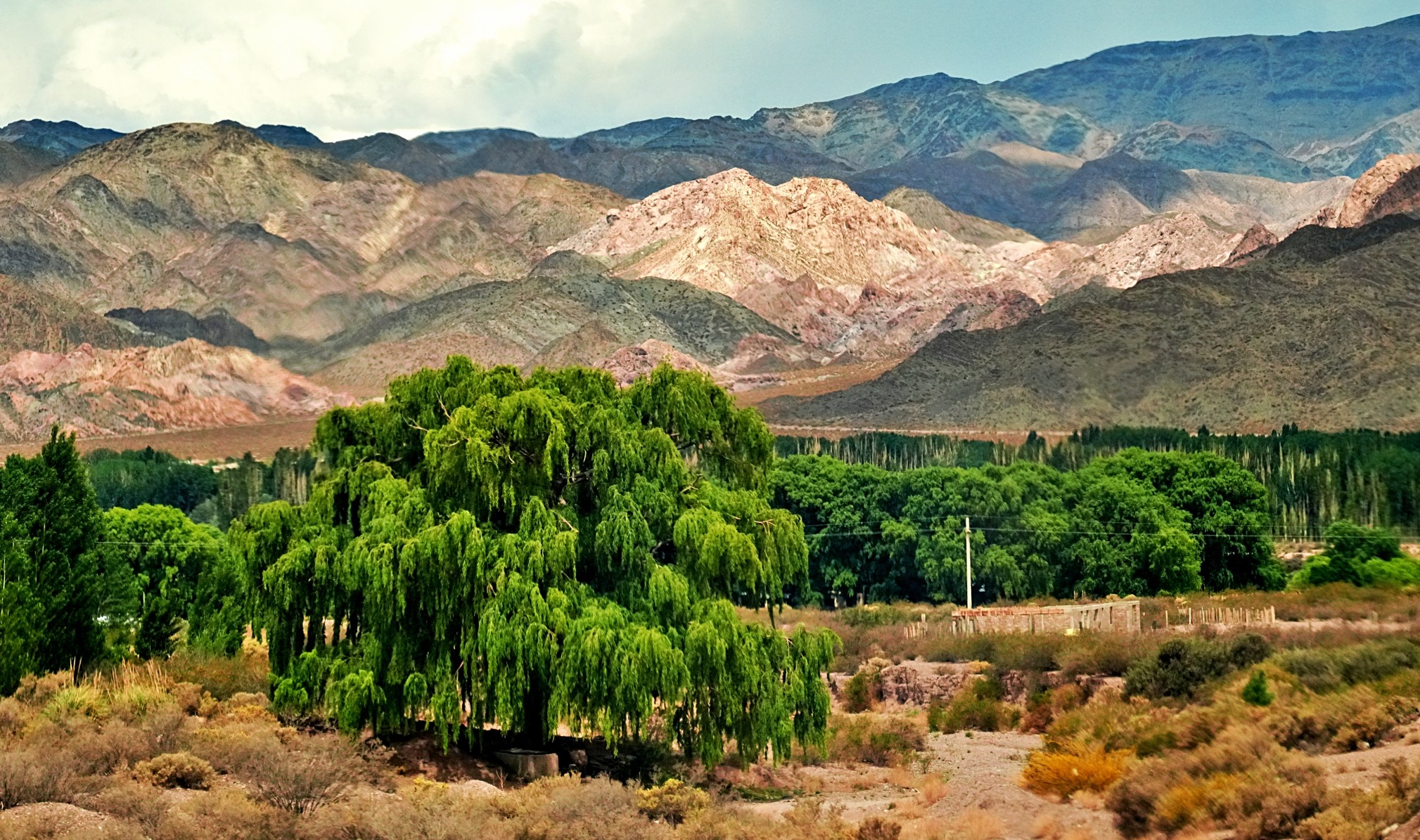
With the tall Andes Mountains on one side and vineyards covering the land on its edge, Mendoza is a mixture of rugged and refined. These two landscapes give it a distinct look from other parts of Argentina. As the home of the most famous Argentine wineries, we knew a visit to Mendoza was in order.
A Short Overview of Mendoza’s History
The Huarpes, among other indigenous tribes, were already established farmers in this region when the Spanish conquistadors arrived in the 16th century. Although its location in the rain shadow of the Andes results in arid terrain, the Huarpes were successful at farming. This was due, in large part, to their ingenious irrigation systems that the invading Spanish apparently found very clever. The Spanish slowly expanded the crops from corn and potatoes to include fruit trees, grapes and olives.
At that time, there were no country borders between present-day Argentina and Chile, and Mendoza was named after the Governor in command of the Chilean territory. In addition to wine, their next claim to fame is that General San Martín began his 1812 march to liberate Argentina, Chile and Peru in Mendoza.
The Story of Wine in Mendoza
Being in the foothills of the Andes gives Mendoza ideal conditions for viticulture. With elevations ranging from 1,000 to 1,700m (3,280 to 5,580ft), they enjoy a strong sun without excessive heat. This environment allows vineyards to cultivate grapes that produce world-class wines. Malbec grapes are a regional specialty, but they also produce Cabernet Sauvignon, Shiraz, Sauvignon Blanc and Chardonnay.
Jesuits planted the first vineyards in the 16th century for use at local religious ceremonies. Their wine was of poor quality and did not transport well across the country, so it was not a revenue generator. Things began to change a few hundred years later when, in 1853, French immigrant vintner Michel Aimé Pouget arrived with Malbec vines. Less than 30 years later, aphids devastated almost all of the Malbec vines in Europe, so the world’s supply of Malbec grapes would have never survived if not for their introduction in Argentina.
The second part of the story depends on the arrival of 3.5 million Italians between the 1850s and 1950s. At that time, Italy was not in very good economic shape, and Argentina needed a labour force. Those with expertise in agriculture and winemaking made their way to Mendoza. Their arrival shifted winemaking in Mendoza from an artisanal hobby to a marketable product, and the wine industry began to grow. The real explosion occurred in the late 1990s and early 2000s, with the expansion into international markets. Today, it is the 5th largest wine exporter in the world.
There are three main wine regions near Mendoza: Maipu Valley, Lujan de Cuyo, and Uco Valley. Maipu is the closest to the city and is where we did our tour.
Wine tasting in Maipu
We couldn’t visit Argentina’s most important wine region without tasting its famous product, but we didn’t have a typical wine tasting day. Instead of scheduling winery tours and tastings at a couple of wineries (as is recommended), we rented bikes for a self-guided tour.
After picking up our bikes, we turned off the main street to ride down country roads lined by tall sycamore trees. Their long branches turn the open roads into tunnels. Biking on these country roads ended up being our favourite part of the day.


We rode our bikes past several wineries, cherry orchards and olive groves, but we were surprised at the long distances between them. It ended up being a much longer ride than we expected.


On the ride, we stopped at three wineries and had a glass of wine on their patios while looking out onto their vineyards. We sampled wine at El Cyclista, Bodega CarinaE, and Bodega Esencia 1870. Each wine was excellent, as we expected, since we love Argentine wine.
On a previous trip, we visited Bodega La Rural. In addition to a tasting, we visited their fascinating museum, which displays equipment from the 18th and 19th centuries. The strangest item was a cowhide press. Searching online, it appears that the hide is no longer on display.


We also stopped by Pasrai Olive Oil. We had never connected Argentina with olive oil before, so we were interested in visiting. On the tour, they demonstrated the processes needed to produce olive oil and spoke about the many different types of olives used.
Pasrai Olive Oil offers a free tour by appointment, and there is only one English tour a day.

Although its biggest industry today is wine, the agricultural lands aren’t limited to viticulture; they also grow soy beans, alfalfa, grains, and raise cattle.
How to take a self-guided bike tour
The best time to do a similar self-guided bike tour is late morning or early afternoon because most restaurants close mid-afternoon. We rented our bikes from Wine and Ride. They’re located across the street from Guiterrez Estaciaon train station. Included in the bike rental are maps with pre-planned routes. The one we selected was 22km, but with a few additions, we ended up biking for about 30km. It’s a flat ride, but the bikes are cruisers with no gears, so much different from what we are accustomed to. They also have e-bikes for rent. If you are travelling with a few people, you might be interested in a multi-bike WineBeetle tour.
Tips – Almost all wineries in Mendoza require reservations for tastings and tours, so it is best to plan ahead. When biking, be aware that the wineries are spread quite far apart, and the roads in between them are relatively busy, so it isn’t the most relaxing ride. Apart from the few tree-lined streets, the landscape is not particularly scenic, so while we enjoyed our day, the other wine regions near Mendoza may be a better choice.
Getting to Maipu Valley
If you don’t have a car, it is very easy to reach Maipu by train. The train line runs beside Ave. Belgrano in the city centre. You can catch it from Estacions Mendoza or Belgrano and get off at Estacion Guiterrez, the last stop. During the day, they run every 6 minutes. Payment can be made with a reloadable SUBE card, or for a few cents more, you can use your international credit card. SUBE cards can be purchased online, but you need to receive the card by mail, so that’s not convenient for travellers. Instead, you can purchase and recharge at any Open 25 Hour Kiosko or other convenience stores. They charge around $1 USD to reload. They are the same cards used in Buenos Aires, Bariloche and San Salvador de Jujuy.
If you enjoyed this, you may be interested in our wine tasting posts from Salta in Argentina, Colchagua and Elqui Valleys in Chile, Georgia, Armenia, Bolivia, Uruguay, Portugal, Bulgaria, and India.
Mendoza
The city’s colonial buildings were destroyed in an earthquake in the mid-1800s, so unfortunately, there isn’t much of an old town, or even very many tourist sites. Even without big attractions, we found it to be a very pleasant, safe city.
Part of what makes it pleasant is the amount of greenery in the city, beginning with tall sycamore trees that provide shade to the neighbourhood streets. You have to watch your step when going for a walk, though. On the edge of the sidewalks are very deep concrete ditches called aeqias. Inspired by the Huarpes, the aeqias are part of the city’s irrigation system that turned the arid city into a garden.

In addition to the tall trees, the city centre has several public squares, most of which were built during the urban renewal after the devastating earthquake.
Independence Square
Also called Central Square, Plaza Independencia is a large park with green grass where locals enjoy lunch under the many shade trees. In the evening, street performers can often be found here.

On one side of the central square are Plazas Chile and San Martin. We visited two on the other side, Plazas España and Italia.
Plaza España
Our favourite square in the city is Plaza España (Spanish Square). The lovely square does feel like it belongs in Spain. Its tiled benches and flooring reminded us of a very small version of Seville‘s Plaza España. The centre is filled with a tiled fountain, but its main feature is a large monument at the end that symbolizes the ties between Argentina and Spain.


Plaza Italia
Only a few blocks away is the treed Italy Square (Plaza Italia), dedicated to the many Italian immigrants who settled in Mendoza. The park is filled with statues of iconic Italian images and tributes to the immigrants who built the wine industry.
A few blocks away is the small Plazoleta Carlos Vagara.


San Martin Park
On the edge of the city, you will find the very large San Martín Park with iron gates welcoming you inside. Beyond the park is Cerro de la Gloria with the Army of the Andes Monument, on top. There is a popular walk to its summit, which we had intended to do, but lost interest when we saw the barren hills.


Hiking in Mendoza
Other than wine tasting, another popular activity in Mendoza is hiking. The multi-day hike to Aconcagua Base Camp is one, and another is to Cerro Arco. Hiking season runs from late spring to early fall (September to March), but this depends on the hike you want to do. Higher elevation hikes may be snow-covered early and late in the season. The mountain parks are typically closed until the end of November.
Where to stay in Mendoza
The neighbourhoods in Parque Central near Plaza España and Plaza Italia have lovely tree-lined streets and are very close to most sites. We stayed in the Residential Sur neighbourhood, near Parque San Martin and liked the quiet streets, big trees and easy access to centre.
Where to eat in Mendoza
One of the most popular places to dine or drink is Atistidas Vileuneuva, called Aistidas by locals. The street is a new addition to the city, and wasn’t here when we visited years ago. We had great burgers at Antares Mendoza on Atistidas and good Italian food at Napoli Trattoria Italiana, only a couple of blocks away. In the middle of downtown is Peatonal Sarmiento with many patios. We enjoyed excellent coffee at Essencia Cafe Bar.
In Mendoza and northern Argentina, everyone, and we mean everyone, expects a tip. And they will ask you outright for one. Bus drivers, luggage handlers, taxis/Uber drivers, and winery staff; virtually all service staff expect tips. Some are very aggressive.


Driving from Santiago to Mendoza
With an international airport, a busy bus station and good highways, it is very easy to reach Mendoza. Buses travel between Santiago and Mendoza several times a day and stop at the border station.
We think the best way to reach the city is by road from Santiago, Chile. The 365 km (227mi) drive travels through the Andes and never fails to impress. Here’s what you can see on the drive.
After climbing through the arid mountains near Santiago, we emerged into Chile’s wine country. Fields of grape vines are spread across the flat lands, bordered by high, shrub-covered hills. Soon after, we were winding our way between the tall, dry mountains that became more and more rocky the closer we got to Argentina.


Then, it was time to work our way up the 19 hairpin turns to climb to over 3,220m (10,500ft) to reach the Chilean border. The road is so steep in this section that as we climbed, we could look straight down to the switchbacks below.


After the switchbacks, you cross the border and travel through the Cristo Redentor Tunnel, from which you emerge into the fantastic scenery of the Argentine Andes. On this side, the mountains are much more colourful, painted in reds and greens. At one point, we could see Aconcagua’s peak down a long valley, and Richard was reminded of his climb to its summit a few years ago.
Aconcagua is the highest mountain in South America and is the tallest outside of the Himalayas. You can read about Richard’s ascent of Aconcagua in our post Seven Summits – Climbing Aconcagua.


Cutting between the red peaks is the chocolate coloured Mendoza River. You can see from the mountains where the river gets its colour.


One notable landmark is Puente del Inca, a natural bridge over the Cuevas River, a tributary of the Mendoza River. The natural bridge was formed by glacial melt and is coated in minerals, giving it a bright yellow appearance.

Border Crossing between Argentina and Chile
Paso Internacional Los Libertadores, also called Cristo Redentor, is located just west of Puente del Inca in Horcones. It is an integrated station for both exiting Chile and entering Argentina. You need to present your Chilean Tourist Card when leaving Chile, and show proof of accommodation in Argentina.
Note – Prices are listed in USD because the rate of inflation in Argentina is so high that as of 2026, any fees listed in pesos would be inaccurate within a few months. Many restaurants don’t list prices on their menus, or if they do, they have been written over many times as the value of the peso drops. Apart from hotels, most business will only accept payment in Argentine pesos.

This article is also featured on GPSmyCity. To download this article for offline reading or create a self-guided walking tour to visit the attractions highlighted in this article, go to Walking Tours and Articles in Mendoza.

Click on the link to read our Travel Tips For Argentina.
To read more of our adventures in Argentina, click here.
Coming Next – Jesuit Monuments in Cordoba, Argentina
For pictures from other blogs go to Gallery at monkeystale.ca.
To read about more of our adventures go to Destinations.
If you like what you read, please comment or share (with credit) using the links below.




We’d love to hear from you, please leave a comment.