
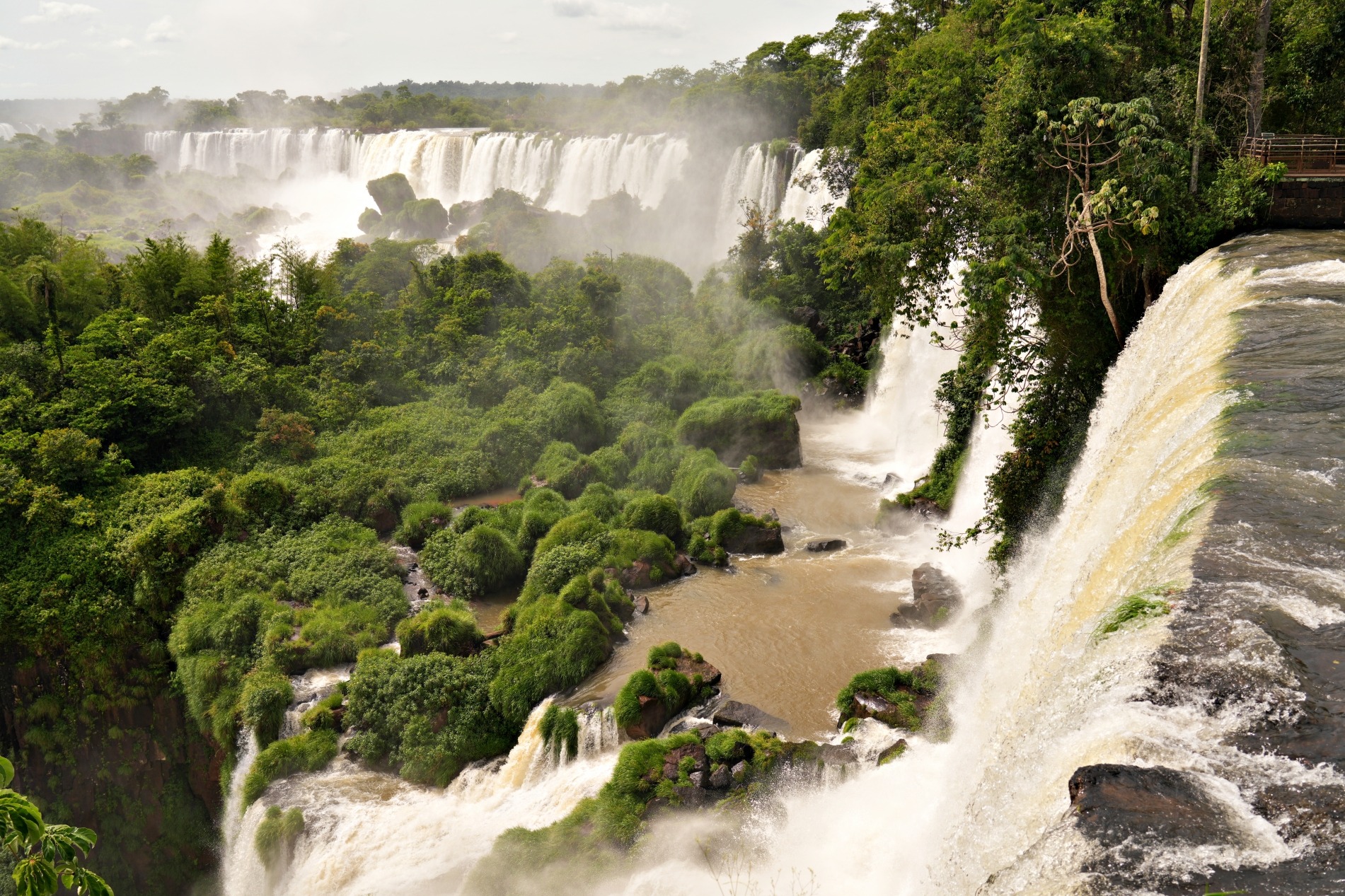
It is rare to visit a place so spectacular that you want to see it again. It’s even rarer to be just as impressed the second time as you were on your first visit. Yet, few places in the world are as awe-inspiring as the natural wonder of Iguazu Falls. We think you’ll agree once you see this breathtaking marvel.
After visiting these cascades in Brazil, we jumped at the opportunity to see them again, from a different perspective in Argentina. Cutting its way through the dense jungle, the lazy Iguazu River forms part of the border between Argentina and Brazil. Near its terminus, the river abruptly plunges over the end of a long canyon in the most dramatic fashion possible. The 2.7 km-long canyon has a staggering 275 individual waterfalls that join to make one of Mother Nature’s most impressive wonders.
This UNESCO World Heritage Site is more than worthy of that distinction.

Most of the falls are in Argentina, but since they’re on the border, you can see them from both Brazil and Argentina. We had already seen the falls from the Brazilian side and were curious how they would look from the Argentine side.
What we found is that while the Argentine side may not be as pretty, it allows you to feel their power. Located in Iguazu National Park, a series of walkways allows visitors to get up close to these amazing waterfalls. Metal boardwalks travel over the many side streams, right near the canyon edge, so the force of the rushing water is right below your feet.

There are three main walking trails in the park, and we’ll show you the views you can expect to see from them now.
Lower Trail
To reach the Lower Trail, you first must descend almost the entire height of the falls. You have your choice between a ramp and stairs. To follow the entire Lower Trail, though, you have to climb up and down a lot of stairs, so this route is not for everyone.
This trail only takes you to the first few waterfalls, but from it, you are rewarded with a close-up view of these magnificent cascades.


Upper Trail
The second option is to take the Upper Trail. It is a long, flat, metal walkway that crosses over the many streams. Often, you will be right above their end, where they suddenly drop over the cliffs.


Both Lower and Upper Trails begin at Estacion Cataratas (Waterfall Station). We suggest doing both trails, and the order doesn’t really matter because both have wow factors.
Garganta del Diablo Trail
You’ll find Iguazu’s masterpiece, Garganta del Diablo (Devil’s Throat), at the far end of the park. Since it is located where the river first drops off the cliffs, it is the most dramatic section of the waterfall. As you approach, you know you are in for something special by the amount of spray arising from the edge of the flat river.

One section of the Devil’s Throat demonstrates its power, and others show you its finesse. There seems to be a waterfall for everyone in the hundreds of different individual falls in the Devil’s Throat.
This is by far the best place to be on the Argentine side because it offers a much better view of this feature than you get in Brazil. Some people do this trail first, but as with our mealtimes, we prefer to save dessert until the end.


When we were on the Brazilian side two years ago, there had been extensive damage to the Argentine trail system and the Garganta del Diablo Trail was closed. For that reason, we didn’t visit the Argentine side at that time. After seeing it today, we are so glad that we waited until it was open because it was by far our favourite part of the Argentine visit.
Butterflies, Coatis, Birds and More
In addition to the waterfalls, there are other things to watch out for, including the thousands of butterflies that flutter about. We think there were more butterflies here than we’ve seen in most butterfly gardens. The fun part was when they landed on us and stayed for 5 or 10 minutes, even as we walked on the paths.


You will also most likely see coatis. These raccoon-like critters usually keep to themselves, but be aware, they may try to steal your lunch. When we visited on Christmas Day, several coati families with young kittens were scurrying around. The older ones slept in the trees, and because of the moss on the trees, their coats had a tinge of green.


The dense jungle is home to a variety of birds. We heard and saw many different ones, but the most exotic were the Plush-Crested Jays. Other wildlife to watch for are iguanas, lizards, turtles and catfish.


So, which should you visit, Argentina or Brazil?
The easy answer is both. Brazil has the most stunning views where you look directly at the cascade and marvel at its immense size. In Argentina, though, you walk on top of the rushing water and feel its power. As well, the view of Garganta del Diablo is better in Argentina. You can look at our post Visiting Iguaçu Falls in Brazil to see for yourself.
Below is a comparison of the same part of the falls from both countries. Brazil is on the left, Argentina is on the right.

Be aware, though, if you do visit both, you will need a full day for each. Both sites are so large that it would be very difficult to see both properly in one day. Buses leave for Foz do Iguaçu in Brazil from the main bus terminal.
Other ways to see the falls include a helicopter ride, which we did in Brazil. Or take a boat ride into the falls.

How to get around in Iguazu National Park
The falls are 2.7 km (1.7 mi) long, but it is quite easy to travel from one end to the other by taking the Jungle Train. They leave every 30 minutes from Central Train Station near the park entrance, and unlimited rides are included in the entrance fee. The first stop is Estación Cataratas (Waterfall Station,10 min). From there, you can do the Lower and Upper Trails. The final stop on the Jungle Train is Garganta del Diablo (10-15 min), which takes you to the Devil’s Throat Trail.
Tip – Don’t forget to stop at the ticket booth just before the train station, though. Train rides are included in the entry fee, but you need a ticket to book a spot on the train.
Getting to Iguazu Falls
Located 12 km from the city of Puerto Iguazu, taxis and private cars are the quickest way to reach the falls, but there are cheaper options. Rio Uruguay buses travel between the main bus terminal (Terminal de Ómnibus) in Puerto Iguazu and the main entrance to Iguazu National Park. They leave every 15 minutes, beginning at 7:15 am. Journey time is around 30 minutes and costs $10 USD each way.
Best time to visit Iguazu Falls
Iguazu will be spectacular no matter when you go. The best season is considered to be the beginning of the dry season between late March and May, because the weather is likely to be good and water levels should be high. December to February is the rainy season, when it is very humid, and it rains a lot. Because of this, boats may not offer tours, and the river may be browner. Our recent trip was in late December, and we experienced some of the most humid weather during our entire South American trip. The dry months of August to early October are said to be bad because there is not much water in the rivers, but this is when we visited the first time, and the falls had plenty of water.
Tickets to Iguazu Falls
Some people recommend purchasing tickets in advance online, but we visited during the busy Christmas season and didn’t find it necessary. While there were a lot of people, we didn’t experience line-ups and were able to purchase our tickets on-site. You can find current fees and buy tickets online at the Iguazu National Park website.
The City of Puerto Iguazu
Not only is Puerto Iguazu the best city to access the Argentine side of the falls, but it also has a few attractions worth checking out. When you visit, don’t forget to save time to explore the city.
Jardin de los Picaflores
This small family-run hummingbird garden contains a remarkable 300 types of plants, but the stars are the dozens of hummingbirds that come to their many feeders.
When we visited, there were eight species of hummingbirds (picaflores), but at other times of the year, as many as fifteen species can be seen in their garden. The busiest time is winter because fewer wildflowers are in bloom, so the birds come to their feeders to eat.


Entry fee -$7USD; Opening Hours – 10 am to 5 pm, Monday to Saturday
Tres Frontieras
The border between Argentina, Brazil and Paraguay is located where the Iguazu and Paraguay Rivers meet and is called Tres Frontieras (Three Borders). From a viewpoint above, we looked down at the meeting of the water, and across both rivers to the other countries.


On the walk to the park, you may see the historic Aduana (Customs Office) and a wall decorated with murals.


Day Trip To Ciudad del Este, Paraguay
Known as an international shopping hub, many take advantage of the proximity to Ciudad del Este to visit on a day trip. You can reach the city from Puerto Iguazu by ferry or bus.
Getting to Puerto Iguazu
Most will arrive in the city by air, but the airport is more than 20 km outside the city. You can get between the two by Uber or taxi, but the more economical way is by bus. The 1st bus leaves the bus terminal (Terminal de Ómnibus) at 6:10 am, and then buses leave once an hour throughout the day. The cost is only $5USD.
You can also travel by bus from Foz do Iguaçu, Brazil (1 hour), Posadas (6 hours), Buenos Aires (13 hours), and other Argentine cities.
You can find Iguazu Falls in the upper right section of the map below. It is an interactive map, so you can zoom-in, or click on a marker to find a link to our post from that region.
Where to stay in Puerto Iguazu
If you have a car, there are quite a few nice resorts south of the city that back onto the Parana River. Otherwise, there are many hotels and short-term apartment rentals in the city. Try to stay within walking distance of Avenida Brazil.
Where to eat in Puerto Iguazu
Most restaurants are located within a few blocks of each other in the city’s downtown. Avenida Brazil is the most popular because it becomes a pedestrian street at night near its intersection with Avenida Missiones.


Note – Prices are listed in USD because the rate of inflation in Argentina is so high that as of 2026, any fees listed in pesos would be inaccurate within a few months. Many restaurants don’t list prices on their menus, or if they do, they have been written over many times as the value of the peso drops. Apart from hotels, most business will only accept payment in Argentine pesos.

Click on the link to read our Travel Tips For Argentina.
To read more of our adventures in Argentina, click here.
Coming Next – Wine Tasting In Mendoza
For pictures from other blogs go to Gallery at monkeystale.ca.
To read about more of our adventures go to Destinations.
If you like what you read, please comment or share (with credit) using the links below.



We'd love to hear from you, please leave a comment.