The small Region of Murcia is not on most tourist itineraries, but they have a few hidden gems for those willing to give them a chance. From Roman theatres and forums in Cartagena to the immaculate cathedral in Murcia, it is worth a visit to this part of Spain.

Murcia and Cartagena are located in the small District of Murcia, east of Andalucía. Murcia is also the name of its capital.

Instead of the usual Moorish fortresses and whitewashed homes that are seen across southern Spain, Cartagena offers something different. Having been an important Roman port as early as the 3rd century BCE, its historic centre has wonderful displays of Roman ruins.

Its defensive port made the site very attractive from as far back as the Carthaginians. Its name came from these first inhabitants Qart Hadasht (“New City”). The Romans called it Carthago Nova. Eventually, the name was transformed into Cartagena. There is a connection to Cartagena in Colombia. Many of the crew aboard ships that invaded Colombia were from this Spanish city. Today, the historic port has a different look. It is filled with cruise ships and sailboats.

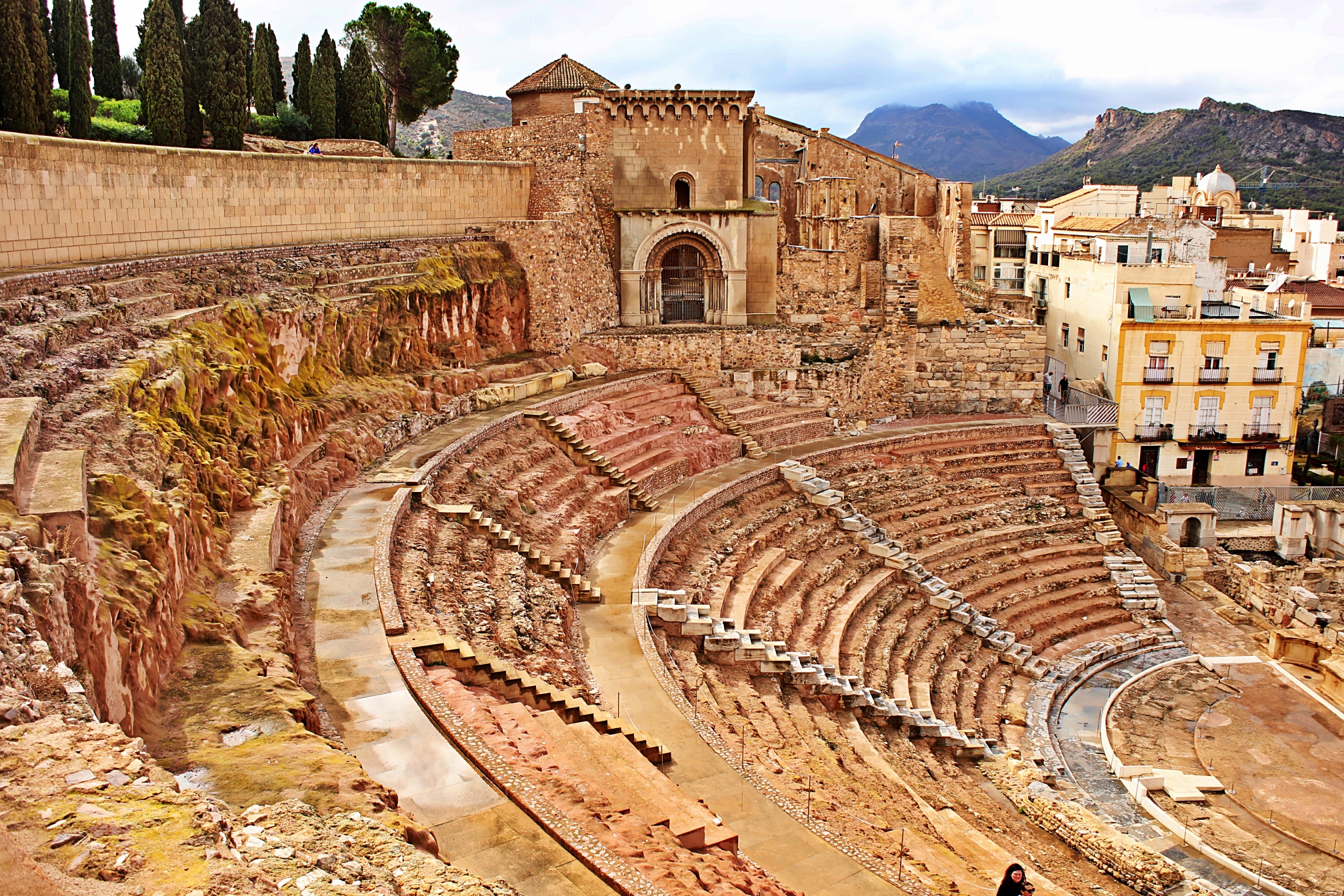
The most famous site in the city is the Roman Theatre of Cartagena (Teatro Romano de Cartagena). The entrance to the ancient site is not obvious from the outside because a row of pretty heritage buildings blocks the view. A small sign in front of one let us know we were in the right place. An on-site museum has a few exhibits of artifacts found in the Roman Theatre, Forum and other ruins scattered throughout the city.

From the museum, old tunnels take you under Santa Maria la Vieja Church. The tunnels open up to a partially restored, 1st century BCE open-air theatre. It was built to hold 6,000 people and must have been a magnificent site. The recent rain left streaks on the red stone, giving it an interesting look.

A few columns remain on the stage, but the old site is in quite rough shape. It is located close to the harbour, in a part of the city that has been inhabited for more than two thousand years. During that time, the theatre was covered by new buildings that were then remodelled many times. Because of this, the theatre lay hidden below the city. It was only discovered in 1988 and until recently, didn’t look like a theatre at all.

Parts of the old cathedral (Iglesia Santa Maria la Viejo) loom above. The 13th century church was partially built over the theatre. You can’t enter the old church, but from its side we looked over City Hall toward the mountains behind.

Another Roman site is located at the foot of Molinete Hill in the city centre. The museum has a few artifacts from the Roman Forum on display, but the best part is in the back.

Under a protective tarp are the old, paved streets and corridors of the Roman city. The most impressive are the baths and their ingenious heated floors. Water was heated in large cauldrons. The heated air travelled through underground channels made of glazed bricks. Above these channels were raised floors belonging to hot rooms and saunas.

At the other end of this complex are the remains of what would have been elaborate banquet halls and meeting rooms. Partial walls are decorated with paintings of masks, garlands and plants. In some, you can see pieces of mosaic flooring. You can imagine that these rooms were once very grand. This area was likely a public meeting space with banquet halls for the city’s elite.

Cartagena is well known in Spain for its collection of Arte Nouveau buildings from the city’s resurgence in the late 19th century. The new wealth came from the mining industry which stimulated growth in other markets. Calle Mayor is a popular spot where you can see many examples of these buildings. It’s also a great spot to grab a coffee or meal. Apart from this street, there are other lovely Arte Nouveau buildings but they are between newer buildings, many of which haven’t been maintained and are falling into ruin themselves.

Calle Mayor ends at Plaza Ayuntamiento where your main focus will be on City Hall. Built in Arte Nouveau style, the elaborate building is also called Palacio Consistorial.

Overall, Cartagena as a good city for a day trip. Don’t expect too much and you’ll leave happy, but the city still needs a lot of restoration before it is a tourist hub.


Murcia isn’t on the usual tourist route, but that doesn’t mean it’s not worth exploring. From a grand cathedral to the tight streets in its historic district, Murcia is a nice city to spend the day.

Set along the bank of the Segura River, City Hall is likely the first building you’ll see and what a great welcome it is. Also called Casa Consistorial, it is a very grand, peach-coloured building. It was built in1848 on top of Casa del Principe, a Muslim Palace. At its side is Bishop’s Palace, also called Episcopal Palace. The pinkish 18th century Rococo building needs a little restoration, but you can still see some of its grand old features.

In front of City Hall is Paseo del Malécon. The sidewalk travels beside Segura River and is crossed by the picturesque Old Bridge (Puente Viejo).

Just behind City Hall is Plaza del Cardenal Belluga. It’s not a typical square though, it’s more like a large sidewalk. The Cathedral of Murcia is the main occupant of the square and has become the symbol of Murcia. Built from the 14th to 18th centuries on top of an old Mosque, it is said to be a classic example of Spain’s Baroque period. Unfortunately, its main entrance was covered in scaffolding when we were there. We could only see a small portion of the recently restored elegant façade above the scaffolding. This baroque front was designed to look like an altar, facing the public square.

As we walked around its perimeter we saw a few of its elaborate features. The 90m tall bell tower is the second tallest in Spain after La Giralda in Seville. With so many details in this large building you can see why it took 400 hundred years to build.

As we stepped inside, the organ welcomed us with its melodic notes. It was nice to finally hear music from one of these old organs. Hearing it play, we immediately went to see the impressive organ situated above the choir room.

We had seen large wooden stands in the centre of many choir rooms in other churches, but didn’t know their purpose. In this church, it held hymn lyrics written in large print. They were used by the monks who sang while seated in their elaborately carved wooden chairs.

Entrance to the church is free, but there is a charge to climb the tower. In October 2024, the tower was being restored, so was closed to visitors.

The 19th century men’s club is in an eccentric building in the city’s old quarter. Built in many styles including neo-Baroque and neo-Mudéjar, Real Casino de Murcia is a feast for your eyes. The ornate designs begin at the entrance where horseshoe shaped arches lead to a long baroque hallway. At the end, is a state of Icarus.

Not all of the club is open to visitors, but we were allowed to explore most of the rooms on the ground floor. This included the library, meeting rooms and banquet halls. Each was decorated in outlandish styles and no two rooms were the alike.

The casino is located on the pedestrian-only Trapería Street. After exploring the casino, plan to spend some time wandering on it and the narrower streets that branch off.

These narrow streets lead to open squares with larger, more elegant buildings. There used to be a 13th century alcázar n the city, but its bricks and stones were used to build Santa Clara Convent

Murcia seemed to be an easy-going city for a capital. It doesn’t wow you with its sites, but it is a nice city to visit if you’re nearby.

Murcia has an international airport that receives flights from all over Spain and many cities in Europe. You can reach Murcia from other Spanish cities by train. It is also only an hour drive from Alicante. Cartagena is a 45 minute drive away.

There are quite a lot of hotels to chose from in Murcia’s historic centre and a few in Cartagena’s downtown. Even though it isn’t very touristy, we were surprised at the prices at restaurants in Murcia’s historic centre. Prices seemed more reasonable in Cartagena.

Murcia and Cartagena can be found on the far right of the map below.

Map of Andalucía, Spain
Read from another device.

This article is now featured on GPSmyCity. To download this article for offline reading or create a self-guided walking tour to visit the attractions highlighted in this article, go to Walking Tours and Articles in Cartagena.

To read more of our adventures in Spain, click here.

Fediverse reactions

86 responses to “Discover Hidden Gems In Cartagena & Murcia”

  1. The Arte Nouveau and the Casino pique my interest.

    1. The Casino was a wonderful surprise. Such a whimsical, eclectic building. The Arte Nouveau in Cartagena is exceptional, it’s just too bad a lot has been damaged. Thanks Swabby. Maggie

  2. I think the less popular places are often the ones that should be visited. You found a lot of history and beauty in these two places. I always find the restored Roman sites so fascinating., seeing and imagining what it must have been like to live there. Happy Friday Maggie. Allan

    1. We often enjoy the less visited places more than the popular ones. The Roman theatre in the middle of the city is fascinating. You wonder how something so large could be hidden for so long. Thanks Allan

      1. I can’t help wondering about the safety rules of the Romans while looking at the upper seats of the theatre 🙂 I haven’t seen this feature until now in such a space (such a large gap in height between the rows of seats) … Of course, nowadays, you need signs to warn you about the fact that floors may be slippery and children are not able anymore to climb trees or other installations that may look dangerous.

        1. Ha I guess the Romans weren’t as concerned with safety 😊

          1. We may also imagine that, like in present days Putin’s Russia, those were the seats reserved for the opponents of the regime. In Russia they have a sort of habit of “felling” from windows at various upper floors, here they could have had a more classy fall 🙂

          2. Haha you may be on to something!

  3. Oh my gosh Maggie, what gems you’ve presented us with my friend. Your adventures are always a great lesson in history. the Royal Casino is a jaw-dropper! 📸😎👍🏼

    1. It is quite the eclectic club isn’t it. Made us wonder what it looked like in the member’s only sections. Thanks Kym.

      1. How interesting Maggie. I can’t imagine how to top those shots you got. You’re so very welcome as always my friend. 🥰🙏🏼😘 Cheers! 🥂

  4. I can’t believe they had heated floors!! And I’m a HUGE fan of anything art nouveau – spectacular! Cheers!!

    1. I know, heated floors – amazing! The Arte Nouveau buildings are brilliant. Thanks! Maggie

  5. I agree with Allan’s comment that the less travelled sites are often the ones to visit, even in such places as Paris or Rome. They can really be enjoyed and appreciated without having to rush through. I’ve liked being able to do that since my first trip to London as a ten-year-old. Cheers.

    1. That’s so true, thanks Lynette, Maggie

  6. We’re great fans of the less-visited destination too, which often offer so much, without the downsides of the Top Ten Must Visits. So thanks for adding these ideas as well to our travel possiblities.

    1. It’s nice to enjoy the sites in a less hectic pace isn’t it? Thanks Margaret

  7. splendid!

    it never ceases to amaze me how you somehow manage to squeeze in and grab yourself a spot in those ram packed theatres 🎭

    ꧁☆♡🎀 ‌ ‌ 𝒽𝒶𝓅𝓅𝓎 𝒻𝓇𝒾𝒹𝒶𝓎 ‌ ‌ 🎀♡☆꧂

    1. Ha yes I don’t imagine the seats were numbered. 😊

  8. You weren’t wrong, Maggie! Cartagena is a gem. I particularly like that mountain backdrop. It’s a bit further round the coast than I’ve wanted to venture, but it might just be worth it at some point xx

    1. I think you’d like Cartagena Jo. It’s quite different from the other cities, and there are a lot of Roman ruins. Some are just scattered about, not even in a museum.


  9. I never heard that the Romans had heated floors, but that’s no surprise as they were quite revolutionary in many engineering aspects.

    Have a lovely weekend🥰

    1. They were pretty clever weren’t they?! Happy Friday Christie! Maggie

  10. so exciting to know about Murcia Cathedral! Thanks

    1. It is a beautiful building, it would be nice to see without the scaffolding though. Thanks for your comment. Maggie

  11. What a switch from Moorish fortress to Art Nouveu! Beautiful architecture with such incredible details in true form of the style 🙂

    1. I know! It is such an odd mix isn’t it – Roman and Arte Nouveau.

  12. Wow.. these cities are full of surprises!!! Great captures, Maggie!

    1. They are quite different from the standard Spanish city, thanks Jyothi, Maggie

  13. Theatre & Old St. Maria Church is interesting verification of the Roman empire’s reach. The baths and their innovative heated floors were amazing! 🙂

    1. Those Romans were pretty clever weren’t they? Thanks Nancy, Maggie

  14. You certainly found some lovely places! The Roman ruins look very similar to the ones in Lyon, France, particularly the open-air theatre. Your posts and photos are always a pleasure to read and see.

  15. I would definitely give the area a chance. Less touristy places are appealing. Thank you for sharing, Maggie.

    1. They are very appealing aren’t they? Thanks Michele

  16. I am starting to get the feeling you could spend a lifetime in Spain and never see it all. Thanks for all the inspiration, Mel

    1. Well, the tables have turned. I pulled this comment out of spam! It’s true, there is so much to see in Spain, it would be difficult to see it all, Thanks, Mel

      1. What is it with us?? Your comments on my posts still go into Spam! Maybe we talk too much!! 🙂

        1. I thought mine were fixed! Grrr.

  17. Stunning details. I felt part of a movie set, for sure.

    1. Some of these places are definitely movie sets. Thanks! Maggie

  18. Thanks for sharing. Keep it up! 👏


  19. Cartagena especially looks so different from most of the other sites of Spain you’ve shared. I love the old theater and what remains of the painted floors.

    1. It does look very different from the other cities we visited, which is partly why we liked it! I’d love to see some of the Roman buildings in good condition, they must have been beautiful.

  20. Your photos are beautiful, and it’s always nice to discover somewhere a bit more off the beaten track. I particularly love the variation in architecture; the art nouveau buildings remind me a lot of Barcelona.

    1. Thanks Hannah, Cartagena is a unique city in southern Spain with the mix of architecture. I haven’t been to Barcelona yet, but it’s on the list 😊

  21. The Roman ruins are fascinating, even if they are in rough shape. It’s pretty incredible how they figured out heated flooring. The mosaics are beautiful.

    1. Those Romans were pretty clever weren’t they?

  22. Beautiful places. Thank you for letting me see them through your lens.

    1. Thanks so much! Maggie

  23. The Moorish influences give those southern Spanish cities an extra layer of beauty, don’t they.

    1. They really did. What a treasure trove!

  24. This is a region with no shortage of interesting resources to visit. It’s nice to have the time to go from town to town, rather than having to stick to the big sites. I found Cartagena’s Art Nouveau architecture and Murcia’s Casino to provide the most variety compared to the rest of the region.

    1. It was so nice to see these two that have quite different sites than we had been seeing through the rest of southern Spain. What a fascinating country it is. Thanks!

  25. These look like two very nice days out. Such beautiful buildings, inside and out. The Roman ruins would be a big draw for me. Always fascinates me what they were able to create.

    1. Wouldn’t you love to see some of the Roman buildings back then? They must have been beautiful when decorated and painted.

    2. I saw you commented on another blog about Playa. Hope you had an amazing time, looking forward to the posts!

      1. We did, but probably just one post. When you mostly read on the beach, splash around in the ocean, and play cribbage at the bar, there’s not much to say. 🙂

  26. The Roman ruins in Cartagena look well worth seeing but from your descriptions Murcia appealed to me more as a city to visit / stay in. That Casino is something else!

    1. They are both quite different from the other cities we saw in Spain, which by that point in our trip we really appreciated. The casino is very eccentric 😊

  27. I like the sandstone hues of the open-air Theatre of Cartagena.

    I am amazed by how much of the theatre’s structure, shape, and stone (travertine and sandstone? I am guessing) remains. A wonderful view and photo of the theatre and the Old St. Maria Church.

    Palacio Consistorial and the Murcia Cathedral are stunning buildings.
    Thanks again for the great photos; that photo of Murcia Cathedral’s buttress and tower offers a wonderful perspective. I know from your description the cathedral’s tower is pretty high, so thanks for taking that amazing closeup!

    I am impressed by the beautiful buildings on the narrow Trapería Street. I wonder how they were constructed. I cannot imagine how they got materials, equipment, and transportation through the street during construction.

    Unrelated question, do they speak regular Spanish in this region (Murcia)? I mean the Spanish taught in schools here in North America?

    Thank you Maggie for all you do to add great insight into these fabulous places full of history. Safe travels to you both.

    1. It is really amazing that anything remains after being buried under the city for centuries isn’t it?
      Judging what we could see, Murcia Cathedral is stunning.
      I often wonder in these old narrow streets, how they are able to build anything. Andy yet they did it without modern cranes etc.
      They do speak regular Spanish in Murcia. Thank goodness, otherwise it would be difficult to communicate.
      Thanks so much Suzette! Maggie

      1. Thank You Maggie for an as always great tour and your informative replies. Cheers.

  28. The Roman theatre’s amazing! It’s crazy to think it was hidden until so recently. They’ve done an excellent job uncovering it, even if it is in rough shape. Gosh, that’s quite an unusual mix of styles in the royal casino. I think someone may have had a lot of fun designing it 🙂

    1. So many quirky funds in this partnof Spain 😊

  29. What a beautiful city – I loved the open air theater. I visited a similar Roman site in Alexandria in Egypt.

    1. The Romans left so many fabulous sites behind didn’t they. Thanks Kerry, Maggie

      1. They even made it into the depths of Scotland…😂

  30. A very interesting post… lesser known and lesser touristy places are often the best.

    1. That’s true, they often more enjoyable. Thanks for your comment. Maggie

      1. You’re most welcome!

  31. Cartagena is lovely, 2 millennia old theater to Art Nouveau!

    1. I know, what a wide range of styles 😊 Thanks Rebecca

  32. I thoroughly enjoy your posts, Maggie. Thank you for sharing the historic sites and stunning architecture.

  33. How amazing that the Roman theatre was even found, having been buried all those years. And the mosaics and baths were still so much in tact. This was a fascinating stop.

    1. It was in much better condition than we expected. Wouldn’t they be amazing to see when at their best? Thanks Ruth

  34. Thanks for the memories. We absolutely loved Cartagena. It was more than we expected. We spent two nights there and glad we did. We also agree for some reason dining out there was very reasonable. Great post!

    1. It’s a great city isn’t it? We stayed in Murcia, but wish we had stayed in Cartagena.

  35. Beautiful images and words on the most memorable moments in travel; discovering local color off the beaten path. Paradise found. I loved the only city I visited in Spain, magical Barcelona. Although one of the most touristy…the cobbled stone streets in the old city area, never fail to enchant..

    1. Thanks Katy, we fell in love with southern Spain on this trip. Maggie

We'd love to hear from you, please leave a comment.

Destinations

Discover more from Monkey's Tale

Subscribe now to keep reading and get access to the full archive.

Continue reading